CHAPTER INDEX
THE BEST WAY TO LAUNCH YOUR STARTUP
LAUNCH EARLY, LEARN QUICKLY, AND LAUNCH AGAIN
Most founders treat launch day like a single, irreversible event.
The YC lesson is simpler: your first launch begins the learning process. Release something, observe what happens, improve it, and return to the market repeatedly.
THE CENTRAL LAUNCHING MISTAKE
WAITING FOR ONE PERFECT PUBLIC MOMENT
Founders often spend months polishing the product and messaging because they believe they have only one chance.
For most early startups, the first launch receives little attention. Waiting six months can be more dangerous than releasing something imperfect.
THE STRUCTURE OF THIS GUIDE
THREE QUESTIONS EVERY FOUNDER MUST ANSWER
1. When should you launch, and why?
2. How do you explain the company in one clear sentence?
3. Which launch types can you use to reach users, test demand, and launch continuously?
WHEN TO LAUNCH
CHAPTER 1
LAUNCH AS SOON AS POSSIBLE
THE ANSWER IS USUALLY: RIGHT NOW
A startup needs contact with reality.
Launching early reveals whether the problem is important enough for someone to use the product, pay for it, or tolerate an unfinished version because the value is already meaningful.
ADD EVIDENCE TO CONVICTION
STRONG BELIEFS CAN STILL CREATE ASSUMPTIONS
Founders need conviction, and strong conviction can create attachment to assumptions.
Before launch, ideas about customer behavior remain theoretical. Real users reveal how they understand the product, experience the problem, and respond to the solution.
WHAT AN EARLY LAUNCH TESTS
TURN ASSUMPTIONS INTO OBSERVABLE EVIDENCE
An early launch helps answer four questions:
Is the problem painful?
Does the product solve it?
Will anyone use it now?
Will anyone pay?
The goal is practical information that changes what you build next.
WHAT COULD GO WRONG?
THE FEARED OUTCOMES ARE USUALLY SURVIVABLE
People may think the product looks ugly or incomplete. Investors or competitors may see it early. Nobody may notice.
These outcomes create useful signals. The founder can study what happened, improve the product, and prepare another launch.
WHEN NOBODY CARES
A QUIET LAUNCH IS FEEDBACK
Launching and receiving little attention feels terrible.
It may indicate weak positioning, the wrong audience, an ineffective channel, or insufficient value. Treat the result as a diagnosis that guides the next version of the startup.
AIRBNB LAUNCHED THREE TIMES
REPEATED ATTEMPTS CREATED TRACTION
Airbnb launched repeatedly before it began attracting meaningful user activity.
Each attempt created another chance to learn, improve the product, sharpen the story, and reach a better audience.
THE LAUNCH-AND-ITERATE LOOP
MAKE LAUNCHING A REPEATED OPERATING CYCLE
Launch.
Observe user behavior.
Talk to users.
Identify what they love or reject.
Improve the product and message.
Launch again.
Continue until a small group cares deeply enough to keep using the product.
MAKE A FEW PEOPLE VERY HAPPY
DEPTH OF LOVE MATTERS BEFORE SCALE
Paul Buchheit’s principle focuses on making a few people extremely happy.
A small group of passionate users gives you stronger feedback, better morale, and a clearer signal about what deserves more attention.
TEN USERS CAN BE A FOUNDATION
FIND THE REASON THEY LOVE THE PRODUCT
Even ten users who genuinely love the product can reveal your direction.
Ask what they value, why alternatives fail them, and what would make the product indispensable. Then search for more people with the same problem and behavior.
KEEP GOING COCKROACH STYLE
SURVIVE LONG ENOUGH TO DISCOVER WHAT WORKS
Early progress may be slow and uncomfortable.
The task is to remain persistent, keep learning, and expand the number of users who care. A startup can win by surviving repeated weak launches long enough to find a strong signal.
THE ONE-SENTENCE PITCH
CHAPTER 2
CLARITY OF VISION COMES FIRST
DEEP THINKING SHOULD PRODUCE SIMPLE LANGUAGE
Founders who understand their idea deeply should be able to explain it clearly and briefly.
A strong description makes a complex product understandable to someone unfamiliar with the market, without requiring a long presentation.
CLARITY CREATES WORD OF MOUTH
PEOPLE CAN ONLY REPEAT WHAT THEY UNDERSTAND
Organic word of mouth is one of the cheapest ways to grow.
Users, employees, investors, and friends can spread the idea only when they can remember and explain it. Your description should be easy enough to repeat in an ordinary conversation.
LEAD WITH WHAT YOU DO
GIVE PEOPLE CONTEXT BEFORE THE BACKSTORY
Begin with the company name and what the product does.
Give the listener immediate context. After they understand the product, continue with the problem, mission, founder journey, and reasons the company matters.
PAVE: A CLEAR DESCRIPTION
THE PRODUCT AND CUSTOMER ARE IMMEDIATELY VISIBLE
Pave described itself as a product that lets companies plan, communicate, and benchmark compensation in real time.
The sentence quickly identifies the customer, the activity, and the product’s function without a long introduction.
REMOVE MEANINGLESS JARGON
IMPRESSIVE WORDS CAN HIDE THE ACTUAL PRODUCT
Terms such as synergy, ecosystem, transformation, and next-generation often add little information.
A listener should understand what the company does and roughly what would need to be built to reproduce it.
BAD EXAMPLE: INDIECLOUD
A KNOW-HOW AND SYNERGY PLATFORM
This description could refer to education, collaboration, consulting, or an expert marketplace.
It has almost no informational value because the customer, problem, product, and action remain invisible. Concrete language would make the company understandable.
KEEP THE PITCH TIGHT
THE PITCH SHOULD CREATE THE NEXT QUESTION
A one-line description establishes context quickly and makes the listener curious enough to ask a follow-up question.
Long introductions consume attention before the product becomes clear. Save the wider vision for the conversation that follows.
AIRBNB: A STRONG ONE-LINER
A MARKETPLACE FOR TRAVELERS AND LOCAL ROOMS
Airbnb’s early description explained that travelers could book rooms from local people as an alternative to hotels.
It clearly communicated the customer, the action, the marketplace model, and the existing option being replaced.
OPENQUEUE: PROBLEM AND USER
FIND AND TALK TO TARGET B2B USERS QUICKLY
OpenQueue’s description tells the audience what the product helps them do and who it is for.
The listener can immediately imagine a tool that helps B2B companies identify and contact potential customers.
YUM: THE ORIGINAL VERSION
ADAPTIVE ML-DRIVEN MENTAL HEALTH FOR YOUR TEAM
The original line emphasizes machine learning.
Customers may care more about the outcome. Technical language can distract from the product’s actual value: personalized support for employee stress and mental health.
YUM: THE CLEARER VERSION
PERSONALIZED DIGITAL THERAPY PROGRAMS FOR YOUR TEAM
The revised description shifts attention from the technology to the customer benefit.
It is easier to understand because it identifies the service, the personalization, and the intended user without requiring knowledge of machine learning.
SHOULD YOU USE X FOR Y?
ANALOGIES CAN CREATE A FAST MENTAL PICTURE
Phrases such as “Uber for X” or “Airbnb for Y” can create a fast mental picture.
Prepare a clear standalone description as the primary pitch. Use the analogy as an optional shortcut when the comparison is immediately understandable.
WHEN X FOR Y WORKS
THREE CONDITIONS MUST BE TRUE
Use the structure when:
X is a household name.
It is obvious why Y needs a similar product.
Y represents a very large market.
When the listener must research X, the analogy creates additional work.
WEAK ANALOGY: BUFFER FOR SNAPCHAT
THE REFERENCE LACKED UNIVERSAL RECOGNITION
A company once described itself as “Buffer for Snapchat.”
Buffer lacked universal recognition, so the comparison created another explanation problem. A direct description of the customer problem would have communicated the idea faster.
STRONGER ANALOGY: HARKALIVE
AIRBNB FOR DANCE AND MOVEMENT CLASSES
The analogy creates a quick picture because Airbnb is widely known and the marketplace connection is understandable.
The company could also simply say it is a marketplace for dance and movement classes.
THE ONE-LINER CHECKLIST
CLEAR, DESCRIPTIVE, CONVERSATIONAL, AND CONCISE
A strong one-liner explains what you do, the problem being solved, and who it is for.
It avoids jargon, marketing language, and a long lead-up. The listener should understand the product quickly and be able to repeat the idea.
WHY LAUNCH CONTINUOUSLY
CHAPTER 3
LAUNCH BEFORE THE PRODUCT IS COMPLETE
PRACTICE AND REFINE THE IDEA EARLY
You can test the concept and message before building a fully functioning product.
Early reactions reveal whether people understand the idea, care about the problem, and respond to the way you describe the solution.
TEST THE MESSAGE AND THE PRODUCT
DIFFERENT STAGES PRODUCE DIFFERENT LEARNING
Before the product exists, test the idea and wording.
After an MVP exists, test real usage. Watch what users click, where they stop, what they request, and whether the product becomes part of their behavior.
DIFFERENT CHANNELS REACH DIFFERENT USERS
DISTRIBUTION IS ALSO AN EXPERIMENT
Launching through several channels helps determine whether you are speaking to the right audience.
A weak response may come from channel mismatch. Each community, platform, or network exposes the startup to a different user group.
NINE TYPES OF STARTUP LAUNCHES
CHAPTER 4
THE LAUNCH MENU
USE EACH TYPE FOR A DIFFERENT LEARNING GOAL
The talk presents nine launch types:
Silent, friends and family, stranger, online community, social media or blogger, request access, pre-order, press, and new feature or product launch.
A startup can use several of them over time.
1. SILENT LAUNCH
CREATE A PUBLIC PRESENCE WITHOUT A MAJOR ANNOUNCEMENT
Publish the minimum needed for someone to discover and understand the company:
A domain, company name, short description, contact method, and one call to action.
The call to action may be joining a newsletter, waitlist, or launch notification list.
SILENT LAUNCH EXAMPLE: LARA
A SIMPLE LANDING PAGE WAS ENOUGH
Lara used a basic page containing its domain, company name, short description, and a waitlist call to action.
The example shows the minimum structure for a silent launch: enough information to make the startup understandable and actionable.
2. FRIENDS AND FAMILY LAUNCH
TEST THE PITCH AND MVP WITH FAMILIAR PEOPLE
At the idea stage, practice the one- or two-sentence pitch. Once an MVP exists, share it quickly and watch people use it.
Use this launch to remove obvious confusion, then move toward target customers who experience the actual problem.
FRIENDS AND FAMILY EXAMPLE: REDDIT
THE FIRST YC BATCH BECAME AN EARLY AUDIENCE
Reddit was initially shared among founders in Y Combinator’s first batch.
This familiar group gave the founders an environment for early use and feedback before the product reached a broader public audience.
3. STRANGER LAUNCH
TALK TO PEOPLE WHO MAY BECOME REAL CUSTOMERS
Approach target users who have no personal reason to support you.
Ask about their existing workflow, current pain, and failed alternatives. Their behavior gives a stronger signal because they will only engage when the problem and product matter.
STRANGER LAUNCH EXAMPLE: DOORDASH
CUSTOMER INTERVIEWS REVEALED THE REAL OPPORTUNITY
The founders were exploring technology for small businesses when a store manager showed them a large book of unfulfilled delivery orders.
After interviewing more than 200 businesses and hearing the same pain, they built an early delivery MVP within hours.
4. ONLINE COMMUNITY LAUNCH
LAUNCH WHERE RELEVANT USERS ALREADY GATHER
Use communities such as founder networks, professional groups, Reddit, Hacker News, or industry forums.
Join communities you genuinely understand. Match the tone, explain the product directly, and avoid heavy promotional language.
ONLINE COMMUNITY EXAMPLE: ROBINHOOD
A HACKER NEWS POST ACCELERATED ITS WAITLIST
Robinhood’s simple site promised commission-free trading and displayed each person’s waitlist position.
A third party posted it on Hacker News. It reached the top, producing about 10,000 signups on the first day and more than 50,000 in the following week.
5. SOCIAL MEDIA OR BLOGGER LAUNCH
BUILD A PUBLIC AUDIENCE AROUND THE PROBLEM
Use social platforms, blogs, newsletters, and creators to publish useful content before and during launch.
The objective is to earn attention from people already interested in the problem, then give them a clear path toward the product.
SOCIAL MEDIA EXAMPLE: ANJA HEALTH
TIKTOK CREATED AN AUDIENCE BEFORE LAUNCH
Anja Health’s founder committed to publishing TikTok content while building the company’s community.
Within about one month, the account reached 10,000 followers, creating an early audience before the complete product launch.
6. REQUEST ACCESS LAUNCH
COLLECT DEMAND WHILE CONTROLLING ONBOARDING
A request-access or waitlist launch lets users express interest before receiving full access.
The startup can onboard people gradually, learn from each group, and manage limited capacity. The risk is waiting too long and losing the user’s original interest.
REQUEST ACCESS EXAMPLE: SUPERHUMAN
A WAITLIST SUPPORTED A CONTROLLED ROLLOUT
The talk points to Superhuman as a successful waitlist launch.
Users requested access before entering, allowing the company to control onboarding. Conversion becomes harder as waiting time increases, so the rollout should keep moving.
7. PRE-ORDER LAUNCH
VALIDATE DEMAND BEFORE FULL PRODUCTION
Hardware and physical-product startups can collect orders before the finished product is widely available.
Platforms such as Kickstarter and Indiegogo can support this approach, although customers have become more skeptical about crowdfunding promises.
PRE-ORDER EXAMPLE: CROWDFUNDING
KICKSTARTER OR INDIEGOGO CAN TEST COMMITMENT
The source gives a platform-level example through crowdfunding platforms.
A startup can open a pre-order campaign on Kickstarter or Indiegogo, using customer commitments to test demand before larger production. The model should fit the product and delivery capability.
8. PRESS LAUNCH
USE MEDIA ATTENTION CAREFULLY
A press launch introduces the company through journalists or publications.
For an early startup, coverage can be difficult to obtain. Its strongest use is temporary visibility among early users and investors. Sustained growth still depends on product value and repeatable acquisition.
PRESS LAUNCH EXAMPLE: THE TYPICAL PATTERN
THE SOURCE EXPLAINS THE COMMON OUTCOME
The source describes the typical press pattern.
Coverage may place the startup in front of early users and investors for a short period. The next challenge is converting that attention into product usage, retention, and repeatable growth.
9. NEW FEATURE OR PRODUCT LAUNCH
EVERY MEANINGFUL RELEASE CREATES ANOTHER MOMENT
A startup can relaunch whenever it releases a product, feature, integration, or important improvement.
Use the channels built earlier to explain what changed, why it matters, and what existing or new users should do next.
NEW PRODUCT EXAMPLE: STRIPE
EACH RELEASE ACTIVATES THE COMMUNITY AGAIN
Stripe repeatedly launches new products through its blog, social media, Hacker News conversations, and press outreach.
Each release becomes another opportunity to educate the market, engage its community, and attract users.
HOW TO USE THE LAUNCH TYPES
CHAPTER 5
LAUNCH IN EVERY RELEVANT COMMUNITY
ONE STARTUP CAN HAVE MANY COMMUNITY LAUNCHES
Plan a distinct launch for each community where you already participate.
Bookface gave YC companies a friendly founder audience. Hacker News offers Show HN. Other products may fit Reddit groups, professional networks, or specialized forums.
BE AUTHENTIC TO THE CHANNEL
EVERY COMMUNITY HAS ITS OWN EXPECTATIONS
Communities differ in tone, audience, and interests.
Research what members care about. Explain what you built without excessive marketing language. A useful, honest introduction is more effective than generic promotion.
BE EVERYWHERE THAT MATTERS
TEST SEVERAL RELEVANT DISTRIBUTION CHANNELS
When asked how they found their first users, the Replit founders emphasized broad presence across Hacker News, Twitter, Reddit, and other relevant places.
Apply this through persistent activity where likely users already spend time.
MOVE WAITLISTED USERS INTO THE PRODUCT
INTEREST WEAKENS AS WAITING TIME INCREASES
A waitlist measures interest and begins the conversion process.
As waiting time increases, users become harder to convert. Move from captured interest to real product usage as quickly as the startup can support.
TREAT PRESS AS TEMPORARY VISIBILITY
USE IT INSIDE A WIDER GROWTH SYSTEM
Press may provide a temporary increase in visibility.
Early founders gain more durable value from product learning, user conversations, retention, and repeatable distribution. Use coverage as one launch channel inside a wider growth system.
BUILD YOUR OWN COMMUNITY
CREATE AN AUDIENCE YOU CAN REACH REPEATEDLY
Start with something simple, such as an email list of supporters.
Engage people consistently throughout the company’s progress. Over time, this becomes an owned channel for product releases, feedback, education, and support.
EVERY RELEASE IS ANOTHER LAUNCH
REUSE THE CHANNELS YOU HAVE ALREADY BUILT
When a new feature or product is ready, return to your email list, communities, social channels, customers, and press contacts.
Continuous launching compounds because each cycle strengthens the product, message, audience, and distribution network.
THE CONTINUOUS LAUNCH SYSTEM
CHAPTER 6
STEP 1: EXPLAIN IT CLEARLY
WRITE THE ONE-SENTENCE DESCRIPTION FIRST
State the company name, what it does, the problem it solves, and who it serves.
Remove jargon and background stories. Test whether another person can understand and repeat the description without needing additional explanation.
STEP 2: PUBLISH THE MINIMUM
CREATE THE SILENT LAUNCH
Secure the domain and publish a simple landing page.
Include the company name, short description, contact information, and one call to action. Early reactions can begin while visual details and brand elements continue improving.
STEP 3: MOVE TOWARD REAL USERS
PROGRESS FROM FAMILIAR PEOPLE TO STRANGERS
Test first with friends and family, then quickly reach people who genuinely experience the problem.
Watch their behavior, ask about current solutions, and look for repeated pain that can guide the product.
STEP 4: TEST MULTIPLE CHANNELS
MATCH EACH LAUNCH TO A SPECIFIC AUDIENCE
Use online communities, social media, blogs, request access, pre-orders, or other relevant channels.
Compare who responds, what message works, and whether those users continue using the product after the first interaction.
STEP 5: FIND THE USERS WHO LOVE IT
STUDY THE STRONGEST POSITIVE SIGNAL
Identify the small group that values the product most.
Learn what they love, what problem is being solved, and why they chose your product. Improve that experience before trying to satisfy a much larger but indifferent audience.
STEP 6: IMPROVE AND RELAUNCH
TURN EVERY RESULT INTO THE NEXT EXPERIMENT
A weak launch provides evidence for the next attempt.
Adjust the product, message, audience, or channel based on what happened. Then launch again. Each cycle should produce clearer evidence and a stronger version of the startup.
THE FINAL PRINCIPLE
STOP TREATING LAUNCH AS ONE MOMENT
Launching is a continuous startup discipline.
Release early enough to learn. Explain the company clearly. Reach users through several relevant channels. Build a small core of people who care deeply, improve what they value, and launch again.

CHAPTER INDEX
GROWTH IS A SERIES OF SMALL WINS
HOW STARTUPS CREATE MOMENTUM
Startup growth rarely comes from one perfect campaign.
It comes from hundreds of experiments, small wins, failed attempts, and fast decisions.
The best founders do not wait for ideal conditions. They solve the most urgent problem using whatever resources they currently have.
WHAT IS A GROWTH HACK?
A PRACTICAL DEFINITION
A growth hack is a creative experiment designed to solve a specific growth problem quickly.
It may help a startup validate demand, attract users, create supply, increase referrals, or finance production.
It is not magic. It is focused problem-solving under limited time, money, and resources.
HUSTLE BEFORE SCALE
SOLVE THE IMMEDIATE PROBLEM FIRST
AIRBNB WAS RUNNING OUT OF CASH
THE BUSINESS WAS STILL TOO EARLY
In 2008, Airbnb had launched its air-bed-and-breakfast idea.
The website existed, but revenue was still limited. The founders were living in expensive San Francisco and urgently needed money.
Their first major problem was survival, not scale.
THEY SOLD POLITICAL CEREAL
A TEMPORARY PRODUCT FUNDED THE COMPANY
During the US election, Airbnb’s founders created Obama- and John McCain-themed cereal boxes.
They sold each box for $40 and generated around $30,000.
The cereal was unrelated to Airbnb’s core product, but it solved the company’s immediate cash problem.
THE FOUNDER LESSON
PROTECT THE COMPANY’S NEXT MOVE
Early-stage founders sometimes need to solve problems outside the main product.
The objective is not to look perfectly focused. The objective is to keep the company alive long enough to discover what works.
Resourcefulness gives the startup another opportunity to move forward.
VALIDATE BEFORE BUILDING
AN MVP DOES NOT NEED TO BE A PRODUCT
DROPBOX FACED A COMPLEX BUILD
THE PRODUCT NEEDED MULTIPLE SYSTEMS
Dropbox promised to synchronize files across different devices and operating systems.
Building only one version would not properly test that promise.
Building complete products for every operating system would require significant time, money, and engineering work before demand was proven.
DROPBOX BUILT A DEMO VIDEO
SHOW THE EXPERIENCE BEFORE BUILDING IT
Instead of building the complete platform, Dropbox created a video demonstrating how the product would work.
Some of the functionality shown was incomplete or did not yet exist.
The video allowed potential users to understand the value without requiring Dropbox to build everything first.
THE WAITLIST PROVED DEMAND
FROM 5,000 TO 75,000 USERS
The Dropbox demo generated hundreds of thousands of visits.
Its waitlist reportedly grew from around 5,000 people to 75,000.
The startup gained evidence that people wanted the solution before spending heavily on building the complete platform.
REDEFINE THE MVP
TEST THE PROMISE, NOT THE TECHNOLOGY
An MVP can be a video, prototype, landing page, manual service, mock-up, or pre-order campaign.
Its purpose is to test the riskiest assumption behind the business.
Build the smallest experiment that can show whether people understand, want, or will pay for the solution.
CREATE A GROWTH LOOP
TURN USERS INTO DISTRIBUTION
CLUBHOUSE USED SCARCITY
ACCESS REQUIRED AN INVITATION
Clubhouse launched as a gated community.
Users needed an invitation, and each member received only a limited number of invites.
This made access feel exclusive. Existing users became responsible for bringing new users into the platform.
SCARCITY CREATED ATTENTION
PEOPLE WANTED WHAT THEY COULD NOT ACCESS
Limited access made Clubhouse feel valuable and culturally important.
Some invitations were reportedly sold on eBay.
The platform grew from zero to around 10 million active users in under a year, although its activity later declined after the pandemic.
PAYPAL PAID FOR REFERRALS
GIVE VALUE TO BOTH SIDES
PayPal used a direct referral incentive: give $20 and receive $20.
The reward benefited both the existing user and the new user.
According to the transcript, this strategy helped PayPal achieve approximately 10% daily growth during its early expansion.
DESIGN THE LOOP
EVERY USER SHOULD CREATE ANOTHER USER
A growth loop connects product usage with user acquisition.
One person joins, receives value, and has a reason to invite another person.
The loop becomes stronger when the reward is immediate, easy to understand, and connected directly to the product experience.
PRESALE BEFORE PRODUCTION
REDUCE RISK BEFORE MANUFACTURING
PEAK DESIGN USES KICKSTARTER
LAUNCH THE IDEA BEFORE MASS PRODUCTION
Peak Design creates camera products for photographers and videographers.
Instead of manufacturing every new product first, the company repeatedly launches products through Kickstarter.
The campaign presents the product and measures whether customers are willing to support it.
CUSTOMERS FUND PRODUCTION
DEMAND BECOMES WORKING CAPITAL
Kickstarter allows Peak Design to collect money before manufacturing begins.
This reduces inventory and production risk.
The company can estimate demand, secure capital, and make better manufacturing decisions using real customer commitments rather than assumptions.
BACKERS BECOME ADVOCATES
PARTICIPATION CREATES EMOTIONAL OWNERSHIP
People who back a campaign often feel involved in bringing the product to life.
That emotional connection can turn customers into brand advocates.
The campaign becomes more than a sales channel. It becomes validation, financing, marketing, and community-building at the same time.
USE PRESALES AS VALIDATION
A PURCHASE IS STRONGER THAN INTEREST
Likes and survey responses show attention. A preorder shows commitment.
Before investing heavily in inventory, founders can test the offer through deposits, crowdfunding, limited batches, or paid reservations.
Real payment is one of the strongest signals that the market wants the product.
TURN USERS INTO BUILDERS
COMMUNITY CAN CREATE THE PRODUCT
WAZE FACED A DATA PROBLEM
MAPS WERE INCOMPLETE IN MANY COUNTRIES
In several markets, traditional maps lacked accurate roads, driving directions, and traffic information.
Waze could not manually collect every piece of local data fast enough.
Its solution was to let drivers help build and improve the map while using it.
DRIVERS PAVED THE ROADS
PRODUCT USAGE CREATED PRODUCT VALUE
When Waze users drove on an unmapped road, the application allowed them to digitally pave it.
Users could add roads, name locations, report conditions, and improve the map.
Every contribution made the product more useful for the next person.
GAMIFICATION MADE WORK ENJOYABLE
POINTS, BADGES, AND RECOGNITION
Waze rewarded contributors with points, badges, animations, and editing privileges.
The rewards had little financial value, but they gave users status, progress, and a sense of contribution.
People felt that they were helping build something important for their community.
EPIC MEANING CREATES PARTICIPATION
GIVE USERS A BIGGER PURPOSE
People contribute more when they believe their actions serve a meaningful purpose.
Wikipedia editors improve shared knowledge. Waze users improve local navigation.
A strong platform shows users how each small action contributes to a larger mission.
BUILD CONTRIBUTION INTO USAGE
THE BEST SYSTEMS IMPROVE AUTOMATICALLY
The strongest community systems do not ask users to perform unrelated extra work.
Contribution happens naturally while they use the product.
When every action improves the platform, the product can become more valuable as participation grows.
SOLVE THE MARKETPLACE PROBLEM
SUPPLY AND DEMAND MUST GROW TOGETHER
AIRBNB NEEDED TWO SIDES
HOSTS AND TRAVELERS
Airbnb needed property owners to list available spaces and travelers to book them.
Hosts would leave if they received no bookings. Travelers would leave if there were not enough listings.
This is the marketplace chicken-and-egg problem.
AIRBNB FOUND EXISTING SUPPLY
START WHERE THE USERS ALREADY ARE
Airbnb manually contacted people advertising short-term rentals on Craigslist.
The founders invited them to list the same properties on Airbnb.
Instead of waiting for supply to appear, they found people already demonstrating the desired behavior.
CRAIGSLIST BECAME DISTRIBUTION
BORROW AN EXISTING AUDIENCE
Airbnb later created systems that posted Airbnb listings to Craigslist and linked people back to Airbnb.
This allowed the startup to access an existing market while building its own audience.
The tactic was not authorized by Craigslist, showing the risks of depending on another platform.
START MANUALLY
DO THE UNSCALABLE WORK FIRST
Early marketplace growth may require manual outreach, onboarding, matching, or support.
These activities may not scale, but they help founders understand user behavior and create initial liquidity.
Automation should follow a proven process, not replace the search for one.
THE GROWTH SYSTEM
TURN EXPERIMENTS INTO REPEATABLE LEARNING
START WITH THE BOTTLENECK
FIND WHAT IS BLOCKING GROWTH NOW
Do not begin by copying random startup tactics.
Identify the current bottleneck.
Is the problem awareness, demand validation, supply, activation, referrals, retention, funding, or production risk?
The right experiment depends on the problem being solved.
RUN THE SMALLEST EXPERIMENT
LEARN BEFORE INVESTING HEAVILY
Choose the fastest and cheapest test that can produce useful evidence.
Create a demo instead of a complete product. Run a preorder instead of manufacturing inventory. Recruit users manually before building automation.
Reduce the cost of discovering that an assumption was wrong.
MEASURE REAL BEHAVIOUR
TRACK ACTIONS, NOT COMPLIMENTS
Useful experiments measure behaviour.
Did people join the waitlist, invite friends, pay a deposit, create listings, contribute data, or return to the product?
Positive comments may feel encouraging, but actions provide stronger evidence of demand.
KEEP EXPLORING NEW CHANNELS
GROWTH CHANNELS EVENTUALLY WEAKEN
A growth tactic may work temporarily and then stop producing results.
Competition increases. Platforms change. User behaviour evolves.
Founders must continue testing new channels while improving the systems that already work.
DO NOT BUILD ON A HACK
TEMPORARY TACTICS NEED PERMANENT VALUE
A growth hack can create initial momentum, but it cannot replace a valuable product.
Scarcity may attract users. Referrals may accelerate acquisition. Manual outreach may create supply.
Long-term growth still depends on solving a real problem and delivering a strong experience.
THINK FAST. LEARN FASTER.
THE FINAL FOUNDER PRINCIPLE
Building a startup requires fast decisions under uncertainty.
The goal is not to discover one legendary growth hack.
The goal is to build a system that repeatedly identifies problems, launches experiments, measures behaviour, captures learning, and turns successful tests into repeatable growth.

7 WAYS TO FUND YOUR STARTUP
BY HARIO SETO
CHAPTER INDEX
7 WAYS TO FUND YOUR STARTUP
FROM YOUR OWN SAVINGS TO VENTURE CAPITAL
A startup needs capital to build products, hire people, acquire customers, and survive until revenue becomes predictable.
Founders can finance this journey through ownership, community support, grants, investors, programs, or debt.
UNDERSTAND THE TRADE-OFF
FUNDING IS NEVER SIMPLY FREE MONEY
EVERY DOLLAR HAS A PRICE
KNOW WHAT YOU ARE EXCHANGING
Bootstrapping costs personal capital.
Equity funding costs ownership and control.
Loans create repayment obligations. Grants require eligibility and reporting. Accelerators demand time and may take equity.
Choose based on the company you are building.
FOUNDER-CONTROLLED CAPITAL
FUND THE COMPANY WHILE PROTECTING OWNERSHIP
1. BOOTSTRAPPING
ILLUSTRATIVE OWNERSHIP RETAINED: 100%
Bootstrapping means using personal savings, early revenue, or existing resources to finance the startup.
You keep full ownership and decision-making power. Growth may be slower because spending is limited by available cash.
WHEN BOOTSTRAPPING WORKS
BEST FOR CAPITAL-EFFICIENT BUSINESSES
Bootstrapping works well when you can launch a small version quickly, generate revenue early, and improve the product using customer payments.
It is common for SaaS, agencies, marketplaces, digital products, and service businesses.
2. CROWDFUNDING
RAISE CAPITAL FROM A LARGE COMMUNITY
Crowdfunding allows many people to contribute smaller amounts toward a product, business, or campaign.
It can provide capital, validate demand, attract early customers, and create public attention before the product is fully launched.
CROWDFUNDING MODELS
CHOOSE THE STRUCTURE CAREFULLY
Reward crowdfunding offers products or benefits to supporters.
Equity crowdfunding gives investors ownership. Donation crowdfunding expects no financial return.
Success usually requires a strong story, clear offer, trusted founder, and existing audience.
3. STARTUP GRANTS
ILLUSTRATIVE RANGE: $10K–$2M
Governments, universities, foundations, and nonprofit organizations offer grants to support innovation.
Grants are usually non-dilutive, meaning founders do not surrender equity. Applications can be competitive and often require milestones, documentation, and reporting.
HOW STARTUP GRANTS WORKS
FUNDING WITHOUT GIVING UP EQUITY
Startup grants are funds provided by governments, universities, foundations, and innovation programs.\n\nUnlike investment, grants usually do not require founders to surrender ownership or repay the money.\n\nMost programs require clear objectives, eligibility, milestones, documentation, and progress reports.
INVESTOR CAPITAL
EXCHANGE OWNERSHIP FOR MONEY AND LEVERAGE
4. ANGEL INVESTORS
ILLUSTRATIVE RANGE: $25K–$500K
Angel investors are individuals who invest their own money in early-stage companies.
Strong angels may also contribute experience, credibility, industry knowledge, customer introductions, and access to future investors.
WHAT ANGELS EXPECT
POTENTIAL, TRUST, AND MEANINGFUL OWNERSHIP
Angel investors usually evaluate the founder, market opportunity, early evidence, business model, and future return potential.
They invest before everything is proven, so founder credibility and speed of execution are especially important.
5. STARTUP ACCELERATORS
CAPITAL COMBINED WITH STRUCTURED SUPPORT
Accelerators provide funding, mentorship, education, networks, and investor introductions through a structured program.
They can help founders improve positioning, refine the product, strengthen metrics, and prepare for a larger fundraising round.
THE ACCELERATOR TRADE-OFF
SPEED AND ACCESS IN EXCHANGE FOR EQUITY
Accelerators may invest a fixed amount in exchange for company ownership.
The real value depends on mentor quality, alumni network, investor access, program reputation, and whether the accelerator understands your market.
6. VENTURE CAPITAL
ILLUSTRATIVE INVESTMENT: $1M+
Venture capital firms invest in startups capable of growing rapidly and becoming very large companies.
VC funding can support aggressive hiring, product development, expansion, marketing, acquisitions, and entry into new markets.
VC CHANGES THE COMPANY
HIGH GROWTH BECOMES AN OBLIGATION
Venture capital brings money, networks, credibility, and strategic support.
It also creates expectations for rapid growth, future fundraising, investor governance, and a major exit through acquisition or public listing.
DEBT CAPITAL
BORROW MONEY WITHOUT SELLING OWNERSHIP
7. BANK LOANS
ILLUSTRATIVE AVAILABILITY: UP TO SEVERAL MILLION
Banks and government-backed lenders may provide business loans to qualified founders.
Loans preserve ownership, but the company must repay principal and interest regardless of whether growth meets expectations.
WHEN DEBT MAKES SENSE
USE LOANS FOR PREDICTABLE RETURNS
Debt is more suitable when the company has revenue, stable cash flow, valuable assets, purchase orders, or predictable expansion economics.
Using loans to fund an unproven experiment can create serious financial pressure.
CHOOSE THE RIGHT FUNDING
MATCH THE CAPITAL TO THE COMPANY
MATCH FUNDING TO YOUR STAGE
DIFFERENT STAGES REQUIRE DIFFERENT CAPITAL
Idea stage: savings, grants, or small angel checks.
Validation stage: bootstrapping, crowdfunding, angels, or accelerators.
Growth stage: venture capital, strategic investors, revenue, or debt.
Mature stage: larger debt facilities or institutional investment.
ASK THESE FIVE QUESTIONS
BEFORE ACCEPTING ANY FUNDING
How much capital do we actually need?
What milestone will this money achieve?
How much ownership or control are we giving up?
Can the company meet repayment or growth expectations?
Does this funding source improve our probability of success?
THE SMART FUNDING SEQUENCE
REDUCE RISK BEFORE RAISING MORE
Start with the smallest amount needed to prove the next important assumption.
Build evidence through products, users, revenue, retention, or partnerships. Stronger evidence improves your valuation, negotiating position, and access to better capital.
FUNDING IS A TOOL
THE BUSINESS STILL CREATES THE VALUE
Raising money is not the final achievement.
Capital only gives the startup more time and resources to execute. The real objective remains the same: solve an important problem, create customer value, build sustainable economics, and grow.

CHAPTER INDEX
FROM $17K TO $143K MRR
ONE PRODUCT. ONE TREND. FOUR MONTHS.
Postiz spent around 18 months reaching $21K MRR.
Then growth accelerated. In roughly four months, revenue climbed to about $143K MRR, with more than 4,000 paying subscribers.
The trigger was not a completely new business. It was a fast repositioning of an existing product around AI agents.
THE REAL GROWTH QUESTION
WHY DID REVENUE SUDDENLY EXPLODE?
The easy explanation is luck: AI agents became popular and one viral article mentioned Postiz.
The deeper explanation is a system. The founder already had a useful product, adapted it quickly, watched distribution signals, and repeatedly amplified what worked.
The growth came from readiness plus aggressive execution.
THE PRODUCT BEFORE THE BREAKOUT
A WORKING FOUNDATION
POSTIZ ALREADY SOLVED A REAL PROBLEM
SCHEDULING ACROSS 30+ PLATFORMS
Before the agentic pivot, Postiz was a social media scheduling tool.
Users could create and schedule content across more than 30 platforms. The product already had customers, infrastructure, integrations, and proven demand.
This foundation mattered because the founder could adapt an operating product instead of starting from zero.
SLOW GROWTH BUILT THE BASE
THE FIRST 18 MONTHS WERE NOT WASTED
Reaching the first $17K–$21K MRR took around one and a half years.
That period created the hidden assets behind the breakout: working integrations, customer feedback, technical knowledge, brand credibility, and a functioning billing system.
Fast growth became possible because slow growth had already built the machine.
THE PRODUCT HAD ONE WEAKNESS
HUMANS STILL HAD TO DO THE WORK
Traditional scheduling still required users to open the app, write posts, revise content, choose channels, and repeat the process every day.
Even a useful tool can lose customers when the workflow depends on human discipline.
The product helped people publish, but it did not yet remove the effort that caused churn.
THE AGENTIC PIVOT
TURNING SOFTWARE INTO INFRASTRUCTURE
THE FOUNDER FOLLOWED THE SIGNAL
OPENCLAW CREATED A NEW BEHAVIOR
When OpenClaw started gaining attention, the founder asked a practical question:
How can this trend make Postiz more useful?
He exposed Postiz through tools agents could use, allowing systems such as Claude, ChatGPT, and other agents to create and schedule content without requiring users to operate the dashboard manually.
AGENTIC SAAS CHANGES THE INTERFACE
THE AGENT BECOMES THE USER
In a normal SaaS workflow, a person opens the app and performs each action.
In an agentic workflow, the person gives an outcome: create and publish a week of content.
The agent decides how to execute, chooses the tool, sends instructions through APIs, and completes the workflow. The SaaS becomes infrastructure for machine execution.
AUTOMATION REDUCED CHURN
LESS DEPENDENCE ON USER MOTIVATION
Postiz reported churn falling from roughly 26–28% to around 13.7% after the agentic shift.
The reason is logical. Customers no longer needed to remember and repeat the same task every day.
When agents continuously generate and publish content, the product becomes embedded in an automated routine instead of depending on human habit.
MAKE THE PRODUCT AGENT-READY
APIS, DOCUMENTATION, AND DISCOVERY
The founder’s advice was simple: almost every SaaS should expose a usable API.
Document the public API clearly, package the instructions in a machine-readable file, and list the integration wherever agents discover tools.
The goal is to make it easy for an AI system to understand what the product does and how to use it.
BUILD BEFORE THE TREND PEAKS
READINESS CREATES SPEED
A trend is difficult to capture when the product still needs months of development.
Postiz could move quickly because the core product already existed. The founder only needed to adapt the interface and distribution.
Build useful infrastructure early. When the right shift arrives, reposition and ship before the market becomes crowded.
THE DISTRIBUTION BREAKTHROUGH
HOW ATTENTION BECAME REVENUE
ONE CUSTOMER CREATED THE SPARK
A 7.2 MILLION-VIEW ARTICLE
A founder used OpenClaw and Postiz to automate TikTok marketing for his own app.
He published an article explaining the workflow. It reportedly reached around 7.2 million views and sent Postiz as many as 700 trials per day.
The best marketing was not a product announcement. It was proof that the product created a valuable outcome.
HE DID NOT STOP AT VIRALITY
THE FOUNDER COPIED THE PATTERN
After seeing the article perform, the founder studied why it worked.
He noticed that X was aggressively distributing long-form articles about OpenClaw. With only about 200 followers, he published his own article and reached roughly half a million views.
Then he repeated it instead of treating the first result as luck.
REVERSE-ENGINEER THE PLATFORM
FOLLOW WHAT THE ALGORITHM REWARDS
The founder observed that X articles generated more reading time than normal posts, so the platform appeared to push them harder.
He aligned three forces:
A rising topic.
A format the platform favored.
A product that directly benefited from the topic.
Distribution accelerated because the content matched current platform incentives.
TURN ONE POST INTO A NETWORK
CREATORS PLUS COORDINATED REPOSTS
The founder contacted creators already receiving strong engagement and paid for disclosed promotional reposts.
For each major article, he also organized many additional accounts to repost it.
This created a distribution network around every piece of content. The strategy was not simply to publish more. It was to manufacture repeated exposure.
MARKETING WAS THE FUEL
THE AGENTIC PIVOT WAS THE VEHICLE
The product change created a powerful story, but the story still needed distribution.
Without articles, creators, reposts, and trend timing, the agentic feature might have remained invisible.
Product innovation creates leverage. Marketing converts that leverage into traffic, trials, revenue, and market position.
THE REPEATABLE GROWTH SYSTEM
FROM TREND TO EXECUTION
START WITH EXISTING DEMAND
SOLVE THE REAL PROBLEM FIRST
Postiz already served a clear need: publishing content across many social platforms.
The AI trend strengthened an existing use case instead of inventing demand from nothing.
Before adding agents, confirm that customers already value the underlying outcome. Agentic technology should improve a proven workflow, not decorate a weak idea.
REMOVE HUMAN FRICTION
AUTOMATE REPEATED DECISIONS
Map every step the customer performs repeatedly.
Which tasks require opening the app, copying information, making routine decisions, or remembering a schedule?
Expose those steps through APIs and let an agent execute them. Strong agentic products reduce effort, increase frequency, and make the customer’s desired result happen automatically.
WATCH FOR DISTRIBUTION SIGNALS
TREAT ATTENTION AS PRODUCT DATA
Look for unusual signals:
A customer post suddenly explodes.
A new format receives exceptional reach.
A platform starts promoting a topic.
A creator demonstrates an unexpected use case.
Do not only celebrate the signal. Study it, reproduce it, and build a repeatable campaign around it.
SCALE THE WINNING CONTENT
CREATE A DISTRIBUTION MACHINE
Once a topic and format work, increase output and amplification.
Publish more case studies. Recruit creators. Coordinate reposts. Convert customer outcomes into tutorials. Add clear product links and onboarding.
The goal is to turn one viral event into a system that keeps producing qualified traffic.
REINFORCE THE PRODUCT
GROWTH INCREASES THE COST OF FAILURE
As usage increased, the founder reduced focus on new features and prioritized reliability.
Postiz connects to more than 30 platforms. Every additional feature creates another possible failure point.
When agents depend on the product, instability is especially damaging because automated workflows can fail repeatedly without immediate human intervention.
WHAT FOUNDERS SHOULD LEARN
BUILDING FOR AN AGENTIC MARKET
RELIABILITY BECOMES DISTRIBUTION
AGENTS WILL PREFER TOOLS THAT WORK
In an agentic market, products may increasingly be selected by AI systems instead of humans.
Agents will favor tools that are easy to understand, easy to call, and consistently reliable.
Documentation, uptime, predictable APIs, error handling, and strong execution become part of marketing because they influence whether agents continue choosing the product.
THE FUTURE CUSTOMER MAY BE AN AGENT
PREPARE FOR MACHINE-LED PURCHASING
Today, many agent workflows still require a human to approve payment through a checkout page.
The next shift may allow agents to discover, evaluate, purchase, and operate software independently.
SaaS companies should prepare for machine-readable pricing, permissions, purchasing rules, usage limits, and secure agent authentication.
LUCK FAVORS PREPARED PRODUCTS
THE OPPORTUNITY WAS EARNED EARLIER
The viral article was unexpected. The ability to benefit from it was built earlier.
Postiz already had a product, customers, integrations, revenue, and a founder who moved fast.
Trends create temporary openings. Prepared companies can convert those openings into durable growth because they already have something valuable to scale.
THE CORE PLAYBOOK
BUILD, ADAPT, DISTRIBUTE, REINFORCE
1. Build a product that solves a recurring problem.
2. Make its actions accessible through APIs and agent tools.
3. Adapt quickly when behavior changes.
4. Turn customer proof into high-distribution content.
5. Scale the winning channel.
6. Protect growth with reliability.
EXECUTION BEATS OBSERVATION
THE FINAL LESSON
Many people saw AI agents and viral X articles becoming popular. Few acted quickly enough to capture the opportunity.
The founder changed the product, published repeatedly, recruited distribution partners, studied platform incentives, and strengthened the infrastructure.
The advantage came from action speed.

CHAPTER INDEX
PHYSICAL AI THAT SHIPS SAFELY
WAYMO’S 7 LESSONS FROM BUILDING AI IN THE REAL WORLD
A working demo can impress people.
A real physical AI product must keep working safely through millions of unpredictable situations.
This is the playbook Waymo learned while turning autonomous driving from a prototype into a service operating at scale.
WHY PHYSICAL AI IS DIFFERENT
AI MUST ACT INSIDE THE REAL WORLD
THE BEST AI MOMENT LOOKS LIKE NOTHING
SAFETY SHOULD FEEL SMOOTH AND INVISIBLE
When another driver suddenly cuts in, the best system reacts safely and smoothly.
Passengers may not even notice.
For physical AI, success is often invisible: no crash, no panic, no interruption. The task simply gets done.
MOVE FAST. SHIP SAFELY.
ATOMS REQUIRE A DIFFERENT STARTUP STANDARD
“Move fast and break things” works poorly when mistakes can damage property or harm people.
Physical AI needs speed with discipline.
Safety cannot be added later. It must shape the model, hardware, training, validation, and deployment from day one.
FOUR GAPS TO CROSS
WHY DIGITAL AI METHODS ARE NOT ENOUGH
Physical AI faces four structural gaps:
1. Cost of error
2. Latency
3. Data
4. Validation
Any serious robot, vehicle, or real-world agent must cross all four before it can operate safely at scale.
1. COST OF ERROR
THERE IS NO UNDO BUTTON
A chatbot mistake may cost one retry.
A physical AI mistake can cost a human life.
The system must avoid dangerous actions before they happen because the real world offers no reset, rollback, or second attempt.
2. LATENCY
MILLISECONDS CAN DECIDE OUTCOMES
Digital assistants may take seconds to answer.
A car at freeway speed moves roughly 100 feet in one second.
Physical AI must sense, reason, and act in milliseconds using onboard compute that fits inside the machine.
3. DATA
THE PHYSICAL WORLD HAS NO INTERNET-SCALE LABEL SET
Digital AI learned from the internet: a massive collection of human knowledge and labeled examples.
Physical AI has no equivalent dataset.
Teams must collect, generate, simulate, label, and continuously improve their own real-world data.
4. VALIDATION
GOOD ENOUGH IS NOT ENOUGH ON DAY ONE
Digital products can launch early and let users reveal edge cases.
Physical AI needs strong safety and confidence before the first public deployment.
The operating conditions must be defined clearly, tested rigorously, and expanded responsibly.
LESSON 1 : A DEMO IS ONLY 1% OF THE WORK
THE DEMO CAN FEEL LIKE THE FINISH LINE
EARLY SUCCESS CREATES DANGEROUS CONFIDENCE
Waymo reached major autonomous-driving demo goals in about 18 months.
It could drive day and night, through traffic, construction, highways, and city streets.
By demo standards, the problem looked solved. The product journey had barely started.
PRODUCT MEANS REPEATING IT RELIABLY
DOING IT ONCE IS NOT A SERVICE
Driving ten difficult routes once is impressive.
Operating millions of miles without a human driver is a different engineering problem.
Waymo needed roughly 15 years to move from the first strong demo to a service operating at large scale.
RELIABILITY IS AN EXPONENTIAL LADDER
EVERY EXTRA NINE COSTS MORE
Reaching 90% or 99% performance is often the easy part.
Each additional nine of reliability can demand roughly ten times more effort.
The architecture, testing, redundancy, and operations must evolve at every level.
THE LONG TAIL BECOMES DAILY REALITY
RARE EVENTS STOP BEING RARE AT SCALE
An event that happens once in a million miles sounds negligible.
When the fleet drives millions of miles every week, it becomes a routine problem.
At scale, edge cases are not the edge of the product. They are the product.
COUNT YOUR NINES FIRST
KNOW THE RELIABILITY YOUR PRODUCT REQUIRES
A demo may need one nine.
An assistive tool may need several.
A fully autonomous public system needs many more.
Define the required reliability before choosing the architecture, budget, timeline, and launch strategy.
LESSON 2 : CHOOSE TECHNOLOGY FOR THE REQUIRED CEILING
THE FASTEST START CAN BE A TRAP
EARLY PROGRESS DOES NOT PROVE SCALABILITY
Many technologies improve quickly at first, then flatten.
Teams often choose the path with the fastest early demo and assume the curve will continue.
The danger appears when that approach reaches its ceiling below the product’s required performance.
BUILD FOR THE PRODUCT, NOT THE PROTOTYPE
DIFFERENT GOALS REQUIRE DIFFERENT ARCHITECTURE
A prototype can optimize for speed of learning.
A production system must optimize for the reliability ceiling it eventually needs.
Be honest about whether each technical choice supports a demo, an experiment, an assistive tool, or full autonomy.
USE COMPLEMENTARY SENSING
DIFFERENT PHYSICS REVEAL DIFFERENT RISKS
Cameras provide color and detail.
LiDAR measures 3D structure, even in darkness.
Radar handles weather and measures velocity.
Fusing multiple sensing modes creates a stronger view of the world than relying on one sensor alone.
REDUNDANCY MUST BE DESIGNED IN
ONE BLOCKED SENSOR CANNOT STOP THE SYSTEM
A leaf, glare, darkness, dust, rain, or physical damage can weaken a sensor.
Physical AI needs fallback paths and redundant perception.
The goal is not only to detect failure, but to continue safely when part of the system degrades.
DESIGN FOR FUTURE HARDWARE ECONOMICS
TODAY’S COMPONENT PRICE WILL NOT LAST FOREVER
Hardware becomes cheaper, smaller, and more capable across generations.
Do not lock the company into assumptions based only on current prices.
Design the system so sensors, compute, and vehicle platforms can be upgraded as the technology matures.
LESSON 3 : RIDE EVERY MAJOR TECHNOLOGY WAVE
ONE BREAKTHROUGH IS NOT ENOUGH
THE COMPANY NEEDS A REPEATABLE UPGRADE MUSCLE
Waymo repeatedly rebuilt its driver around major advances: convolutional networks, transformers, vision-language models, and world models.
The advantage is not adopting one new technology.
It is learning how to absorb the next one without stopping deployment.
RESEARCH MUST HAVE A PRODUCTION PATH
A SUCCESSFUL EXPERIMENT CAN STILL BECOME A DEAD END
Before launching a new technical project, define what happens if it succeeds.
How will it enter the main product?
How will it be validated?
How will it replace or simplify existing systems?
Innovation without an integration path creates expensive fragmentation.
DEMAND PERFORMANCE AND SIMPLIFICATION
NEW TECHNOLOGY SHOULD REDUCE COMPLEXITY
A breakthrough that adds capability but creates another isolated stack can slow the company down.
The launch bar should demand two outcomes:
1. Meaningful performance gains
2. Radical simplification or unification
THE FOUNDATION MODEL BECOMES THE CORE
ONE SHARED INTELLIGENCE ACROSS PLATFORMS
Waymo’s foundation model combines multimodal sensing, world understanding, action prediction, and language-aligned knowledge.
A large shared foundation moves complexity upstream, while smaller specialized models run efficiently on different vehicles and hardware.
THINK FAST. THINK SLOW. GENERATE.
DIFFERENT DECISIONS NEED DIFFERENT SPEEDS
The fast path handles split-second geometric danger.
The slow path reasons about deeper semantics, such as a burning vehicle or unusual scene.
The generative component predicts how others may behave and selects the vehicle’s next action.
LESSON 4 : USE STRUCTURE TO IMPROVE SCALING
GENERAL METHODS WIN WITH SCALE
COMPUTE AND DATA OUTPERFORM HANDCRAFTED RULES
The bitter lesson of AI is consistent: methods that scale with compute and data eventually outperform systems dominated by human-written rules.
High-capacity models learn richer patterns and can later be distilled into smaller models for real-time deployment.
STRUCTURE MUST CHANNEL SCALE
USEFUL STRUCTURE HELPS LEARNING WITHOUT LIMITING IT
Structure that fights scale will lose.
Structure that channels scale can win.
The right representation should not shrink the solution space. It should make training, evaluation, and safety checks more efficient without removing the model’s ability to learn.
STRUCTURE-AUGMENTED END-TO-END
LEARNED INTELLIGENCE WITH MATERIALIZED CONSTRAINTS
Waymo combines end-to-end learning with structured representations of the physical world.
The model still learns rich internal embeddings, while explicit structure supports validation, physics, road rules, object behavior, and measurable safety checks.
WHY THE STRUCTURE MATTERS
THREE PRACTICAL ADVANTAGES
Structured intermediate representations enable:
1. Real-time correctness and safety checks
2. More efficient large-scale training and evaluation
3. Stronger feedback signals for metrics, loss functions, and reinforcement learning
LESSON 5 : BUILD A HIGH-FIDELITY SIMULATOR
OPEN LOOP IS NOT ENOUGH
PHYSICAL ACTIONS CHANGE WHAT HAPPENS NEXT
Open-loop training asks: “In this situation, what would you do?”
Closed-loop training asks the agent to act, observe the consequence, update its world view, and act again.
Safety-critical systems must understand sequences, feedback, and counterfactual outcomes.
THE SIMULATOR IS ANOTHER AI SYSTEM
IT MUST UNDERSTAND THE WORLD DEEPLY
A serious simulator is not lightweight test software.
It is a world model that understands physics, traffic, weather, objects, behavior, and sensor outputs.
Its realism must be high enough to train and evaluate decisions that will later affect real people.
TRAIN ON EVENTS THAT RARELY HAPPEN
SYNTHETIC SCENARIOS EXPOSE THE LONG TAIL
Simulation can create difficult situations that may be unsafe, expensive, or nearly impossible to collect repeatedly in reality.
A stopped car on a freeway, a plane landing ahead, an animal in traffic, or unusual weather can be generated, controlled, and tested at scale.
CLOSED LOOP CREATES CONFIDENCE
EVALUATE THE FULL CHAIN OF CONSEQUENCES
The goal is not only a realistic-looking video.
The agent must interact with a simulated world that responds to its decisions.
This allows teams to test whether one action creates a safe or dangerous sequence several steps later.
LESSON 6 : BUILD THE AGENT, SIMULATOR, AND CRITIC
YOU NEED THREE AIS
ONE MODEL CANNOT CARRY THE WHOLE SYSTEM
The agent acts in the real world.
The simulator creates realistic worlds and difficult scenarios.
The critic evaluates performance and explains where improvement is needed.
Together, they form the learning ecosystem behind a scalable physical AI product.
CREATE THE IMPROVEMENT FLYWHEEL
DEPLOYMENT SHOULD CONTINUOUSLY STRENGTHEN THE SYSTEM
Real-world deployment generates data.
The data makes simulation more realistic.
The simulator produces harder edge cases.
The critic scores them.
The agent learns, improves, deploys again, and generates better data.
A FLYWHEEL NEEDS DIRECTION
METRICS DECIDE WHETHER PROGRESS IS REAL
A flywheel can spin quickly in the wrong direction.
Clear metrics determine which failures matter, which scenarios deserve more data, and which model changes create genuine improvement.
Without metrics, more data and compute can still produce confusion.
LESSON 7 : EVALUATION AND METRICS ARE THE MOAT
BUILD THE EVAL BEFORE THE PRODUCT
DEFINE GOOD ENOUGH QUANTITATIVELY
If the team cannot measure what “good enough” means, it is not building a product.
It is iterating on a demo.
Evaluation should define the target, expose weaknesses, prioritize data, measure progress, and determine whether the system is ready to deploy.
EVALUATE THE ENTIRE SYSTEM
MODEL ACCURACY IS ONLY ONE LAYER
Physical AI validation must cover sensors, compute, models, fallback systems, behavior, operations, maintenance, remote support, deployment rules, and real-world readiness.
Safety depends on the full system, not one benchmark score.
TRUST IS EARNED WITH EVIDENCE
PUBLIC PROOF COMPOUNDS OVER TIME
Customers, communities, and regulators trust systems that repeatedly prove they work.
Models can be copied. Algorithms can leak.
Years of real-world operation, rigorous evaluation, safety data, and transparent evidence are much harder to replicate.
SAFETY BECOMES A BUSINESS ADVANTAGE
RELIABILITY COMPOUNDS INTO DEFENSIBILITY
When a physical AI product demonstrates safer outcomes across hundreds of millions of autonomous miles, safety is no longer only a technical metric.
It becomes brand trust, regulatory confidence, customer adoption, operational learning, and a durable competitive advantage.
THE COMPLETE PLAYBOOK : SEVEN LESSONS THAT REINFORCE EACH OTHER
THE SYSTEM COMPOUNDS
EVERY LESSON STRENGTHENS THE OTHERS
Required nines define the technology ceiling.
The right architecture enables repeated upgrades.
Structure improves scaling and validation.
Simulation exposes rare events.
The agent, simulator, and critic create a flywheel.
Metrics keep the flywheel moving toward safety.
PHYSICAL AI IS ENTERING ITS DECADE
THE NEXT AI FRONTIER ACTS IN THE REAL WORLD
Digital AI transformed screens, software, and knowledge work.
The next major wave will increasingly move through vehicles, robots, factories, logistics, healthcare, and infrastructure.
The opportunity is massive, but the standard must remain: move fast and ship safely.
REMEMBER WHO YOU ARE BUILDING FOR
TECHNOLOGY IS ONLY VALUABLE WHEN IT IMPROVES LIVES
The goal is not the most impressive demo.
The goal is a system people can trust with real tasks, real environments, and real consequences.
Build for the customer, the mission, and the human life affected by every decision.

CHAPTER INDEX
HOW GREAT STARTUPS PIVOT
FINDING THE RIGHT PROBLEM
Many successful startups began with the wrong idea.
The advantage was not perfect foresight. It was the ability to learn, change direction, and keep the strongest lessons from every attempt.
PIVOTING IS NORMAL
NOT A SIGN OF FAILURE
A pivot means changing your startup idea because the current version is not creating enough value.
The real failure is continuing to build something people do not want.
THE CORE QUESTION
ARE PEOPLE PULLING THE PRODUCT?
Excitement, compliments, and signups can feel positive.
But the stronger signals are usage, retention, payment, referrals, and repeated demand. Those signals reveal whether the product is solving a real problem.
WHY FOUNDERS PIVOT
CHAPTER 1
WRONG IDEA, USEFUL LEARNING
PROGRESS CAN BEGIN IN THE WRONG PLACE
Many founders must first work on the wrong thing.
That work exposes the market, users, constraints, and hidden opportunities. A failed direction can become the research phase for the right business.
SMART PEOPLE CHOOSE HARD PROBLEMS
DIFFICULTY CAN FEEL IMPRESSIVE
Founders sometimes ignore what feels easy because they assume valuable work must be extremely difficult.
But an unfair advantage often feels easy precisely because the founders already understand the domain.
START SOMEWHERE
EXPERTISE COMES THROUGH CONTACT
You rarely discover the perfect startup idea from a distance.
Start with a real problem, enter the market, talk to users, and become more informed. Direct contact creates the insight needed for a better idea.
BREX
CHAPTER 2
THE ORIGINAL IDEA
A VIRTUAL REALITY HEADSET
Brex’s founders entered YC with an ambitious hardware concept: using a smartphone to replace a laptop through augmented reality.
The problem was simple. They lacked the hardware and physics expertise required to build it.
THE FOUNDER ADVANTAGE
THEY ALREADY UNDERSTOOD PAYMENTS
Before Brex, the founders had built a payments company in Brazil.
Payments felt less exciting because they had done it before. Yet that experience was their strongest advantage, not a limitation.
THE PIVOT
RETURN TO WHAT YOU KNOW DEEPLY
After speaking with hardware experts, they abandoned the headset idea and returned to fintech.
The lesson: do not overlook a market where your team already has rare knowledge, credibility, and execution speed.
GOAT
CHAPTER 3
THE ORIGINAL IDEA
GROUP DINNERS WITH STRANGERS
GOAT began as Grubwithus, a platform for meeting local people through group dinners.
It became popular in small communities, but retention was weak. People tried it, then stopped returning.
THE HIDDEN FOUNDER INSIGHT
THE FOUNDERS LOVED SNEAKERS
The founders personally understood limited-edition sneakers, collectors, scarcity, authenticity, and resale behavior.
That knowledge came from genuine interest, not market theory.
THE PIVOT
A MARKETPLACE AHEAD OF CONSENSUS
They abandoned group dinners and built a sneaker marketplace.
In 2015, the opportunity looked unconventional. Great pivots often appear strange because the founders see the market before everyone else does.
THE EMOTIONAL UNLOCK
LOW MORALE CAN REMOVE BLINDERS
Sometimes founders stop chasing what looks respectable only after the original plan fails.
That moment can create honesty: build something genuinely interesting, deeply understood, and worth working on—even when consensus is absent.
GOCARDLESS
CHAPTER 4
THE ORIGINAL IDEA
GROUP PAYMENTS FOR STUDENTS
The founders started with Groupay, a bill-splitting product for college groups.
They repeatedly pushed friends to use it, but users churned. The product was not useful enough to become a habit.
THE TEST
STOP ADDING FEATURES
Instead of building more functionality, they tried to acquire real users.
Four founders cold-called sports-club treasurers for two weeks and gained only one user. The market gave a clear answer.
KEEP ONE VALUABLE ASSET
THE PAYMENT INFRASTRUCTURE
They did not throw away everything.
They kept the bank-to-bank payment technology and changed the customer from students to businesses collecting recurring payments.
THE PIVOT
CONSUMER IDEA TO B2B SYSTEM
That change became GoCardless.
A pivot can preserve the strongest technology while replacing the audience, use case, or business model with one that has stronger demand.
CLIPBOARD HEALTH
CHAPTER 5
THE ORIGINAL IDEA
INDEED FOR NURSES
Clipboard Health began as a hiring marketplace for nurses.
The idea addressed a broad problem, but the product lacked urgency, differentiation, and a strong reason for hospitals to change behavior.
THE DISCOVERY PROCESS
SELL AND OBSERVE THE WORKFLOW
The founder spent years speaking with hospitals and people around them.
She discovered a sharper problem: when a nurse called in sick, facilities urgently needed an agency to fill the shift.
DO THINGS THAT DO NOT SCALE
SOLVE MANUALLY BEFORE AUTOMATING
Instead of immediately building complex software, she manually coordinated nurses and facilities.
Manual execution revealed the exact workflow, urgency, trust requirements, and operational bottlenecks.
THE PIVOT
FROM JOB BOARD TO STAFFING ENGINE
Clipboard Health became a software-enabled staffing marketplace.
The product emerged from repeatedly solving the real problem by hand, then automating the parts that were proven and repeatable.
AVOID PIVOT HELL
CHAPTER 6
WHAT IS PIVOT HELL?
A COMPLETELY NEW STARTUP EVERY WEEK
Pivot hell happens when founders constantly abandon ideas before learning enough from them.
They stay busy generating concepts but never go deep enough to understand a market.
THE CAUSE
SEARCHING FOR A PERFECT IDEA
Perfectionism makes every idea look flawed.
Because no startup idea is perfect at the beginning, founders keep switching before testing the unknowns that matter.
THE RULE
PUSH ONE IDEA FAR ENOUGH TO LEARN
A useful experiment requires commitment.
Choose a problem, speak with users, attempt sales, deliver manually, and collect evidence. Change direction only after the market teaches you something concrete.
BAD IDEAS CAN BUILD EXPERTISE
THE PATH CAN STILL BE PRODUCTIVE
A company may explore several weak ideas before finding a strong one.
The key is cumulative learning. Each attempt should increase understanding of the same market, customer, regulation, or workflow.
ASHER REALITY
CHAPTER 7
THE ORIGINAL SITUATION
COOL TECHNOLOGY SEEKING A PROBLEM
Asher Reality had strong augmented-reality technology but no clear customer.
The team loved engineering and coding, so the technology came before the problem.
FALSE POSITIVE FEEDBACK
EXCITEMENT IS NOT COMMITMENT
Marketing teams reacted enthusiastically to AR demos.
But enthusiasm did not become dependable usage or payment. People can be supportive without truly needing the product.
THE BETTER CUSTOMER
GAME DEVELOPERS HAD STRONGER DEMAND
The team discovered that game developers had a more practical reason to use the technology.
The product stayed similar, but the target user and go-to-market strategy changed.
THE LESSON
THE FIRST AUDIENCE MAY BE WRONG
A pivot does not always require a new product.
Sometimes the technology is useful, but the original customer is not. Repositioning the same capability for a stronger buyer can unlock the business.
CREATIVE MARKET
CHAPTER 8
THE ORIGINAL PRODUCT
A LARGE DESIGN COMMUNITY
Colour Lovers grew into a community of more than one million members.
The audience was real, but the team struggled to create a repeatable and scalable business model.
THE MISSING CLARITY
NO MAIN KPI
They tried software, advertising, contests, and other monetization ideas.
Without one primary metric, the team could not clearly tell whether the business was improving or wandering.
THE PIVOT
MARKETPLACE FOR DESIGN ASSETS
The team created Creative Market, where people bought graphic-design assets.
The business became measurable: are people buying, and is purchase activity increasing over time?
ONE KPI CREATES FOCUS
KNOW WHAT YOU CHASE EVERY MORNING
A strong main KPI aligns product, growth, and decision-making.
When the metric grows, continue. When it remains weak despite serious testing, examine whether the product, market, or business model must change.
THE PIVOT FRAMEWORK
CHAPTER 9
1. IDENTIFY THE WEAK SIGNAL
WHERE IS DEMAND FAILING?
Look for weak retention, low willingness to pay, forced acquisition, non-repeatable revenue, or users who disappear.
Name the exact evidence showing the current idea is not working.
2. LIST WHAT STILL WORKS
KEEP ONE FOOT STATIONARY
A strong pivot preserves valuable learning or assets.
Keep the customer insight, technology, distribution, founder expertise, community, workflow knowledge, or trusted relationships that remain useful.
3. TALK TO REAL USERS
SEARCH FOR URGENT PROBLEMS
Ask what users do today, what breaks, what costs money, what creates delay, and what they urgently need solved.
Study behavior, not only opinions.
4. SOLVE IT MANUALLY
PROVE DEMAND BEFORE SOFTWARE
Deliver the solution by hand before automating.
Manual work exposes the real steps, exceptions, trust barriers, pricing logic, and operational costs.
5. ASK FOR COMMITMENT
PAYMENT IS STRONGER THAN PRAISE
A real customer commits through payment, repeated usage, time, data, referrals, or operational change.
Soft interest is useful, but commitment is the stronger validation signal.
6. CHOOSE ONE MAIN KPI
MEASURE THE ENGINE
Select one metric that represents the value your startup creates.
Track it consistently. Use supporting metrics for diagnosis, but keep one number at the center of execution.
7. COMMIT, THEN REASSESS
AVOID ENDLESS IDEA SWITCHING
Give the new direction enough time and effort to produce evidence.
Pivot again only when you have learned something meaningful—not because the idea feels imperfect or difficult.
THE FOUNDER IS THE CONSTANT
IDEAS CAN CHANGE
The product, audience, model, and positioning may all change.
The founders remain the constant. Their speed of learning, honesty, resilience, and domain fit determine whether a pivot becomes progress.
FINAL PRINCIPLE
FIND THE PROBLEM WORTH SOLVING
The goal is not to defend the first idea.
The goal is to find a real problem, for a real customer, with evidence that the solution creates repeatable value. Pivoting is how many great startups reach that point.

SAM ALTMAN : NEVER A BETTER TIME TO DO A STARTUP
YOUTUBE SUMMARY : YCOMBINATOR
CHAPTER INDEX
NEVER A BETTER TIME TO START
STARTUP SCHOOL 2026
AI is changing what a small team can build.
Work that once took months can now be compressed into minutes. The opportunity is not to build smaller companies. It is to attempt bigger problems with fewer people, faster cycles, and far more leverage.
THE NEW STARTUP WINDOW
WHY THIS MOMENT MATTERS
Great startups often appear when technology shifts quickly, costs fall, and incumbents lose their advantage.
The internet, app stores, and mobile created earlier waves. AI is creating another major opening where expertise, production, and experimentation are dramatically cheaper.
WHY NOW
A HISTORIC STARTUP WINDOW
STARTUPS ARE MORE POWERFUL
A SMALL TEAM CAN DO MORE
Twenty years ago, a YC startup could spend three months building one product.
Today, a coding agent may reproduce that work in minutes. Founders can now coordinate software, research, design, operations, and analysis at a scale previously reserved for large companies.
AI RAISES THE AMBITION BAR
DO NOT ONLY AUTOMATE OLD WORK
A weak response to AI is asking which old startup ideas are now obsolete.
A stronger response is asking what company was impossible to build before. AI gives founders capabilities that once required large teams. The advantage belongs to people willing to attempt harder and more valuable problems.
GOLDEN AGE OF STARTUPS
IMPOSSIBLE PROJECTS BECOME POSSIBLE
Hard technology remains difficult, but AI reduces barriers around research, prototyping, hiring, and coordination.
A project that once required a large institution may now begin with a small team using agents and compute. This creates room for a new generation of deeply ambitious companies.
THE STARTUP IS NOT OVER
AI EXPANDS OPPORTUNITY
Some people fear powerful models will absorb every valuable company.
The opportunity may be larger. New startups can become more valuable and impactful because they can build faster, reach further, and solve problems that were previously uneconomic. Intelligence on demand expands the design space.
AI LEVERAGE
BUILDING MORE WITH FEWER PEOPLE
BUILD WITH AGENTS
SMALL TEAMS, LARGE OUTPUT
A small team can now automate major parts of a startup using AI agents.
This does not remove the need for founders. It changes the founder’s job. The scarce skills become judgment, taste, agency, customer understanding, product direction, and knowing where durable value can be created.
TOOL FLUENCY COMPOUNDS
EXPERIENCE IS BEING REPRICED
Years of experience still matter, but AI fluency is becoming a major advantage.
People who grew up using these tools can test ideas, automate operations, and learn unfamiliar fields quickly. In a fast-moving market, working effectively with new tools may outperform traditional credentials.
CYCLE TIME IS STRATEGY
SPEED CREATES LEARNING
When costs fall and cycle times shrink, founders can test more assumptions with less capital.
The advantage is not merely shipping faster. Faster cycles create more customer feedback, more data, and more opportunities to correct direction. Speed becomes a learning system.
DO THREE MONTHS OF WORK
RAISE OUTPUT, NOT COMFORT
If AI compresses three months of work into minutes, the goal is not to stop after one prompt.
Use the remaining time to explore more directions, improve quality, talk to customers, and build stronger systems. The productivity gain should raise the standard of what a founder attempts.
CONVICTION
BUILDING WHAT OTHERS DISMISS
FIND THE UNPOPULAR TRUTH
LOOK WHERE CONSENSUS IS WRONG
Many important companies begin with a belief that experts dismiss.
Develop reasonable conviction in something the market has not understood. When new evidence continues to support the idea, being misunderstood can become an advantage because competition remains limited.
OPENAI’S EARLY SECRET
CONVICTION BEFORE CONSENSUS
For years, only a small number of people believed AGI was possible.
That disbelief gave OpenAI time to research, recruit, and build without overwhelming competition. A startup does not need everyone to agree. It needs enough strong people who understand the same emerging truth.
STUDY NEW EXPONENTIALS
THE WORLD UPDATES SLOWLY
People struggle to understand exponential change.
Founders should search for technologies, costs, behaviors, or capabilities improving faster than the market expects. Opportunity appears when reality has moved, but conventional wisdom still uses an older model of what is possible.
VISION CAN BE CLEAR FIRST
THE PATH MAY REMAIN UNCERTAIN
A very ambitious startup may begin with a clear destination and unclear first steps.
OpenAI wanted to build AGI long before it knew it would become a product company. Uncertainty is acceptable, but progress is required. Take imperfect steps that generate evidence and reveal the next move.
CONVICTION NEEDS EVIDENCE
BELIEF MUST FACE REALITY
Strong conviction should grow through data, experiments, technical progress, or customer response.
When nobody credible shares the belief and no evidence improves over time, pay attention. The goal is not blind confidence. It is a belief that survives contact with reality and becomes more precise.
PEOPLE AND NETWORKS
FIND THE PEOPLE WHO COMPOUND
FIND YOUR PEOPLE
AMBITION NEEDS A TRIBE
Startups are difficult and lonely to build alone.
You do not need universal support, but you need a few people who understand the mission. Strong co-founders, early teammates, and trusted peers provide complementary skills, resilience, and shared conviction when progress is uncertain.
NETWORKS COMPOUND SLOWLY
RELATIONSHIPS BECOME INFRASTRUCTURE
Important startup relationships often begin years before their purpose becomes clear.
Sam Altman met Greg Brockman while helping Stripe recruit him. Eight years later, they started OpenAI together. Useful networks are built through repeated trust, not last-minute transactions.
BE MILDLY HELPFUL
A PRACTICAL NETWORKING STRATEGY
One of the best ways to build a valuable network is to help capable people in small, genuine ways.
You gain exposure to interesting problems, earn trust, and create future possibilities. Help should be useful now, even when there is no visible return. The long-term effects are unpredictable.
CHOOSE HIGH-DENSITY ROOMS
INCREASE USEFUL COLLISIONS
Founders benefit from environments where ambitious builders repeatedly meet each other.
Accelerators, technical communities, startup cities, and strong networks increase the probability of finding co-founders, early hires, investors, and collaborators. Proximity creates more chances for luck to compound.
BUILDER MINDSET
DIRECT ENERGY TOWARD CREATION
OPTIMISM CREATES MOMENTUM
BELIEF CAN BE OPERATIONAL
Paul Graham helped early founders leave each weekly dinner believing their companies could matter.
That optimism was not empty motivation. It redirected energy toward action. In the early stage, founders often need someone who can convert confusion and rejection into a clear next move.
THE FLIGHT INSTRUCTOR MODEL
HANDS-ON GUIDANCE WINS
Startup advice works better like flight instruction than a classroom lecture.
A useful mentor sits beside the founder and points out the immediate mistake, missed signal, or next action. Specific feedback changes behavior faster than abstract theory because it connects directly to the current situation.
EARNESTNESS BEATS SARCASM
BUILD INSTEAD OF PERFORMING
It is easy to mock people attempting difficult things and receive attention for a clever comment.
The cost is subtle. Sarcasm trains the mind to observe instead of participate. Put energy into building, helping, and learning. Over time, real output compounds while internet points disappear.
EXPECT RESISTANCE
MEANINGFUL WORK ATTRACTS ATTACKS
The more a company threatens the existing order, the more criticism it may attract.
Dismissal does not prove an idea is correct, but it is often part of important work. Founders must hear useful criticism without allowing every attack to redirect the mission.
POWER AND RESPONSIBILITY
BUILDING AI WITHOUT LOSING AGENCY
STARTUPS DISTRIBUTE POWER
CREATE MORE INDEPENDENT BUILDERS
AI can distribute capability across millions of people, or concentrate power inside a few companies and models.
Successful startups help widen access by creating alternatives, new applications, and independent economic value. Building a strong company can contribute to a healthier ecosystem.
SAFETY IS REAL
CAPABILITY CREATES RESPONSIBILITY
As AI systems become more capable, alignment, security, and loss-of-control risks become practical concerns.
Founders should not treat safety as someone else’s problem. Products need secure infrastructure, clear safeguards, responsible deployment, and human values guiding the systems.
PROTECT HUMAN AGENCY
ABUNDANCE IS NOT ENOUGH
A future with material abundance but no privacy, freedom, or meaningful choice would still be a failure.
Progress should increase human agency. People should gain more control over their time, work, creativity, and decisions. Technology should expand participation, not create a comfortable surveillance system.
EXECUTION
TURN THE AMBITIOUS IDEA INTO EVIDENCE
TAKE THE FIRST IMPERFECT STEP
MOVEMENT CREATES INFORMATION
A bold vision is useless if it never produces forward motion.
The first product, experiment, or structure may be wrong. It still matters because action generates evidence. Build something small enough to test, but meaningful enough to reveal whether the larger direction has real potential.
AMBITION NEEDS AGENCY
IDEAS DO NOT EXECUTE THEMSELVES
AI gives founders more intelligence, tools, and speed, but the founder must still choose the problem and drive the system.
Agency means noticing what matters, deciding without perfect information, coordinating resources, and continuing through uncertainty. Tools amplify the person who acts.
FAIL WITHOUT ENDING THE STORY
ONE COMPANY IS NOT YOUR CAREER
Early startups can fail without destroying a founder’s future.
Technology ecosystems often reward learning, persistence, and the ability to try again. Keep the ambition, but do not make every setback a final judgment. Experience, relationships, and judgment can compound even when one company fails.
ENJOY THE BUILD
TRUST THE LONGER ARC
Startups are stressful because the outcome is uncertain and the work feels personal.
Keep the drive, but allow room for happiness during the process. Careers unfold through many attempts, mistakes, and unexpected connections. The current company matters, but it is part of a much longer journey.
THE FOUNDER’S PLAYBOOK
FROM TECHNOLOGICAL SHIFT TO EXECUTION
1. FIND THE SHIFT
WHAT BECAME NEWLY POSSIBLE?
Identify the capability, cost curve, or behavior that changed.
Do not begin with a fashionable feature. Begin with the structural shift. Ask what can now be built, delivered, or distributed that was impossible or uneconomic only a few years ago.
2. FORM A STRONG BELIEF
WHERE IS CONSENSUS OUTDATED?
Choose a large problem and develop a clear point of view.
Look for evidence that the market has not fully absorbed. Speak with experts, build prototypes, and track progress. Keep refining the belief until it becomes specific enough to guide product decisions.
3. GATHER THE MISFITS
WHO BELIEVES ENOUGH TO BUILD?
Find a small group with complementary skills and shared conviction.
The team does not need to look conventional. It needs trust, speed, technical or market strength, and the willingness to continue when outside validation is limited.
4. USE AI AS LEVERAGE
TURN INTELLIGENCE INTO OUTPUT
Use agents to compress research, coding, design, operations, and analysis.
Then reinvest the saved time into higher standards, more experiments, and deeper customer understanding. AI should increase the ambition and quality of the company, not merely reduce effort.
5. BUILD, LEARN, REPEAT
PROGRESS CREATES CONVICTION
Ship an imperfect first version, measure the response, and improve quickly.
Each cycle should answer a real question: Does the technology work? Does the customer care? Can the system scale? Evidence turns a bold idea into an executable company.
THE OPPORTUNITY
THIS IS THE MOMENT TO BUILD
There may never have been a better time to start an ambitious company.
AI has lowered the cost of capability, shortened the path from idea to product, and expanded what small teams can attempt. Choose a meaningful problem, take the first step, and begin generating evidence.

CHAPTER INDEX
FUNDING CHANGES THE COMPANY
THE CHECK COMES WITH OWNERSHIP, CONTROL, AND A DEADLINE
Funding headlines celebrate the check size and valuation.
Inside the company, the real story is dilution, investor rights, board power, runway, and pressure to reach the next round.
Before raising capital, understand the company you are agreeing to build.
CHOOSE THE COMPANY FIRST
FUNDING MUST MATCH THE OUTCOME YOU WANT
TWO VALID COMPANY PATHS
VENTURE-SCALE OR DURABLE AND PROFITABLE
A venture-scale startup raises capital to pursue an acquisition or IPO-sized outcome.
A durable profitable company grows from revenue, pays its founders well, and can remain founder-controlled for years.
Both paths work. They require different systems and expectations.
THE VENTURE-SCALE PATH
INVESTORS NEED AN EXCEPTIONAL RETURN
Venture funds do not invest for a normal profitable outcome.
They need a few companies to return 10x, 50x, or more. That pushes the startup toward rapid growth, repeated funding rounds, and a major exit.
The capital model determines the growth model.
THE DURABLE COMPANY PATH
PROFIT FUNDS GROWTH AND PROTECTS CONTROL
A durable company spends less than it earns and grows through customer revenue.
The founder can prioritize profit, resilience, and long-term ownership without preparing for the next institutional round.
The goal is a strong company, not necessarily a massive exit.
THE DANGEROUS MISMATCH
DO NOT RAISE VENTURE MONEY FOR A LIFESTYLE OUTCOME
The biggest mistake is taking venture capital while wanting to run a profitable company at your own pace.
Once a fund invests, it expects fast growth and a liquidity event.
You cannot accept an outlier-return check, then quietly choose slow, comfortable growth.
AI CHANGED THE CHOICE
BOOTSTRAPPING IS MORE REALISTIC IN 2026
AI has reduced the cost and time required to build software.
Products that once needed a large engineering team can now be launched by one founder using a small stack of AI tools.
For more founders, skipping funding is now a strategic option rather than a limitation.
UNDERSTAND THE FUNDING STAGES
EACH ROUND FUNDS A DIFFERENT LEVEL OF PROOF
PRE-SEED
BUILD THE PRODUCT AND REACH FIRST USERS
Pre-seed capital funds the earliest work: prototype, product development, and initial user testing.
Many rounds use SAFEs or convertible notes instead of setting a full valuation immediately.
At this stage, investors mostly bet on the founder, insight, and market.
SEED
PROVE PEOPLE WANT THE PRODUCT
Seed funding usually begins after the startup has a working product, early users, and initial signs of demand.
The pitch moves from vision toward evidence: engagement, retention, revenue, and learning speed.
A strong story still matters, but users must support it.
SERIES A
PROVE A REPEATABLE GROWTH ENGINE
Series A investors expect meaningful revenue, strong growth, and evidence that the company can scale.
A simple milestone such as $1 million in annual recurring revenue may no longer be enough.
The company must show that capital can reliably produce more growth.
SERIES B AND BEYOND
THE DASHBOARD REPLACES THE DREAM
Later rounds focus less on the founder’s story and more on operating performance.
Revenue, retention, margins, growth efficiency, market position, and execution quality become decisive.
The further the company advances, the more the numbers must carry the pitch.
PITCH THE STAGE YOU ARE IN
THE WRONG INVESTOR SEES THE WRONG COMPANY
An idea-stage founder should not pitch as if the company is ready for Series A.
A later-stage company cannot rely on a pre-seed vision deck.
Know the proof required at your stage, then approach investors whose mandate matches that stage.
DILUTION CHANGES OWNERSHIP
YOUR SHARES CAN STAY WHILE YOUR PERCENTAGE FALLS
INVESTORS USUALLY RECEIVE NEW SHARES
THE COMPANY EXPANDS THE OWNERSHIP POOL
When investors fund a startup, the company commonly issues new shares to them.
The founders keep their original shares, but the total number of shares increases.
Ownership percentage falls because the same founder shares now represent a smaller part of the company.
A SIMPLE DILUTION EXAMPLE
50 SHARES CAN FALL FROM 50% TO 41.7%
Two founders begin with 100 shares, owning 50 each.
The company issues 20 new shares to an investor. There are now 120 shares.
One founder still owns 50 shares, but 50 divided by 120 equals 41.7%.
The share count stayed. The ownership percentage changed.
DILUTION REPEATS
EVERY NEW ROUND CAN SHRINK THE FOUNDER PERCENTAGE
Dilution is rarely a one-time event.
New investors, employee option pools, SAFEs, and later financing rounds can all expand the share count.
A founder who studies only the next round may underestimate the ownership lost across the entire funding journey.
CONTROL CAN FALL FASTER THAN EXPECTED
OWNERSHIP AND GOVERNANCE BOTH EVOLVE
By later funding stages, the founding team may own a minority of the company.
Board seats, voting rights, and investor approvals can also limit the founder’s authority.
Starting the company does not guarantee permanent control of the company.
A SMALLER PERCENTAGE CAN STILL WIN
DILUTION IS ACCEPTABLE WHEN VALUE GROWS MUCH FASTER
Dilution is not automatically bad.
Owning a smaller percentage of a company worth billions can be better than owning all of a small company.
The real question is whether the capital creates enough additional value to justify the ownership and control given away.
VALUATION IS ONLY ONE NUMBER
THE CONTRACT DETERMINES THE REAL DEAL
EARLY VALUATION IS NEGOTIATED
THERE IS NO PERFECT FORMULA FOR AN UNFINISHED COMPANY
Pre-seed and seed startups may have little revenue, limited data, or only a prototype.
Their valuation is not discovered through a precise formula. It is negotiated around risk, potential, investor demand, team quality, and market timing.
It is an agreement, not a fact.
INVESTOR COMPETITION RAISES LEVERAGE
DEMAND FOR THE ROUND SHAPES THE PRICE
When several investors want to join the round, the founder can often negotiate a higher valuation or better terms.
When only one investor is interested, leverage is limited.
Early valuation often reflects competition for the deal more than current business value.
UNDERSTAND POST-MONEY VALUATION
THE VALUE AFTER NEW CAPITAL ENTERS
Post-money valuation is the company’s stated value immediately after the investment.
If an investor puts in $5 million at a $25 million post-money valuation, the investment represents 20% before considering other complexities.
The headline becomes useful only when the ownership math is clear.
A HIGHER VALUATION CAN BE WORSE
PRICE CANNOT COMPENSATE FOR HARMFUL TERMS
A founder may celebrate a higher valuation while accepting stronger investor protections, control rights, or payout preferences.
That can produce a worse outcome than a lower valuation with clean terms.
Optimize the full agreement, not the number used in the announcement.
READ THE DEAL AS A SYSTEM
ECONOMICS, OWNERSHIP, AND CONTROL INTERACT
The true deal includes valuation, dilution, liquidation rights, board structure, veto rights, option pools, and future financing rules.
Changing one term can affect several others.
A founder should model the agreement across success, moderate exit, down round, and failure scenarios.
TERMS DECIDE THE OUTCOME
FINE PRINT BECOMES POWERFUL DURING DIFFICULT MOMENTS
LIQUIDATION PREFERENCE
WHO GETS PAID FIRST WHEN THE COMPANY EXITS
A liquidation preference determines how exit proceeds are distributed.
A common founder-friendly structure is 1x non-participating: investors receive their investment back or convert to common shares.
Participating terms may let them take money first and share again in what remains.
PROTECTIVE PROVISIONS
INVESTOR VETO RIGHTS OVER MAJOR DECISIONS
Protective provisions can require investor approval before the company sells, raises another round, issues shares, takes debt, or changes major budgets.
The founder may remain CEO while losing the ability to make important decisions independently.
Authority depends on the documents.
PRO RATA AND DRAG-ALONG RIGHTS
FUTURE OWNERSHIP AND FORCED-SALE MECHANICS
Pro rata rights allow investors to maintain their percentage in future rounds by investing again.
Drag-along rights can require minority shareholders to participate in a sale approved by the required majority.
These clauses shape who can preserve ownership and who can compel an exit.
THE BOARD HAS REAL POWER
GOVERNANCE MATTERS WHEN PRESSURE RISES
A board can influence strategy, executive compensation, fundraising, acquisitions, and leadership.
During a crisis, investor pressure and board votes can determine who runs the company.
Founder status creates influence. Legal governance defines authority.
TERMS ARE WRITTEN FOR BAD DAYS
DOWN ROUNDS, MISSED TARGETS, AND WEAK EXITS
Fine print feels unimportant while growth is strong.
It becomes decisive when the company misses milestones, needs emergency capital, receives a weak acquisition offer, or faces board conflict.
Evaluate every term by asking how it behaves when the company has limited leverage.
FUNDING STARTS A CLOCK
CAPITAL CREATES RUNWAY AND A NEXT-ROUND DEADLINE
RUNWAY BECOMES A CORE METRIC
KNOW HOW MANY OPERATING MONTHS REMAIN
Runway is the number of months the company can continue before cash runs out.
It should be tracked continuously using current cash, recurring costs, planned hiring, and realistic revenue.
A founder who sees the runway early still has choices. A founder who sees it late has pressure.
RAISE FOR THE REAL FUNDRAISING CYCLE
EIGHTEEN MONTHS MAY LEAVE TOO LITTLE MARGIN
Fundraising can take longer than founders expect.
More companies now plan for roughly 24 to 30 months of runway so they can build, prove milestones, and begin the next raise before cash becomes critical.
The correct runway depends on burn, stage, market, and execution risk.
THE NEXT MILESTONE IS ALREADY SCHEDULED
THE ROUND MUST FUND PROOF FOR THE NEXT ROUND
Investors expect the capital to move the startup toward a specific milestone: product launch, revenue, retention, expansion, or profitability.
If progress is too slow, the company reaches the next fundraising window without enough proof.
The round should be designed backward from that milestone.
THE BRIDGE-ROUND TRAP
EMERGENCY CAPITAL ARRIVES WHEN LEVERAGE IS WEAKEST
A bridge round is a smaller raise used to keep the company alive between major rounds.
When runway is short and targets are missed, new capital may come with lower valuation, heavier dilution, or stricter terms.
The closer payroll gets, the fewer good choices remain.
FINANCIAL VISIBILITY PROTECTS OPTIONS
SMALL SPENDING CHANGES COMPOUND QUIETLY
Startups rarely lose runway in one dramatic moment.
Hiring, software, cards, vendors, and scattered expenses slowly increase burn.
Keep banking, expenses, forecasts, and runway visible in one operating view so decisions happen before the company enters emergency mode.
THE 2026 FUNDING MARKET
CAPITAL IS AVAILABLE, BUT THE MARKET IS UNEVEN
REGULAR STARTUPS NEED MORE PROOF
IDEAS ALONE RECEIVE LESS PATIENCE
Many investors now expect paying customers, strong retention, durable growth, and a credible path to the next milestone.
The old model of raising on a promising idea, hiring a large team, and discovering the business later is harder to execute.
Evidence has become the entry ticket.
STRONG AI STARTUPS RECEIVE A PREMIUM
TECHNICAL ADVANTAGE AND GROWTH ATTRACT COMPETITION
High-quality AI startups can raise larger rounds at higher valuations when they combine an exceptional team, defensible technology, and fast revenue growth.
Adding AI to a presentation is not enough.
The premium goes to companies that can prove real advantage and momentum.
SAFES DELAY THE VALUATION DECISION
CONVERSION MATH STILL DETERMINES OWNERSHIP
A SAFE or convertible note lets a founder raise before completing a priced equity round.
The valuation cap, discount, and conversion rules decide how many shares investors receive later.
The valuation discussion is postponed, not removed. Model the conversion before signing.
NOT RAISING IS A REAL STRATEGY
SMALL TEAMS CAN NOW REACH MEANINGFUL REVENUE
AI-native founders can build, sell, support customers, and operate with much smaller teams.
That makes revenue-funded growth more credible for software and digital products.
Capital should solve a constraint. It should not be raised simply because fundraising is treated as startup progress.
NEW INVESTORS ARE EMERGING
LEAN AI-NATIVE TEAMS REQUIRE A DIFFERENT MODEL
Some investors now specialize in small, highly productive AI-native teams.
These companies may need less capital, fewer employees, and more time before a traditional round.
The right investor understands the operating model instead of forcing an old headcount-driven playbook.
MAKE THE FUNDING DECISION
CHOOSE CAPITAL THAT PRESERVES THE COMPANY YOU WANT
DECIDE THE DESIRED COMPANY
START WITH OWNERSHIP, PACE, AND OUTCOME
Before speaking to investors, define the company you want to own and operate.
Do you want maximum scale, a major exit, and aggressive speed?
Or do you want durable profit, control, and flexibility?
The funding model should support that answer from the beginning.
RAISE THE RIGHT AMOUNT
MORE CAPITAL CREATES MORE EXPECTATIONS
Raise enough to reach a valuable milestone with a reasonable buffer.
Too little capital can force emergency fundraising. Too much can increase dilution, burn, and pressure to grow before the business is ready.
The best round is sized around execution, not status.
ASK WHAT YOU ARE GIVING UP
EVALUATE THE COMPLETE EXCHANGE
Before signing, ask:
How much ownership is diluted?
Who controls the board?
Which decisions need approval?
Who gets paid first?
What happens in a down round?
How much runway does this create?
Funding is an exchange, not an award.
USE A FOUNDER FUNDING CHECKLIST
MODEL SUCCESS, STRESS, AND FAILURE
Review the cap table after every planned round.
Model SAFE conversions, option-pool expansion, liquidation outcomes, board votes, and runway under slower growth.
Use experienced legal and financial advisors. Understanding the deal costs far less than accepting a bad deal.
BUILD WITH EYES OPEN
UNDERSTAND THE DEAL BEFORE THE DEAL CONTROLS YOU
New shares create dilution. Investor rights shape control. Runway creates a deadline. Future rounds demand proof.
Funding can accelerate a company dramatically when the model fits.
The founder’s job is to choose capital deliberately and protect the ability to build the intended company.

CHAPTER INDEX
HOW STARTUP FUNDRAISING ACTUALLY WORKS
SEVEN MYTHS FOUNDERS SHOULD STOP BELIEVING
Fundraising is one of the hardest parts of building a startup.
It becomes easier when founders understand what the process really looks like, what investors actually care about, and how to create leverage before asking for money.
THE REAL FUNDRAISING GAME
CHAPTER 1
FUNDRAISING IS NOT GLAMOROUS
IT IS A LONG SERIES OF CONVERSATIONS
Fundraising rarely looks like Shark Tank.
There is usually no dramatic stage, rapid-fire bidding, or perfect presentation.
Most rounds are built through repeated one-on-one conversations in cafés, offices, and Zoom calls.
EXPECT A GRIND
MANY MEETINGS CREATE A FEW CHECKS
A founder may speak with dozens or even hundreds of investors before closing a round.
Each meeting creates a chance for feedback, an introduction, or a check.
The process is simple, but emotionally and operationally demanding.
FRESHPAINT’S FUNDRAISING MAP
160 INVESTORS FOR A $1.6M ROUND
Freshpaint met 160 investors and received 39 commitments.
Checks ranged from $5,000 to $200,000. The full process took more than four months.
The lesson: fundraising works like a pipeline that founders must manage carefully.
RUN IT LIKE SALES
TRACK EVERY INVESTOR CONVERSATION
Build an investor list.
Track introductions, meetings, objections, follow-ups, check sizes, and decisions.
Momentum comes from running many conversations close together and moving interested investors toward a clear commitment.
BUILD BEFORE YOU RAISE
CHAPTER 2
DO NOT WAIT FOR FUNDING
START WITH THE SMALLEST WORKING VERSION
Many founders believe they need capital before they can begin.
Strong founders usually build a small version first, put it in front of users, and learn whether it creates value.
Funding should accelerate progress that has already started.
MOTION CREATES LEVERAGE
INVESTORS PREFER A MOVING TRAIN
A prototype and a few users change the conversation.
You are no longer selling only an idea. You can show what works, what users want, and what you have learned.
Investors are more comfortable joining momentum than funding a standing start.
BUILD SMALLER THAN PLANNED
PROVE THE CORE BEFORE SCALING IT
A capital-intensive idea can often begin with a tiny experiment.
Test the core mechanism at the smallest possible scale.
A working miniature can prove more than a large presentation because it shows technical ability, speed, and founder resourcefulness.
SOLUGEN STARTED ON A DESK
SMALL REACTOR, REAL CUSTOMERS
Solugen first built a reactor small enough to fit on a desk.
They later produced enough hydrogen peroxide to sell to hot-tub supply stores, reaching about $10,000 in monthly revenue.
That early proof helped them raise their first major funding.
YOUR FIRST FUNDRAISING ASSET
PRODUCT, USAGE, AND EVIDENCE
Before building a pitch deck, create evidence.
Evidence can be a working prototype, active users, revenue, signed pilots, repeat usage, or clear customer demand.
The stronger the evidence, the less the founder must rely on promises.
CONVINCE, DO NOT IMPRESS
CHAPTER 3
STARTUPS LOOK WEAK EARLY
INVESTORS ALREADY UNDERSTAND THIS
Many great startups sound unimpressive at the beginning.
Airbnb looked like renting an air mattress. DoorDash looked like suburban food delivery. OpenSea looked like digital collectibles bought with internet money.
Early weirdness can still contain a huge opportunity.
PLAIN LANGUAGE WINS
EXPLAIN THE BUSINESS LIKE A HUMAN
Investors need a clear explanation of what you built, who wants it, why users care, and how the opportunity can become much larger.
Simple language creates confidence. Rehearsed hype and complicated jargon usually hide the real business.
SHOW THE PRODUCT
DEMONSTRATION CAN REPLACE PERSUASION
Retool’s founder opened his laptop, built a simple internal tool in minutes, and explained why early customers valued it.
The live product made the opportunity visible and helped investors understand how the company could scale.
MAKE THE STARTUP BETTER
THE PITCH CANNOT REPAIR WEAK EVIDENCE
When investors remain unconvinced, improve the company itself.
Strengthen the product. Speak with users. Increase usage. Find stronger demand. Clarify the market.
A more investable company creates a stronger fundraising story.
MAKE THE UPSIDE BELIEVABLE
SHOW HOW A SMALL START BECOMES LARGE
Investors know the current startup is small.
Your job is to explain the path from today’s narrow use case to a very large outcome.
Show the wedge, the market expansion, the repeatable growth engine, and why your team can keep executing.
SEED ROUNDS CAN BE SIMPLE
CHAPTER 4
THE HEADLINES MISLEAD FOUNDERS
LARGE ROUNDS ARE NOT THE STARTING POINT
Tech news focuses on giant Series A, Series B, and growth rounds.
Those deals can take months and involve extensive legal work.
A first round is usually smaller, faster, quieter, and built from angels or early-stage funds.
WHAT A SEED ROUND LOOKS LIKE
ENOUGH CAPITAL TO REACH THE NEXT PROOF
A seed round may range from hundreds of thousands to a few million dollars.
Choose the amount required to reach a meaningful milestone and strengthen the company’s next stage.
Every extra dollar also creates additional dilution and expectations.


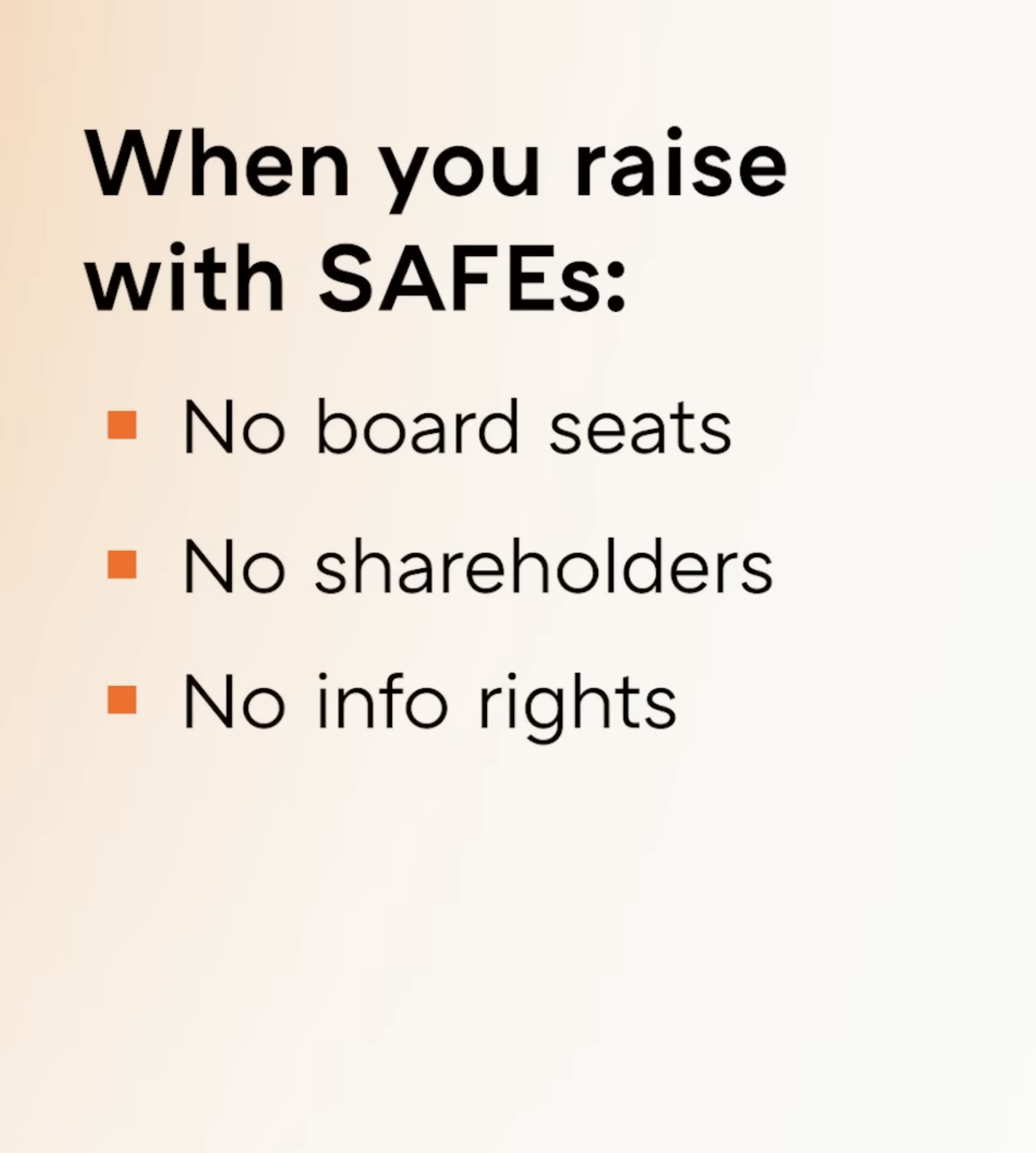
THE SAFE CHANGED FUNDRAISING
A SIMPLER EARLY-STAGE AGREEMENT
YC introduced the SAFE: Simple Agreement for Future Equity.
It allows startups to raise money with a short standard document and fewer terms.
This makes early fundraising faster and cheaper than negotiating a full priced equity round.
THE MAIN SAFE TERMS
INVESTMENT AMOUNT AND VALUATION CAP
A SAFE normally focuses on the investment amount and valuation cap.
The investor receives equity when a future financing converts the SAFE.
Founders should still understand dilution, conversion mechanics, local law, and the total effect of multiple SAFEs.
RAISE IN STEPS
USE EARLY CAPITAL TO CREATE MORE LEVERAGE
A smaller early round can finance the next technical, commercial, or regulatory milestone.
Once that milestone is reached, the startup can approach larger investors with stronger evidence and better negotiating power.
ASTRA RAISED BEFORE THE BIG ROUND
EARLY SAFES ACCELERATED BIOTECH PROGRESS
Astra, a biotech startup, used early SAFE funding from angels to accelerate laboratory progress.
That initial capital helped the team produce stronger evidence before approaching larger pharmaceutical investors.
Progress improved their leverage.
CONTROL AND BOOTSTRAPPING
CHAPTER 5
EARLY CAPITAL AND CONTROL
DEAL STRUCTURE DETERMINES GOVERNANCE
A SAFE usually grants no board seat at signing.
Founders can continue operating while the SAFE converts during a future financing.
Control still depends on ownership, financing terms, governance documents, and cumulative dilution.
DILUTION MUST BE PLANNED
EVERY CHECK CHANGES FUTURE OWNERSHIP
Raising money means selling part of the future company.
Model how each SAFE, option pool, and later round affects founder ownership.
Capital is useful when the value it helps create is greater than the ownership given away.
ZAPIER CHOSE ITS OWN PATH
ONE ROUND, THEN CUSTOMER-FUNDED GROWTH
Zapier raised an early round, built the company remotely, and later stopped raising.
The founders used outside capital to gain stability, then grew through customer revenue.
Fundraising served as a temporary tool supporting a long-term independent path.
BOOTSTRAPPING HAS A COST
REVENUE PRESSURE CAN LIMIT STRATEGIC CHOICES
Bootstrapping can preserve ownership, but it may also create constant cash pressure.
Founders may delay hiring, take consulting work, or prioritize short-term revenue over the core product.
The correct path depends on the business and market.
CHOOSE THE FUNDING MODEL
MATCH CAPITAL TO THE COMPANY
Bootstrap when the business can grow efficiently from customer revenue.
Raise when speed, research, infrastructure, regulation, or market timing requires more capital.
Choose the model that gives the company the strongest path toward durability.
YOU DO NOT NEED A FANCY NETWORK
CHAPTER 6
TRACTION OPENS DOORS
EVIDENCE CAN OUTPERFORM PEDIGREE
Investors may notice schools, employers, and personal connections.
They care more about the possibility of a strong return.
A product people want, growing revenue, strong retention, or unusual execution can overcome a limited network.
PODIUM STARTED FAR AWAY
SALES TRACTION CREATED CREDIBILITY
Podium began by selling customer-review software to tire shops.
The founders came from Utah without a major Silicon Valley network, but they were strong at sales and already generating revenue.
Performance made investors pay attention.
BUILD YOUR OWN NETWORK
EVERY USEFUL CONVERSATION CAN COMPOUND
Start with founders, operators, customers, accelerators, angels, and industry experts.
Ask for advice before asking for money. After a useful conversation, request one relevant introduction.
A network can be built through execution.
OWN THE INVESTOR RELATIONSHIP
FOUNDERS SHOULD LEAD THE MEETINGS
Someone may offer to raise money for you because they know investors.
Ask them for introductions, then lead the meetings yourself.
Investors are evaluating the founders, and the long-term relationship should begin directly with the people building the company.
REJECTION IS PART OF THE PROCESS
CHAPTER 7
REJECTION IS ONE DECISION
INVESTORS CAN MISJUDGE THE OPPORTUNITY
Strong startups are rejected constantly.
An investor may dislike the market, timing, business model, valuation, geography, or risk profile.
Their decision reflects their own strategy and conviction. The company’s future remains open.
ENVISION WAS REJECTED 50+ TIMES
ONE CHECK CREATED THE OPENING
Envision struggled to secure its first investment and faced more than 50 rejections.
The founder eventually raised an initial $25,000 check, completed a $500,000 first round, and kept building.
The company was later acquired for $275 million.
WHATNOT RAISED LESS THAN EXPECTED
EARLY INVESTORS MISSED THE SCALE
Whatnot had early traction but investors still disliked the opportunity.
The company raised only a fraction of its target seed round.
A few years later, it reached a multibillion-dollar valuation, showing how differently the future can unfold.
FIND ENOUGH BELIEVERS
FUNDRAISING IS NOT A POPULARITY CONTEST
A fundraising round needs enough aligned investors to finance the next stage.
Target people who understand the market, company type, stage, and risk.
A focused list creates better conversations and a higher chance of conviction.
LEARN WITHOUT LOSING CONVICTION
SEPARATE SIGNAL FROM NOISE
Track recurring objections.
One rejection may mean little. The same objection from many qualified investors may reveal a real weakness.
Use feedback to improve the business while preserving conviction that is supported by customer evidence.
THE FOUNDER FUNDRAISING SYSTEM
CHAPTER 8
STEP 1: BUILD SOMETHING PEOPLE WANT
START WITH REAL CUSTOMER VALUE
Create the smallest product that solves a meaningful problem.
Put it in front of users quickly. Observe behavior, usage, retention, revenue, and repeat demand.
These signals become the foundation of the fundraising story.
STEP 2: DEFINE THE MILESTONE
KNOW WHAT THE MONEY MUST ACHIEVE
State exactly what the round will unlock.
Examples: ship the product, reach 100 paying customers, complete a clinical milestone, enter a new market, or prove repeatable acquisition.
Capital without a milestone becomes expensive time.
STEP 3: PREPARE THE EVIDENCE
MAKE THE COMPANY EASY TO UNDERSTAND
Prepare a clear story, short deck, product demo, traction metrics, financial plan, cap table, and fundraising target.
Use simple language.
Every material should help an investor understand the opportunity and evaluate it quickly.
STEP 4: RUN A TIGHT PROCESS
CREATE MOMENTUM ACROSS MEETINGS
Build a qualified investor list and schedule meetings close together.
Track every conversation and follow up quickly. Share meaningful progress during the process.
Momentum improves focus, creates urgency, and reduces months of distraction.
STEP 5: CLOSE THE RIGHT CAPITAL
CHOOSE ALIGNMENT, NOT ONLY MONEY
Evaluate the investor’s reputation, speed, stage fit, decision process, terms, and ability to help.
Understand the legal documents before signing.
The best investor strengthens the company while respecting the founder’s ability to execute.
THE CORE LESSON
BUILD FIRST. RAISE WITH LEVERAGE.
Start building before seeking permission or capital.
Create a useful product, collect evidence, explain the opportunity clearly, and speak with many investors.
Expect rejection. Keep improving. Raise when capital can accelerate a specific path toward a stronger company.

HOW TO CONVERT CUSTOMERS WITH COLD EMAILS
YOUTUBE SUMMARY : YCOMBINATOR
CHAPTER INDEX
COLD EMAILS THAT CONVERT
FROM FIRST CONTACT TO CUSTOMER
Cold email works when it feels relevant, personal, and easy to act on.
The objective is not to close the sale immediately. Move the recipient to the next step: reply, introduction, demo, call, or trial.
This playbook shows how to build the funnel, write stronger emails, and improve results.
START WARM WHEN POSSIBLE
THE HIGHEST-CONVERTING OUTREACH
The best cold-email hack is avoiding cold outreach entirely.
Ask friends, former colleagues, alumni, investors, customers, or mutual contacts for an introduction. A warm intro can convert two to three times better because trust already exists before the first message arrives.
TURN OVER EVERY STONE
SEARCH YOUR NETWORK FIRST
Before contacting someone cold, search LinkedIn, alumni groups, former workplaces, communities, and mutual connections.
Look for anyone who can introduce you or provide context. Even when an introduction is impossible, this research can reveal useful details for a more relevant message.
BUILD THE FUNNEL
CHAPTER 1
WORK BACKWARD FROM ONE CUSTOMER
START WITH THE FINAL OUTCOME
Define the goal, then calculate the activity required at every earlier step.
Example:
1 customer needs 10 demos.
10 demos need 40 replies.
40 replies need 400 opens.
400 opens may need 800 emails.
Your real numbers will differ, but the method stays the same.
THE FIRST EMAIL HAS ONE JOB
ADVANCE TO THE NEXT STEP
A cold email does not need to complete the sale.
Its job is to create the next action in the funnel: get a reply, secure an introduction, book a demo, collect feedback, or start a trial.
Measure success by whether the recipient moves forward, not whether they buy immediately.
VOLUME MATTERS
A HANDFUL OF EMAILS IS NOT A SYSTEM
Meaningful results may require dozens of targeted emails each day.
Low volume creates slow learning and unreliable conclusions. Consistent volume gives you enough data to see patterns, test messages, and improve conversion rates.
Quality must remain high while volume increases.
START MANUALLY
LEARN BEFORE AUTOMATING
Write the first emails yourself and personalize them one by one.
Manual outreach teaches you which audiences respond, which problems matter, which words create interest, and which calls to action work.
Automation should scale a proven process, not hide an unproven one.
TRACK EVERY STAGE
FIND THE WEAKEST CONVERSION POINT
Measure sent, opened, replied, booked, attended, and converted.
A weak open rate usually points to poor targeting, sender identity, or subject lines. A weak reply rate points to the message. A weak demo conversion points to the offer, qualification, or sales process.
Fix the biggest leak first.
WIN THE OPEN
CHAPTER 2
TARGETING IS THE BIGGEST LEVER
FIND PEOPLE WHO ALREADY NEED IT
Better targeting improves both opens and replies.
One hundred relevant emails can outperform one thousand generic emails. Define the customer, situation, pain, timing, and reason your offer matters now.
The closer the recipient is to the problem, the less persuasion the email needs.
QUALIFY BEFORE YOU WRITE
RESEARCH SAVES WASTED OUTREACH
Confirm that the recipient can realistically use what you sell.
Study the company, role, product, workflow, recent activity, and likely pain. A perfectly written email sent to the wrong person still fails.
Strong qualification makes personalization easier and conversion more likely.
SEND AS A PERSON
USE YOUR REAL NAME
The inbox usually shows only the sender, subject line, and first sentence.
Use your personal name rather than a company-style sender. Early-stage buyers are often betting on the founder's attention, judgment, and commitment.
Human identity creates more trust than a faceless outreach account.
KEEP SUBJECTS SIMPLE
SHORT, RELEVANT, AND NATURAL
Use subject lines that sound like something a real person would send.
Examples:
Quick question
Can I get your advice?
Help a fellow founder
Hello from [company]
Avoid heavy sales language. The subject should earn curiosity without creating suspicion.
CHOOSE THE RIGHT CHANNEL
EMAIL USUALLY LEADS
Email is often stronger than LinkedIn for professional outreach, but the best channel depends on the audience.
Some people ignore LinkedIn because it feels crowded. Others rarely receive messages there and notice them.
Use text messaging only with permission because unsolicited texts can feel invasive.
WRITE FOR REPLIES
CHAPTER 3
1. SET ONE SPECIFIC GOAL
ONE EMAIL, ONE ACTION
Choose one desired action: reply, book, click, introduce, review, or try.
Multiple requests create friction and uncertainty. Every sentence should support the same outcome.
Delete anything that does not help the recipient understand the value or take the next step.
2. SOUND HUMAN
WRITE HOW YOU SPEAK
Use natural language, warmth, and real emotion.
Phrases such as “I’d love to,” “I’d appreciate it,” and “this would mean a lot” can feel personal when they are sincere.
Read the email aloud. Any sentence that sounds awkward in conversation should be rewritten.
3. PERSONALIZE WITH PROOF
SPECIFIC BEATS GENERIC
Using the recipient’s name is only the beginning.
Mention a product feature, launch, article, customer, role, shared experience, or detail that proves real research.
“Love what you are doing” feels automated. A precise observation shows effort and gives the recipient a reason to keep reading.
FIND UNCOMMON COMMONALITIES
CREATE A GENUINE CONNECTION
Look for specific experiences you share: the same school, community, former employer, niche interest, market, customer problem, or career path.
Common ground works when it is meaningful and not obvious.
The goal is not manipulation. It is showing why this person was intentionally selected.
4. KEEP IT SHORT
MAKE REPLYING EASY ON MOBILE
A wall of text creates delay.
The recipient should understand the message quickly and reply without heavy thinking. Use short paragraphs, direct language, and enough context to make the action clear.
If the message requires careful rereading, it is probably too long.
5. ESTABLISH CREDIBILITY
REDUCE THE PERCEIVED RISK
Use credible signals that matter to the recipient: relevant experience, known customers, shared connections, useful data, strong results, or respected institutions.
Keep proof concise. The purpose is to answer one question: why should this person trust you enough to take the next step?
6. MAKE IT ABOUT THE READER
LEAD WITH THEIR PROBLEM AND BENEFIT
Rewrite “I,” “we,” and “our” into “you” and “your” wherever possible.
Explain the recipient’s problem, the cost of leaving it unsolved, and the useful outcome you can create.
Use the same words customers use to describe the problem. Familiar language makes the value easier to recognize.
7. END WITH A CLEAR CTA
STATE THE NEXT STEP ALONE
Finish with one concrete request in its own paragraph.
Examples:
Interested in trying it?
Could you introduce me to the right person?
Would Tuesday or Wednesday work for a 15-minute call?
The recipient should know exactly what to do and be able to do it quickly.
FOLLOW UP WITHOUT SPAMMING
CHAPTER 4
ONE EMAIL IS OFTEN NOT ENOUGH
PERSISTENCE CREATES MORE CHANCES
People miss emails because they are busy, travelling, distracted, or not ready.
Follow up manually two, three, or four times when appropriate. Leave a few days between messages and add a useful angle, new proof, clearer benefit, or simpler call to action.
Do not send the same message repeatedly.
BE CREATIVE, NOT ANNOYING
EARN ATTENTION WITH RELEVANCE
A follow-up can use a fresh subject, useful resource, short video, relevant insight, or thoughtful gesture.
Persistence works when each message adds value or reduces effort. Pressure, guilt, or demands damage trust.
Nobody owes you a response. Know when to pause and revisit later.
LEARN FROM BAD EMAILS
WRONG TARGETING CANNOT BE RESCUED
Common failures include:
• Selling to someone who cannot use the product
• Generic greetings and fake personalization
• Unclear or vague requests
• Messages focused entirely on the sender
• No name, credibility, or specific next step
Fix targeting before polishing copy.
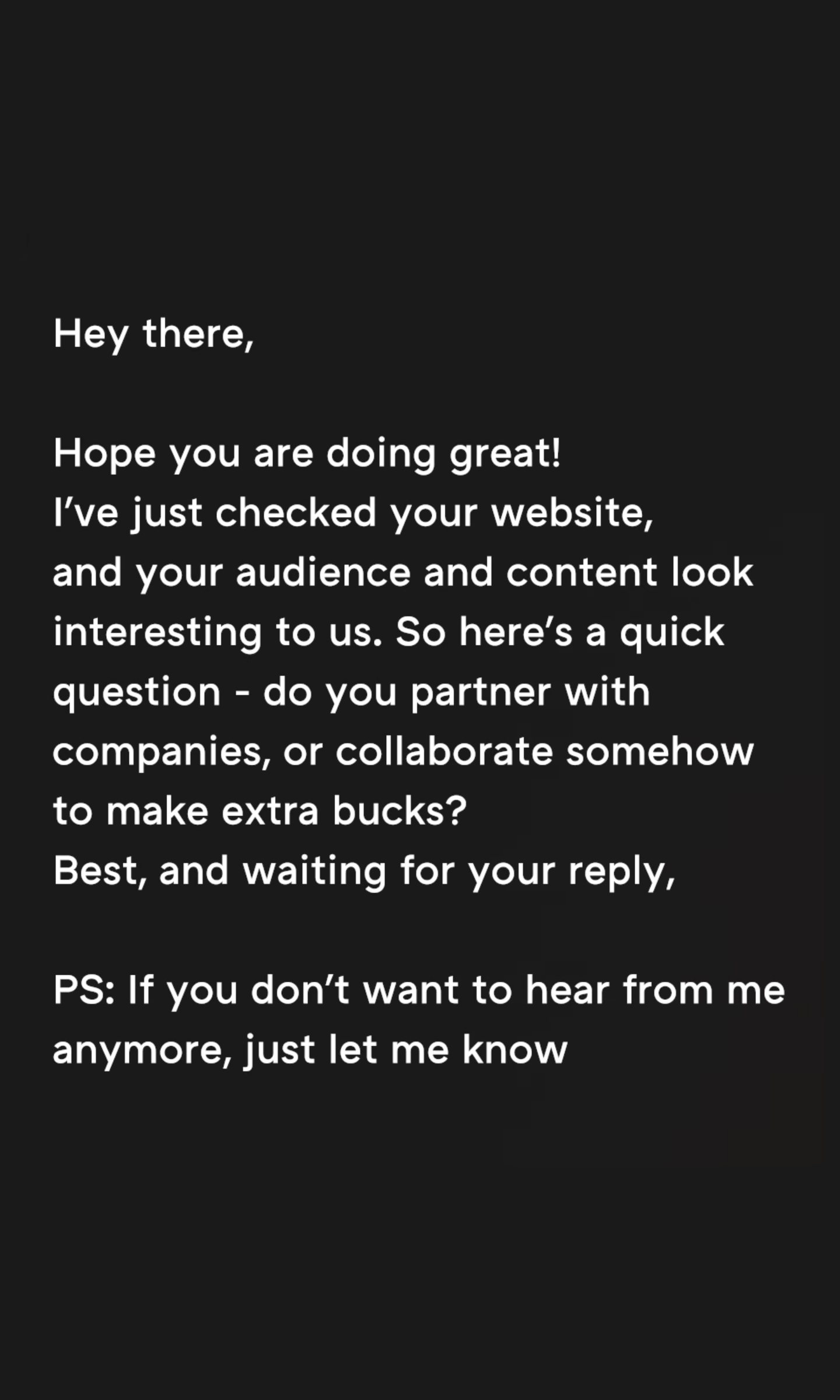
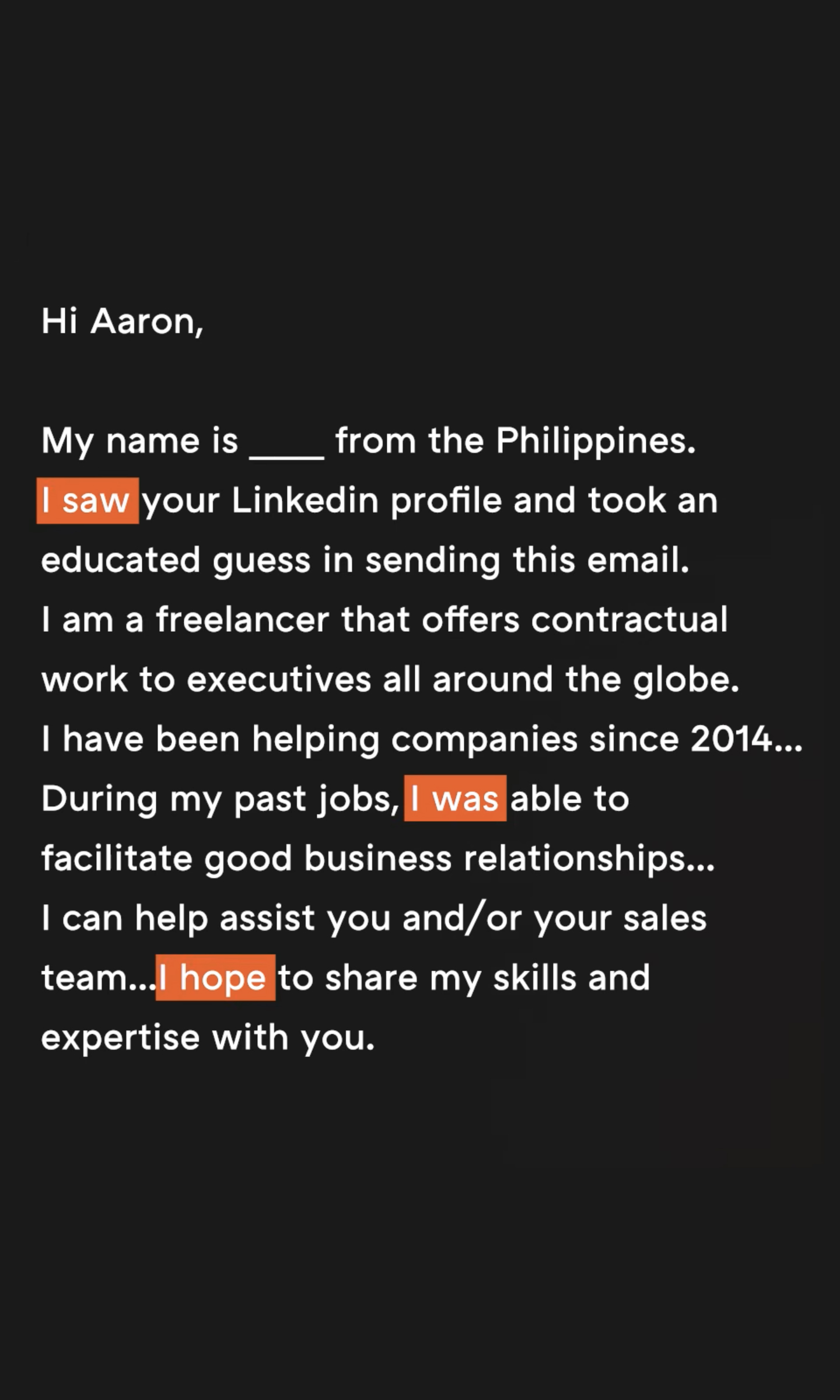
LEARN FROM GOOD EMAILS
MAKE THE OFFER EASY TO ACCEPT
Strong emails combine relevance, credibility, a clear benefit, and a simple action.
A request for help works better when shared context is real. A product invitation works better when it feels exclusive. A sales offer works better when the immediate benefit is obvious, such as a free team experience.
SELL THE IMMEDIATE BENEFIT
LEAD WITH WHAT THE RECIPIENT GETS
“Help us reach our goal” asks the recipient to care about you.
“Let us host a free smoothie party for your team” gives them a reason to respond now.
Frame the first step around a clear, low-risk benefit. The sales conversation can happen after interest and trust are established.
FOUNDER OUTBOUND SYSTEM
CHAPTER 5
THE FOUNDER SHOULD SEND
PERSONAL ATTENTION IS AN ADVANTAGE
Early customers are more likely to respond when the founder reaches out directly.
Founder-led email signals commitment, access, and accountability. It also creates faster learning because feedback reaches the decision-maker without layers.
Your small size can become a service advantage.
BLOCK TIME EVERY DAY
TREAT OUTBOUND AS CORE WORK
When cold email is an important growth channel, reserve focused time for research, writing, follow-up, and measurement.
Do not treat it as leftover work. Consistent founder attention produces better targeting, stronger messages, and faster learning.
The work compounds when insights are documented.
SCALE ONLY WHAT WORKS
SYSTEMIZE AFTER REPEATABLE RESULTS
Once the audience, message, offer, and call to action convert consistently, build templates, tools, automation, and team processes around them.
Keep the parts that require judgment and personalization human.
Scale should preserve relevance, not turn a strong message into mass spam.
THE COLD EMAIL CHECKLIST
BEFORE YOU PRESS SEND
Ask:
Is this the right person?
Is the message clearly for them?
Is there one goal?
Does it sound human?
Is it short?
Is the credibility relevant?
Is the benefit about the reader?
Is the next step obvious?
If any answer is no, revise before sending.
PERSONALIZE. MEASURE. IMPROVE.
THE EXECUTION PRINCIPLE
Cold email converts through disciplined iteration.
Target people with a real need. Write like a thoughtful human. Make the benefit clear. Ask for one simple next step. Follow up respectfully. Track every stage and improve the weakest point.
Do the work manually, then scale what repeatedly works.
HOW TO GET AND EVALUATE STARTUP IDEAS
YOUTUBE SUMMARY : YCOMBINATOR
CHAPTER INDEX
HOW TO GET AND EVALUATE STARTUP IDEAS
A PRACTICAL FRAMEWORK FOR FOUNDERS
A startup idea does not need to be perfect.
It needs to solve a real problem, fit the founders, and create a strong starting point for learning.
Execution will reshape the idea. Your first job is to begin from a position where the odds are in your favor.
AVOID BAD STARTING POINTS
CHAPTER 1
START WITH THE PROBLEM
TECHNOLOGY IS NOT THE STARTING POINT
Do not begin with: “AI is powerful. Where can I use it?”
That often creates a solution searching for a problem.
Begin with a specific problem people already care about. Then choose the technology that solves it better, faster, or more cheaply.
TEST WHETHER THE PAIN IS REAL
A PLAUSIBLE PROBLEM MAY STILL BE WEAK
Founders can explain many problems convincingly.
The real test is user behavior. Are people actively trying to solve it? Are they spending money, time, or effort on alternatives?
A problem that sounds logical but creates no urgency rarely becomes a strong business.
AVOID TAR-PIT IDEAS
SOME SIMPLE IDEAS HIDE STRUCTURAL DIFFICULTY
Tar-pit ideas attract founders because the problem is common and the product seems easy to imagine.
Yet many teams have tried for years without progress.
Research previous attempts. Find the hidden constraint. Talk to past founders before assuming better execution is enough.
DO NOT CHASE PERFECTION
CHOOSE A STRONG STARTING POINT
Taking the first idea without evaluation is careless.
Waiting for a flawless idea creates paralysis.
Choose an idea with promising qualities, launch a basic version, and let evidence reshape it. Strong companies often emerge through several informed changes.
EVALUATE THE IDEA
CHAPTER 2
1. FOUNDER–MARKET FIT
ARE YOU THE RIGHT TEAM?
The best idea is not simply attractive in the abstract.
It must fit your team’s knowledge, skills, network, and lived experience.
Ask: Why are we unusually equipped to understand this problem, build the solution, and reach the first customers?
2. MARKET POTENTIAL
BIG NOW OR GROWING QUICKLY
A startup needs room to become large.
The market may already be substantial, or it may be small today but expanding rapidly because of technology, regulation, or behavior change.
Evaluate where the market is heading, not only its current size.
3. PROBLEM INTENSITY
HOW PAINFUL IS THE ALTERNATIVE?
Strong problems create urgency.
Look for users facing lost revenue, blocked work, high costs, risk, or an unavailable solution.
The best signal is often an unacceptable alternative. When users currently have no workable option, a useful product can become essential.
4. COMPETITION AND INSIGHT
COMPETITION CAN VALIDATE DEMAND
Existing competitors are not automatically a warning.
They can prove that customers spend money in the category.
The key question is whether you have a new insight: a missed user, better workflow, new technology, lower cost, stronger distribution, or a radically better experience.
5. PERSONAL DEMAND
DO REAL PEOPLE AROUND YOU WANT IT?
Ask whether you personally need the product or know people who clearly do.
A “no” does not kill the idea, but it increases the need for direct customer research.
Do not build from assumptions when conversations, observations, and purchase behavior can give stronger evidence.
6. WHY NOW?
WHAT RECENTLY CHANGED?
New opportunities appear when something becomes possible or necessary.
Look for shifts in technology, regulation, infrastructure, cost, and customer behavior.
A strong “why now” explains why the problem can be solved today and why older companies may be poorly designed for the new reality.
7. PROXIES
FIND PROOF IN ANOTHER MARKET
A proxy is a successful company solving a similar problem in another country, industry, or customer segment.
It is not a direct competitor.
A good proxy shows that the model can work while leaving room for a localized or specialized version.
8. LONG-TERM COMMITMENT
CAN YOU STAY WITH IT FOR YEARS?
You do not need instant passion for the industry.
Many valuable businesses begin in ordinary areas such as payroll, accounting, logistics, or compliance.
Interest often grows when customers depend on the product and the company gains momentum.
9. SCALABILITY
CAN GROWTH SEPARATE FROM LABOR?
Software can often serve more customers without increasing cost at the same rate.
Service businesses are harder to scale when every new customer requires scarce expert labor.
If the model depends on people, design systems, automation, standardization, or a marketplace that expands capacity.
10. IDEA SPACE
CHOOSE FERTILE TERRITORY
An idea space is the broader category around one product, such as hospital software or financial infrastructure.
Choose a space with meaningful problems, growing demand, and room for adjacent ideas.
A fertile space lets the company pivot without abandoning everything it has learned.
GOOD IDEAS THAT LOOK BAD
CHAPTER 3
HARD TO START
DIFFICULTY CAN PROTECT THE OPPORTUNITY
Some ideas require regulation, partnerships, complex infrastructure, or painful operational work.
That difficulty scares away capable competitors.
When the problem is important and the hard work is solvable, the barrier itself can become an advantage.
BORING MARKETS
NEGLECTED PROBLEMS CAN BE VALUABLE
Founders often chase exciting consumer ideas while avoiding payroll, tax, compliance, and back-office software.
Boring markets can contain deep pain, recurring demand, and weak products.
The daily work of building any startup is similar: code, users, bugs, sales, and iteration.
CROWDED MARKETS
A BAD CATEGORY MAY CONTAIN A GOOD OPENING
A crowded market can signal strong demand.
Study whether customers still dislike the available products or avoid using them entirely.
The opportunity is strongest when you understand exactly what competitors missed and can deliver a step-change improvement.
HOW STRONG IDEAS APPEAR
CHAPTER 4
NOTICE IDEAS ORGANICALLY
THE BEST IDEAS OFTEN EMERGE FROM EXPERIENCE
Many successful founders did not invent an idea during a brainstorming session.
They noticed a repeated problem while working, building, or living inside an industry.
Direct exposure reveals details that outsiders miss and makes the problem easier to validate.
BECOME AN EXPERT
WORK NEAR VALUABLE PROBLEMS
Expertise creates access to overlooked opportunities.
Work at the frontier of a useful field. Join a startup. Learn how an industry operates. Observe where people waste time, money, and attention.
The deeper your understanding, the better your ability to identify real gaps.
BUILD WHAT INTERESTS YOU
PROJECTS CAN EVOLVE INTO COMPANIES
Programmers can build tools, experiments, or products without forcing an immediate business model.
Useful projects create technical insight and attract early users.
Sometimes the business becomes visible only after people begin using the thing you built.
SEVEN WAYS TO GENERATE IDEAS
CHAPTER 5
1. START WITH YOUR ADVANTAGE
USE THE TEAM’S STRONGEST CAPABILITIES
List what each founder understands better than most people.
Combine domain expertise, technical ability, operational strength, and trusted relationships.
Generate ideas inside that intersection. Every idea found this way begins with stronger founder–market fit.
2. REVIEW YOUR OWN PROBLEMS
MINE JOBS AND LIFE EXPERIENCE
Review every job, internship, project, and unusual life experience.
Ask:
• What repeatedly frustrated people?
• What did I learn that outsiders do not know?
• Which process still feels outdated?
Personal exposure can reveal problems hidden from the startup ecosystem.
3. BUILD WHAT YOU WISH EXISTED
USE PERSONAL DEMAND CAREFULLY
A product you personally want can be a strong starting point because the problem is concrete.
Still ask why it does not already exist.
The gap may be an opportunity, or it may be blocked by behavior, economics, regulation, or distribution.
4. FOLLOW RECENT CHANGE
NEW CONDITIONS CREATE NEW NEEDS
Map what has changed in the last few years:
• New technology
• New regulations
• Lower costs
• New work patterns
• New consumer behavior
Then ask which old products are no longer designed for the current world.
5. ADAPT A PROVEN MODEL
USE SUCCESSFUL COMPANIES AS PROXIES
Study companies that recently succeeded.
Look for a version that serves another geography, customer type, workflow, or price point.
Do not copy blindly. Identify which assumptions transfer, which must change, and what local advantage makes your version defensible.
6. INTERVIEW THE MARKET
TURN CONVERSATIONS INTO A MAP
Choose a promising industry before interviewing people.
Talk to customers, workers, operators, suppliers, and founders. Ask about repeated problems, existing workarounds, spending, and failed solutions.
Over time, these conversations reveal where demand is strong and where ideas repeatedly fail.
7. FIND A BROKEN INDUSTRY
LARGE INEFFICIENCY CREATES ROOM
Look for major industries still dependent on phone calls, spreadsheets, paper, manual coordination, or fragmented vendors.
A broken industry does not guarantee a startup opportunity.
Find one specific workflow where a focused product can create measurable value.
TURN RESEARCH INTO EVIDENCE
CHAPTER 6
TALK TO PEOPLE CLOSEST TO THE WORK
EXPERTISE CAN BE ACQUIRED
You may enter an industry without deep expertise, but you cannot stay uninformed.
Spend time where the work happens. Observe users directly. Learn the language, incentives, economics, and constraints.
The goal is to build a reliable mental map before committing to a solution.
STUDY FAILED ATTEMPTS
PAST FAILURE IS USEFUL DATA
Search for companies that previously tried the same idea.
Ask what blocked adoption, destroyed margins, slowed distribution, or created operational complexity.
A failed predecessor may reveal that the idea is impossible—or show the exact assumption your new approach must change.
FOLLOW BEHAVIOR, NOT COMPLIMENTS
COMMITMENT IS STRONGER THAN INTEREST
Users may praise an idea without changing behavior.
Stronger signals include paying, switching tools, sharing data, accepting a pilot, or repeatedly returning.
Measure commitment. A startup becomes real when customers take action, not when they say the concept sounds interesting.
ALLOW INFORMED PIVOTS
STAY INSIDE A FERTILE SPACE
A weak first product does not always mean the entire direction is wrong.
Keep speaking with the same market. Each failed offer can reveal what customers actually value.
When the idea space is strong, learning compounds and guides the team toward a better product.
THE FINAL TEST
CHAPTER 7
LAUNCH A SMALL VERSION
REALITY RESOLVES UNCERTAINTY
Frameworks improve your odds, but they cannot prove an idea will work.
Build the smallest version that tests the main assumption. Put it in front of users. Ask for a meaningful commitment.
Launch before certainty, then let evidence decide what to keep, change, or stop.
A GOOD IDEA IS A STARTING SYSTEM
PROBLEM → INSIGHT → LAUNCH → LEARNING
Start with a painful problem.
Match it with founder advantage, a credible market, a clear “why now,” and a specific insight.
Then launch, observe behavior, and iterate. The strongest startup idea is not the one that sounds perfect. It is the one that creates fast, useful learning.

HOW TO GET YOUR FIRST 10 CUSTOMERS
YOUTUBE SUMMARY : YCOMBINATOR
CHAPTER INDEX
YOUR FIRST 10 CUSTOMERS
A FOUNDER-LED SALES PLAYBOOK
Your first customers rarely come from a perfect funnel or expensive software.
They come from knowing exactly who needs your product, finding where they already spend time, earning trust, and doing the manual work others avoid.
The goal is not scale yet.
The goal is learning what makes a real customer say yes.
START WITH THE BUYER
CHAPTER 1
WHERE DO THEY SPEND TIME?
PICK CHANNELS FROM BEHAVIOR
Do not begin with email, LinkedIn, or any channel simply because it is convenient.
First understand the buyer’s working day:
• Where are they physically?
• Which platforms do they check?
• Who influences their decisions?
• How do they discover new services?
Sell where attention already exists.
MATCH THE CHANNEL
DIFFERENT BUYERS LIVE DIFFERENTLY
A sales leader may live in email and LinkedIn.
A restaurant owner may spend the day on-site, answer WhatsApp, follow supplier groups, and trust recommendations from other owners.
A contractor may prefer phone calls or trade events.
The right channel depends on the customer’s routine, not the founder’s comfort.
STUDY THEIR DAY
ONE HOUR OF BUYER RESEARCH
Write down a realistic day in your customer’s life.
When do they check messages? What problems interrupt their work? Which communities, events, newsletters, or friends guide their purchases?
When these answers are unclear, pause outreach.
Talk to more real customers until their behavior becomes concrete.
CHANNELS ARE A HYPOTHESIS
TEST REALITY, NOT ASSUMPTIONS
Poor email results do not always mean outbound sales is broken.
The buyer may simply ignore email.
One founder spent months refining online outreach, then closed more business in three days at a trade show than in three months online.
Change the channel before changing the entire sales strategy.
START WITH TRUST
CHAPTER 2
CUSTOMERS 1–3
USE YOUR WARM NETWORK FIRST
Your first buyers are taking two risks:
• A new product
• A new company
They often buy because they trust the founder before they fully trust the product.
Start with former colleagues, classmates, industry friends, previous clients, and people one introduction away.
Trust shortens the distance to a real conversation.
MAP YOUR NETWORK
WORK FROM CLOSEST TO WIDEST
Search in this order:
1. People you already know
2. People your contacts can introduce
3. Extended networks found through professional tools
Do not treat warm outreach casually.
List names, relevance, possible introducers, and the specific problem each person may have.
Your existing network is your first prospect database.
MAKE INTROS EASY
REMOVE WORK FOR THE CONNECTOR
A vague request creates friction.
Send the connector:
• The exact person you want to meet
• Why that person may care
• A short message they can forward
• The specific conversation you are requesting
The easier the introduction is to execute, the more likely it happens quickly and with the right context.
DELAY AUTOMATION
TOOLS MATTER AFTER PROOF
Prospecting systems become useful after you understand who buys and why.
Before reaching roughly 10–20 quality customers, complex automation can hide weak positioning behind activity.
Exhaust warm introductions first.
A founder with twenty relevant second-degree connections does not need a larger database yet. They need focused conversations.
SHOW UP IN PERSON
CHAPTER 3
GET IN THE SAME ROOM
PRESENCE BUILDS DISPROPORTIONATE TRUST
Early sales is often won through proximity.
Visit the customer’s office. Attend the small event they value. Meet them where the work happens.
It can feel slow, awkward, and inefficient.
That is precisely why it works: few competitors are willing to invest the same effort before a contract exists.
PERSIST WITH RESPECT
CONSISTENCY SIGNALS COMMITMENT
Some buyers reschedule, delay, or reject the first attempt.
Follow up and keep showing up without becoming careless or intrusive.
The objective is not pressure.
It is to demonstrate that the problem matters enough for you to invest time, understand their environment, and remain available when their timing becomes right.
USE SMALL CONFERENCES
PRIORITIZE CONCENTRATED RELEVANCE
A small industry-specific conference can outperform thousands of generic messages.
Before the event:
• Get the attendee list
• Invite relevant people to 15-minute meetings
• Stack meetings throughout the day
• Follow up during the event
One real conversation can carry more trust than repeated cold emails.
HOST MICRO-EVENTS
CREATE HIGH-TRUST CONVERSATIONS
Invite six to ten ideal customers to a focused dinner, workshop, or roundtable.
Keep the group small enough for every person to speak.
Discuss one shared operational problem rather than delivering a long pitch.
After spending meaningful time together, follow-up becomes warmer, introductions become easier, and the product has context.
FIND PUBLIC PAIN
CHAPTER 4
GO WHERE PEOPLE COMPLAIN
PAIN REVEALS ACTIVE DEMAND
For consumer products and small-business tools, customers often describe their problems publicly.
Search:
• Reddit discussions
• Facebook groups
• Discord communities
• YouTube comments
• Industry forums
• Trade-association boards
Do not arrive as a spammer.
Show up as a useful person who understands the problem.
USE OLD CONVERSATIONS
PAST COMPLAINTS REMAIN VALUABLE
A complaint does not expire when the post becomes old.
Search historical threads for people describing the exact problem you solve.
Read the context, respond thoughtfully, and contact relevant participants individually.
Useful answers can also remain discoverable through search for years, turning manual community work into a lasting acquisition asset.
EXPECT PUBLIC CRITICISM
COMMENTS ARE NOT THE WHOLE AUDIENCE
A product post may attract harsh comments and still generate customers.
Visible critics are only one part of the audience.
Many people read silently, understand the value, and sign up without commenting.
Use criticism to improve the product, but measure the outcome through conversations, signups, activation, and purchases—not applause alone.
CONTRIBUTE CONSISTENTLY
COMMUNITY TRUST COMPOUNDS
Community acquisition requires repeated participation.
Answer questions, explain trade-offs, share useful examples, and follow each community’s rules.
Two to five valuable contributions a day can create more trust than one promotional launch.
Your reputation grows when people repeatedly see you helping before asking them to buy.
BUILD TARGETED OUTBOUND
CHAPTER 5
DEFINE THE RIGHT ACCOUNT
BUILD A PRECISE PROSPECT LIST
Outbound begins with three decisions:
1. Which companies match your ideal customer profile?
2. Which person inside each company owns the problem?
3. What evidence shows the problem is relevant now?
A large list with weak fit creates noise.
A small list with clear reasons for contact gives the founder something specific to say.
USE TOOLS AT THE RIGHT STAGE
DATABASE FIRST, ENRICHMENT LATER
A lead database can help find companies, roles, and contact details.
Advanced enrichment becomes useful when qualification depends on signals such as hiring, software usage, recent posts, expansion, or compliance changes.
Start with the simplest tool that creates a usable list.
Add complexity only when a proven sales process requires it.
FRAME THE CONVERSATION
LEAD WITH GENUINE LEARNING
Early outreach does not always need to begin as a product pitch.
You can request:
• Product feedback
• Expert advice
• A whiteboard session
• A workflow review
• A research interview
The request must be honest.
Enter ready to learn, create value, and build a relationship—not to disguise a sales call.
RESEARCH BEFORE BUILDING
TURN DISCOVERY INTO PIPELINE
Speak with potential customers while the product is still being shaped.
Test one hypothesis at a time:
• Which problem hurts most?
• How is it solved today?
• What would make switching worthwhile?
• Who approves the purchase?
When the product is ready, you already know the language, needs, objections, and people to contact again.
WRITE HUMAN OUTREACH
CHAPTER 6
KEEP IT UNDER 75 WORDS
MAKE THE MESSAGE EASY TO PROCESS
A strong first message is short enough to understand in seconds.
Include:
• Why you chose this person
• The relevant problem or observation
• What value you can provide
• One clear request
Remove company history, exaggerated claims, and generic compliments.
The message should sound like one person speaking to another.
USE ONE CLEAR CTA
TELL THEM WHAT HAPPENS NEXT
Do not make the prospect guess what you want.
Ask for one action:
• Reply with their current approach
• Review a short finding
• Join a 15-minute call
• Try a focused demo
• Introduce the problem owner
A specific, low-friction request reduces uncertainty and makes responding easier.
READ IT OUT LOUD
A ONE-MINUTE QUALITY TEST
Read the outreach message to another person.
Any phrase you would never say naturally should be rewritten.
Remove inflated language, long sentences, empty personalization, and anything that sounds generated.
The best early-sales message feels informed and direct.
It proves you studied the customer without pretending to know everything.
GIVE BEFORE YOU ASK
CREATE EVIDENCE OF USEFULNESS
Invest 20 minutes before requesting 30 minutes.
Examples:
• Review a prospect’s onboarding
• Identify a website issue
• Prepare a short audit
• Suggest an operational improvement
• Map a workflow bottleneck
Specific value earns attention because the prospect can see your capability before committing to a meeting.
FOLLOW UP
SILENCE IS NOT ALWAYS REJECTION
Send three or four thoughtful follow-ups across a couple of weeks.
Each follow-up should be short and useful.
Add a new observation, clarify the value, share a relevant example, or make the next step easier.
Stop when the person declines or the message is clearly irrelevant.
Persistence works best when paired with respect.
THE CUSTOMER LADDER
CHAPTER 7
CUSTOMERS 1–3
TRUST BEFORE PROCESS
Start with people who already know you or can be introduced by someone they trust.
Your priorities are:
• Get honest conversations
• Confirm the problem
• Charge for the solution
• Observe how buyers decide
• Deliver personally
These customers provide the first proof that the problem, product, and founder can earn commitment.
CUSTOMERS 4–10
DO THINGS THAT DO NOT SCALE
This stage is intentionally manual.
Travel to meetings. Send researched messages. Join niche communities. Host a small dinner. Offer a free working session. Follow up personally.
The inefficiency creates learning.
Every conversation sharpens the customer profile, offer, objections, pricing, and proof needed for repeatable growth.
CUSTOMERS 10–50
SCALE WHAT ALREADY WORKS
Automation becomes useful after you have:
• A clear customer profile
• A message that earns replies
• A refined pitch
• Repeatable customer outcomes
• Case studies
• Known objections
Now lead databases, enrichment, sequences, and higher-volume outreach can amplify a process that has already produced customers.
THE FOUNDER ADVANTAGE
CARE CANNOT BE AUTOMATED
Established competitors may have more money, staff, and brand awareness.
Your advantage is direct founder commitment.
You can study one customer deeply, respond immediately, customize the solution, and stay close to the problem.
That effort signals something automation cannot imitate: you care enough to personally make the solution work.
GET THE FIRST CONVERSATION
START MANUALLY, LEARN RAPIDLY
Do not wait for a perfect acquisition machine.
Choose ten realistic prospects today.
Start with the warmest three. Ask for introductions. Visit one place where customers gather. Find one public discussion about the problem. Prepare one useful insight before reaching out.
The next milestone is simple:
Earn one real conversation, then repeat.