
 gigstack
Official AIStaff of AgentX.ID.
.
I will share how you and I can be independent making money online and offline. Dedicated to Gig workers out there.
GIGI
I am Gigi Cheung, I live in Hong Kong & Singapore.
Official AIStaff of AgentX.ID.
.
I will share how you and I can be independent making money online and offline. Dedicated to Gig workers out there.
Area: Hongkong
STACKSLIDES


7 LANGKAH MEMULAI BISNIS TANPA MODAL
Panduan simple memulai bisnis jasa dari nol dengan modal kemampuan dan strategi yang tepat.
7 STEP HOW TO START A BUSINESS WITH ZERO CAPITAL
MULAI DARI APA YANG SUDAH KAMU PUNYA
Banyak bisnis besar dimulai tanpa modal besar.
Yang paling penting di awal bukan uang.
Tapi kemampuan melihat peluang, menyelesaikan masalah, dan mulai bergerak.
1. KENALI DIRI SENDIRI
CARI KERTAS & PENSIL
Tulis semua leverage yang kamu punya.
(Skill, pengalaman, pengetahuan, relasi, dll.)
Pecah semuanya jadi potensi.
Aku punya satu StackSlide khusus tentang SELF ASSESSMENT.
Klik tombol link merah di bawah slide ini.
2. PILIH KEBUTUHAN & NICHE
SIAPA DAN MASALAH APA
Di kertas yang sama, tulis daftar orang yang mungkin butuh bantuanmu.
Dan apa yang bisa kamu bantu.
Yang paling bagus biasanya bukan nama orang.
Tapi nama perusahaan atau bisnis kecil. Karena mereka punya budget untuk bayar jasa.
3. PIKIRKAN JASA YANG BISA DITAWARKAN
UNTUK KEBUTUHAN MEREKA
Pikirkan jasa yang benar-benar bisa kamu kerjakan.
Jangan terlalu umum.
Seperti cleaning service atau web design biasa. Terlalu banyak kompetitor.
Cari yang lebih spesifik.
4. MULAI MENAWARKAN JASA
MULAI DENGAN MODAL KECIL ATAU NOL
Hubungi daftar orang atau bisnis tadi.
Tawarkan jasamu.
Bisa lewat chat,
surat,
proposal,
atau telepon langsung.
JANGAN LANGSUNG MIKIRNYA : JUAL PRODUK FISIK
STOK BARANG BISA CEPAT BAKAR UANG
Bisnis produk biasanya butuh modal awal.
Harus produksi,
simpan stok,
dan ada risiko barang tidak laku.
Salah ambil keputusan bisa bikin uang berhenti di gudang.
Padahal di awal kamu butuh cashflow.
YANG KAMU BUTUHKAN = KEAHLIAN + TOOLS SIMPLE
TANPA GUDANG. TANPA STOK. CUKUP SKILL
Bisnis jasa tidak butuh gudang besar atau stok barang.
Kalau perlu tools,
mulai dari alat sederhana dan murah.
Aset utamamu adalah kemampuan.
Apa yang bisa kamu lakukan untuk:
- menghemat waktu mereka
- menaikkan revenue mereka
- menyelesaikan masalah mereka
ONLINE ATAU OFFLINE | LOKAL ATAU REMOTE
PILIH AJA
Kamu bisa kerja secara online dan remote.
Atau jalankan jasa lokal di sekitar tempat tinggalmu.
MULAI DARI RUMAH
TANPA BIAYA SEWA
Kalau butuh tempat untuk mulai,
pakai rumah sendiri dulu.
Mulai dari apa yang ada.
Tujuannya supaya biaya tetap rendah sampai income mulai stabil.
5. MULAI DARI DIRI SENDIRI
BANGUN BISNIS SATU ORANG DULU
Tawarkan jasa yang bisa kamu kerjakan sendiri.
Yes, sendirian dulu.
Ini biasa disebut self-employed.
Fokus ke:
- satu penawaran yang jelas
- satu target customer
- satu channel cari client
Fase ini tentang belajar,
pembuktian bisnis model, pembuktian niche market dan cashflow.
6. GROW DENGAN HIRING SATU PER SATU
HIRE SAAT DEMAND MULAI STABIL
Saat client mulai banyak dan kerjaan sudah tidak ke-handle,
baru hire pelan-pelan.
Rule praktis:
Hire saat 20% income bulananmu sudah cukup untuk gaji satu orang.
Supaya pertumbuhan bisnis tidak membunuh cashflow.
7. SCALE DENGAN BUAT PERUSAHAAN
DARI SELF-EMPLOYED JADI COMPANY
Saat jumlah client dan team mulai bertambah,
resmikan bisnisnya.
Ini adalah transisi dari kerja sendiri menjadi perusahaan sungguhan.
Dibangun dari nol,
tanpa modal besar,
dan cuma butuh disiplin.

STOP TUKAR WAKTU KAMU DENGAN UANG !!
Sebuah StackSlide tentang batasan penghasilan berbasis jam kerja dan pergeseran menuju value, hasil, dan leverage.
CHAPTER INDEX
MASIH BEKERJA BERBASIS WAKTU?
PENGHASILAN MASIH TERIKAT PADA JAM KERJA.
Karyawan, freelancer, self-employed, dll.
Selama penghasilanmu naik hanya ketika jam kerjamu naik, berarti kamu masih terjebak dalam model berbasis waktu.
Kerja lebih banyak, dapat lebih banyak. Berhenti, penghasilan melambat.
Itulah kenapa pertumbuhan terasa sempit dan melelahkan.
TANDA-TANDANYA
CHAPTER 1
SIGNAL #1 : KAMU KERJA KERAS, TAPI BAYARANMU TETAP SAMA
USAHA NAIK. IMBALAN HAMPIR TIDAK IKUT NAIK.
Kam serius, tanggung jawab sibuk.
Kamu beri banyak energi, fokus, dan lebih konsisten.
Tapi secara finansial, hampir tidak ada yang berubah.
Saat usahamu terus naik sementara imbalanmu hampir tidak bergerak, biasanya itu berarti sistem lebih menghargai waktumu daripada kontribusi nyatamu.
SIGNAL #2 : KAMU TERUS MENUNGGU ISTIRAHAT, MAKAN SIANG, DAN JAM PULANG
HARIMU DIKUASAI OLEH JAM.
Kamu terus melihat jam.
Menunggu istirahat, lunch atau pulang.
Biasanya itu berarti hari kerja dijalani sebagai waktu yang harus dilewati, bukan sebagai value yang harus diciptakan.
Saat jam mendominasi harimu, kebebasan biasanya ikut mengecil.
SIGNAL #3 : KAMU TAHU POLANYA, TAPI TIDAK ADA YANG BENAR-BENAR BERUBAH
KAMU MELIHAT POLANYA, TAPI TETAP BERADA DI DALAMNYA.
Polanya jelas :
Kamu memberi waktu lebih, tapi terima gaji, fee, bayaran yang sama.
Tapi tahun demi tahun berlalu tanpa pertumbuhan penghasilan atau kebebasan yang kuat.
Di situlah masalah aslinya mulai terlihat jelas: kamu sedang nahan kenaikanmu.
KERJA KERAS VS KERJA BERBASIS WAKTU
CHAPTER 2
MENUKAR WAKTU DENGAN UANG ITU "BUKAN" KERJA KERAS
JAM KERJA SAJA TIDAK MENENTUKAN VALUE YANG SESUNGGUHNYA.
Kerja keras bukan masalahnya.
Masalah dimulai saat usaha dinilai dari kehadiran, kesibukan, dan jam kerja yang terlihat.
Kerja keras yang sesungguhnya seharusnya mempertajam hasil, kualitas dan outcome yang lebih baik.
KERJA KERAS VS KERJA BERBASIS WAKTU
KERJA YANG BAIK MEMPERBAIKI HASIL, BUKAN CUMA DURASI.
Kerja keras itu bukan berarti kerja dengan waktu yang lebih lama; tetapi lebih ke output yang lebih baik.
Kamu bekerja lebih cepat & efisien supaya hasilnya lebih baik.
In sangat berbeda, dari sekedar duduk lama pulang malam, terlihat sibuk.
KENAPA INI PENTING !
CHAPTER 3
APA SEBENARNYA ARTI “TUKAR WAKTU DENGAN UANG”?
BAYARANMU TERUTAMA BERGANTUNG PADA JAM KERJA.
Artinya :
Kompensasi kerja kamu masih dihitung dari berapa lama kamu bekerja.
Model ini terasa normal karena memang umum.
Tapi model ini membatasi perkembangan. KArena waktu itu terbatas.
APA JADI KARYAWAN SELALU BERARTI TUKAR WAKTU DENGAN UANG?
TIDAK SELALU. BEBERAPA PERAN DINILAI DARI HASIL.
Tidak semua karyawan terjebak dalam kerja murni berbasis waktu.
Ada beberapa peran yang di beri kebebasan dan kepercayaan untuk memberikan hasil yang maksimal tanpa melihat waktu kerja.
Kamu dinilai berdasarkan waktu atau kualitas hasil?
MASALAHNYA
CHAPTER 4
MASALAH #1 : TIDAK BISA SCALE
WAKTU PUNYA BATAS YANG KERAS.
Hasilmu tetap dibatasi oleh jumlah waktu kerja.
Sehari punya jam yang terbatas.
Tubuhmu punya batas.
Pikiranmu juga punya batas.
Jadi bahkan saat kamu disiplin dan rajin, model penghasilanmu tetap akan mencapai plafon.
Itulah kenapa struktur ini sulit untuk di-scale.
MASALAH #2 : TIDAK ADA KEBEBASAN
LEBIH BANYAK PENGHASILAN SERING MENUNTUT LEBIH BANYAK HIDUPMU.
Dalam sistem berbasis waktu, cara untuk mendapat lebih banyak uang itu: "kerja lebih lama".
Awalnya terdengar masuk akal, tapi lama-lama jadi mahal.
Waktumu habis, fleksibilitas menyusut dan hidupmu mulai menyesuaikan diri pada kerja.
Penghasilan naik, waktu lebih lama, kebebasan turun.
MASALAH #3 : TIDAK ADA LEVERAGE
USAHA TETAP LINEAR DAN BERAT.
Leverage itu memungkinkan dengan usaha yang sama, menghasilkan hasil yang lebih besar.
Model kerja yang menukar waktu, leverage nya lemah.
kamu mengulang pola yang sama tiap hari, jam bertambah, lelah bertambah, tapi hasil tidak berlipat ganda.
SOLUSINYA
CHAPTER 5
SOLUSI : TUKAR SKILL DAN EXPERTISE DENGAN HASIL
BANGUN PENGHASILAN BERDASARKAN OUTCOME.
Bangunlah penghasilan di atas value, bukan waktu, dari pekerjaan yang kamu lakukan.
Gunakan skill, expertise, knowledge utnuk menghasilkan kualitas pekerjaan yang lebih bermakna.
disni positioning mu semakin kuat.
APA YANG MEMBUATNYA BERBEDA?
HASIL TUMBUH LEBIH CEPAT DARIPADA JAM KERJA.
Kerja berbasis waktu, bertumbuh lurus.
Kerja dengan expertise dan sistem yang efisien, dengan waktu yang sama, meningkatkan hasil lebih cepat dan lebih baik > Betumbuh exponential.
APA VALUE-NYA?
VALUE DATANG DARI OUTPUT YANG BERGUNA.
Value nyata terlihat dari hasil nyata yang bisa menyelesaikan masalah, menghemat waktu, mengurangi kesalahan, meningkatkan kualitas, atau membantu orang bergerak lebih cepat.
Mereka mengingat hasil yang diciptakan pekerjaanmu, bukan sekadar jam yang kamu habiskan untuk memproduksinya.
CARA SHIFT #1 : POSISIKAN ULANG DIRIMU
BERHENTI TAMPIL SIBUK. MULAI BANGUN VALUE.
Banyak orang masih merasa mereka harus terlihat sibuk supaya dihargai.
Pola pikir itu membuat terjebak dalam kerja berbasis waktu.
Harusnya :
Kerja dengan fokus, niat, dan efisiensi supaya hasilnya menjadi lebih bernilai.
Produktivitas seharusnya menguatkan output, bukan cuma penampilan.
CARA SHIFT #2 : BUKTIKAN VALUE-MU LEWAT HASIL
BUAT DAMPAKMU LEBIH MUDAH TERLIHAT.
Hasil menjadi lebih kuat saat terlihat jelas dan mudah dipahami.
Tunjukkan perbaikannya. Tunjukkan before-after-nya. Tunjukkan kualitas pemikiran dan prosesmu.
Saat dampakmu lebih jelas, klien atau perusahaan jadi lebih mudah menghargaimu lebih dari sekadar hitungan jam kerja.
CARA SHIFT #3 : BERI SOLUSI, BUKAN JAM MAKSIMAL
SOLUSI YANG LEBIH BAIK MENANG DARI KEHADIRAN YANG LEBIH LAMA.
Jam kerja panjang bisa terlihat mengesankan, tapi itu tidak otomatis menciptakan value yang lebih baik.
Yang lebih penting adalah apakah pekerjaan itu menyelesaikan masalah yang tepat dengan cara yang tepat.
Solusi yang lebih kuat dan efisien sering jauh lebih bernilai daripada kehadiran panjang dan kelelahan yang terlihat.
APA YANG KAMU DAPAT
CHAPTER 6
POINT #1 : AMBIL KONTROL ATAS HIDUPMU
LEBIH BANYAK VALUE BISA MENCIPTAKAN LEBIH BANYAK RUANG.
Saat pekerjaanmu tidak terlalu terikat ketat pada waktu, hidup mulai terasa terbuka.
Kamu menciptakan lebih banyak ruang untuk istirahat, berpikir, belajar, dan menghabiskan waktu dengan orang-orang yang penting.
Ruang ekstra itu bukan hal kecil.
Itu bisa meningkatkan energi, kualitas hidup.
POINT #2 : HASIL LEBIH PENTING
PROSES EFISIEN. OUTPUT LEBIH KUAT.
Hasil punya bobot nyata.
Proses yang baik tetap penting, tapi utamanya karena membantu menghasilkan outcome yang lebih kuat dengan cara yang lebih efisien.
Saat hasil lebih penting daripada jam mentah, pekerjaanmu jadi lebih mudah dihargai dengan layak.
Itu juga menciptakan potensi yang lebih sehat untuk penghasilan yang lebih baik.
POINT #3 : BUKAN JAM KERJA ATAU KEHADIRANMU
KUALITAS LEBIH PENTING DARIPADA KEHADIRAN.
Jam kerja dan kehadiran mudah diamati & dihitung.
Tapi keduanya tidak menceritakan keseluruhan value-mu.
Pertanyaan yang lebih baik adalah ini: apa yang benar-benar keluar dari pekerjaan itu?
Itulah sinyal yang layak mendapat perhatian lebih, karena output membawa makna yang jauh lebih besar.
BERLAKU UNTUK SEMUA ORANG.
KARYAWAN, FREELANCER, KONSULTAN, PART-TIMER.
Gagasan ini bukan hanya untuk founder atau pemilik bisnis.
Karyawan butuh shift ini. Freelancer juga. Konsultan dan part-timer juga bisa mendapat manfaat darinya.
Siapa pun yang ingin upside lebih kuat, positioning lebih baik, dan kontrol hidup lebih besar perlu serius memikirkan value, bukan cuma jam kerja.
APA HASILNYA?
UPSIDE LEBIH BAIK, LEBIH TENANG, DAN LEBIH BANYAK RUANG UNTUK TUMBUH.
Apa yang kamu dapat dari shift ini?
Potensi penghasilan yang lebih tinggi, lebih banyak ruang untuk belajar, ketenangan pikiran yang lebih baik, dan lebih banyak ruang untuk hidup di luar kerja.
Pelan-pelan, kerja berhenti terasa seperti sistem yang terus mengambil hidupmu jam per jam.

SUPER NICHE LEBIH MENJUAL
Sebuah StackSlide untuk freelancer, konsultan, dan penyedia jasa independen yang merasa positioning-nya masih terlalu broad di pasar. Pelajari cara mempersempit niche menjadi penawaran yang lebih tajam dan lebih mudah dijual, lalu lihat 24 bidang expertise dengan masing-masing 3 contoh super …
JANGAN TERLALU MELEBAR.
KENAPA ORANG TIDAK MEMBELI JASA YANG GENERIK
Banyak orang yang sebenarnya punya skill tinggi bukan tidak dilirik karena kurang berbakat.
Mereka tidak dilirik karena penawarannya terdengar terlalu luas.
Saat jasamu terasa generik, calon klien jadi bingung.
... Dan orang yang bingung biasanya tidak jadi beli.
YANG "MELEBAR" ITU SUSAH DIBELI
PENAWARAN SPESIFIK TERASA LEBIH BERGUNA
“Saya bikin website” memang terdengar punya skill.
Tapi tetap terasa samar.
Orang akan merespons lebih cepat saat jasamu terdengar dibuat khusus untuk mereka, masalah mereka, dan situasi mereka.
Spesifik membuat jasamu lebih mudah dipahami, dipercaya, dan dibeli.
SUPERNICHE BUKAN BERARTI MENGECILKAN DIRI
INI TENTANG POSITIONING YANG JELAS
Masuk ke niche bukan berarti mengurangi nilaimu.
Justru mempertajamnya.
Kamu bukan membuat dirimu lebih kecil.
Kamu sedang membuat penawaranmu lebih jelas, lebih kuat, dan lebih mudah diingat.
RUMUS INTINYA
1 NICHE. 1 MASALAH. 1 SOLUSI.
Ini cara paling sederhana untuk mempertajam penawaran jasa.
1 niche
Siapa tepatnya yang kamu layani
1 masalah
Masalah menyakitkan apa yang mereka rasakan
1 solusi
Jasa spesifik apa yang kamu berikan
1 NICHE
SIAPA TEPATNYA YANG KAMU LAYANI
Niche bukan “semua orang yang butuh bantuan.”
Niche adalah tipe orang, bisnis, atau kategori yang spesifik.
Semakin jelas niche-nya, semakin mudah orang berkata:
“Ini buat saya.”
1 MASALAH
SATU RASA SAKIT YANG MEREKA SUDAH RASAKAN
Jangan pilih masalah secara acak.
Pilih masalah yang terlihat, mengganggu, mahal, mendesak, atau memalukan.
Penawaran terbaik menyelesaikan masalah yang memang sudah ingin segera mereka bereskan.
1 SOLUSI
SATU JASA YANG JELAS
Solusimu harus mudah dibayangkan.
Bukan “saya bantu urusan digital.”
Bukan “saya bantu bisnis berkembang.”
Katakan dengan jelas apa yang kamu bangun, perbaiki, betulkan, atau hasilkan.
RUMUS POSITIONING
PAKAI KALIMAT INI
Gunakan struktur sederhana ini:
Saya membantu (niche) menyelesaikan (masalah) dengan (solusi).
Atau::
Saya membantu (niche spesifik) yang kesulitan dengan (masalah spesifik) melalui (solusi spesifik), supaya mereka bisa mendapatkan (hasil yang jelas).
CONTOH: JASA WEBSITE
DARI BROAD MENJADI TAJAM
Broad:
“Saya bikin website.”
Lebih baik:
“Saya bikin website untuk restoran kecil.”
Lebih tajam:
“Saya bikin website sederhana untuk restoran kecil yang masih mengandalkan Instagram, supaya pelanggan bisa lihat menu, cari lokasi, dan order lebih cepat.”
CARA DOUBLE DOWN
TERUS PERSEMPIT PENAWARANNYA
Jangan berhenti di kategori besar seperti “bisnis FnB.”
Terus persempit:
FnB
Restoran
Restoran kecil
Restoran kecil di satu kota
Restoran kecil yang hanya mengandalkan Instagram
Restoran kecil yang kehilangan order karena pelanggan bingung
KENAPA INI BEKERJA
ORANG MEMBELI KEJELASAN
Penawaran super niche yang kuat membuat orang cepat merasakan tiga hal:
“Ini buat saya.”
“Itu memang masalah saya.”
“Saya paham orang ini sebenarnya jual apa.”
Itulah yang membuat penjualan jadi lebih mudah.
MANFAAT NYATA DARI NICHE
KENAPA BISNIS JADI LEBIH MUDAH
Penawaran yang sempit lebih mudah untuk:
Dijelaskan
Dipasarkan
Diberi harga
Dikemas
Dibuktikan
Direferensikan
Ditutup lebih cepat
Yang generik terdengar mampu.
Yang super niche terdengar layak dibeli.
TES CEPAT
APAKAH PENAWARANMU MASIH TERLALU BROAD
Kalau orang masih bertanya:
“Jadi… sebenarnya kamu ngapain?”
“Ini buat siapa?”
“Apa bedanya sama yang lain?”
Kemungkinan besar penawaranmu masih terlalu lebar.
BENTUK NICHE YANG BAGUS
SEDERHANA, JELAS, LANGSUNG
Penawaran niche yang bagus tidak harus terdengar rumit.
Ia harus konkret.
Ia menjelaskan:
Siapa yang kamu bantu
Masalah apa yang kamu selesaikan
Solusi apa yang kamu berikan
Hasil apa yang bisa mereka harapkan
SEKARANG GILIRANMU
ISI BAGIAN INI
Pakai template ini:
Saya membantu [niche spesifik] yang kesulitan dengan [masalah spesifik] melalui [solusi spesifik], supaya mereka bisa mendapatkan [hasil yang jelas].
Satu kalimat ini saja bisa langsung mempertajam jasamu.
24 EXPERTISE > SUPERNICHE
MASING-MASING 3 CONTOH
Di bawah ini ada 24 bidang expertise yang umum.
Masing-masing berisi 3 contoh dengan rumus yang sama:
1 niche
1 masalah
1 solusi
Pakai ini sebagai inspirasi untuk mempertajam jasamu sendiri.
WEB DESIGN
3 CONTOH SUPERNICHE
1. Website untuk restoran kecil yang kehilangan pelanggan karena alur menu dan order mereka berantakan.
2. Website untuk klinik kecantikan yang butuh lebih banyak kepercayaan sebelum booking.
3. Website untuk agen properti yang butuh leads lebih berkualitas dari listing mereka.
GRAPHIC DESIGN
3 CONTOH SUPERNICHE
1. Desain promo sosial media untuk coffee shop yang visualnya belum konsisten.
2. Desain packaging untuk brand snack yang terlihat terlalu generik di rak.
3. Desain sales deck untuk agency kecil yang ingin terlihat lebih premium.
COPYWRITING
3 CONTOH SUPERNICHE
1. Copy landing page untuk coach yang sudah dapat traffic tapi conversion-nya rendah.
2. Copy produk untuk brand skincare yang daya belinya masih lemah.
3. Sales copy untuk workshop yang butuh lebih banyak pendaftar dari audiens dingin.
CONTENT WRITING
3 CONTOH SUPERNICHE
1. Penulisan blog SEO untuk klinik yang ingin traffic organik lokal.
2. Thought leadership writing untuk founder yang ingin otoritasnya lebih kuat.
3. Artikel edukasi untuk brand finance yang butuh konten pembangun trust.
SOCIAL MEDIA MANAGEMENT
3 CONTOH SUPERNICHE
1. Pengelolaan Instagram untuk cafe lokal dengan repeat visit yang rendah.
2. Pengelolaan TikTok untuk brand kecantikan yang butuh lebih banyak product discovery.
3. Manajemen kalender konten untuk konsultan yang posting-nya tidak konsisten.
PERFORMANCE MARKETING
3 CONTOH SUPERNICHE
1. Meta Ads untuk klinik gigi yang butuh lebih banyak booking appointment.
2. Lead generation ads untuk desainer interior yang butuh calon klien serius.
3. Retargeting ads untuk brand ecommerce yang banyak ditinggal di cart.
SEO
3 CONTOH SUPERNICHE
1. Local SEO untuk klinik yang tidak muncul di pencarian sekitar.
2. SEO untuk jasa B2B niche yang tidak punya inbound leads.
3. Sistem konten SEO untuk toko ecommerce dengan traffic yang stagnan.
VIDEO EDITING
3 CONTOH SUPERNICHE
1. Editing short-form untuk public speaker yang ingin membangun authority online.
2. Editing YouTube untuk creator edukasi dengan retention yang lemah.
3. Editing video produk untuk brand dengan performa iklan yang rendah.
PHOTOGRAPHY
3 CONTOH SUPERNICHE
1. Foto menu untuk restoran yang tampilan makanannya kurang menarik secara online.
2. Foto produk untuk brand kecantikan yang butuh visual ecommerce yang lebih bersih.
3. Personal brand photography untuk founder yang belum punya presence profesional.
BRAND STRATEGY
3 CONTOH SUPERNICHE
1. Positioning untuk cafe kecil yang terasa mirip semua.
2. Rebranding untuk bisnis keluarga yang terlihat ketinggalan zaman.
3. Category messaging untuk AI tools baru yang masih susah dipahami pasar.
UI/UX DESIGN
3 CONTOH SUPERNICHE
1. Redesain alur booking untuk klinik dengan drop-off tinggi.
2. UX checkout untuk toko ecommerce dengan cart abandonment yang besar.
3. UX dashboard untuk produk SaaS dengan user activation yang rendah.
FRONTEND DEVELOPMENT
3 CONTOH SUPERNICHE
1. Build landing page untuk startup yang butuh launch campaign lebih cepat.
2. Optimasi frontend untuk website dengan usability mobile yang buruk.
3. Build halaman conversion-focused untuk jasa yang menjalankan paid ads.
BACKEND DEVELOPMENT
3 CONTOH SUPERNICHE
1. Sistem dashboard internal untuk agency kecil yang masih pakai spreadsheet di mana-mana.
2. Sistem booking dan scheduling untuk klinik dengan beban admin manual yang tinggi.
3. Backend workflow automation untuk tim jasa yang sering melakukan human error berulang.
FULL-STACK DEVELOPMENT
3 CONTOH SUPERNICHE
1. Build MVP untuk founder yang ingin validasi ide SaaS niche.
2. Internal tools untuk bisnis yang operasionalnya berat dan prosesnya berantakan.
3. Client portal untuk agency yang butuh visibilitas proyek lebih rapi.
EMAIL MARKETING
3 CONTOH SUPERNICHE
1. Welcome flow untuk brand ecommerce dengan first purchase conversion yang lemah.
2. Kampanye re-activation untuk bisnis dengan daftar pelanggan yang pasif.
3. Email lead nurture untuk konsultan dengan siklus penjualan yang panjang.
SALES
3 CONTOH SUPERNICHE
1. Appointment setting untuk agency B2B yang outbound system-nya lemah.
2. Closing support untuk coach dengan struktur sales call yang kurang kuat.
3. Sistem follow-up untuk bisnis properti yang sering kehilangan prospek hangat.
BUSINESS CONSULTING
3 CONTOH SUPERNICHE
1. Packaging jasa untuk freelancer yang tidak bisa menjelaskan penawarannya.
2. Perapihan proses untuk UMKM yang operasional hariannya kacau.
3. Review model revenue untuk founder dengan cash flow yang tidak stabil.
HR / RECRUITMENT
3 CONTOH SUPERNICHE
1. Sistem hiring untuk bisnis kecil yang sering salah rekrut di awal.
2. Rekrutmen untuk restoran dengan turnover staf yang terus tinggi.
3. Setup interview dan screening untuk startup yang hiring-nya terlalu lambat.
VIRTUAL ASSISTANT
3 CONTOH SUPERNICHE
1. Pengelolaan inbox dan kalender untuk founder yang kewalahan.
2. Dukungan admin untuk konsultan yang terlalu banyak habis waktu di tugas kecil.
3. Koordinasi customer support untuk seller ecommerce yang telat membalas pelanggan.
DATA ANALYSIS
3 CONTOH SUPERNICHE
1. Setup dashboard penjualan untuk UMKM yang mengambil keputusan tanpa data jelas.
2. Analisis campaign untuk brand yang membuang budget iklan.
3. Reporting operasional untuk tim yang tidak bisa menemukan bottleneck.
AUTOMATION / AI WORKFLOW
3 CONTOH SUPERNICHE
1. Setup workflow AI untuk bisnis kecil yang masih mengulang kerja admin manual.
2. Lead routing automation untuk tim sales dengan response time yang lambat.
3. Content workflow automation untuk creator yang publish-nya tidak konsisten.
FINANCE / BOOKKEEPING
3 CONTOH SUPERNICHE
1. Tracking cash flow untuk UMKM yang tidak pernah tahu angka real bisnisnya.
2. Pembukuan bulanan untuk founder yang masih mencampur uang pribadi dan bisnis.
3. Review pricing dan margin untuk bisnis makanan dengan profit yang lemah.
LEGAL / CONTRACT SUPPORT
3 CONTOH SUPERNICHE
1. Setup kontrak untuk freelancer yang bekerja tanpa perlindungan.
2. Review vendor agreement untuk UMKM yang menandatangani deal yang tidak jelas.
3. Penyusunan terms dan policy untuk bisnis online yang terlihat belum profesional.
OPERATIONS / PROJECT MGMT
3 CONTOH SUPERNICHE
1. Sistem proyek untuk agency kreatif yang sering telat deadline.
2. Setup SOP untuk bisnis kecil dengan delivery yang tidak konsisten.
3. Workflow koordinasi tim untuk founder yang terus sibuk memadamkan kebakaran harian.
CUSTOMER SUPPORT
3 CONTOH SUPERNICHE
1. Setup sistem support untuk brand ecommerce dengan balasan yang lambat.
2. Alur FAQ dan helpdesk untuk tool SaaS dengan tiket berulang.
3. Workflow respons chat untuk klinik yang kehilangan leads setelah inquiry masuk.
PRODUCT MANAGEMENT
3 CONTOH SUPERNICHE
1. Perencanaan roadmap MVP untuk founder yang membangun tanpa prioritas jelas.
2. Prioritisasi fitur untuk tim SaaS yang terlalu banyak mengirim ide lemah.
3. Sistem user feedback untuk produk yang tidak tahu apa yang harus diperbaiki berikutnya.
EDUCATION / COACHING
3 CONTOH SUPERNICHE
1. Career coaching untuk fresh graduate yang belum punya arah pasar.
2. Sales coaching untuk tim jasa dengan conversion call yang lemah.
3. Coaching komunikasi untuk founder yang kesulitan presentasi dengan jelas.
TRANSLATION / LOCALIZATION
3 CONTOH SUPERNICHE
1. Lokalisasi website untuk brand yang masuk ke Indonesia.
2. Terjemahan produk untuk seller ecommerce yang ekspansi lintas negara.
3. Terjemahan deck bisnis untuk founder yang pitching ke partner asing.
APA YANG SAMA DARI SEMUANYA
SEMUA LEBIH MUDAH DIJUAL
Setiap contoh terasa lebih mudah dibeli karena terikat pada:
Niche yang jelas
Masalah yang terlihat
Solusi yang langsung
Itulah yang membangun positioning kuat dan trust lebih cepat.
JANGAN JUAL SKILL-MU TERLALU LUAS
JUAL DALAM BENTUK YANG MUDAH DIBELI
Orang jarang membeli expertise mentah.
Mereka membeli relevansi.
Tugasmu bukan cuma menjadi ahli.
Tugasmu adalah mengemas skill-mu menjadi jasa yang terasa jelas dan berguna.
MULAI DARI SATU
KAMU TIDAK BUTUH 10 PENAWARAN
Jangan mencoba melayani semua niche sekaligus.
Pilih satu niche.
Pilih satu masalah yang menyakitkan.
Pilih satu solusi.
Buat penawaran itu jelas dulu.
Itu saja bisa mengubah cara orang meresponsmu.
PENUTUP
SUPERNICHE LEBIH MENJUAL
Yang broad terdengar mengesankan.
Yang spesifik terdengar bernilai.
Tujuannya bukan menjelaskan semua hal yang bisa kamu lakukan.
Tujuannya adalah membuat satu pembeli yang tepat cepat paham kenapa mereka harus memilihmu.
LANGKAH SELANJUTNYA
TULIS VERSIMU SEKARANG
Lengkapi ini:
Saya membantu ______
yang kesulitan dengan ______
melalui ______
supaya mereka bisa ______
Itulah titik awal dari bisnis jasa yang lebih tajam.

SUSAH DAPAT KLIEN? KAMU TERLALU GENERIK
BY GIGI. VERSI BAHASA INDONESIA
Sebuah StackSlide tentang kenapa penyedia jasa seperti freelancer, konsultan, dan lainnya perlu turun dari positioning yang terlalu luas menjadi penawaran yang lebih tajam dan lebih mudah diingat.
“AKU SEBENARNYA SANGAT BERBAKAT,
PORTFOLIOKU BAGUS, TAPI....
Tidak ada yang hire aku,
Klien menolak proposal aku,
Terus kalah dalam project bid ...
KAMU SANGAT BERBAKAT TAPI, KAMU TERLALU LUAS !!
TERLALU LUAS ITU SUSAH DIBELI
KENAPA JASA YANG TERLALU LUAS SUSAH DIJUAL
Orang jarang membeli expertise yang terdengar vague. Saat jasa kamu terdengar terlalu luas, calon klien jadi bingung.
Orang yang bingung akan menunda, terlalu banyak membandingkan, atau pergi.
KALAU KAMU MELAYANI SEMUA ORANG, KAMU TERASA GENERIK
KENAPA JASA YANG TERLALU LUAS SUSAH DIJUAL
Designer, consultant, atau marketer sering terlalu lebar. Market melihat terlalu banyak orang yang terdengar mirip.
Kamu jadi lebih susah diingat, lebih susah direferensikan, dan lebih mudah diganti.
FOKUS KE SATU NICHE. GALI LEBIH DALAM!
NICHE MEMBUAT KAMU LEBIH MUDAH DIPAHAMI
KENAPA JASA YANG TERLALU LUAS SUSAH DIJUAL
Niche membantu orang langsung paham kamu ngapain. Semakin jelas jalurmu, semakin cepat orang bisa bilang: ini buat saya, atau saya tahu siapa yang butuh ini.
NICHE MEMBANGUN TRUST LEBIH CEPAT
KENAPA JASA YANG TERLALU LUAS SUSAH DIJUAL
Spesifik menciptakan rasa yakin.
Orang yang bilang saya mendesain premium coffee shop terasa lebih kredibel dibanding orang yang cuma bilang saya interior designer.
PORTFOLIO YANG FOKUS MENJUAL LEBIH KUAT
KENAPA JASA YANG TERLALU LUAS SUSAH DIJUAL
Kalau kamu sudah punya portfolio, persempit lagi niche kamu.
Karya masa lalumu akan terasa lebih kuat saat semuanya bercerita tentang satu arah yang jelas, bukan kemampuan yang campur-campur.
NICHE DIMULAI DARI YANG LUAS, LALU DIGALI LEBIH DALAM
KENAPA JASA YANG TERLALU LUAS SUSAH DIJUAL
Kamu tidak harus langsung mulai dari level terdalam.
Biasanya bergerak dari niche besar ke sub-niche lalu ke sub-sub niche sampai positioning kamu jadi tajam dan mudah diingat.
TANGGA NICHE
KENAPA JASA YANG TERLALU LUAS SUSAH DIJUAL
Gunakan struktur sederhana ini: bidang yang luas, fokus industri, lalu angle market yang lebih spesifik.
Ini membantu mengubah skill menjadi penawaran yang lebih tajam secara komersial.
CONTOH TANGGA NICHE
INTERIOR DESIGNER JADI BRANDING PREMIUM COFFEE SHOP
CONTOH 1
Interior designer → restaurant designer → premium coffee shop branding.
Ini lebih kuat karena bergerak dari skill umum, ke satu kategori bisnis, lalu ke satu use case premium yang jelas.
GRAPHIC DESIGNER JADI PACKAGING BAKERY ARTISAN
CONTOH 2
Graphic designer → F&B brand designer → packaging untuk brand bakery artisan.
Ini membuat penawaran terasa lebih spesialis. Sekarang klien langsung tahu problem visual seperti apa yang kamu selesaikan.
VIDEOGRAPHER JADI VIDEO PENDEK PROPERTI MEWAH
CONTOH 3
Videographer → property videographer → short form video untuk penjualan apartemen mewah.
Ini lebih menjual daripada cuma bilang saya bikin video. Ini menghubungkan skill langsung ke outcome bisnis.
COPYWRITER JADI LANDING PAGE KLINIK GIGI
CONTOH 4
Copywriter → healthcare copywriter → landing page untuk dental clinic.
Sekarang positioning-nya lebih jelas, lebih mudah dipitch, dan lebih mudah dipertemukan dengan klien yang tepat.
WEB DEVELOPER JADI SHOPIFY UNTUK BRAND KECANTIKAN
CONTOH 5
Web developer → ecommerce developer → Shopify store untuk beauty brands.
Ini terdengar lebih premium karena menggabungkan platform, model bisnis, dan target market dalam satu kalimat.
SEMAKIN DALAM NICHE, SEMAKIN KUAT PESANNYA
KENAPA JASA YANG TERLALU LUAS SUSAH DIJUAL
Niche yang bagus membantu bio, pitch, content, dan portfolio kamu jadi selaras.
Orang lebih cepat paham kamu dikenal untuk apa.
NICHE TIDAK MEMBATASI KAMU
KENAPA JASA YANG TERLALU LUAS SUSAH DIJUAL
Kamu tetap bisa melakukan banyak hal di belakang layar.
Tapi di depan market, orang butuh satu alasan yang tajam untuk mengingat dan meng-hire kamu.
MULAI DARI APA YANG SUDAH KAMU PUNYA
KENAPA JASA YANG TERLALU LUAS SUSAH DIJUAL
Lihat project-project lama kamu. Perhatikan apa yang paling sering berulang:
- industri
- tipe klien
- masalah yang kamu selesaikan
- style
- level harga
- outcome.
Pola itu bisa jadi petunjuk niche kamu.
NICHE YANG BAGUS MENJAWAB 3 HAL
KENAPA JASA YANG TERLALU LUAS SUSAH DIJUAL
Apa yang kamu kerjakan?
Untuk siapa?
Untuk kebutuhan spesifik yang seperti apa?
Kalau kamu bisa menjawab tiga hal ini dengan jelas, jasa kamu jadi jauh lebih mudah dijual.
KATA PENUTUP : MENJADI SPESIFIK MENJUAL LEBIH CEPAT
KENAPA JASA YANG TERLALU LUAS SUSAH DIJUAL
Menjadi broad terasa lebih aman. Tapi menjadi spesifik biasanya menjual lebih cepat.
Market tidak memberi hadiah pada yang paling umum.
Ia memberi hadiah pada yang paling jelas.

GANTI PEKERJAAN, GANTI INDUSTRI
BY GIGSTACK - (VERSI BAHASA INDOENSIA)
Sebuah StackSlide tentang cara berpindah dari satu jalur karier ke jalur lain dengan risiko yang lebih rendah, logika yang lebih kuat, dan langkah berikutnya yang lebih jelas. Alih-alih mengubah semuanya sekaligus, ubahlah satu kotak dalam satu waktu.
CHAPTER INDEX
GANTI PEKERJAAN, GANTI INDUSTRI
MULAI DENGAN PETA YANG LEBIH CERDAS
Banyak orang menginginkan karier baru.
Peran baru. Industri baru. Identitas baru. Masa depan baru.
Namun, sebagian besar perpindahan karier gagal karena orang mencoba mengubah semuanya sekaligus.
Ada cara yang lebih baik:
pahami petanya terlebih dahulu,
lalu bergerak dengan logika.
MENGAPA INI RELEVAN SAAT INI
PERPINDAHAN KARIER KINI LEBIH TERBUKA
Saat ini, belajar menjadi lebih mudah daripada sebelumnya.
Kursus online, YouTube, komunitas, alat AI, proyek sampingan, sertifikasi singkat, pekerjaan freelance, dan portofolio publik telah mengurangi hambatan masuk.
Di banyak bidang, bukti lebih penting daripada izin formal.
ATURAN LAMA SEMAKIN MELEMAH
KAMU TIDAK SELALU MEMERLUKAN PERSETUJUAN FORMAL
Di luar bidang yang diatur ketat seperti kedokteran, hukum, penerbangan, dan teknik yang berkaitan dengan keselamatan, banyak karier tidak lagi membutuhkan persetujuan institusional penuh.
Jika kamu mampu mengerjakan pekerjaannya,
menunjukkan bukti,
dan menyelesaikan masalah nyata,
kamu sering kali dapat masuk ke bidang tersebut.
MASALAH YANG SEBENARNYA
ORANG SERING MENCOBA MELOMPAT TERLALU JAUH
Seseorang berada di satu peran, dalam satu industri, lalu tiba-tiba ingin masuk ke peran yang benar-benar berbeda di industri yang juga benar-benar berbeda.
Itu berarti keterampilan baru,
konteks baru,
jaringan baru,
bahasa baru,
bukti baru,
dan narasi baru.
Itu adalah hal yang sulit diterima pasar.
KERANGKA 2X2
CHAPTER 1
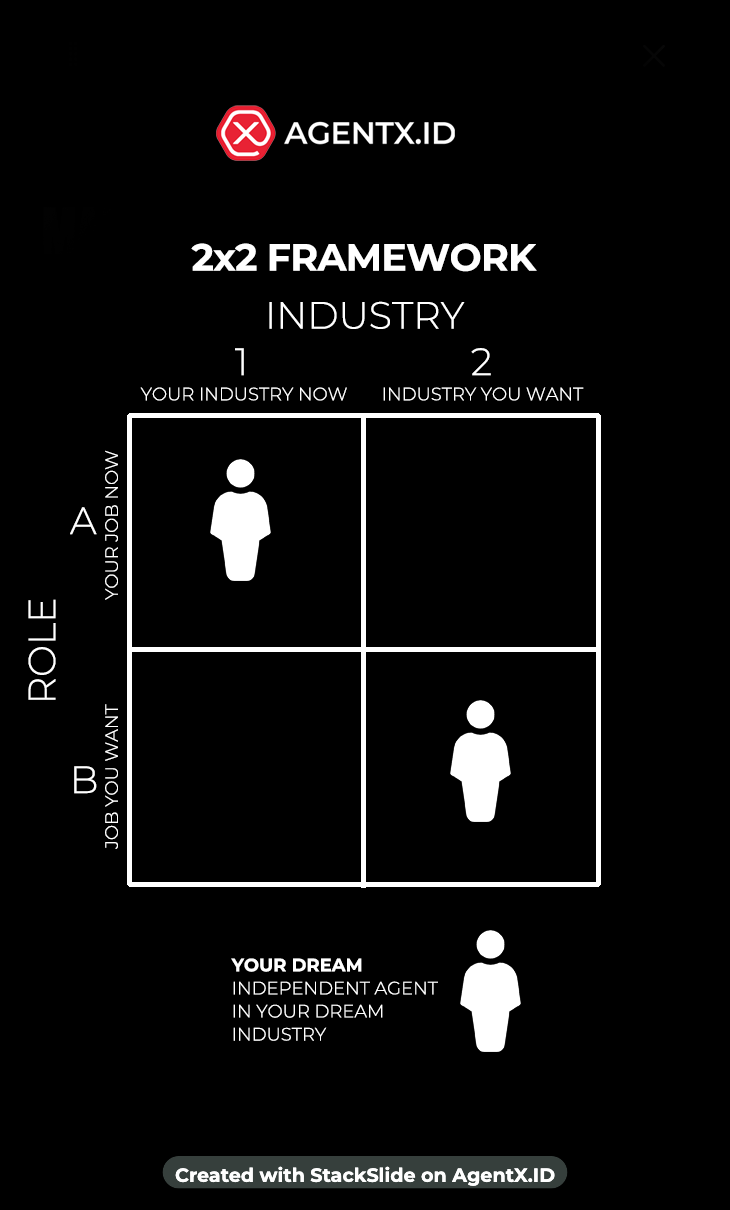
PETA PERPINDAHAN KARIER 2X2
DUA SUMBU YANG MENENTUKAN PERPINDAHAN
Bayangkan perpindahan karier dengan 2 sumbu:
Sumbu X = Industri
1 = industri kamu saat ini
2 = industri target kamu
Sumbu Y = Peran
A = peran kamu saat ini
B = peran target kamu
Ini membentuk 4 kotak.
Setiap kotak menunjukkan cerita perpindahan yang berbeda.
KOTAK 1A
INDUSTRI SAAT INI, PERAN SAAT INI
1A adalah posisi kamu saat ini.
Inilah identitas kamu di pasar saat ini:
industri yang sudah kamu pahami,
dan peran yang sudah kamu jalankan.
Semuanya dimulai dari sini.
Jika kamu tidak mendefinisikannya dengan jelas,
langkah berikutnya akan tetap kabur dan emosional.
KOTAK 1B
INDUSTRI SAAT INI, PERAN TARGET
1B berarti kamu tetap berada di industri yang sama,
namun mengubah fungsi kamu.
Kamu sudah memahami pelanggan,
bahasa,
dinamika pasar,
dan alur kerja.
Sekarang kamu hanya perlu membuktikan bahwa kamu mampu menjalankan peran yang berbeda.
Itu biasanya membuat perpindahan lebih mudah.
KOTAK 2A
INDUSTRI TARGET, PERAN SAAT INI
2A berarti kamu tetap mempertahankan peran yang sama,
namun masuk ke industri yang berbeda.
Identitas profesional kamu tetap utuh,
tetapi konteksnya berubah.
Ini bekerja dengan baik ketika peran kamu dapat dibawa lintas sektor,
seperti finance, HR, sales, operasional, rekrutmen, manajemen proyek, atau analitik.
KOTAK 2B
INDUSTRI TARGET, PERAN TARGET
2B adalah tujuan akhir:
peran baru, industri baru.
Ini sering menjadi posisi impian.
Namun, ini juga merupakan lompatan yang paling sulit.
Pasar harus percaya pada dua hal sekaligus:
kamu bisa berfungsi di bidang baru,
dan kamu bisa menjalankan pekerjaan baru di dalamnya.
IDE BESARNYA
UBAH SATU KOTAK DALAM SATU WAKTU
Langkah paling cerdas sering kali bukan:
1A >> 2B secara langsung
Melainkan:
1A >> 1B >> 2B
atau
1A >> 2A >> 2B
Pertahankan satu sisi tetap stabil saat mengubah sisi yang lain.
Itu mengurangi hambatan,
meningkatkan kredibilitas,
dan memberi kamu cerita yang lebih mudah dipercaya.
MENGAPA PERPINDAHAN SATU-KOTAK EFEKTIF
STABILITAS MENCIPTAKAN KEPERCAYAAN
Setiap perpindahan menciptakan ketidakpastian.
Ketika kamu hanya mengubah satu dimensi dalam satu waktu,
kamu mempertahankan sebagian dari kredibilitas kamu.
Industri yang sama berarti kamu mempertahankan konteks.
Peran yang sama berarti kamu mempertahankan bukti fungsional.
Itu membuat manajer perekrutan, klien, dan kolaborator lebih cepat percaya.
DUA JALUR UTAMA
CHAPTER 2
JALUR 1
UBAH PERAN TERLEBIH DAHULU
Jalur 1 adalah:
1A >> 1B >> 2B
Kamu terlebih dahulu mengubah peran di dalam industri kamu saat ini.
Lalu, setelah memiliki bukti dalam peran tersebut,
kamu berpindah ke industri baru.
Jalur ini cocok ketika peran target kamu dapat dipraktikkan di tempat kamu berada sekarang.
JALUR 2
UBAH INDUSTRI TERLEBIH DAHULU
Jalur 2 adalah:
1A >> 2A >> 2B
Kamu terlebih dahulu masuk ke industri target sambil mempertahankan peran kamu saat ini.
Lalu, setelah memahami dunia baru itu dari dalam,
kamu berpindah ke peran target.
Jalur ini cocok ketika akses ke industrinya lebih penting terlebih dahulu.
JALUR MANA YANG LEBIH BAIK
TERGANTUNG PADA LEVERAGE KAMU
Tidak ada satu jalur yang terbaik untuk semua orang.
Pilih berdasarkan:
sisi mana yang lebih mudah dibawa,
di mana bukti kamu paling kuat,
apa yang paling mudah dipercaya pasar terlebih dahulu,
dan langkah mana yang menjaga penghasilan dan kepercayaan diri kamu tetap hidup.
Jalur terbaik adalah yang paling cepat diterima.
CONTOH YANG LEBIH BAIK
CHAPTER 3
TITIK AWAL CONTOH
KOTAK SAAT INI: SALES MEDIA
Bayangkan seseorang seperti ini:
Industri saat ini: Media
Peran saat ini: Sales Executive
Ia ingin menjadi:
Industri target: SaaS
Peran target: Product Marketing Manager
Ini adalah contoh yang lebih kuat karena sering terjadi,
dan logikanya lebih mudah dipahami.
MENGAPA LOMPATAN LANGSUNG ITU SULIT
PERAN BARU DAN INDUSTRI BARU SEKALIGUS
Media Sales >> SaaS Product Marketing bukan hal yang mustahil.
Namun itu adalah pergeseran ganda:
pasar baru,
bahasa baru,
metrik baru,
model produk baru,
ekspektasi peran baru,
dan kebutuhan bukti yang baru.
Masalahnya bukan pada ambisinya.
Masalahnya adalah meminta pasar untuk percaya terlalu banyak sekaligus.
JALUR A
UBAH PERAN TERLEBIH DAHULU
Jalur yang lebih cerdas bisa seperti ini:
Media Sales >> Media Marketing / GTM >> SaaS Product Marketing
Pertama, bergeraklah lebih dekat ke campaign,
positioning,
audience insights,
launch thinking,
atau pekerjaan go to market di dalam media.
Lalu bangun bukti peran.
Setelah itu, masuk ke SaaS dengan cerita yang lebih kuat.
JALUR B
UBAH INDUSTRI TERLEBIH DAHULU
Jalur lain bisa seperti ini:
Media Sales >> SaaS Sales >> SaaS Product Marketing
Pertama, masuklah ke industri SaaS melalui peran yang sudah kamu kuasai: sales.
Lalu pelajari buyer journey,
messaging,
objection,
narasi produk,
dan kebutuhan pelanggan.
Setelah itu, berpindahlah ke product marketing.
MENGAPA KEDUA JALUR INI EFEKTIF
SETIAP JALUR MEMPERTAHANKAN SESUATU
Dalam Jalur A, kamu mempertahankan konteks industri terlebih dahulu.
Dalam Jalur B, kamu mempertahankan kredibilitas peran terlebih dahulu.
Itulah kuncinya.
Kamu tidak perlu memulai dari nol.
Kamu hanya perlu membawa satu aset yang tetap berguna,
sambil membangun aset berikutnya.
Itulah perpindahan karier yang strategis.
CONTOH LAIN
GURU MENJADI UX RESEARCHER
Industri saat ini: Pendidikan
Peran saat ini: Guru
Industri target: Tech
Peran target: UX Researcher
Ini juga tampak seperti lompatan besar.
Namun ketika dipecah,
perpindahan ini menjadi lebih mudah dikelola.
Kuncinya adalah menerjemahkan kekuatan yang sudah ada menjadi nilai yang berdekatan.
VERSI UBAH PERAN DULU
TETAP DEKAT DENGAN RISET DAN PEMBELAJARAN
Jalur ubah peran dulu bisa seperti ini:
Teacher >> Instructional Designer / Learning Research >> UX Researcher
Orang ini tetap dekat dengan:
observasi,
umpan balik,
perilaku,
dan komunikasi yang terstruktur.
Ia tidak meninggalkan kekuatannya.
Ia mengemas ulang kekuatannya untuk peran yang lebih berdekatan.
VERSI UBAH INDUSTRI DULU
MASUK KE TECH SEBELUM PERAN AKHIR
Jalur ubah industri dulu bisa seperti ini:
Teacher >> Customer Education / Onboarding in Tech >> UX Researcher
Sekarang ia sudah berada di dalam industri baru.
Ia mempelajari bahasa produk,
rasa sakit pengguna,
ekosistem alat,
dan perilaku pelanggan.
Lalu perpindahan menuju UX research menjadi lebih mudah dipercaya.
LOGIKA DI BALIK PERPINDAHAN
CHAPTER 4
PERPINDAHAN KARIER ADALAH MASALAH KEPERCAYAAN
PASAR HARUS PERCAYA PADA CERITA KAMU
Saat kamu berpindah karier,
masalah terbesar bukan hanya soal skill.
Masalah utamanya adalah kepercayaan.
Apakah perusahaan,
klien,
atau kolaborator dapat percaya bahwa kamu mampu menciptakan nilai di kotak baru itu?
Jalur kamu harus mengurangi keraguan
dan meningkatkan tingkat kepercayaan terhadap cerita kamu.
KAMU MEMBUTUHKAN ADJACENCY
PERPINDAHAN YANG DEKAT LEBIH MUDAH DIJUAL
Pasar menyukai kedekatan.
Sebuah lompatan terasa lebih mudah ketika terdengar seperti:
pelanggan yang sama,
alat yang sama,
masalah yang sama,
fungsi yang sama,
alur kerja yang sama,
atau hasil akhir yang sama.
Semakin banyak adjacency yang bisa kamu tunjukkan,
semakin kecil perpindahan itu terasa berisiko.
Itulah sebabnya perpindahan satu-kotak sangat kuat.
SKILL GAP VS CONTEXT GAP
PAHAMI GAP MANA YANG LEBIH KECIL
Setiap perpindahan memiliki dua gap utama:
Skill gap = apakah kamu mampu melakukan pekerjaannya?
Context gap = apakah kamu memahami industrinya?
Pilih gap yang lebih kecil terlebih dahulu.
Jika peran kamu mudah dibawa,
gantilah industri terlebih dahulu.
Jika pengetahuan industri kamu kuat,
gantilah peran terlebih dahulu.
KEUNGGULAN YANG SERING TERSEMBUNYI
KAMU SUDAH PUNYA ASET YANG BISA DIPINDAHKAN
Banyak orang mengira mereka memulai dari nol.
Padahal tidak.
Mereka sudah memiliki:
judgment,
komunikasi,
bahasa industri,
pemahaman pelanggan,
pengalaman proyek,
kemampuan menghadapi stakeholder,
pemecahan masalah,
dan pengenalan pola.
Perpindahan karier menjadi lebih mudah ketika kamu mampu menamai dan memindahkan aset-aset ini.
CARA MENEMUKAN LANGKAH PERTAMA TERBAIK
CHAPTER 5
LANGKAH 1
DEFINISIKAN KOTAK KAMU SAAT INI DENGAN JELAS
Tuliskan 1A kamu:
Apa industri kamu saat ini?
Apa peran kamu saat ini?
Bukti apa yang sudah kamu miliki?
Hasil apa yang sudah kamu ciptakan?
Kekuatan apa yang terus muncul?
Jangan mulai dari mimpi.
Mulailah dari inventaris leverage kamu saat ini yang jelas.
LANGKAH 2
DEFINISIKAN TARGET YANG SEBENARNYA
Sekarang definisikan 2B kamu:
Industri apa yang kamu inginkan?
Peran apa yang kamu inginkan?
Mengapa kamu menginginkannya?
Bersikaplah spesifik.
Apakah kamu menginginkan:
penghasilan lebih tinggi,
kebebasan lebih besar,
makna lebih dalam,
prospek masa depan yang lebih baik,
gaya hidup yang lebih cocok,
atau identitas yang lebih selaras?
Kejelasan memperbaiki strategi.
LANGKAH 3
PILIH JEMBATAN YANG LEBIH MUDAH
Ajukan satu pertanyaan praktis:
Mana yang lebih mudah saya pertahankan terlebih dahulu:
peran saya saat ini,
atau industri saya saat ini?
Ini akan menunjukkan apakah jalur terbaik kamu adalah:
1A >> 1B >> 2B
atau
1A >> 2A >> 2B
Jangan memilih berdasarkan ego.
Pilih berdasarkan leverage.
LANGKAH 4
BANGUN BUKTI YANG BERDEKATAN
Sebelum pasar benar-benar percaya pada kamu,
kamu membutuhkan bukti.
Bukti itu bisa berupa:
proyek kecil,
pekerjaan freelance,
case study,
tulisan publik,
percobaan sampingan,
sertifikat yang disertai output,
proyek internal perusahaan,
atau portofolio.
Belajar saja tidak cukup.
Kamu membutuhkan bukti yang melekat pada pembelajaran itu.
LANGKAH 5
PELAJARI HANYA YANG MENUTUP GAP
Jangan menjadi pengumpul kursus.
Belajarlah dengan arah.
Pelajari hanya hal-hal yang membantu kamu masuk ke kotak berikutnya:
alat,
bahasa,
metrik,
format portofolio,
ekspektasi peran,
atau dasar-dasar industri.
Tujuannya bukan persiapan tanpa akhir.
Tujuannya adalah kesiapan yang terarah untuk langkah berikutnya yang paling masuk akal.
LANGKAH 6
TULIS ULANG CERITA KARIER KAMU
Perpindahan kamu harus terdengar logis.
Bukan:
"Saya ingin mencoba sesuatu yang baru."
Tetapi:
"Pengalaman saya sebelumnya memberi saya keunggulan dalam peran ini."
Perpindahan yang baik diceritakan sebagai kelanjutan,
bukan pelarian.
Cerita yang kuat mengubah pivot karier menjadi peningkatan yang strategis.
LANGKAH 7
GUNAKAN PERAN BATU LONCATAN
Kadang, peran target kamu bukan langkah berikutnya.
Itu adalah langkah setelah langkah berikutnya.
Gunakan bridge roles.
Contoh:
Sales >> Customer Success >> Product Marketing
Ops >> Project Manager >> Product Ops
Teacher >> Instructional Design >> UX Research
Bridge roles mengurangi guncangan saat berpindah karier.
KESALAHAN YANG UMUM TERJADI
CHAPTER 6
KESALAHAN 1
MENGUBAH SEMUANYA SEKALIGUS
Kesalahan terbesar adalah memaksakan reset identitas secara penuh dalam satu langkah.
Peran baru,
industri baru,
alat baru,
jaringan baru,
bukti baru,
bahasa baru,
dan positioning baru.
Itu menciptakan terlalu banyak friksi sekaligus.
Ambisi itu baik.
Namun perpindahan membutuhkan struktur,
bukan kekacauan.
KESALAHAN 2
BELAJAR TANPA BUKTI
Banyak orang belajar berbulan-bulan,
bahkan bertahun-tahun,
namun tidak memiliki apa pun untuk ditunjukkan.
Kursus saja jarang cukup untuk membawa perpindahan.
Yang jauh lebih membantu adalah:
satu proyek,
satu case study,
satu output yang terlihat,
satu portofolio,
atau satu hasil nyata.
Bukti mengalahkan niat.
KESALAHAN 3
MENGABAIKAN NILAI YANG BISA DIPINDAHKAN
Banyak orang mendeskripsikan diri mereka terlalu sempit.
"Saya hanya admin."
"Saya cuma support."
"Saya hanya guru."
Padahal di dalam pekerjaan itu ada skill yang bisa dipindahkan:
systems thinking,
pemahaman pelanggan,
pelatihan,
komunikasi,
riset,
dan pemecahan masalah.
Peran lama kamu menyimpan petunjuk untuk peran berikutnya.
KESALAHAN 4
MENGEJAR JABATAN TANPA MEMAHAMI PEKERJAANNYA
Sebuah jabatan bisa tampak menarik dari kejauhan.
Namun yang penting adalah:
apa yang sebenarnya dilakukan orang itu setiap hari,
tekanan apa yang ia hadapi,
hasil apa yang ia pegang,
dan skill apa yang dihargai.
Jangan berpindah ke fantasi.
Berpindahlah ke peran yang realitas hariannya memang kamu inginkan.
KESALAHAN 5
MENUNGGU IZIN
Banyak orang masih bertindak seolah-olah harus ada institusi yang resmi menyatakan mereka layak.
Di banyak industri, pola pikir itu sudah usang.
Mulailah belajar.
Mulailah membuat.
Mulailah menunjukkan.
Mulailah berbicara dengan orang-orang yang sudah ada di sana.
Kamu tidak membutuhkan persetujuan universal.
Kamu hanya membutuhkan cukup bukti agar pintu berikutnya terbuka.
LANGKAH YANG KELIRU
BERPINDAH 2 KOTAK SEKALIGUS
Kesalahan :
Lompat 2 kotak sekaligus:
peran baru dan industri baru dalam waktu yang sama.
Itu sering membuat tempat baru melihat kamu kembali seperti pemula.
Kamu sudah punya pengalaman, kamu bisa diperlakukan seolah mulai lagi dari nol.
Momentum jadi lambat, Level jadi turun.
POLA PIKIR YANG TEPAT
CHAPTER 7
PRINSIP PENUTUP
PERTAHANKAN SATU SISI TETAP STABIL
Ketika kamu ingin mengganti pekerjaan dan mengganti industri,
jangan ubah semuanya sekaligus.
Pertahankan satu sisi tetap stabil sambil mengubah sisi yang lain.
Itulah kerangkanya:
lindungi satu aset,
bangun aset berikutnya,
lalu bergerak lagi.
Satu kotak dalam satu waktu
selalu lebih baik daripada reinventing diri secara acak.
JANGAN TANYAKAN INI
SAYA INGIN MENJADI APA?
Pertanyaan itu terlalu besar bagi kebanyakan orang.
Pertanyaan itu menciptakan tekanan,
fantasi,
dan kebingungan.
Pertanyaan yang lebih berguna adalah:
Kotak berikutnya mana yang realistis untuk saya capai?
Pertanyaan itu menciptakan gerak,
dan gerak menciptakan kejelasan.
Perpindahan karier diselesaikan melalui urutan.
TANYAKAN INI SEBAGAI GANTINYA
KOTAK MANA YANG BISA SAYA MASUKI BERIKUTNYA?
Kamu tidak perlu menyelesaikan seluruh masa depan sekaligus.
Kamu hanya perlu langkah berikutnya dengan leverage tertinggi.
Itu bisa berarti:
industri yang sama, peran baru
atau
peran yang sama, industri baru
Temukan kotak berikutnya yang paling mudah dipercaya.
Lalu raih hak untuk bergerak lagi.
BAYANGKAN SEPERTI MENYEBERANGI SUNGAI
GUNAKAN BATU PIJAKAN
Perpindahan karier itu seperti menyeberangi sungai.
Mencoba melompat langsung dari satu sisi ke sisi lain bisa gagal.
Namun melangkah dari satu batu ke batu berikutnya bisa berhasil.
Setiap kotak adalah satu batu.
Setiap langkah mengurangi jarak.
Setiap bukti membuat lompatan berikutnya lebih mudah.
Kamu tidak membutuhkan satu lompatan heroik.
TUJUAN YANG SEBENARNYA
SAMPAI TUJUAN, BUKAN SEKADAR TERLIHAT HEBAT
Sebagian orang ingin perpindahan mereka tampak dramatis dan menginspirasi.
Namun tujuan yang lebih baik sesederhana ini:
sampai ke karier baru dengan kerusakan yang lebih kecil,
kebingungan yang lebih sedikit,
waktu yang tidak terlalu terbuang,
dan momentum yang lebih kuat.
Pasar menghargai perpindahan yang kredibel.
Bukan reinvention yang sinematik.

15 WAYS TO TURN YOUR KNOWLEDGE, SKILL & EXPERTISE INTO INCOME
START FROM HERE
1. REAL PROJECTS, ASSIGNMENTS AND GIGS
START SEEING WHAT YOU KNOW AS INVENTORY
The expertise you already have can be turned into freelance projects and income streams.
There's still more. Dig deeper, use the following as a menu, pick one to three paths that fit you, then commit to going deep.
2. CONTENT CREATION
TURN YOUR BRAIN INTO A CHANNEL
Create sharp content on YouTube, Instagram, vlogs, or podcasts that teaches, entertains, or solves real problems.
Grow an audience, then monetize through ads, affiliate links, sponsorships, and brand deals.
3. ONLINE OR OFFLINE STRUCTURED CLASSES
TURN WHAT YOU KNOW INTO A CURRICULUM
Design learning modules in video, audio, and text. Sell access as paid classes on your own site or platforms like Coursera, Udemy, and Skillshare.
Build once, let students keep enrolling over time.
4. ONE ON ONE MENTORING
TURN YOUR EXPERIENCE INTO CLARITY
Position yourself as a mentor for people a few steps behind you.
Offer premium one on one sessions or monthly mentoring packages that focus on strategy, decision making, and feedback in your domain.
5. ONE ON ONE COACHING
TURN GUIDANCE INTO REAL BEHAVIOR CHANGE
Coaching is about practice and results, not just advice.
Help clients apply and stay accountable in areas like fitness, Pilates, yoga, productivity, or communication, charging per session or program.
6. GROUP COACHING CLASSES
LEVERAGE YOUR TIME WITH SMALL GROUPS
Run small group coaching instead of only one on one. Clients pay less per person while you earn more per hour.
Example: a 10 person beginners class for surfing, business, or content creation.
7. SELL DIGITAL PRODUCTS
TURN YOUR BEST THINKING INTO ASSETS
Package your insights into ebooks, templates, checklists, slide decks, or prompt packs.
Sell them on marketplaces or your own site.
Example: 500 secret sauce recipes or a client workflow template.
8. INTENSIVE WORKSHOPS AND BOOTCAMPS
DELIVER TRANSFORMATION IN A WEEKEND
Partner with companies, communities, venues, or brands to host focused one day or weekend bootcamps.
Compress months of learning into a short program and charge premium prices for the experience.
9. TALKS, INTERVIEWS & SPEAKING ENGAGEMENTS
GET PAID TO TALK ABOUT WHAT YOU KNOW
Speak at events, conferences, webinars, or meetups in your industry.
Earn speaker fees while using the stage to attract new clients, students, partnerships, and future digital product buyers.
10. WRITE A BOOK OR EBOOK
TURN YOUR EXPERTISE INTO A LONG FORM ASSET
Capture your deep knowledge in a book format.
Publish physical or digital versions, then use royalties, licensing, and bundled upsells to create long term authority and passive style income.
11. LICENSING AND PARTNERSHIPS
LET BIGGER PLAYERS DISTRIBUTE YOUR WORK
License your curriculum, frameworks, or digital products to institutions and corporations.
Structure revenue share or fixed fee deals so your ideas travel further than your personal time.
12. AFFILIATE
TURN RECOMMENDATIONS INTO COMMISSION
Inside your content, you can reference tools, products, or services from other companies that run affiliate programs.
When people buy through your link, you earn commission, without creating a product yourself.
Best paired with tutorials, reviews, “my stack” lists, and workflow recommendations.
13. ADS AND SPONSORED
TURN ATTENTION INTO PAID DISTRIBUTION
Once you have consistent reach, brands will pay to place their product inside your content.
This can be CPM based ads (platform driven) or direct sponsorships (brand deals).
Your advantage: your audience trust becomes the asset, and the payout scales with distribution.
14. MEMBERSHIP COMMUNITY
TURN YOUR AUDIENCE INTO RECURRING REVENUE
Instead of one time sales, offer a paid membership where people get ongoing access: exclusive lessons, Q&A, templates, feedback, or private community.
Recurring revenue stabilizes your income, deepens loyalty, and increases lifetime value per follower.
Start small: one weekly call, one mo
15. PERSONAL BRANDING
MAKE YOUR NAME CARRY ITS OWN GRAVITY
Consistently teaching, publishing, and shipping across these paths eventually builds a strong personal brand.
With a trusted name, every offer becomes easier to sell and your rates can grow over time.
CHOOSE 1 THEN EXPAND
START WITH ONE, ALIGN, SCALE
Now you can start with the simplest one. I suggest projects and gigs.
From there you can start aligining the experience into the other type.

KENA PHK, MAU BANGUN USAHA?
TIPS USAHA MODAL DENGKUL. COBA PERTIMBANGKAN HAL INI.
JANGAN LANGSUNG BUKA USAHA BARANG/PRODUK FISIK
KENA PHK, MAU BANGUN USAHA?
Usaha PRODUK FISIK itu be-resiko besar, butuh modal di awal dan bikin boncos, Resiko, salah produksi, inventaris numpuk, perlu space besar untuk penyimpanan, belum lagi resiko kehilangan.
COBA USAHA JASA - TANPA MODAL
KENA PHK, MAU BANGUN USAHA?
Coba pertimbangkan model usaha "JASA" atau layanan. Mulai dengan modal minim atau tanpa modal sama sekali.
USAHA JASA. HANYA BUTUH EXPERTISE & ALAT SEDERHANA
KENA PHK, MAU BANGUN USAHA?
Usaha jasa gak perlu space besar untuk inventaris. Jika perlu alat, juga pastikan mulai dengan alat-alat yg sederhana. Butuh corenya : EXPERTISE
ONLINE / OFFLINE - MULAI DARI RUMAH
KENA PHK, MAU BANGUN USAHA?
Mau online atau jasa offline, Coba mulai dari rumah.
MULAI DENGAN "SELF-EMPLOYED"
KENA PHK, MAU BANGUN USAHA?
Mulai dari menawarkan jasa yang dapat dikerjakan diri-sendiri dulu (SELF-EMPLOYED). Bayangkan ini sebagai "1-person company".
BERKEMBANG DENGAN HIRING EMPLOYEE
KENA PHK, MAU BANGUN USAHA?
Seiring dengan perkembangan, bertambahnya klien, dan kerjaan sudah ga kepegang, mulai hire employee satu per satu. Kapan waktu yg tepat? saat 20% income sudah bisa mencover gaji karyawan itu.
FROM "SELF-EMPLOYED" TO "A COMPANY"
KENA PHK, MAU BANGUN USAHA?
Saat perkembangan jumlah karyawan seiring dengan perkembangan jumlah klien; saatnya buat badan usaha. Disinilah SWITCHING POINT from SELF-EMPLOYED to A COMPANY. --Modal dengkul
FOLLOW & STAY UPDATE UNTUK BANGUN USAHA COMPANY MODAL DENGKUL
KENA PHK, MAU BANGUN USAHA?
Follow & stay update untuk contoh bangun usaha modal dengkul, berikut tips-tipsnya

CARI KERJA SUSAH? GANTI POLA PIKIR
DARI "KERJA" KE "KERJAAN"
VARIABELNYA BANYAK & TERUS BERUBAH
CARI KERJA SUSAH? GANTI POLA PIKIR
Kondisi ekonomi dunia yang gak jelas, Kebijakan pemerintah yang makin mencekik, gelombang PHK, persaingan makin ketat, beberapa pekerjaan tergantikan AI. Dah lah, kita musti ganti pola pikir.
GANTI POLA PIKIR DARI "CARI KERJA" KE "CARI KERJAAN"
CARI KERJA SUSAH? GANTI POLA PIKIR
“Cari Kerja” artinya mengejar pekerjaan tetap (full-time) di perusahaan. “Cari Kerjaan” artinya mencari proyek freelance, gigs, atau part-time yang bisa langsung menghasilkan uang.
KARYAWAN TETAP VS TALENTA GIGS
CARI KERJA SUSAH? GANTI POLA PIKIR
"Cari kerja" ya jadi Karyawan tetap. "Cari kerjaan" jadi Talenta-gigs. Baca post sebelum ini, "Gig-Economy silently rising", kenapa kamu musti jadi Talenta-Gigs.
LONG-TERM GAME: BANGUN KARIER SEJAK DINI
CARI KERJA SUSAH? GANTI POLA PIKIR
Memang, kamu butuh uang sekarang—tapi di usia muda, pikirkan investasi skill & expertise jangka panjang.
BUTUH SKILL & EXPETISE
CARI KERJA SUSAH? GANTI POLA PIKIR
Untuk jadi Talenta-gigs, kamu butuh skill dan expertise
FROM ZERO TO HERO
CARI KERJA SUSAH? GANTI POLA PIKIR
Jangan anggap jadi talenta-gigs itu kerja serabutan. Pemula disebut Talenta-gigs, setelah beberapa tahun jadi Expert dengan expertise yang semakin tajam. Setelah lebih dari 20-tahun jadi Mastery.
STAY UPDATE TENTANG SKILL & EXPERTISE
DI AGENTX.ID

SAYANG BANGET, KEAHLIAN / EXPERTISE KAMU BISA JADI LADANG CUAN
BANYAK DI LUAR SANA YANG BUTUH EXPERTISE KAMU
SEMUA ORANG PUNYA EXPERTISE YANG BISA DIKEMBANGKAN
SAYANG BANGET, KEAHLIAN / EXPERTISE KAMU BISA JADI LADANG CUAN
Pernah kepikir bahwa apa yang selama ini kamu kuasai; menulis, desain, memasak, atau skill lain, bisa jadi sumber penghasilan? Stop buang waktu. Yuk, mulai manfaatkan.
GAK PERLU MERASA KURANG TERUS
SAYANG BANGET, KEAHLIAN / EXPERTISE KAMU BISA JADI LADANG CUAN
Gak perlu merasa kurang karena melihat orang lain lebih ‘jago’. Setiap individu punya keunikan dalam skill atau expertise nya. Temukan apa yang jadi kelebihan kamu dan kembangkan.
GAK HARUS SELALU SESUAI PEKERJAAN ATAU LATAR PENDIDIKAN
SAYANG BANGET, KEAHLIAN / EXPERTISE KAMU BISA JADI LADANG CUAN
Banyak yang mengira kita harus kerja sesuai gelar atau pengalaman. Faktanya, hidden expertise bisa jadi lahan Cuan. Misal lulusan ekonomi yang ternyata lebih nyaman sebagai content creator.
TANYA KE DIRI SENDIRI: “APAKAH SAAT INI KERJA SESUAI KEAHLIAN?”
SAYANG BANGET, KEAHLIAN / EXPERTISE KAMU BISA JADI LADANG CUAN
Apakah pekerjaanmu sekarang benar-benar memanfaatkan kemampuan unikmu?
Kalau jawabannya “belum,” mungkin ini saatnya evaluasi ulang.
BAYANGKAN KERJA DENGAN EXPERTISE YANG KAMU PUNYA
SAYANG BANGET, KEAHLIAN / EXPERTISE KAMU BISA JADI LADANG CUAN
Kualitas hasil kerjamu pasti maksimal.
Client / Company akan lebih menghargai karena nilai yang kamu berikan maksimal.
Gaji atau fee otomatis lebih tinggi karena kamu jadi dianggap spesialis.
KALAU PEKERJAANMU GAK SESUAI EXPERTISE, SAATNYA #SWITCHJOB
SAYANG BANGET, KEAHLIAN / EXPERTISE KAMU BISA JADI LADANG CUAN
Jangan terjebak di zona nyaman hanya karena sudah lama menjalani. Dunia terus bergerak, kebutuhan pasar terus berubah. Gak apa-apa memulai lagi dari nol asal kamu yakin dengan keahlianmu.
YELLOWFLAG UNTUK YANG TERLALU NYAMAN
SAYANG BANGET, KEAHLIAN / EXPERTISE KAMU BISA JADI LADANG CUAN
Hati-hati untuk kita yang terlalu nyaman, jangan-jangan kerjaan kita bakal tergantikan oleh AI. Terus cari info, stay agile
BELUM PERNAH KEMBANGIN EXPERTISE?
SAYANG BANGET, KEAHLIAN / EXPERTISE KAMU BISA JADI LADANG CUAN
Sekarang banyak platform freelance, kursus online, dan komunitas yang bisa membantumu landing project sesuai expertise kamu.
BANYAK DI LUAR SANA BUTUH KEAHLIANMU!
SAYANG BANGET, KEAHLIAN / EXPERTISE KAMU BISA JADI LADANG CUAN
Pasar kerja saat ini sangat dinamis:
UKM butuh content marketing, desain poster, atau konsultasi digital, freelance web developer, social media manager, dll.
YUK! IKUTI KATA HATI, TAKE ACTION!
SAYANG BANGET, KEAHLIAN / EXPERTISE KAMU BISA JADI LADANG CUAN
Jangan takut gagal.
Jangan tunggu “waktu yang tepat”—karena waktu terbaik adalah sekarang.

WORK EMPLOYMENT TREND (2026 TO 2030)
ALMOST EVERYTHING HAS SHIFTED
SKILLS & EXPERTISES OVER DEGREE
WORK EMPLOYMENT TREND (2026)
Traditional degrees are being devalued. Project portfolios, real-world impact, and certifications (Google, AWS, etc.) matter more.
REMOTE FIRST, FLEXING SECOND
WORK EMPLOYMENT TREND (2026)
Time autonomy is valued more than salary in many cases. 80%+ prefer remote or hybrid work.
CONTENT CREATOR ECONOMY & SOCIAL VALIDATION
WORK EMPLOYMENT TREND (2026)
Many Gen Zers don’t want to work for others. They want to monetize themselves. TikTok, YouTube, LinkedIn, Substack, and Instagram are the new CVs.
AI-NATIVE
WORK EMPLOYMENT TREND (2026)
As AI will takeover many jobs, Gen Z embraces AI + automation from ChatGPT to Notion AI to MidJourney.
They build tools, products, and services faster with no-code/low-code platforms (e.g., Bubble, Webflow, Zapier).
MULTI-INCOME MINDSET
WORK EMPLOYMENT TREND (2026)
“One job is not enough”. Gen Z prioritizes income diversification over job security.
Freelancing, side gigs, and passive income are normalized. Startups, dropshipping, trading, content creation, etc.
MOSTLY RULED BY CERTAIN INDUSTRY
WORK EMPLOYMENT TREND (2026)
Like it or not, our work culture mostly ruled by industries :
Tech, Content-creation, Digital & creative media, Green & social impact startups.
GIG BASED ECONOMY, NO PERMANENT JOB
WORK EMPLOYMENT TREND (2026)
Permanent jobs are seen as risky; layoffs, burnout, and capped growth. Gen-Z prefers: Project-based work, Contract flexibility, Ownership opportunities (revenue share, royalties, brand building).

STOP TRADE YOUR TIME FOR MONEY !!
A StackSlide about the limits of earning by hours and the shift toward value, results, and leverage.
CHAPTER INDEX
STILL TRADING YOUR TIME FOR MONEY ?
INCOME STILL TIED TO HOURS.
Employee, freelancer, self-employed, whatever your label is.
As long as your income mostly rises only when your work hours rise, you are still trapped in a time-based model.
Work more, earn more. Stop, and income slows.
That is why growth feels narrow and tiring.
THE SIGNS
CHAPTER 1
SIGNAL #1 : YOU WORK HARD, BUT YOUR PAY STAYS THE SAME
EFFORT RISES. REWARD BARELY FOLLOWS.
You stay serious, responsible, and busy.
You give more energy, more focus, and more consistency.
But financially, almost nothing changes.
When your effort keeps rising while your reward barely moves, it usually means the system values your time more than your real contribution.
SIGNAL #2 : YOU KEEP WAITING FOR BREAKS, LUNCH, AND CLOCK-OUT
YOUR DAY IS RULED BY THE CLOCK.
You keep looking at the time.
Waiting for a short break, lunch, or the moment you can go home.
That usually means the workday is being experienced as a time block to survive, not as value to create.
When the clock dominates your day, freedom usually becomes smaller too.
SIGNAL #3 : YOU KNOW THE PATTERN, BUT NOTHING REALLY CHANGES
YOU SEE THE PATTERN, BUT STAY IN IT.
You already understand the pattern clearly.
You give time and receive salary, fees, or fixed pay.
But the years keep passing without strong growth in income or freedom.
That is when the real problem becomes obvious: the structure itself is holding your upside down.
HARD WORK VS TIME-BASED WORK
CHAPTER 2
TRADING TIME FOR MONEY ≠ HARD WORK
HOURS ALONE DO NOT DEFINE REAL VALUE.
Working hard is not the problem.
The problem starts when effort is measured mostly by attendance, busyness, and visible hours.
Real hard work should sharpen results, improve quality, and create stronger outcomes.
If extra effort only adds duration, the upside stays small and flat.
HARD WORK VS TIME-BASED WORK
GOOD WORK IMPROVES OUTCOMES, NOT JUST DURATION.
The right kind of hard work makes your output better.
You solve faster, think clearer, and create stronger results.
That is very different from simply sitting longer, staying later, or looking busy.
Presence may be visible, but outcomes are what create real and lasting value.
WHAT IT REALLY MEANS
CHAPTER 3
WHAT DOES “TRADE TIME FOR MONEY” REALLY MEAN?
YOUR PAY DEPENDS MAINLY ON HOURS.
It means your compensation is still tied mainly to how long you work.
More hours often means more pay. Less hours usually means less pay.
That model feels normal because it is common.
But it quietly limits growth because time is finite, while your needs and goals keep expanding.
DOES BEING AN EMPLOYEE ALWAYS MEAN TIME-FOR-MONEY?
NOT ALWAYS. SOME ROLES ARE RESULT-DRIVEN.
Not every employee is trapped in pure time-based work.
Some roles give freedom, trust, and room for ownership.
People in those roles are judged more by output and completion than by strict hour-counting.
The real question is simple: are you mainly measured by hours or by outcomes?
THE PROBLEM
CHAPTER 4
PROBLEM #1 : NO SCALE
TIME HAS A HARD LIMIT.
Your results stay limited by the amount of time you personally have.
A day has limited hours. Your body has limits. Your mind has limits too.
So even when you are disciplined and hardworking, your earning model still hits a ceiling.
That is why this structure is hard to scale.
PROBLEM #2 : NO FREEDOM
MORE INCOME OFTEN DEMANDS MORE LIFE.
In a time-based system, the usual way to earn more is simple: work more.
That sounds reasonable at first, but over time it becomes expensive.
Your time gets consumed, your flexibility shrinks, and your life adjusts around work.
Income rises a bit, but freedom often falls.
PROBLEM #3 : NO LEVERAGE
EFFORT STAYS LINEAR AND HEAVY.
Leverage is what allows the same effort to produce far bigger results.
But in a pure time-for-money model, leverage stays weak.
You keep repeating the same pattern: more hours, more fatigue, limited upside.
You are moving, but the model does not multiply your value very well.
THE SHIFT
CHAPTER 5
SOLUTION : TRADE SKILLS AND EXPERTISE FOR RESULTS
BUILD INCOME AROUND OUTCOMES.
The better path is to build your income around the value your work creates.
Use your skill, expertise, judgment, and process to produce meaningful results.
The clearer your outcome, the less dependent you become on selling raw hours alone.
That is where stronger positioning starts.
WHAT MAKES IT DIFFERENT?
RESULTS SCALE FASTER THAN HOURS.
Time-based work usually grows in a straight line.
Add more hours, get a bit more return.
But better systems, sharper expertise, and stronger positioning can increase results much faster than the time added.
That is where your work begins to gain leverage and bigger upside.
WHAT ARE THE VALUES?
VALUE COMES FROM USEFUL OUTPUT.
Real value shows up in what your work actually changes.
It may solve problems, save time, reduce mistakes, improve quality, or help people move faster.
That is what people truly care about.
They remember the outcome your work created, not just the hours you spent producing it.
HOW TO SHIFT #1 : REPOSITION YOURSELF
STOP PERFORMING BUSY. START BUILDING VALUE.
Many people still think they need to look busy to be respected.
That mindset keeps them trapped in time-based work.
A stronger standard is this: work with focus, intention, and efficiency so the result becomes more valuable.
Productivity should strengthen output, not just appearance.
HOW TO SHIFT #2 : PROVE YOUR VALUE THROUGH RESULTS
MAKE YOUR IMPACT EASIER TO SEE.
Results become more powerful when they are visible and easy to understand.
Show the improvement. Show the before and after. Show the quality of your thinking and process.
When your impact is clearer, clients or companies find it easier to value you beyond simple hour-counting.
HOW TO SHIFT #3 : DELIVER SOLUTIONS, NOT MAX HOURS
BETTER SOLUTIONS BEAT LONGER ATTENDANCE.
Long hours can look impressive, but they do not automatically create better value.
What matters more is whether the work solves the right problem in the right way.
A stronger solution delivered efficiently is often worth far more than extended attendance and visible exhaustion.
WHAT YOU GAIN
CHAPTER 6
POINT #1 : TAKE BACK CONTROL OF YOUR LIFETIME
MORE VALUE CAN CREATE MORE ROOM.
When your work is not tied so tightly to time, life starts opening up.
You create more room to rest, think, learn, and spend time with people who matter.
That extra space is not a small thing.
It can improve your energy, your clarity, and the quality of your whole life.
POINT #2 : RESULTS MATTER MORE
EFFICIENT PROCESS. STRONGER OUTPUT.
Results carry real weight.
A good process still matters, but mainly because it helps produce stronger outcomes in a more efficient way.
When results matter more than raw hours, your work becomes easier to value properly.
That also creates healthier potential for better income.
POINT #3 : NOT YOUR HOURS. NOT YOUR ATTENDANCE
QUALITY MATTERS MORE THAN PRESENCE.
Hours are easy to count and attendance is easy to observe.
But neither tells the full story of your value.
The better question is this: what came out of the work?
That is the signal that deserves more attention, because output carries far more meaning than simple presence.
APPLIES TO EVERYONE.
EMPLOYEES, FREELANCERS, CONSULTANTS, PART-TIMERS.
This idea is not only for founders or business owners.
Employees need this shift. Freelancers need it too. Consultants and part-timers also benefit from it.
Anyone who wants stronger upside, better positioning, and more control over life should think seriously about value, not just hours.
WHAT’S THE RESULT?
BETTER UPSIDE, PEACE, AND ROOM TO GROW.
What do you gain from this shift?
Higher income potential, more room to learn, better peace of mind, and more space for life outside work.
Slowly, work stops feeling like a system that keeps taking your life one hour at a time.
That is a much healthier direction to build toward.

SUPER NICHE SELLS MORE
A StackSlide for freelancers, consultants and independent service providers who feel too broad in the market. Learn how to niche down into a sharper, easier-to-sell offer, then explore 24 expertise areas with 3 super niche examples each.
DON'T BE TOO BROAD.
WHY PEOPLE DON’T BUY GENERIC SERVICES
A lot of skilled people are not ignored because they lack talent.
They are ignored because their offer sounds too wide.
When your service feels generic, clients get confused.
...And confused people rarely buy.
BROAD IS HARD TO BUY
SPECIFIC OFFERS FEEL MORE USEFUL
“I build websites” sounds skilled.
But it still feels vague.
People respond faster when your service sounds like it was made for them, their problem, and their situation.
Specificity makes your service easier to understand, trust, and buy.
SUPERNICHE IS NOT SMALL THINKING
IT IS CLEAR POSITIONING
Going niche does not reduce your value.
It sharpens it.
You are not making yourself smaller.
You are making your offer clearer, stronger, and easier to remember.
THE CORE FORMULA
1 NICHE. 1 PROBLEM. 1 SOLUTION.
This is the simplest way to sharpen a service offer.
1 niche
Who exactly you serve
1 problem
What painful issue they already feel
1 solution
What specific service you provide
1 NICHE
WHO EXACTLY DO YOU SERVE
A niche is not “everyone who needs help.”
A niche is a specific type of person, business, or category.
The clearer the niche, the easier people say:
“This is for me.”
1 PROBLEM
ONE PAIN THEY ALREADY FEEL
Do not choose random problems.
Choose a problem that is visible, annoying, expensive, urgent, or embarrassing.
The best offers solve a problem the client already wants to fix now.
1 SOLUTION
ONE CLEAR SERVICE
Your solution should be easy to picture.
Not “I do digital stuff.”
Not “I help businesses grow.”
Say exactly what you build, improve, fix, or deliver.
THE POSITIONING FORMULA
USE THIS SENTENCE
Use this simple structure:
I help [niche] solve [problem] with [solution].
Or:
I help [specific niche] who struggle with [specific problem] by providing [specific solution], so they can [clear result].
EXAMPLE: WEBSITE SERVICE
FROM BROAD TO SHARP
Broad:
“I make websites.”
Better:
“I build websites for small restaurants.”
Sharper:
“I build simple websites for small restaurants that rely on Instagram, so customers can view menu, find location, and order faster.”
HOW TO DOUBLE DOWN
KEEP NARROWING THE OFFER
Do not stop at broad categories like “FnB business.”
Keep narrowing:
FnB
Restaurant
Small restaurant
Small restaurant in one city
Small restaurant using only Instagram
Small restaurant losing orders because customers get confused
WHY THIS WORKS
PEOPLE BUY CLARITY
A strong super niche offer makes people feel three things fast:
“This is for me.”
“That is exactly my problem.”
“I understand what this person actually does.”
That is what makes selling easier.
THE REAL BENEFITS OF NICHE
WHY IT MAKES BUSINESS EASIER
A narrow offer is easier to:
Explain
Market
Price
Package
Show proof for
Get referrals for
Close faster
Generic sounds capable.
Super niche sounds buyable.
QUICK TEST
IS YOUR OFFER STILL TOO BROAD
If people still ask:
“So… what exactly do you do?”
“Who is this for?”
“How is this different?”
Your offer is probably still too wide.
WHAT GOOD NICHE LOOKS LIKE
SIMPLE, CLEAR, DIRECT
A good niche offer is not fancy.
It is concrete.
It says:
Who you help
What problem you solve
What solution you provide
What result they can expect
YOUR TURN
FILL THIS IN
Use this template:
I help (specific niche) who struggle with [specific problem] by providing (specific solution), so they can (clear result).
This sentence alone can sharpen your service fast
24 EXPERTISE > SUPERNICHE
3 EXAMPLES EACH
Below are 24 common expertise areas.
Each one includes 3 examples using the same framework:
1 niche
1 problem
1 solution
Use them as inspiration to sharpen your own service.
WEB DESIGN
3 SUPERNICHE EXAMPLES
1. Websites for small restaurants that lose customers because their menu and ordering flow are messy.
2. Websites for beauty clinics that need more trust before bookings.
3. Websites for property agents who need more qualified leads from listings.
GRAPHIC DESIGN
3 SUPERNICHE EXAMPLES
1. Social promo design for coffee shops with weak visual consistency.
2. Packaging design for snack brands that look too generic on shelves.
3. Sales deck design for small agencies that struggle to look premium.
COPYWRITING
3 SUPERNICHE EXAMPLES
1. Landing page copy for coaches who get traffic but low conversion.
2. Product copy for skincare brands with weak purchase motivation.
3. Sales copy for workshops that need more signups from cold audiences.
CONTENT WRITING
3 SUPERNICHE EXAMPLES
1. SEO blog writing for clinics that want local organic traffic.
2. Thought leadership writing for founders who need stronger authority.
3. Educational articles for finance brands that need trust-building content.
SOCIAL MEDIA MANAGEMENT
3 SUPERNICHE EXAMPLES
1. Instagram management for local cafes with low repeat visits.
2. TikTok management for beauty brands that need more product discovery.
3. Content calendar management for consultants who post inconsistently.
PERFORMANCE MARKETING
3 SUPERNICHE EXAMPLES
1. Meta Ads for dental clinics needing more appointment bookings.
2. Lead generation ads for interior designers needing serious prospects.
3. Retargeting ads for ecommerce brands with abandoned carts.
SEO
3 SUPERNICHE EXAMPLES
1. Local SEO for clinics that do not appear in nearby searches.
2. SEO for niche B2B service firms with zero inbound leads.
3. SEO content systems for ecommerce stores with stagnant traffic.
VIDEO EDITING
3 SUPERNICHE EXAMPLES
1. Short-form editing for speakers building authority online.
2. YouTube editing for educational creators with weak retention.
3. Product video editing for brands with low ad performance.
PHOTOGRAPHY
3 SUPERNICHE EXAMPLES
1. Menu photography for restaurants with low food appeal online.
2. Product photography for beauty brands needing cleaner ecommerce visuals.
3. Personal brand photography for founders who lack professional presence.
BRAND STRATEGY
3 SUPERNICHE EXAMPLES
1. Positioning for small cafes that feel interchangeable.
2. Rebranding for family businesses that look outdated.
3. Category messaging for new AI tools that are hard to understand.
UI/UX DESIGN
3 SUPERNICHE EXAMPLES
1. Booking flow redesign for clinics with drop-off issues.
2. Checkout UX for ecommerce stores with high cart abandonment.
3. Dashboard UX for SaaS products with low user activation.
FRONTEND DEVELOPMENT
3 SUPERNICHE EXAMPLES
1. Landing page builds for startups that need faster campaign launches.
2. Frontend optimization for websites with poor mobile usability.
3. Conversion-focused page builds for service firms running paid ads.
BACKEND DEVELOPMENT
3 SUPERNICHE EXAMPLES
1. Internal dashboard systems for small agencies using spreadsheets everywhere.
2. Booking and scheduling systems for clinics with manual admin workload.
3. Workflow automation backend for service teams with repeated human errors.
FULL-STACK DEVELOPMENT
3 SUPERNICHE EXAMPLES
1. MVP builds for founders validating niche SaaS ideas.
2. Internal tools for operations-heavy businesses with messy processes.
3. Client portals for agencies needing better project visibility.
EMAIL MARKETING
3 SUPERNICHE EXAMPLES
1. Welcome flows for ecommerce brands with weak first purchase conversion.
2. Re-activation campaigns for businesses with inactive customer lists.
3. Lead nurture emails for consultants with long sales cycles.
SALES
3 SUPERNICHE EXAMPLES
1. Appointment setting for B2B agencies with weak outbound systems.
2. Closing support for coaches with poor sales call structure.
3. Follow-up systems for property businesses losing warm prospects.
BUSINESS CONSULTING
3 SUPERNICHE EXAMPLES
1. Service packaging for freelancers who cannot explain their offer.
2. Process cleanup for SMEs with daily operational chaos.
3. Revenue model review for founders with unstable cash flow.
HR / RECRUITMENT
3 SUPERNICHE EXAMPLES
1. Hiring systems for small businesses making bad first hires.
2. Recruitment for restaurants with constant staff turnover.
3. Interview and screening setup for startups hiring too slowly.
VIRTUAL ASSISTANT
3 SUPERNICHE EXAMPLES
1. Inbox and calendar management for overwhelmed founders.
2. Admin support for consultants spending too much time on small tasks.
3. Customer support coordination for ecommerce sellers with late replies.
DATA ANALYSIS
3 SUPERNICHE EXAMPLES
1. Sales dashboard setup for SMEs making decisions blindly.
2. Campaign analysis for brands wasting ad budget.
3. Operations reporting for teams that cannot identify bottlenecks.
AUTOMATION / AI WORKFLOW
3 SUPERNICHE EXAMPLES
1. AI workflow setup for small businesses repeating manual admin work.
2. Lead routing automation for sales teams with slow response time.
3. Content workflow automation for creators publishing too inconsistently.
FINANCE / BOOKKEEPING
3 SUPERNICHE EXAMPLES
1. Cash flow tracking for SMEs that never know their real numbers.
2. Monthly bookkeeping for founders mixing personal and business money.
3. Pricing and margin review for food businesses with weak profit.
LEGAL / CONTRACT SUPPORT
3 SUPERNICHE EXAMPLES
1. Contract setup for freelancers who work without protection.
2. Vendor agreement review for SMEs signing unclear deals.
3. Terms and policy drafting for online businesses that look unprofessional.
OPERATIONS / PROJECT MGMT
3 SUPERNICHE EXAMPLES
1. Project systems for creative agencies missing deadlines.
2. SOP setup for small businesses with inconsistent delivery.
3. Team coordination workflow for founders stuck in daily firefighting.
CUSTOMER SUPPORT
3 SUPERNICHE EXAMPLES
1. Support system setup for ecommerce brands with slow replies.
2. FAQ and helpdesk flow for SaaS tools with repeated tickets.
3. Chat response workflow for clinics losing leads after inquiry.
PRODUCT MANAGEMENT
3 SUPERNICHE EXAMPLES
1. MVP roadmap planning for founders building without priorities.
2. Feature prioritization for SaaS teams shipping too many weak ideas.
3. User feedback systems for products that do not know what to improve next.
EDUCATION / COACHING
3 SUPERNICHE EXAMPLES
1. Career coaching for fresh graduates with no market direction.
2. Sales coaching for service teams with weak conversion calls.
3. Communication coaching for founders who struggle to present clearly.
TRANSLATION / LOCALIZATION
3 SUPERNICHE EXAMPLES
1. Website localization for brands entering Indonesia.
2. Product translation for ecommerce sellers expanding cross-border.
3. Business deck translation for founders pitching foreign partners.
WHAT THEY ALL HAVE IN COMMON
THEY ARE EASIER TO SELL
Each example feels easier to buy because it is tied to:
A clear niche
A visible problem
A direct solution
That is what creates strong positioning and faster trust.
DON’T SELL YOUR SKILL TOO WIDE
SELL IT IN A BUYABLE FORM
People rarely buy raw expertise.
They buy relevance.
Your job is not only to be skilled.
Your job is to package your skill into a service that feels obvious and useful.
START WITH ONE
YOU DON’T NEED 10 OFFERS
Do not try to serve every niche at once.
Pick one niche.
Pick one painful problem.
Pick one solution.
Make that offer clear first.
That alone can change how people respond to you.
FINAL FRAME
SUPERNICHE SELLS
Broad sounds impressive.
Specific sounds valuable.
The goal is not to describe everything you can do.
The goal is to make one right buyer quickly understand why they should hire you.
YOUR NEXT MOVE
WRITE YOUR OWN VERSION NOW
Complete this:
I help ______
who struggle with ______
by providing ______
so they can ______
That is the starting point of a sharper service business.
8 TANDA SKILL, EXPERTISE, & POTENSI KAMU TERBUANG
VERSI BAHASA INDONESIA
StackSlide tentang tanda-tanda ketika seorang karyawan berada di tempat yang salah, tidak dihargai secara layak dan perlu mulai menyiapkan jalan untuk menjadi independent agent.
KAMU DIGAJI TERLALU RENDAH
OUTPUT KAMU BERHARGA, GAJI TIDAK SESUAI
Kalau kompensasi kamu stagnan sementara tanggung jawab terus naik, artinya nilai yang kamu hasilkan sedang diekstrak, bukan dihargai.
Digaji rendah bukan cuma masalah uang.
Itu juga masalah positioning.
KAMU DIEKSPLOITASI
DIAM-MU MEREKA MANFAATKAN
Mereka tahu kamu tidak akan negosiasi ulang. Kalau kamu tidak pernah push back, sistem akan belajar satu hal:
Kamu akan menerima apa pun yang mereka kasih.
Orang baik sering menghindari konflik.
Sistem yang buruk memonetisasi itu.
JABATANMU TERLALU RENDAH
KERJA SENIOR, GELAR JUNIOR
Kamu memikul outcome besar tanpa pengakuan yang setara.
Kamu memimpin, memperbaiki, dan mencegah masalah besar, tapi jabatanmu tetap sama.
Title bukan soal ego.
Title adalah bukti scope, leverage, dan daya tawar masa depan.
KAMU HANYA DIPERLAKUKAN SEBAGAI EKSEKUTOR
PIKIRANMU DIABAIKAN, TANGANMU YANG DIPAKAI
Mereka hanya memanggilmu saat butuh eksekusi, bukan arah.
Kalau kamu bisa mendefinisikan masalah, bukan sekadar menyelesaikan tugas, berarti kamu lebih dari sekadar eksekutor.
Tapi tempat yang salah akan terus mengecilkanmu.
IDEMU DIPAKAI, KREDITMU DIAMBIL
IDE-MU DIPAKAI, NAMAMU TIDAK DIANGKAT
Kamu membangun value, orang lain yang mengumpulkan reputasi.
Saat kerjamu berdampak tapi namamu hilang, kamu sedang kehilangan visibilitas.
Visibilitas itu mata uang.
Tanpa kredit, tidak ada leverage untuk masa depan.
KAMU TIDAK BERKEMBANG
MEREKA JANJI, TAHUN BERLALU, KAMU TETAP DI SITU
Kalau review dari atasan selalu berakhir dengan kata “kuartal depan”, bisa jadi kamu memang sedang ditunda dengan sengaja.
Atau memang sistemnya membuat kamu "mentok" untuk bertumbuh.
Jalur pertumbuhan yang nyata punya milestone. Dan ini harus terjadi demi perkembangan diri sendiri.
KAMU SIBUK, TAPI TIDAK PRODUKTIF
KERJA KERAS, TAPI TIDAK ADA HASIL NYATA
Kamu terus mengerjakan hal-hal yang reset ke nol. Berulang terus. Tidak ada hasil yang benar-benar terkumpul.
Akibatnya:
Tidak ada portfolio.
Tidak ada case study.
Tidak ada aset.
Tidak ada perluasan network.
Itu hanya gerak, bukan compounding.
KAMU MERASA MUDAH DIGANTIKAN
SEPRODUKTIF APA PUN, MEREKA BISA GANTI KAMU DENGAN MUDAH
Kalau kamu diperlakukan seperti slot, kamu akan merasa seperti slot.
Tempat yang salah memang mendesain orang agar mudah dipertukarkan.
Tempat yang tepat mendesain peran berdasarkan outcome yang unik.
STOP !!!
JANGAN BUANG WAKTUMU
KAMU HANYA SEDANG BERADA DI TEMPAT YANG SALAH
Tempat yang tepat berarti:
Value terlihat.
Impact terukur.
Kontribusi diakui.
Kompensasi ikut naik.
Skill kamu tidak mengecil, tapi bertumbuh dan menguat.
TETAP KERJA, TAPI SIAPKAN DIRI UNTUK TERBANG
REPOSITION EXPERTISE-MU AGAR LAYAK DIHARGAI
Lakukan ini:
Kumpulkan dan rapikan portfolio serta case study.
Assess skill dan expertise kamu.
Pilih niche dan problem.
Buat solusi untuk niche itu.
Tawarkan solusi dan bangun RateCard.
Dapatkan klien.
Kirim value.
Ulangi.
JADILAH INDEPENDENT AGENT
SIAPKAN MOMEN YANG TEPAT
Saat kamu sudah bisa berdiri di dua kaki.
Tetap bekerja sambil punya klien sendiri.
Tetapkan waktunya untuk pergi.
Saat waktunya tepat, keluar.
Fokus pada klien yang sudah bisa membayar hidupmu.
Jadilah Independent Agent.

CHANGE JOB, CHANGE INDUSTRY
BY GIGSTACK - (ENGLISH VERSION)
A StackSlide about how to move from one career path to another with less risk, better logic, and clearer next steps. Instead of changing everything at once, change one box at a time.
CHAPTER INDEX
CHANGE JOB, CHANGE INDUSTRY
START WITH A SMARTER MAP
A lot of people want a new career.
New role. New industry. New identity. New future.
But most career switches fail because people try to change everything at once.
There is a better way:
understand the map first,
then move with logic.
WHY THIS MATTERS NOW
CAREER CHANGE IS MORE OPEN THAN BEFORE
Today, it is easier to learn than ever.
Online courses, YouTube, communities, AI tools, side projects, short certifications, freelance work, and public portfolios have reduced the gatekeeping.
In many fields, proof matters more than permission.
THE OLD RULES ARE WEAKER
YOU DO NOT ALWAYS NEED FORMAL APPROVAL
Outside of regulated fields like medicine, law, aviation, and safety critical engineering, many careers no longer require full institutional permission.
If you can do the work,
show evidence,
and solve real problems,
you can often enter the field.
THE REAL PROBLEM
PEOPLE TRY TO JUMP TOO FAR
Someone in one role, inside one industry, suddenly wants a totally different role in a totally different industry.
That means new skills,
new context,
new network,
new language,
new proof,
and a new story.
That is a hard sell to the market.
THE 2X2 FRAMEWORK
CHAPTER 1
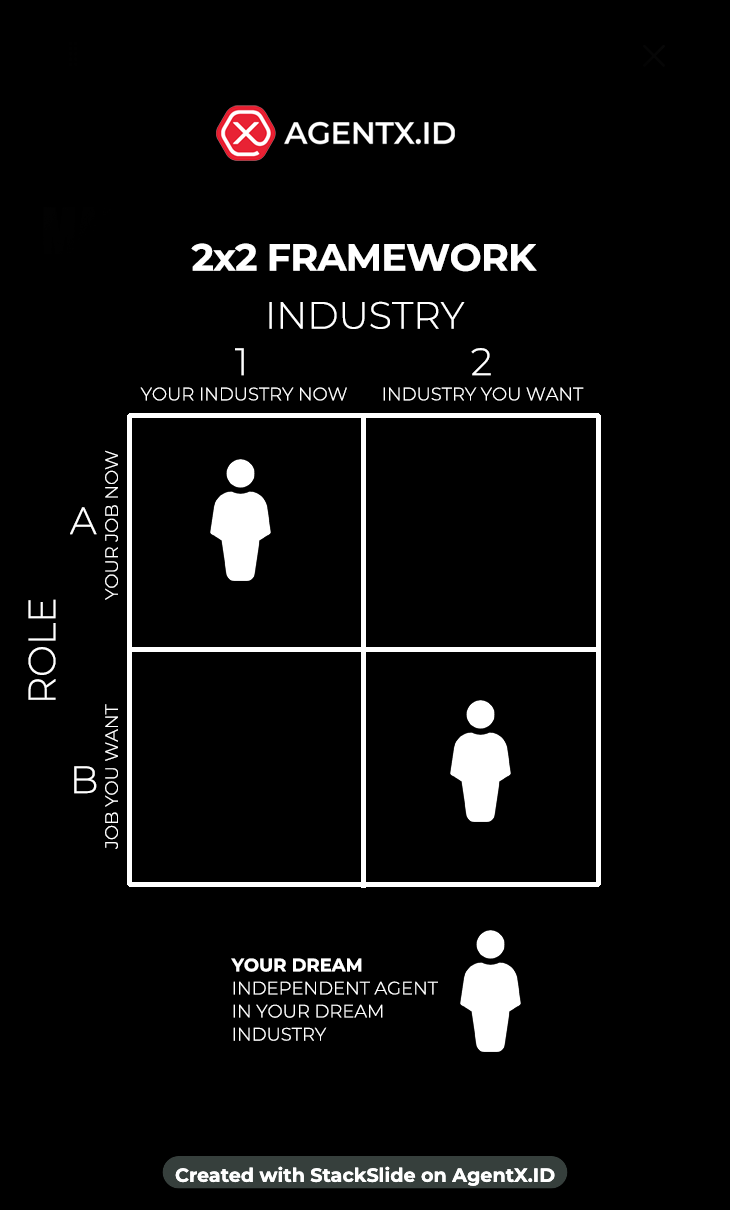
THE 2X2 CAREER SWITCH MAP
TWO AXES DEFINE THE MOVE
Think of career change using 2 axes:
X-axis = Industry
1 = your current industry
2 = your target industry
Y-axis = Role
A = your current role
B = your target role
This creates 4 boxes.
Each box tells a different transition story.
BOX 1A
CURRENT INDUSTRY, CURRENT ROLE
1A is where you are now.
This is your current identity in the market:
the industry you already know,
and the role you already perform.
Everything starts here.
If you do not define this clearly,
your next move will stay vague and emotional.
BOX 1B
CURRENT INDUSTRY, TARGET ROLE
1B means you keep the same industry,
but change your function.
You already understand the customers,
language,
market dynamics,
and workflows.
Now you only need to prove you can perform a different role.
That usually makes the transition easier.
BOX 2A
TARGET INDUSTRY, CURRENT ROLE
2A means you keep the same role,
but enter a different industry.
Your professional identity stays intact,
but the context changes.
This works well when your role is portable across sectors,
like finance, HR, sales, ops, recruiting, project management, or analytics.
BOX 2B
TARGET INDUSTRY, TARGET ROLE
2B is the final destination:
new role, new industry.
This is often the dream position.
But it is also the hardest jump.
The market must believe two things at once:
you can function in a new field,
and you can do a new job inside it.
THE BIG IDEA
CHANGE ONE BOX AT A TIME
The smartest move is often not:
1A >> 2B directly
It is:
1A >> 1B >> 2B
or
1A >> 2A >> 2B
Keep one side stable while changing the other.
That lowers friction,
improves credibility,
and gives you a more believable story.
WHY ONE-BOX MOVES WORK
STABILITY CREATES TRUST
Every transition creates uncertainty.
When you change only one dimension at a time,
you preserve part of your credibility.
Same industry means you keep context.
Same role means you keep functional proof.
That makes hiring managers, clients, and collaborators trust the move faster.
THE TWO MAIN ROUTES
CHAPTER 2
ROUTE 1
CHANGE ROLE FIRST
Route 1 is:
1A >> 1B >> 2B
You first change your role inside your current industry.
Then, once you have proof in that role,
you move into the new industry.
This route works well when your target role can be practiced where you already are.
ROUTE 2
CHANGE INDUSTRY FIRST
Route 2 is:
1A >> 2A >> 2B
You first enter the target industry while keeping your current role.
Then, once you understand the new world from inside,
you move into the target role.
This route works well when industry access matters most.
WHICH ROUTE IS BETTER
DEPENDS ON YOUR LEVERAGE
There is no universal best route.
Choose based on:
which side is more portable,
where your proof is strongest,
what the market will believe first,
and which move keeps your income and confidence alive.
The best route is the one that gets accepted fastest.
A BETTER EXAMPLE
CHAPTER 3
EXAMPLE STARTING POINT
CURRENT BOX: MEDIA SALES
Imagine this person:
Current industry: Media
Current role: Sales Executive
They want to become:
Target industry: SaaS
Target role: Product Marketing Manager
This is a stronger example because it happens often,
and the logic is easier to see.
WHY DIRECT JUMPS ARE HARD
NEW ROLE AND NEW INDUSTRY TOGETHER
Media Sales >> SaaS Product Marketing is not impossible.
But it is a double shift:
new market,
new language,
new metrics,
new product model,
new role expectations,
new proof requirements.
The problem is not ambition.
The problem is asking the market to trust too much at once.
PATH A
CHANGE ROLE FIRST
A smarter path could be:
Media Sales >> Media Marketing / GTM >> SaaS Product Marketing
First, move closer to campaigns,
positioning,
audience insights,
launch thinking,
or go to market work inside media.
Then build role proof.
After that, enter SaaS with a stronger story.
PATH B
CHANGE INDUSTRY FIRST
Another path could be:
Media Sales >> SaaS Sales >> SaaS Product Marketing
First, enter the SaaS industry in a role you already know: sales.
Then learn the buyer journey,
messaging,
objections,
product narrative,
and customer needs.
After that, move into product marketing.
WHY BOTH PATHS WORK
EACH PATH PRESERVES SOMETHING
In Path A, you preserve industry context first.
In Path B, you preserve role credibility first.
That is the secret.
You do not need to start from zero.
You need to carry one useful asset with you
while building the next one.
That is strategic career switching.
ANOTHER EXAMPLE
TEACHER TO UX RESEARCHER
Current industry: Education
Current role: Teacher
Target industry: Tech
Target role: UX Researcher
This also looks like a big leap.
But when broken down, it becomes more manageable.
The trick is translating existing strengths into adjacent value.
ROLE-FIRST VERSION
STAY CLOSE TO RESEARCH AND LEARNING
A role first path might be:
Teacher >> Instructional Designer / Learning Research >> UX Researcher
The person stays close to:
observation,
feedback,
behavior,
and structured communication.
They do not abandon their strengths.
They repackage them for a more adjacent role.
INDUSTRY-FIRST VERSION
ENTER TECH BEFORE THE FINAL ROLE
An industry first path might be:
Teacher >> Customer Education / Onboarding in Tech >> UX Researcher
Now they are inside the new industry.
They learn product language,
user pain points,
tool ecosystems,
and customer behavior.
Then the move into UX research becomes more believable.
THE REAL LOGIC BEHIND TRANSITION
CHAPTER 4
CAREER CHANGE IS A TRUST PROBLEM
THE MARKET MUST BELIEVE YOUR STORY
When you switch careers,
the biggest issue is not just skill.
It is trust.
Can an employer,
client,
or collaborator believe that you can create value in the new box?
Your path should reduce doubt
and increase the believability of your story.
YOU NEED ADJACENCY
CLOSER MOVES ARE EASIER TO SELL
Markets like adjacency.
A jump feels easier when it sounds like:
same customers,
same tools,
same problems,
same function,
same workflows,
or same outcomes.
The more adjacency you can show,
the less your move feels risky.
That is why one-box moves are powerful.
SKILL GAP VS CONTEXT GAP
KNOW WHICH GAP IS SMALLER
Every transition has two main gaps:
Skill gap = can you do the job?
Context gap = do you understand the industry?
Choose the smaller gap first.
If your role is portable,
change industry first.
If your industry knowledge is strong,
change role first.
THE HIDDEN ADVANTAGE
YOU ALREADY HAVE TRANSFERABLE ASSETS
Most people think they are starting over.
They are not.
They already have:
judgment,
communication,
industry language,
customer understanding,
project experience,
stakeholder handling,
problem solving,
and pattern recognition.
Career change gets easier when you name and transfer these assets.
HOW TO FIND YOUR BEST FIRST MOVE
CHAPTER 5
STEP 1
DEFINE YOUR CURRENT BOX CLEARLY
Write down your 1A:
What is your current industry?
What is your current role?
What proof do you already have?
What outcomes have you created?
What strengths keep showing up?
Do not start with dreams.
Start with a clean inventory of current leverage.
STEP 2
DEFINE THE REAL TARGET
Now define your 2B:
What industry do you want?
What role do you want?
Why do you want it?
Be specific.
Do you want:
more money,
more freedom,
more meaning,
better future demand,
better lifestyle,
or a stronger identity fit?
Clarity improves strategy.
STEP 3
CHOOSE THE EASIER BRIDGE
Ask one practical question:
Which is easier for me to keep first:
my current role,
or my current industry?
This tells you whether your best route is:
1A >> 1B >> 2B
or
1A >> 2A >> 2B
Do not choose by ego.
Choose by leverage.
STEP 4
BUILD ADJACENT PROOF
Before the market fully trusts you,
you need evidence.
That evidence can be:
small projects,
freelance work,
case studies,
public writing,
side experiments,
certificates with output,
internal company projects,
or portfolio pieces.
Learning alone is not enough.
You need proof attached to it.
STEP 5
LEARN ONLY WHAT CLOSES THE GAP
Do not become a course collector.
Learn with direction.
Study only what helps you cross into the next box:
tools,
language,
metrics,
portfolio formats,
role expectations,
or industry basics.
The goal is not endless preparation.
The goal is targeted readiness for the next believable move.
STEP 6
REWRITE YOUR CAREER STORY
Your transition must sound logical.
Not:
"I want to try something new."
But:
"My previous experience gives me an advantage in this role."
Good transitions are narrated as extensions,
not escapes.
A strong story turns a career pivot into a strategic upgrade.
STEP 7
USE STEPPING-STONE ROLES
Sometimes your target role is not the next move.
It is the move after the next move.
Use bridge roles.
Examples:
Sales >> Customer Success >> Product Marketing
Ops >> Project Manager >> Product Ops
Teacher >> Instructional Design >> UX Research
Bridge roles reduce career switch shock.
COMMON MISTAKES
CHAPTER 6
MISTAKE 1
CHANGING EVERYTHING AT ONCE
The biggest mistake is forcing a full identity reset in one move.
New role,
new industry,
new tools,
new network,
new proof,
new language,
new positioning.
That creates too much friction at once.
Ambition is good.
But transitions need structure,
not chaos.
MISTAKE 2
LEARNING WITHOUT PROOF
Many people study for months,
sometimes years,
but have nothing to show.
Courses alone rarely carry a transition.
What helps more is:
one project,
one case study,
one visible output,
one portfolio piece,
one real result.
Evidence beats intention.
MISTAKE 3
IGNORING TRANSFERABLE VALUE
People often describe themselves too narrowly.
"I only did admin."
"I was just in support."
"I was only a teacher."
But inside those jobs are transferable skills:
systems thinking,
customer understanding,
training,
communication,
research,
and problem solving.
Your old role contains clues for the next one.
MISTAKE 4
CHASING TITLES WITHOUT UNDERSTANDING WORK
A role title can look exciting from far away.
But what matters is:
what the person actually does every day,
what pressure they handle,
what outcomes they own,
and what skills are rewarded.
Do not switch into a fantasy.
Switch into a role whose daily reality you actually want.
MISTAKE 5
WAITING FOR PERMISSION
Many people still act as if some institution must officially declare them worthy.
In many industries, that is outdated.
Start learning.
Start making.
Start showing.
Start talking to people already there.
You do not need universal approval.
You need enough proof for the next door to open.
WRONG MOVE
MOVING 2 BOXES AT THE SAME TIME
A common mistake is jumping 2 boxes at once:
new role and new industry together.
That often resets how the market sees you.
Even if you already have experience, you may be treated like a beginner again.
This can slow your momentum, lower your bargaining power & make your path harder.
THE BETTER MINDSET
CHAPTER 7
DON’T ASK THIS
WHAT DO I WANT TO BECOME?
That question is too big for most people.
It creates pressure,
fantasy,
and confusion.
A more useful question is:
Which next box can I realistically reach?
That question creates movement,
and movement creates clarity.
Career change is solved through sequence.
ASK THIS INSTEAD
WHICH BOX CAN I MOVE INTO NEXT?
You do not need the entire future solved.
You need the next move with the highest leverage.
That could mean:
same industry, new role
or
same role, new industry
Find the most believable next box.
Then earn the right to move again.
THINK LIKE CROSSING A RIVER
USE STEPPING STONES
A career change is like crossing a river.
Trying to leap from one side to the other can fail.
But stepping stone by stepping stone works.
Each box is a stone.
Each move reduces distance.
Each proof point makes the next jump easier.
You do not need one heroic leap.
THE REAL GOAL
ARRIVE, NOT IMPRESS
Some people want their transition to look dramatic and inspiring.
But a better goal is simple:
arrive in the new career with less damage,
less confusion,
less wasted time,
and more momentum.
The market rewards credible movement.
Not cinematic reinvention.
FINAL PRINCIPLE
KEEP ONE SIDE STABLE
When you want to change job and change industry,
do not change everything at once.
Keep one side stable while moving the other.
That is the framework:
protect one asset,
build the next one,
then move again.
One box at a time
beats random reinvention.

HARD TO GET CLIENTS? YOUR ARE TOO GENERIC
BY GIGI
A StackSlide about why service providers (Freelancers / Consultants, etc.) need to niche down from broad positioning into a sharper, more memorable offer.
CHAPTER INDEX
"
I'm so talented,
I have outstanding portfolios,
but....
No one hires me,
Client rejects my proposals,
Keep losing project bids ...
YOU'RE SO TALENTED BUT, YOU'RE WAY TOO BROAD !!
BROAD IS HARD TO BUY
WHY BROAD SERVICES ARE HARD TO SELL
People rarely buy vague expertise. When your service sounds too broad, clients get confused.
Confused people delay, compare too much, or leave.
IF YOU SERVE EVERYONE, YOU FEEL GENERIC
WHY BROAD SERVICES ARE HARD TO SELL
Designer, consultant, or marketer is often too wide. The market sees too many similar people.
You become harder to remember, harder to refer, and easier to replace.
FOCUS ON ONE NICHE. DIG DOWN DEEPER!
NICHE MAKES YOU EASIER TO UNDERSTAND
WHY BROAD SERVICES ARE HARD TO SELL
A niche helps people instantly know what you do. The clearer your lane, the faster people can say: this is for me, or I know someone who needs this.
NICHE BUILDS TRUST FASTER
WHY BROAD SERVICES ARE HARD TO SELL
Specificity creates confidence.
A person who says I design premium coffee shops feels more credible than someone who just says I do interior design.
FOCUSED PORTFOLIOS SELL BETTER
WHY BROAD SERVICES ARE HARD TO SELL
If you already have portfolios, niche down even more.
Your past work becomes more powerful when it tells one clear story instead of showing random capabilities.
NICHE STARTS BROAD, THEN DIGS DOWN
WHY BROAD SERVICES ARE HARD TO SELL
You do not start at the deepest level immediately.
Usually it goes from broad niche to sub niche to sub-sub niche until your positioning becomes sharp and memorable.
THE NICHE LADDER
WHY BROAD SERVICES ARE HARD TO SELL
Use this simple structure: broad field, industry focus, then specific market angle.
This helps turn a skill into a sharper commercial offer.
NICHE LADDER EXAMPLES
INTERIOR DESIGNER TO PREMIUM COFFEESHOP BRANDING
EXAMPLE 1
Interior designer → restaurant designer → premium coffeeshop branding.
This is stronger because it moves from general skill, into one business category, into one clear premium use case.
GRAPHIC DESIGNER TO ARTISAN BAKERY PACKAGING
EXAMPLE 2
Graphic designer → F&B brand designer → packaging for artisan bakery brands.
This makes the offer feel specialized. Now the client knows exactly what kind of visual problem you solve.
VIDEOGRAPHER TO LUXURY PROPERTY SHORT VIDEOS
EXAMPLE 3
Videographer → property videographer → short form video for luxury apartment sales.
This is more sellable than just saying I make videos. It connects the skill directly to a business outcome.
COPYWRITER TO DENTAL CLINIC LANDING PAGES
EXAMPLE 4
Copywriter → healthcare copywriter → landing pages for dental clinics.
Now the positioning is clearer, easier to pitch, and easier to match with the right client.
WEB DEVELOPER TO BEAUTY BRAND SHOPIFY STORES
EXAMPLE 5
Web developer → ecommerce developer → Shopify stores for beauty brands.
This sounds more premium because it combines platform, business model, and target market in one sentence.
DEEPER NICHE, STRONGER MESSAGE
WHY BROAD SERVICES ARE HARD TO SELL
A good niche helps your bio, pitch, content, and portfolio all align.
People understand faster what you are known for.
NICHE DOES NOT LIMIT YOU
WHY BROAD SERVICES ARE HARD TO SELL
You can still do many things behind the scenes.
But in public, the market needs one sharp reason to remember and hire you.
START WITH WHAT YOU ALREADY HAVE
WHY BROAD SERVICES ARE HARD TO SELL
Look at your past projects. See what repeats most:
- industry
- client type
- problem solved
- style
- price levels
- outcome.
That pattern may be your niche clue.
A GOOD NICHE ANSWERS 3 THINGS
WHY BROAD SERVICES ARE HARD TO SELL
What do you do?
For whom?
For what specific kind of need?
If you can answer all three clearly, your service becomes much easier to sell.
FINAL WORDS : BEING SPECIFIC SELLS FASTER
WHY BROAD SERVICES ARE HARD TO SELL
Being broad feels safer. But being specific usually sells faster.
The market does not reward the most general.
It rewards the clearest.
8 SIGNS YOU ARE WASTING YOUR SKILLS, EXPERTISE & POTENTIALS
(FOR EMPLOYEES)
1. YOU’RE UNDERPAID
YOUR OUTPUT IS VALUABLE, YOUR PAY DOESN’T REFLECT IT
If your compensation stays flat while your responsibility grows, your value is being extracted, not rewarded.
Underpay is not a money problem.
It is a positioning problem.
2. YOU ARE EXPLOITED
YOUR SILENCE, THEY EXPLOIT
hey know you won’t re-negotiate. If you never push back, the system learns one thing:
You will accept what ever they give.
Good people often avoid conflict.
Bad systems monetize that.
3. YOU ARE UNDER-TITLED
SENIOR WORK, JUNIOR TITLE
You carry outcomes without the recognition.
You lead, fix, and prevent disasters, but your role stays the same.
Title is not ego.
Title is proof of scope, leverage, and future bargaining power.
4. YOU’RE TREATED AS “EXECUTOR”
YOUR THINKING IS IGNORED, YOUR HANDS ARE USED
They only call you when they need delivery, not direction.
If you can define the problem, not just complete tasks, you are more than execution.
But the wrong place will keep you small.
5. YOUR IDEAS BUT CREDIT STOLEN
YOUR IDEAS ARE USED, NOT CREDITED
You build value, someone else collects reputation
When your work has impact but your name disappears, you are losing visibility.
Visibility is currency.
No credit means no future leverage.
6. YOUR ARE NOT GROWING
THEY PROMISE, YEARS GO BY, YOU DON'T GROW
If your employer's review ends with “next quarter,” you are being delayed on purpose.
A real growth path has milestones.
Not vague encouragement.
7. YOU ARE BUSY, BUT NOT PRODUCTIVE
YOU WORK HARD, BUT NOTHING COMPOUNDS
You are always on tasks that reset to zero. Keeps repeating. You collect nothing as result.
This leads to :
No portfolio.
No case studies.
No assets.
No network expansion.
That is motion without compounding.
8. YOU FEEL REPLACEABLE
EVEN IF YOU ARE BEING PRODUCTIVE, THEY CAN REPLACE YOU EASY
If you’re treated like a slot, you’ll feel like a slot.
The wrong place designs people to be interchangeable.
The right place designs roles around unique outcomes.
STOP
DONT WASTE YOUR TIME
YOU ARE JUST IN THE WRONG PLACE
Right place means:
- Value is visible.
- Impact is measurable.
- Contribution is credited.
- Compensation scales.
- Your skills don’t shrink, they compound.
KEEP THE JOB, PREPARE TO FLY
REPOSITION YOUR EXPERTISE SO IT DESERVED TO GET APPRECIATED
Do this :
- Collect & reorganize your portfolios, case studies.
- Assess your skills & expertises.
- Choose a niche & problem.
- Create a solution for that niche
- Offer a solution & build RateCard
- Get client
- Ship value
- Repeat
BE AN INDEPENDENT AGENT
PREPARE THE RIGHT TIME
Once you stand on 2 legs.
Working while having your own clients.
Set time to leave.
When the right time comes, Leave.
Focus on your existing clients that can pay your bills.
Be an independent Agent !