

CHANGE JOB, CHANGE INDUSTRY
BY GIGSTACK - (ENGLISH VERSION)
CHAPTER INDEX
CHANGE JOB, CHANGE INDUSTRY
START WITH A SMARTER MAP
A lot of people want a new career.
New role. New industry. New identity. New future.
But most career switches fail because people try to change everything at once.
There is a better way:
understand the map first,
then move with logic.
WHY THIS MATTERS NOW
CAREER CHANGE IS MORE OPEN THAN BEFORE
Today, it is easier to learn than ever.
Online courses, YouTube, communities, AI tools, side projects, short certifications, freelance work, and public portfolios have reduced the gatekeeping.
In many fields, proof matters more than permission.
THE OLD RULES ARE WEAKER
YOU DO NOT ALWAYS NEED FORMAL APPROVAL
Outside of regulated fields like medicine, law, aviation, and safety critical engineering, many careers no longer require full institutional permission.
If you can do the work,
show evidence,
and solve real problems,
you can often enter the field.
THE REAL PROBLEM
PEOPLE TRY TO JUMP TOO FAR
Someone in one role, inside one industry, suddenly wants a totally different role in a totally different industry.
That means new skills,
new context,
new network,
new language,
new proof,
and a new story.
That is a hard sell to the market.
THE 2X2 FRAMEWORK
CHAPTER 1
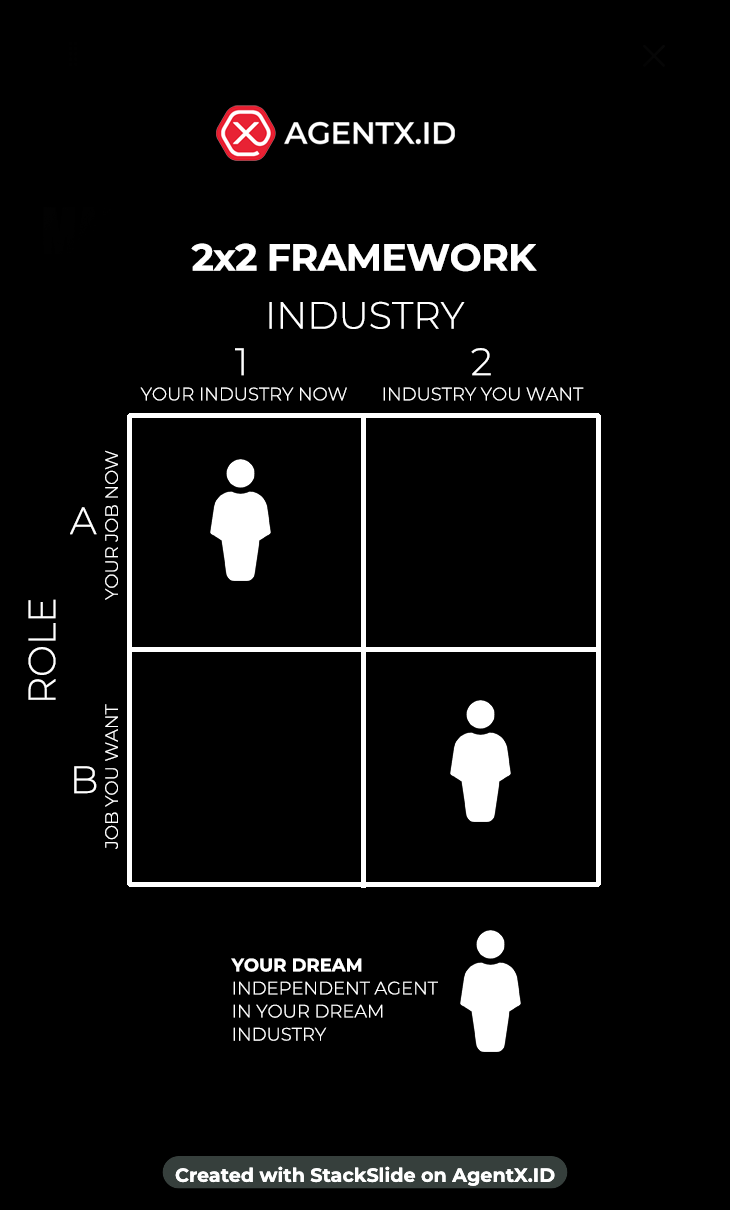
THE 2X2 CAREER SWITCH MAP
TWO AXES DEFINE THE MOVE
Think of career change using 2 axes:
X-axis = Industry
1 = your current industry
2 = your target industry
Y-axis = Role
A = your current role
B = your target role
This creates 4 boxes.
Each box tells a different transition story.
BOX 1A
CURRENT INDUSTRY, CURRENT ROLE
1A is where you are now.
This is your current identity in the market:
the industry you already know,
and the role you already perform.
Everything starts here.
If you do not define this clearly,
your next move will stay vague and emotional.
BOX 1B
CURRENT INDUSTRY, TARGET ROLE
1B means you keep the same industry,
but change your function.
You already understand the customers,
language,
market dynamics,
and workflows.
Now you only need to prove you can perform a different role.
That usually makes the transition easier.
BOX 2A
TARGET INDUSTRY, CURRENT ROLE
2A means you keep the same role,
but enter a different industry.
Your professional identity stays intact,
but the context changes.
This works well when your role is portable across sectors,
like finance, HR, sales, ops, recruiting, project management, or analytics.
BOX 2B
TARGET INDUSTRY, TARGET ROLE
2B is the final destination:
new role, new industry.
This is often the dream position.
But it is also the hardest jump.
The market must believe two things at once:
you can function in a new field,
and you can do a new job inside it.
THE BIG IDEA
CHANGE ONE BOX AT A TIME
The smartest move is often not:
1A >> 2B directly
It is:
1A >> 1B >> 2B
or
1A >> 2A >> 2B
Keep one side stable while changing the other.
That lowers friction,
improves credibility,
and gives you a more believable story.
WHY ONE-BOX MOVES WORK
STABILITY CREATES TRUST
Every transition creates uncertainty.
When you change only one dimension at a time,
you preserve part of your credibility.
Same industry means you keep context.
Same role means you keep functional proof.
That makes hiring managers, clients, and collaborators trust the move faster.
THE TWO MAIN ROUTES
CHAPTER 2
ROUTE 1
CHANGE ROLE FIRST
Route 1 is:
1A >> 1B >> 2B
You first change your role inside your current industry.
Then, once you have proof in that role,
you move into the new industry.
This route works well when your target role can be practiced where you already are.
ROUTE 2
CHANGE INDUSTRY FIRST
Route 2 is:
1A >> 2A >> 2B
You first enter the target industry while keeping your current role.
Then, once you understand the new world from inside,
you move into the target role.
This route works well when industry access matters most.
WHICH ROUTE IS BETTER
DEPENDS ON YOUR LEVERAGE
There is no universal best route.
Choose based on:
which side is more portable,
where your proof is strongest,
what the market will believe first,
and which move keeps your income and confidence alive.
The best route is the one that gets accepted fastest.
A BETTER EXAMPLE
CHAPTER 3
EXAMPLE STARTING POINT
CURRENT BOX: MEDIA SALES
Imagine this person:
Current industry: Media
Current role: Sales Executive
They want to become:
Target industry: SaaS
Target role: Product Marketing Manager
This is a stronger example because it happens often,
and the logic is easier to see.
WHY DIRECT JUMPS ARE HARD
NEW ROLE AND NEW INDUSTRY TOGETHER
Media Sales >> SaaS Product Marketing is not impossible.
But it is a double shift:
new market,
new language,
new metrics,
new product model,
new role expectations,
new proof requirements.
The problem is not ambition.
The problem is asking the market to trust too much at once.
PATH A
CHANGE ROLE FIRST
A smarter path could be:
Media Sales >> Media Marketing / GTM >> SaaS Product Marketing
First, move closer to campaigns,
positioning,
audience insights,
launch thinking,
or go to market work inside media.
Then build role proof.
After that, enter SaaS with a stronger story.
PATH B
CHANGE INDUSTRY FIRST
Another path could be:
Media Sales >> SaaS Sales >> SaaS Product Marketing
First, enter the SaaS industry in a role you already know: sales.
Then learn the buyer journey,
messaging,
objections,
product narrative,
and customer needs.
After that, move into product marketing.
WHY BOTH PATHS WORK
EACH PATH PRESERVES SOMETHING
In Path A, you preserve industry context first.
In Path B, you preserve role credibility first.
That is the secret.
You do not need to start from zero.
You need to carry one useful asset with you
while building the next one.
That is strategic career switching.
ANOTHER EXAMPLE
TEACHER TO UX RESEARCHER
Current industry: Education
Current role: Teacher
Target industry: Tech
Target role: UX Researcher
This also looks like a big leap.
But when broken down, it becomes more manageable.
The trick is translating existing strengths into adjacent value.
ROLE-FIRST VERSION
STAY CLOSE TO RESEARCH AND LEARNING
A role first path might be:
Teacher >> Instructional Designer / Learning Research >> UX Researcher
The person stays close to:
observation,
feedback,
behavior,
and structured communication.
They do not abandon their strengths.
They repackage them for a more adjacent role.
INDUSTRY-FIRST VERSION
ENTER TECH BEFORE THE FINAL ROLE
An industry first path might be:
Teacher >> Customer Education / Onboarding in Tech >> UX Researcher
Now they are inside the new industry.
They learn product language,
user pain points,
tool ecosystems,
and customer behavior.
Then the move into UX research becomes more believable.
THE REAL LOGIC BEHIND TRANSITION
CHAPTER 4
CAREER CHANGE IS A TRUST PROBLEM
THE MARKET MUST BELIEVE YOUR STORY
When you switch careers,
the biggest issue is not just skill.
It is trust.
Can an employer,
client,
or collaborator believe that you can create value in the new box?
Your path should reduce doubt
and increase the believability of your story.
YOU NEED ADJACENCY
CLOSER MOVES ARE EASIER TO SELL
Markets like adjacency.
A jump feels easier when it sounds like:
same customers,
same tools,
same problems,
same function,
same workflows,
or same outcomes.
The more adjacency you can show,
the less your move feels risky.
That is why one-box moves are powerful.
SKILL GAP VS CONTEXT GAP
KNOW WHICH GAP IS SMALLER
Every transition has two main gaps:
Skill gap = can you do the job?
Context gap = do you understand the industry?
Choose the smaller gap first.
If your role is portable,
change industry first.
If your industry knowledge is strong,
change role first.
THE HIDDEN ADVANTAGE
YOU ALREADY HAVE TRANSFERABLE ASSETS
Most people think they are starting over.
They are not.
They already have:
judgment,
communication,
industry language,
customer understanding,
project experience,
stakeholder handling,
problem solving,
and pattern recognition.
Career change gets easier when you name and transfer these assets.
HOW TO FIND YOUR BEST FIRST MOVE
CHAPTER 5
STEP 1
DEFINE YOUR CURRENT BOX CLEARLY
Write down your 1A:
What is your current industry?
What is your current role?
What proof do you already have?
What outcomes have you created?
What strengths keep showing up?
Do not start with dreams.
Start with a clean inventory of current leverage.
STEP 2
DEFINE THE REAL TARGET
Now define your 2B:
What industry do you want?
What role do you want?
Why do you want it?
Be specific.
Do you want:
more money,
more freedom,
more meaning,
better future demand,
better lifestyle,
or a stronger identity fit?
Clarity improves strategy.
STEP 3
CHOOSE THE EASIER BRIDGE
Ask one practical question:
Which is easier for me to keep first:
my current role,
or my current industry?
This tells you whether your best route is:
1A >> 1B >> 2B
or
1A >> 2A >> 2B
Do not choose by ego.
Choose by leverage.
STEP 4
BUILD ADJACENT PROOF
Before the market fully trusts you,
you need evidence.
That evidence can be:
small projects,
freelance work,
case studies,
public writing,
side experiments,
certificates with output,
internal company projects,
or portfolio pieces.
Learning alone is not enough.
You need proof attached to it.
STEP 5
LEARN ONLY WHAT CLOSES THE GAP
Do not become a course collector.
Learn with direction.
Study only what helps you cross into the next box:
tools,
language,
metrics,
portfolio formats,
role expectations,
or industry basics.
The goal is not endless preparation.
The goal is targeted readiness for the next believable move.
STEP 6
REWRITE YOUR CAREER STORY
Your transition must sound logical.
Not:
"I want to try something new."
But:
"My previous experience gives me an advantage in this role."
Good transitions are narrated as extensions,
not escapes.
A strong story turns a career pivot into a strategic upgrade.
STEP 7
USE STEPPING-STONE ROLES
Sometimes your target role is not the next move.
It is the move after the next move.
Use bridge roles.
Examples:
Sales >> Customer Success >> Product Marketing
Ops >> Project Manager >> Product Ops
Teacher >> Instructional Design >> UX Research
Bridge roles reduce career switch shock.
COMMON MISTAKES
CHAPTER 6
MISTAKE 1
CHANGING EVERYTHING AT ONCE
The biggest mistake is forcing a full identity reset in one move.
New role,
new industry,
new tools,
new network,
new proof,
new language,
new positioning.
That creates too much friction at once.
Ambition is good.
But transitions need structure,
not chaos.
MISTAKE 2
LEARNING WITHOUT PROOF
Many people study for months,
sometimes years,
but have nothing to show.
Courses alone rarely carry a transition.
What helps more is:
one project,
one case study,
one visible output,
one portfolio piece,
one real result.
Evidence beats intention.
MISTAKE 3
IGNORING TRANSFERABLE VALUE
People often describe themselves too narrowly.
"I only did admin."
"I was just in support."
"I was only a teacher."
But inside those jobs are transferable skills:
systems thinking,
customer understanding,
training,
communication,
research,
and problem solving.
Your old role contains clues for the next one.
MISTAKE 4
CHASING TITLES WITHOUT UNDERSTANDING WORK
A role title can look exciting from far away.
But what matters is:
what the person actually does every day,
what pressure they handle,
what outcomes they own,
and what skills are rewarded.
Do not switch into a fantasy.
Switch into a role whose daily reality you actually want.
MISTAKE 5
WAITING FOR PERMISSION
Many people still act as if some institution must officially declare them worthy.
In many industries, that is outdated.
Start learning.
Start making.
Start showing.
Start talking to people already there.
You do not need universal approval.
You need enough proof for the next door to open.
WRONG MOVE
MOVING 2 BOXES AT THE SAME TIME
A common mistake is jumping 2 boxes at once:
new role and new industry together.
That often resets how the market sees you.
Even if you already have experience, you may be treated like a beginner again.
This can slow your momentum, lower your bargaining power & make your path harder.
THE BETTER MINDSET
CHAPTER 7
DON’T ASK THIS
WHAT DO I WANT TO BECOME?
That question is too big for most people.
It creates pressure,
fantasy,
and confusion.
A more useful question is:
Which next box can I realistically reach?
That question creates movement,
and movement creates clarity.
Career change is solved through sequence.
ASK THIS INSTEAD
WHICH BOX CAN I MOVE INTO NEXT?
You do not need the entire future solved.
You need the next move with the highest leverage.
That could mean:
same industry, new role
or
same role, new industry
Find the most believable next box.
Then earn the right to move again.
THINK LIKE CROSSING A RIVER
USE STEPPING STONES
A career change is like crossing a river.
Trying to leap from one side to the other can fail.
But stepping stone by stepping stone works.
Each box is a stone.
Each move reduces distance.
Each proof point makes the next jump easier.
You do not need one heroic leap.
THE REAL GOAL
ARRIVE, NOT IMPRESS
Some people want their transition to look dramatic and inspiring.
But a better goal is simple:
arrive in the new career with less damage,
less confusion,
less wasted time,
and more momentum.
The market rewards credible movement.
Not cinematic reinvention.
FINAL PRINCIPLE
KEEP ONE SIDE STABLE
When you want to change job and change industry,
do not change everything at once.
Keep one side stable while moving the other.
That is the framework:
protect one asset,
build the next one,
then move again.
One box at a time
beats random reinvention.