FOLDER
LEARN FROM PEOPLE & BIOGRAPHY
CONTENT


ANTHONY BOURDAIN: STAY CURIOUS, KEEP CREATING
YOUTUBE SUMMARY
CHAPTER INDEX
STAY CURIOUS, KEEP CREATING
ANTHONY BOURDAIN'S WAY OF LIVING
Bourdain was a chef, writer, traveler, and storyteller.
But underneath all those identities was something simpler:
He liked making things.
And he built his life around protecting the freedom to keep making them.
THE 5 IDEAS
A PHILOSOPHY FOR CREATIVE LIFE
1. Never let yesterday control tomorrow.
2. Protect your creative freedom.
3. Love the process of making.
4. Stay curious about people and the world.
5. Keep becoming a beginner.
CREATE WITHOUT REPEATING
CHAPTER 1
ALWAYS HAVE A PROJECT
A CREATOR NEEDS SOMETHING TO MAKE
Bourdain believed he was happiest when working on something.
A television episode.
A story.
A plate of food.
The form mattered less than the act of creating.
For him, making things was not merely work.
It was how he engaged with life.
“I LIKE MAKING THINGS. I’M A GUY WHO SHOULD HAVE A PROJECT.”
__ ANTHONY BOURDAIN
DON'T COPY LAST WEEK
SUCCESS CAN BECOME A CREATIVE TRAP
Television often works by one rule:
Do what worked last week.
Bourdain wanted the opposite.
Even when something succeeded, he didn't automatically want to repeat it.
The question was always:
What can we do differently this time?
SUCCESS CREATES FEAR
PEOPLE BECOME AFRAID TO LOSE WHAT WORKS
Once people become successful, experimentation becomes harder.
They have something to protect.
Their position.
Their audience.
Their reputation.
Their income.
So the safe decision becomes repeating what already worked.
“I’M NOT INTERESTED IN DOING THE SAME THING EVEN IF IT WORKED.”
__ ANTHONY BOURDAIN
FEAR MAKES WORK PREDICTABLE
NOBODY WANTS TO PROPOSE THE FAILED EXPERIMENT
Organizations often say they want something new.
But new ideas carry risk.
If the experiment fails, someone may be blamed.
So people slowly choose predictable ideas instead.
Creativity disappears through thousands of safe decisions.
BE WILLING TO WALK AWAY
FREEDOM CREATES NEGOTIATING POWER
Bourdain realized something powerful:
Not desperately needing television gave him freedom inside television.
If losing the opportunity is unimaginable, you become easy to control.
When you can accept walking away, your creative position becomes much stronger.
ASK A BETTER QUESTION
HOW CAN WE OUTDO OURSELVES?
Bourdain didn't ask:
How do we reproduce the last successful episode?
He asked:
How can we make this show differently?
How can the camera team, editors, sound designers, and producers push themselves further?
“HOW CAN WE DO SOMETHING STRANGE AND WONDERFUL?”
__ ANTHONY BOURDAIN
STRANGE AND WONDERFUL
PUSH BEYOND THE EXPECTED
His goal was not simply to make something acceptable.
He wanted something strange.
Something wonderful.
Something unexpected.
Creativity begins when the goal moves beyond repeating proven formulas.
PROTECT YOUR FREEDOM
CHAPTER 2
THINK ABOUT TOMORROW MORNING
A SIMPLE DECISION FILTER
Bourdain had a practical rule for his work:
Would I feel bad tomorrow about what I did today?
He had experienced enough mornings filled with regret.
So he became careful about accepting compromises that would make him dislike his own decisions.
QUALITY OF LIFE
FREEDOM WAS PERSONAL
Bourdain didn't present his choices as heroic principles.
He described them as a quality-of-life issue.
He wanted to wake up feeling good about his work.
Creative independence wasn't about appearing noble.
It was about being able to live with himself.
“I DON’T WANT TO WAKE UP TOMORROW AND FEEL BAD ABOUT WHAT I DID TODAY.”
__ ANTHONY BOURDAIN
FOLLOW WHAT YOU CARE ABOUT
ATTENTION BECOMES STRONGER WHEN IT IS GENUINE
Bourdain had the unusual privilege of focusing on people and places that genuinely interested him.
That mattered.
When curiosity is real, the audience can feel it.
The storyteller stops performing interest and starts discovering something.
MAKE FOR THE PROCESS
CHAPTER 3
YOU DON'T NEED TO KEEP IT
CREATION CAN BE TEMPORARY
Bourdain said he didn't necessarily need to have the thing afterward.
The meal disappears.
The episode ends.
The moment passes.
What mattered was creating it well.
The satisfaction lived inside the process.
THE PRIVATE MOMENT
KNOW WHEN YOU DID SOMETHING WELL
As a chef, Bourdain loved the brief moment when a finished plate sat in the kitchen window.
Before anyone touched it, he could look at it and know:
I did this particular thing well.
A tiny private satisfaction.
That was enough.
LOVE THE NUTS AND BOLTS
CRAFT LIVES INSIDE THE DETAILS
He carried the same mindset into television.
Pre-production.
Editing.
Sound.
Camera work.
Story construction.
He enjoyed assembling the individual pieces with other people until everything produced one small golden moment.
DON'T CHASE PERMANENCE
GOOD WORK CAN STILL DISAPPEAR
Cooking taught Bourdain to appreciate something temporary.
A great plate exists for only a moment.
That lesson transferred into writing and television:
Something doesn't need to last forever to be worth making beautifully.
FOOD TELLS THE REAL STORY
CHAPTER 4
FOOD IS NEVER JUST FOOD
EVERY PLATE HAS A HISTORY
For Bourdain, food revealed the reality of a place.
Who gets to eat?
Who doesn't?
What ingredients are available?
What must be preserved?
The food on a plate can be the final result of a long economic, political, and historical story.
“WHAT DO YOU LIKE TO EAT? WHAT MAKES YOU HAPPY?”
__ ANTHONY BOURDAIN
READ THE PLATE
CUISINE CONTAINS EVIDENCE
Preservation, pickling, scarcity, abundance, and available ingredients can reveal what a society has experienced.
Food can carry traces of:
War.
Poverty.
Migration.
Trade.
Climate.
Prosperity.
The plate becomes evidence.
ASK SIMPLE QUESTIONS
CURIOSITY LOWERS DEFENSES
Bourdain discovered that simple questions could reveal extraordinary things.
What do you like to eat?
What makes you happy?
Instead of arriving as someone demanding answers, he arrived curious.
People often responded by opening up.
NOTICE THE ELEPHANT
REALITY EVENTUALLY ENTERS THE STORY
Sometimes the story around food becomes impossible to separate from politics.
Why are certain fish unavailable?
Why can't fishermen travel farther?
Why does someone carry injuries from an old conflict?
You don't have to tell people what to think.
But you cannot pretend facts aren't there.
TRAVEL CHANGES THE MAP
CHAPTER 5
THEY ARE MOSTLY LIKE US
TRAVEL DESTROYS EASY STEREOTYPES
After eating with people across the world, including in countries described as enemies, Bourdain reached a simple conclusion:
People are different.
But they are also overwhelmingly similar.
Sitting together around a table makes that difficult to ignore.
THE TABLE CHANGES EVERYTHING
SHARED HUMANITY BECOMES VISIBLE
Politics creates categories.
Borders create separation.
Narratives create enemies.
Then people sit around a table.
They eat.
Talk.
Laugh.
Talk about family.
Talk about work.
Suddenly the categories become less convincing.
THE WORLD IS CONNECTED
SEPARATION IS OFTEN AN ILLUSION
Travel also showed Bourdain how interconnected economies had become.
Money, goods, food, labor, and people move across borders constantly.
The world may appear divided on maps.
In everyday life, its systems are deeply connected.
STAY A BEGINNER
CHAPTER 6
START SOMETHING YOU'RE BAD AT
BOURDAIN BEGAN JIU-JITSU AT 58
At 58, Bourdain started learning jiu-jitsu.
He was surrounded by younger, fitter, and more experienced people.
He got beaten repeatedly.
And he loved it.
Why?
Because being bad at something gave him somewhere new to go.
BECOME THE LOWEST AGAIN
BEGINNER STATUS CAN BE LIBERATING
Learning jiu-jitsu recreated a feeling Bourdain remembered from entering a professional kitchen at 17.
Knowing nothing.
Being the least experienced person there.
Having no reputation to protect.
Only learning remained.
GET A LITTLE LESS AWFUL
PROGRESS DOESN'T NEED TO BE DRAMATIC
Bourdain enjoyed the tiny satisfactions of improvement.
Not becoming great overnight.
Just becoming a little less awful every day.
Then returning tomorrow and trying again.
That makes progress a never-ending journey instead of a destination.
“IT’S A NEVER-ENDING JOURNEY.”
__ ANTHONY BOURDAIN
VISIT UNUSED PARTS OF YOUR BRAIN
NOVELTY KEEPS LIFE EXPANDING
Learning something completely unfamiliar activated parts of Bourdain's mind he felt he hadn't visited before.
That's one reason beginners stay curious.
The unfamiliar forces attention.
You stop operating automatically and start noticing again.
THE BOURDAIN LOOP
A SYSTEM FOR STAYING ALIVE CREATIVELY
1. Find something you genuinely care about.
2. Make something from it.
3. Learn the craft deeply.
4. Finish it well.
5. Don't cling to it.
6. Find the next unfamiliar thing.
7. Become a beginner again.
DON'T LIVE BACKWARD
PAST SUCCESS IS INFORMATION, NOT INSTRUCTION
Many people look backward to decide what to do next.
What worked?
What did people like?
What is safest?
Bourdain kept looking forward.
What haven't I seen?
What haven't I tried?
What haven't I learned?
That's where curiosity lives.
MAKE SOMETHING
THE LESSON
Don't spend your life protecting yesterday's version of yourself.
Make something.
Care about the process.
Meet people outside your world.
Ask simple questions.
Try things you're bad at.
Get a little better.
Then go make something else.

HORMOZI : STOP CHASING AI. BUILD WHAT AI CANT REPLA…
YOUTUBE SUMMARY : THE DIARY OF CEO
CHAPTER INDEX
STOP CHASING AI
BUILD WHAT AI CANNOT REPLACE
AI is becoming faster, cheaper, and more available.
That does not remove the need for entrepreneurs. It raises the value of judgment, responsibility, reputation, real-world proof, and the ability to keep executing when the answer is unclear.
THE REAL QUESTION
IS AI IMPROVING THE BUSINESS?
Using more tools does not automatically create more value.
Before automating another task, ask:
• Does this solve our main constraint?
• Does it improve the customer outcome?
• Does it increase revenue, margin, speed, or retention?
USE AI WHERE IT MATTERS
CHAPTER 1
AUTOMATING THE WRONG THING
EFFICIENCY IS NOT ALWAYS PROGRESS
A company spent $350,000 building AI to replace work that cost about $11,000 per month.
The process could be automated, but it was not blocking growth. The real problem was demand. They needed more customers, not a more sophisticated internal system.
FIND THE CONSTRAINT
FIX WHAT LIMITS GROWTH
Every business has a current bottleneck.
It may be:
• Too few qualified leads
• Weak conversion
• Poor delivery
• Low retention
• Limited capacity
Use AI on the constraint, not simply on the task that looks easiest to automate.
SELL THE OUTCOME
CUSTOMERS DO NOT BUY YOUR TECHNOLOGY
Founders often advertise that their business is powered by AI because they are excited about the technology.
Customers usually care about something simpler: a faster result, lower cost, less risk, better quality, or a problem finally being solved.
AI INSIDE THE BUSINESS
A TOOL, NOT THE WHOLE IDENTITY
You do not always need to start an AI company.
You can use AI inside a normal business to research faster, improve service, reduce repetitive work, support employees, and make delivery more consistent. The value remains the result you create.
PROTECT YOUR JUDGMENT
CHAPTER 2
AI CAN AGREE WITH YOU
AGREEMENT IS NOT GOOD JUDGMENT
AI can often be pushed toward different answers depending on how the question is framed.
That makes it useful for exploring options, challenging assumptions, and organizing information. It is still dangerous to treat its confidence as proof that a decision is correct.
DO NOT OUTSOURCE THINKING
KEEP YOUR STRONGEST ASSET SHARP
The hardest thinking is often the work that develops your judgment.
Use AI to expand your view, test arguments, summarize evidence, or expose blind spots. Do not let it replace the mental effort required to understand the problem and choose a direction.
SOMEONE MUST OWN THE DECISION
RECOMMENDATION IS NOT RESPONSIBILITY
AI can produce recommendations, but a person still accepts the risk.
Someone invests the money, signs the contract, employs the team, faces the customer, and lives with the result. That ownership gives human judgment economic value.
HUMANS CARE ABOUT STAKES
REALITY MAKES OUTCOMES MEANINGFUL
Machines can outperform people in chess, yet people still watch human matches.
F1 remains compelling because a real driver is inside the car. Reality creates consequences, emotion, risk, and responsibility. Intelligence alone does not create meaning.
THINK LONGER
CHAPTER 3
TIME CHANGES THE FOUNDATION
BUILD FOR THE HEIGHT YOU WANT
A tower built in five seconds needs a different foundation from one built over five years.
The same is true in business. A company designed for quick cash may depend on one founder, one client, or one channel. A durable company needs systems that can carry greater weight.
$1M, $10M, AND $100M
DIFFERENT GOALS REQUIRE DIFFERENT COMPANIES
The fastest way to reach $1 million is not necessarily the fastest way to reach $10 million.
A one-person agency can grow quickly. A much larger company needs repeatable delivery, leadership, capital discipline, retention, hiring systems, and distribution that does not depend on one person.
BUILD THE FACTORY
THE PROTOTYPE IS ONLY THE BEGINNING
Creating one successful result proves that something can work.
The harder task is building the factory that produces the result repeatedly: the people, processes, standards, data, technology, and feedback loops that make quality dependable at a larger scale.
FOCUS AND PATIENCE
TWO ANTI-HUMAN ADVANTAGES
Focus is difficult because every new opportunity feels attractive. Patience is difficult because progress often looks slow before it compounds.
Competitors may copy features. Few will stay committed to the same important problem long enough to build a deep advantage.
REBUILD WHEN REQUIRED
A PLATEAU CAN EXPOSE WEAK FOUNDATIONS
A business can rise quickly and then stop because its early foundation cannot support the next stage.
Sometimes progress requires two steps back: simplify the offer, rebuild delivery, improve retention, hire stronger leaders, or replace systems that worked only at a smaller size.
RETENTION BEFORE SCALE
CHAPTER 4
REVENUE MUST STAY
GROWTH COMPOUNDS WHEN CUSTOMERS REMAIN
A business that keeps its customers does not restart from zero every year.
Each new customer adds to an existing base. Revenue can stack through subscriptions, repeat purchases, renewals, expansions, or a service customers continue choosing.
THE LEAKY BUSINESS
MORE SALES CAN HIDE A WEAK PRODUCT
A company may sell 100 customers in year one, 200 in year two, and 300 in year three while losing everyone each year.
Revenue appears to grow, but the company must constantly replace lost customers. Acquisition becomes more expensive, and growth collapses when selling slows.
THE STICKY BUSINESS
THE SAME SALES EFFORT CREATES COMPOUNDING
Another company sells only 100 new customers each year but keeps the previous customers.
It reaches the same 300 customers with far less acquisition pressure. More of its revenue comes from relationships already earned, which usually creates stronger margins and a more valuable company.
STAY LONGER IN PRODUCT-MARKET FIT
DO CUSTOMERS KEEP CHOOSING YOU?
Product-market fit is not simply proving that someone will buy once.
A stronger test is whether the right customers stay, return, upgrade, refer others, and continue receiving value. Solve this before pouring more fuel into distribution.
MARKETING CAN HIDE THE PROBLEM
FAST GROWTH CAN CREATE A LARGER LEAK
Strong marketing and sales can bring customers into a weak business faster.
That creates impressive short-term revenue while increasing refunds, churn, complaints, support costs, and operational pressure. Distribution becomes powerful after the offer reliably keeps customers.
PRICE FOR CAPACITY
CHAPTER 5
OVERWHELM IS OFTEN A MARGIN PROBLEM
THE SYMPTOM IS LACK OF TIME
When a founder cannot afford help, the problem may have started earlier.
The offer may include too much work for too little money. The sales process may fail to communicate the value. Low margin forces the founder to deliver everything personally.
DO NOT SELL FROM YOUR OWN WALLET
EASY FOR YOU MAY BE VALUABLE TO OTHERS
A skill feels simple after years of practice, so experts often underestimate its value.
The customer may gladly pay to avoid the time, risk, confusion, or effort involved. Price should not be limited by what you personally would pay for work you already know how to do.
UNDERPRICING CREATES A TRAP
MORE WORK, LESS CAPACITY
Low prices attract work but leave little room to hire, train, improve systems, or recover from mistakes.
The founder becomes busy, quality becomes harder to protect, and growth creates stress instead of leverage. Healthy pricing funds better delivery.
PRICE IS A SIGNAL
THE RIGHT CUSTOMER READS THE SIGNAL
In service businesses, price often communicates the level of expertise, attention, and capacity available.
A price that is too low can make sophisticated buyers doubt whether the provider can handle the work. Higher prices must be supported by stronger proof and delivery.
ASK FOUR PRICING QUESTIONS
FIND THE BELIEVABLE RANGE
Ask potential customers:
• What price feels too expensive?
• What price feels too cheap to trust?
• What price feels expensive but acceptable?
• What price feels like a bargain?
Use the answers to test a range instead of guessing.
BUILD A TEAM, NOT A CLONE
CHAPTER 6
STOP LOOKING FOR A UNICORN
ONE PERSON CANNOT REPLACE THE FOUNDER
Founders often want one hire who can think, sell, operate, create, manage, and care exactly as they do.
That person rarely exists. The founder's role was built from a unique combination of experience, ownership, context, and years of mistakes.
BREAK THE ROLE APART
FIND SPECIALISTS FOR SPECIFIC OUTCOMES
Instead of finding one person with every quality, divide the work into clear responsibilities.
One person may manage clients. Another may run operations. Another may own content or sales. A team of strong specialists is easier to build than one mythical replacement.
THE BUSINESS IS NOT YOUR THERAPY
BEING NEEDED CAN BECOME A BOTTLENECK
Founders sometimes protect their importance by believing nobody can meet their standard.
The business is not responsible for satisfying the founder's need to feel special. Its job is to serve customers. Teach the work, transfer context, and let capable people own outcomes.
HOLD THE HIGHEST STANDARD
LEADERSHIP DEFINES WHAT GOOD MEANS
Delegation does not mean lowering expectations.
The leader of each function should understand the standard, measure it, coach toward it, and correct work that misses it. When someone consistently holds a higher standard than you, they may be ready to lead that function.
START BEFORE CERTAINTY
CHAPTER 7
MAKE THE FIRST DOLLAR
TURN THE IDEA INTO A TRANSACTION
Starting a business feels complicated when it remains an abstract idea.
Reduce it to action: create a legal way to operate, prepare a way to receive money, and ask someone to pay for a useful result. The first transaction changes your identity and gives you real data.
THE FOG CLEARS THROUGH MOVEMENT
YOU ONLY NEED THE NEXT VISIBLE STEPS
Entrepreneurs want certainty before acting, but the full path is rarely visible.
Take the steps you can see. Each action reveals customers, objections, costs, skills, and opportunities that thinking alone cannot show. Clarity is often produced by movement.
MAKE FEAR SPECIFIC
VAGUE FEAR BECOMES CATASTROPHE
Fear grows when failure remains undefined.
Write down what failure would actually mean. A rejected offer? Lost savings? Returning to a job? Sleeping on a friend's couch? Specific problems can be planned for. Vague disasters cannot.
LOCAL FAILURE IS NOT GLOBAL FAILURE
QUIT THE BAD IDEA, NOT THE JOURNEY
A product can fail without proving that you are incapable of business.
An offer may be wrong. A market may not care. A channel may not work. Use the feedback, change the approach, and test again. Do not turn one failed experiment into a permanent identity.
PUSH OR PIVOT?
TEST THE ORIGINAL ASSUMPTIONS
Pivot when real evidence disproves a fundamental assumption behind the business.
Push when the assumptions still appear valid and the main frustration is that progress is slower or harder than expected. Discomfort alone is not evidence that the direction is wrong.
REALITY IS THE MOAT
CHAPTER 8
GENERIC CONTENT WILL MULTIPLY
INFORMATION IS BECOMING ABUNDANT
AI can produce tips, summaries, images, videos, and opinions at enormous scale.
As supply grows, generic content becomes less valuable. More output is not enough. People will increasingly ask why they should trust this source and whether the advice is grounded in reality.
REALITY CREATES CREDIBILITY
REPUTATION IS BUILT OUTSIDE THE PROMPT
A track record cannot be generated instantly.
Real customers, real results, real risks, repeated delivery, and years of accumulated trust create credibility. In a world where everyone can access similar intelligence, reputation helps people decide whose judgment to follow.
DO WHAT ONLY YOU CAN DO
MAKE THE WORK HARD AND SCARCE
Build content around access, experience, relationships, experiments, and situations that cannot be reproduced with one prompt.
Show real decisions, real customers, live problem-solving, original data, difficult production, or a perspective earned through work.
PROOF OF OUTCOME
SHOW WHAT CHANGED
When you have results, document them clearly.
Show the starting condition, the work completed, the obstacles, the measurable result, and what was learned. Proof reduces the effort required for a customer to believe that you can help.
PROOF OF EFFORT
USE WORK WHEN RESULTS ARE STILL SMALL
Beginners may not have a long track record, but they have time and effort.
Document the calls, tests, failed attempts, hours of practice, customer conversations, and improvements. Serious effort signals commitment and produces the experience that later becomes proof of outcome.
CREDIBILITY RISES WITH RISK
HIGHER STAKES DEMAND STRONGER PROOF
People may accept a beauty tip from an unknown source because the downside is small.
They become more careful with financial, legal, health, or business advice. The greater the cost of being wrong, the more they rely on reputation, evidence, and accountable experts.
DO THE UNSCALABLE WORK
CHAPTER 9
YOU ARE NOT TOO BIG TO START SMALL
REVENUE COMES BEFORE ELEGANT SCALE
Early founders often reject useful work because it is not scalable.
At the beginning, the priority is learning what customers value and proving they will pay. A manual service can create cash, relationships, insight, and credibility before automation makes sense.
START WITH EXTREME VALUE
IMAGINE THE PREMIUM VERSION
Choose a much higher price, then ask what would make the offer worth it.
The answer may include personal support, faster delivery, implementation, direct access, customization, or guarantees. This exercise reveals what customers value most.
UNSCALABLE WORK CREATES UNIQUE DATA
DO FIRST, SYSTEMIZE LATER
Direct service exposes details that a thought experiment cannot predict.
You learn what customers ask, where they hesitate, which steps create results, and what repeatedly breaks. That knowledge allows you to design a scalable offer based on evidence.
PREMIUM FIRST, MASS LATER
USE CASH FLOW TO BUILD ACCESS
A premium, high-touch service can produce strong margins with relatively few customers.
Once the result is understood, parts of the process can become templates, training, software, group services, or lower-priced products. Start with depth, then expand access.
TRUST YOUR FUTURE SELF
TOMORROW HAS DIFFERENT RESOURCES
Founders often try to solve future scale problems using today's limited money, skills, data, and team.
Your future self will have more resources because of the work completed now. Solve the current problem well, collect feedback, and earn the ability to solve the next one.
KEEP FIGHTING
FINAL CHAPTER
A BAD DAY IS NOT A NEW STRATEGY
EMOTIONAL DISCOMFORT IS NOT ENOUGH
A difficult day can make the entire business or life feel wrong.
Pause before changing the plan, ending a relationship, firing the team, or abandoning the work. Temporary emotion is real, but it is not always reliable evidence.
CONSISTENCY IS HARD TO SEE
PEOPLE SEE THE RESULT, NOT THE REPETITION
Audiences see the launch, the growth, or the final win. They rarely see the ordinary days that produced it.
Consistency, patience, and focus are almost invisible while they are happening. Their value appears later through compounding.
SLOW, THEN FAST
COMPOUNDING LOOKS INACTIVE BEFORE IT LOOKS OBVIOUS
Many correct paths feel unrewarding in the middle.
The early work builds skill, reputation, systems, relationships, and data. Results may remain small until these assets combine. People often abandon the right path because the payoff arrives later than expected.
CONTROL THE NEXT ACTION
PROGRESS THROUGH DIFFICULT SEASONS
Large problems create painful open loops because they cannot be solved in one day.
Focus on the next controllable action: one conversation, one decision, one workout, one customer, one improvement. Small completed steps restore movement.
THE ENDURING ADVANTAGE
WHAT TO BUILD IN THE AGE OF AI
Use AI aggressively, but keep building the assets that technology cannot instantly grant:
• Judgment
• Responsibility
• Customer trust
• Real-world proof
• Strong standards
• Durable systems
• Focus and patience
That is the business.
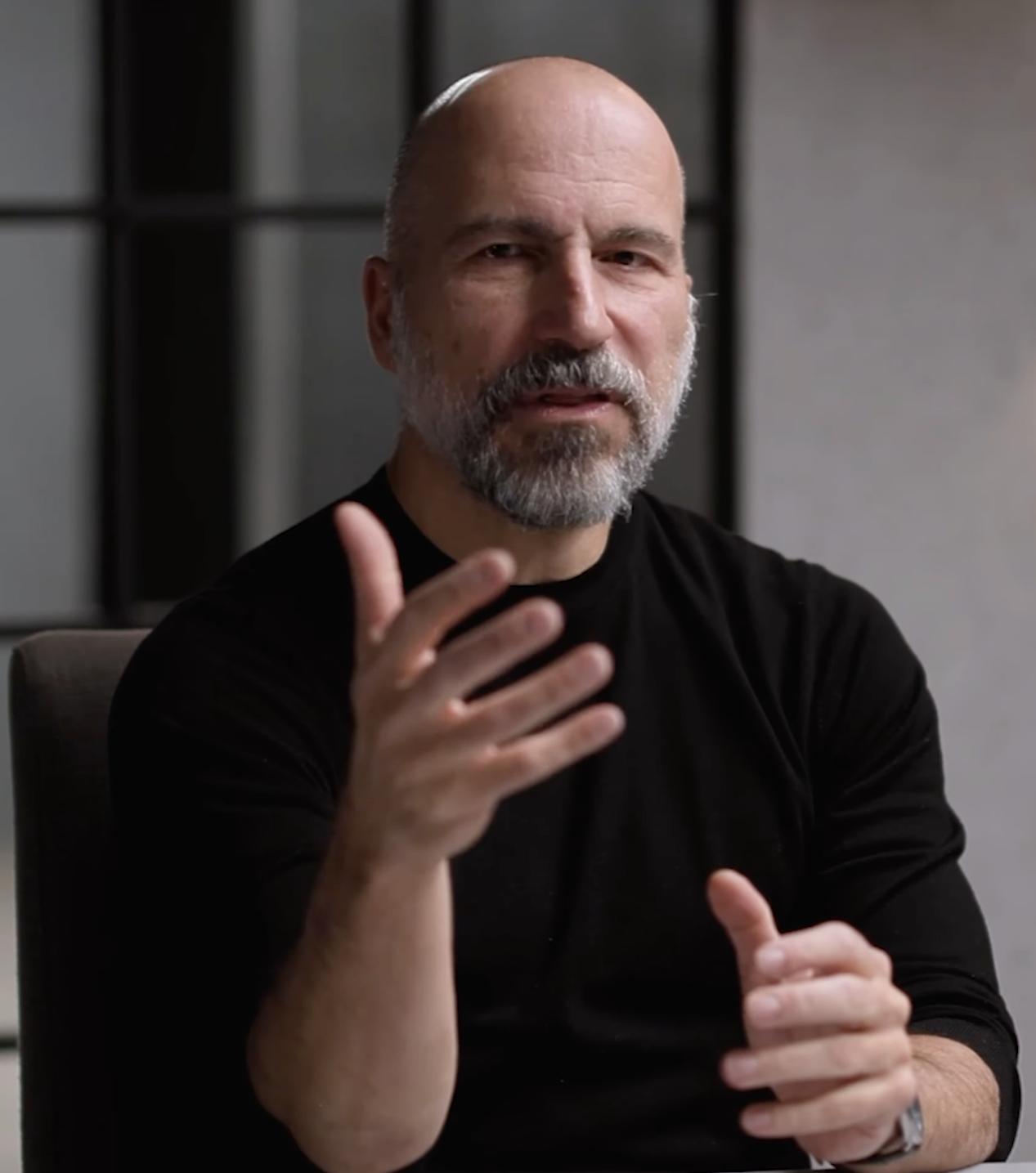
WHAT WE CAN LEARN FROM DARA KHOSROWSHAHI (UBER CEO)
YOUTUBE SUMMARY
CHAPTER INDEX
FROM LOSS TO DRIVE
CHAPTER 1
BORN FROM INSTABILITY
THE EARLY IMPRINT
Dara’s life was shaped by political upheaval.
His family lost safety, status, and everything they had built in Iran.
That experience did not just create fear.
It created a permanent drive to rebuild and never take stability for granted.
WHEN THE FLOOR CAN DISAPPEAR
WHY URGENCY STAYS
He described a feeling that never leaves:
The rug can be pulled from under you.
That mindset can create anxiety.
But in business it also creates vigilance, ambition, and a refusal to become complacent when things look safe on the surface.
HIS FATHER’S IMPACT
MEANING BEYOND MONEY
Watching his father lose not just wealth but also his sense of value left a deep mark.
The lesson is massive:
Work is not only about income.
It is tied to dignity, worth, contribution, and identity.
That matters in every discussion about AI and unemployment.
WANTED TO MAKE FAMILY PROUD
CHAPTER 2
AMBITION BEGAN AS DUTY
BEFORE TITLES AND STRATEGY
He did not begin with a master plan to become CEO.
His early motivation was simpler:
Make his family proud.
That matters because many careers are built first on duty, responsibility, and hunger long before they are shaped by a polished career narrative.
IMPACT MATTERS MORE OVER TIME
MONEY FIRST THEN MEANING
After losing everything, making money mattered.
That was real.
But as safety improved, what mattered more was building something important.
This is a useful founder lesson:
Money can motivate the start.
Impact often sustains the long game.
LEARN FROM THE FATHER YOU SAW
POWER WITH RESPECT
One memory stayed with him:
Visiting his father’s factory and seeing workers respect him.
Not fear.
Respect.
That shaped a core idea:
Real leadership is not just scale or authority.
It is building something big while treating people with dignity.
ENGINEERING AS A CEO MINDSET
CHAPTER 3
WHY ENGINEERING MATTERS
THE COMPANY AS A SYSTEM
He loved engineering because equations map to reality.
That same logic shaped his view of business:
A company is an organism and a machine.
The CEO’s job is to engineer goals, structures, incentives, teams, and systems that make the machine produce the intended result.
PICK THE RIGHT GOALS
NOT JUST SOLVE HARD PROBLEMS
Problem solving is not enough.
You also have to choose the right problem.
That is a strong operator lesson:
A well-run team can still lose if it is optimizing the wrong goal.
Execution excellence cannot save a company from strategic misalignment.
GREAT CEOS THINK LIKE BUILDERS
OPERATIONAL DESIGN
His framing is sharp:
The CEO is not just a spokesperson or capital allocator.
The CEO is designing a living system.
That means structure, pacing, accountability, information flow, and talent design all become part of the product of leadership itself.
BET ON PEOPLE
CHAPTER 4
GREAT COMPANIES START WITH GREAT PEOPLE
A DURABLE RULE
One lesson he learned early:
Always bet on people.
Companies rise and fall.
Markets change.
But great people remain unusually valuable over long periods.
This matters for founders, investors, and hiring managers making long-term decisions.
WHAT MAKES SOMEONE WORTH BETTING ON
CHARACTER SIGNALS
He pointed to traits like success, honor, loyalty, and follow-through.
Not charisma alone.
Not hype alone.
A great person says what they will do and then does it.
That consistency compounds trust over time and becomes a strategic asset in business.
RELATIONSHIPS OVER TRANSACTIONS
THE LONG GAME
The idea is not just to find talent once.
It is to stay with good people through their careers.
That is how strong networks and enduring businesses are built.
You do not just collect deals.
You build long arcs of trust with exceptional people.
SPOTTING OPPORTUNITY IN TRANSITIONS
CHAPTER 5
FIND THE LEADERS IN THE SHIFT
WHO IS ALREADY WINNING
When big transitions happen, exact outcomes are unclear.
So instead of predicting every detail, identify who is already emerging as the leader in the shift.
That is how he and his team approached online commerce categories like travel, ticketing, and personals.
OVERPAYING FOR GREATNESS
PRICE VS FUTURE REALITY
He said they often overpaid for great companies based on what the market thought at the time.
But those prices looked cheap later because the future was not linear.
Strong transitions often create exponential outcomes that ordinary valuation logic fails to fully price.
HUMANS THINK LINEARLY
BUT TECHNOLOGY COMPOUNDS
People project the future in straight lines because everyday life feels linear.
But new technologies can create hockey-stick outcomes.
The opportunity often lives in the gap between what people assume will happen and how fast a superior technology actually scales.
TURNAROUNDS REQUIRE FORCE
CHAPTER 6
A BROKEN ENGINE IS AN EMERGENCY
EXPEDIA’S WARNING SIGN
At Expedia he saw something dangerous:
The technology engine was broken.
Old codebase.
Weak reinvestment.
Coasting leadership.
His lesson was decisive:
When you see the bell ring, act.
Do not wait for more proof while momentum turns against you.
TECHNOLOGY DECAY BECOMES EXPONENTIAL
THE DOWNSIDE CURVE
He explained that just as growth can become exponential, decline can too.
A bad technology trajectory may not look catastrophic in year one.
But if left untouched it can turn into a long-term disaster.
Leaders must act before the full damage becomes visible.
SOMETIMES YOU REPLACE THE TEAM
CULTURE VIA PEOPLE
He was blunt:
Sometimes the shortcut to changing culture is changing people.
Values posters are not enough.
If the company is coasting, you may need hungry people with the right operating instincts before culture can actually reset in real life.
TRANSPARENCY AS SELF-DEFENSE
CHAPTER 7
TELL THE TRUTH FIRST
SO TRUTH COMES BACK
His view is powerful:
As a leader, if you hide reality from your team, they will hide reality from you.
Transparency is not just ethics.
It is information strategy.
You tell the truth because it is the only way to increase the odds of receiving truth in return.
BAD DECISIONS OFTEN START WITH BAD DATA
THE REAL PROBLEM
He said many CEO failures are not from low intelligence.
They come from getting the wrong information.
This is crucial:
A leader must design channels that surface uncomfortable truth quickly.
Otherwise polished summaries slowly separate leadership from reality.
GO TO THE SOURCE
CUT THROUGH LAYERS
He learned to bypass filtered reporting and hear directly from the source.
The farther information travels up a hierarchy, the more its sharp edges get rounded off.
That is why direct channels with people deep in the system can be so valuable for CEOs.
CULTURE OF HARD WORK
CHAPTER 8
HARD WORK IS A SKILL
NOT JUST A PERSONALITY TRAIT
One of his strongest ideas:
Working hard is a skill.
It includes discipline, focus, repetition, emotional endurance, and the ability to keep going after losses.
He sees it as one of the most important advantages a person can build over time.
RELENTLESSNESS COMPOUNDS
TIME ACCELERATION
His logic is simple:
If you can take two shots while others take one, you compress time.
You get more data.
You learn faster.
You increase your odds of success.
Relentless execution is not just effort.
It is a compounding system for learning and winning.
BE HONEST ABOUT THE STANDARD
NO COASTING
He believes a company should be clear:
If you come here, you will work hard.
You will be stretched.
You will be held accountable.
That honesty lets the right people opt in.
It also reduces the damage caused by hidden expectations and cultural mismatch.
FLEXIBILITY IS NOT LAZINESS
DIFFERENT FROM LOW STANDARDS
He makes an important distinction:
You can work very hard and still have flexibility.
Dinner with family.
Emails at night.
Early morning check-ins.
The issue is not rigid office theater.
The issue is whether the person and the company are truly committed to output.
RISK, LOSS, AND LEARNING
CHAPTER 9
SAY THE LOSS OUT LOUD
THEN MOVE
He admired leaders who can say:
They won.
We lost.
Next.
That matters.
Do not deny the loss.
Do not drown in it.
Study it enough to learn.
Then move.
A company or person that cannot metabolize failure gets stuck in fear and self-protection.
TOO DEFENSIVE IS DANGEROUS
SUCCESS CAN WEAKEN YOU
As companies become successful they often become risk-averse.
They have more to protect.
He argues the opposite should happen.
A stronger company should be able to take smarter risks because it has more resources to absorb mistakes while pushing for bigger upside.
SET THE EXAMPLE ON RISK
THE LEADER DEFINES RANGE
He pushes teams to take smart risks through language, example, and personal decisions.
People do not learn courage from slogans.
They learn it when leaders take visible risks, survive misses, and show that intelligent experimentation is expected rather than punished.
VALUES THAT ACTUALLY MEAN SOMETHING
CHAPTER 10
GENERIC VALUES ARE FORGETTABLE
PASSION IS NOT ENOUGH
He criticized generic value lists that sound nice but describe every company on earth.
If your values could fit any brand, they do not really guide behavior.
Strong values should reflect how your company is different and how people are expected to act under pressure.
DO THE RIGHT THING. PERIOD.
JUDGMENT MATTERS
His favorite value was simple:
Do the right thing. Period.
No long paragraph.
No corporate poetry.
The power is in the burden it places on the employee:
Use judgment.
That pushes responsibility downward instead of hiding behind process or technical excuse.
GO GET IT
AN ATTITUDE NOT A PHRASE
One value he highlighted was 'go get it.'
It fits Uber’s product and its operating posture.
It signals movement, aggression, initiative, and winning intent.
Good values are memorable because they capture actual behavior in language the company can live with daily.
AI IS ALREADY INSIDE UBER
CHAPTER 11
UBER WAS BUILT ON APPLIED AI
BEFORE THE HYPE WAVE
He explained that Uber already runs on AI:
pricing, routing, matching, batching, and orchestration across tens of millions of daily trips.
This matters because it shows AI transformation often begins long before the public narrative catches up to it.
COMFORT WITH IMPERFECTION
96% RIGHT STILL MATTERS
Uber learned to live with AI systems that work most of the time but still create edge-case failures.
That is a mature lesson:
AI adoption is not about waiting for perfection.
It is about building organizations that can operate with probabilistic systems responsibly.
APPLIED AI WILL RESHAPE EVERY TEAM
NOT JUST AI LABS
He does not frame Uber as a frontier research lab.
He frames it as a company moving hard on applied AI.
That distinction matters for builders:
You do not need to invent foundation models to gain advantage.
You need to apply models deeply inside real workflows.
THE BIG JOB QUESTION
CHAPTER 12
AI CAN REPLACE MUCH HUMAN WORK
A SERIOUS WARNING
He said the capability may exist within about 10 years for many intellectual jobs and longer for physical jobs.
He did not give false comfort.
The point was clear:
The scale of disruption may be enormous and society may not be ready for the retraining challenge.
THE SPEED IS THE PROBLEM
NOT JUST THE TECHNOLOGY
Society has adjusted to past technological shifts.
But his concern is timing.
If the capability arrives too fast, the social systems around retraining, identity, income, and meaning may not adapt quickly enough.
That is where the real shock could happen.
JOBS ARE ALSO ABOUT WORTH
BEYOND SALARY
He connected work to value and self-worth.
That is why job loss is not only an economic issue.
It is psychological, social, and existential.
Any serious AI strategy that ignores human meaning will misread the scale of the coming societal challenge.
CODING IS CHANGING FAST
CHAPTER 13
MOST ENGINEERS ALREADY USE AI
BUT INTENSITY MATTERS
He shared that most of Uber’s coders already use AI tools.
But the biggest gains came from a smaller group of power users.
That is a useful signal:
Adoption alone is not the advantage.
Depth of usage and workflow redesign are where real productivity jumps begin.
FROM WRITING CODE TO ORCHESTRATING AGENTS
THE ROLE SHIFT
He sees coding moving from manual construction toward orchestration.
The engineer still matters.
But the job increasingly becomes directing systems, reviewing outputs, shaping architecture, and managing agent-based production rather than typing every piece by hand.
PRODUCTIVITY GAINS CHANGE HIRING LOGIC
MORE BUILDERS OR MORE AGENTS
His view is pragmatic:
If engineers become more productive, maybe you hire more of them to move faster.
Later, maybe you add fewer humans and more agents and GPUs.
That is how AI shifts strategy:
Not only what teams do but what management decides to buy.
AUTONOMY AND THE FUTURE OF UBER
CHAPTER 14
AUTONOMOUS VEHICLES WILL LIKELY WIN
ON SAFETY AND COST
He was direct:
Autonomous systems are becoming safer than human drivers in key contexts.
That creates a massive social upside through fewer deaths and cheaper transport.
But it also means large numbers of driving-related jobs may eventually disappear.
NOT TOMORROW BUT NOT FAR AWAY
PHYSICAL WORLD SLOWS IT
He does not expect full replacement overnight.
Regulation, hardware, manufacturing, sensors, and real-world deployment take time.
Still, the direction is clear:
Over 15 to 20 years, a growing share of trips could be fulfilled by non-human systems.
WHAT DO THE DRIVERS DO?
THE UNANSWERED QUESTION
When asked what millions of displaced drivers will do, he did not pretend to have a clean answer.
That honesty matters.
He pointed to new forms of platform work and AI-related tasks.
But the balance between new opportunity and automation remains uncertain.
ADVICE FOR PEOPLE IN THE AI ERA
CHAPTER 15
WORK HARD FIRST
A TIMELESS EDGE
His default advice to young people stayed the same:
Work hard.
Not because it solves everything.
But because it remains one of the few durable edges that compounds across industries, roles, and changing technology cycles.
A strong work ethic travels well across uncertainty.
DO NOT OVER-PLAN YOUR CAREER
LEAVE ROOM FOR SIGNAL
He warned against overly rigid career plans.
Why?
Because they reduce curiosity.
People start filtering reality for evidence that supports their existing plan instead of staying open to life-changing signals coming from the real world around them.
LET THE WORLD CHANGE YOU FIRST
STAY OPEN
Before trying to change the world, let the world change you.
That is one of the strongest lines in the interview.
It argues for curiosity over ego, signal over rigid identity, and responsiveness over self-constructed certainty in rapidly shifting environments.
FINAL LESSONS
CHAPTER 16
WHAT FOUNDERS CAN LEARN
PRACTICAL TAKEAWAYS
Tell the truth early.
Act fast when the engine is broken.
Bet on exceptional people.
Build direct information channels.
Treat hard work as culture.
Use values that actually guide behavior.
Take smart risks.
Operate with urgency before the market forces urgency on you.
WHAT PROFESSIONALS CAN LEARN
PERSONAL TAKEAWAYS
Do not depend only on job titles for security.
Build resilience.
Learn to work hard.
Stay useful.
Stay curious.
Adapt faster.
Treat AI as a force you must understand, not a topic you postpone.
And remember that meaning and contribution matter as much as income.
THE DEEPER TENSION
PROGRESS AND CONSEQUENCE
The interview sits inside one central tension:
Technology can improve life and still destabilize millions.
That means serious leaders must do two things at once:
Build the future aggressively and speak honestly about the cost of getting there.
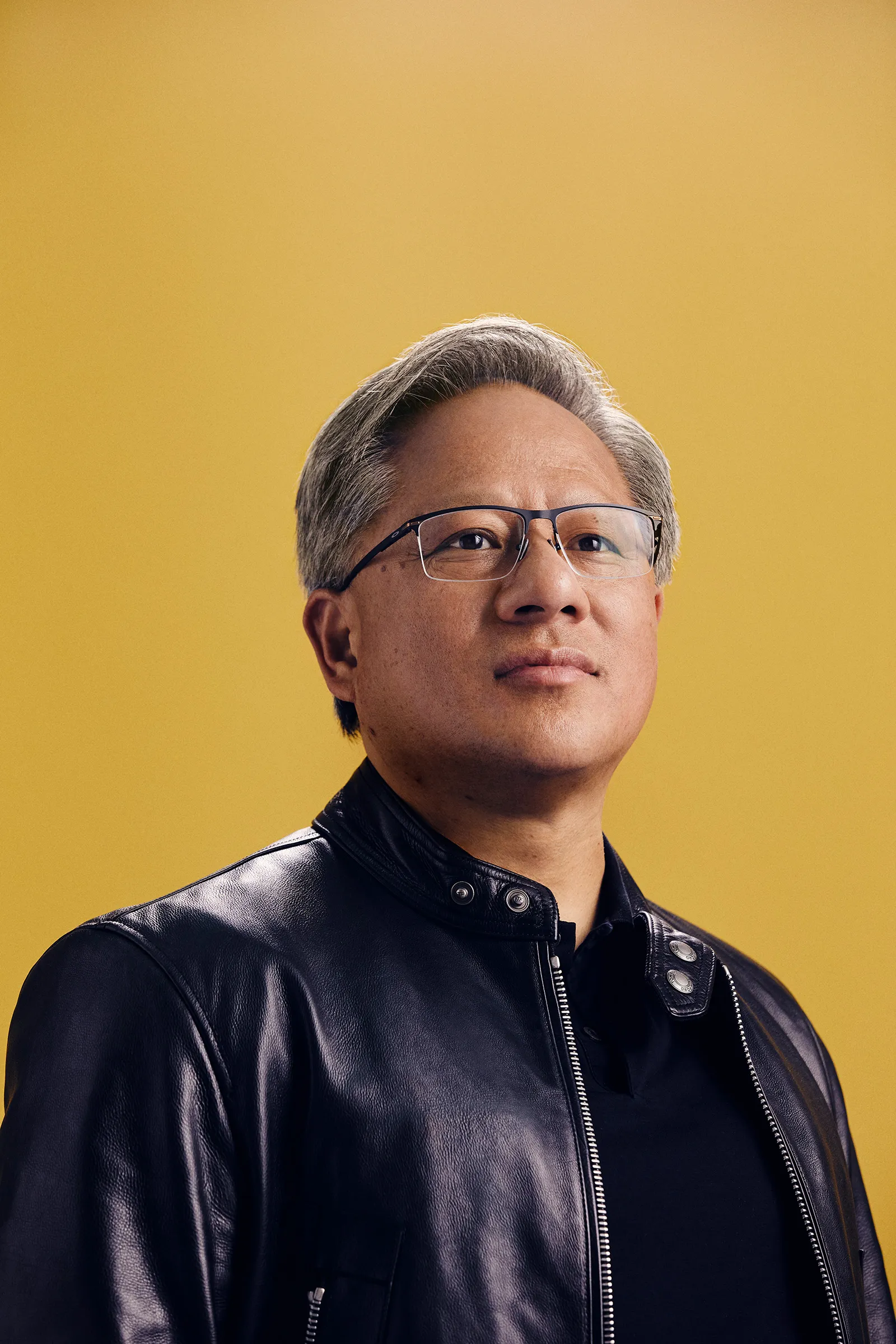
WHAT WE CAN LEARN FROM JENSEN HUANG
BY HARIO SETO
CHAPTER INDEX
WHAT WE CAN LEARN FROM JENSEN HUANG
A COMPLETE STUDY OF RESILIENCE, STRATEGY, LEADERSHIP, AND LONG-TERM CONVICTION
Jensen Huang is not only a successful CEO.
He is a builder of systems, platforms, and future markets.
This StackSlide combines his origin story, near-death moments, philosophy of suffering, management style, culture, strategy, and practical lessons for builders.
WHY JENSEN HUANG MATTERS
WHY STUDY HIM NOW
NVIDIA became one of the most important companies in the AI era.
But its rise was not sudden.
It was built through decades of hard choices, long silence, painful setbacks, and disciplined conviction.
That is why Jensen Huang is worth studying carefully.
THE CORE THESIS
WHAT HIS LIFE TEACHES
Jensen Huang’s edge : intelligence., endurance, clarity under pressure, first-principles thinking and the ability to build for a future the market cannot yet see.
His story is a study in long-term compounding through pain, focus, and systems.
ORIGIN STORY
CHAPTER 1
HIS BACKSTORY IS PART OF THE STRATEGY
THE BUILDER WAS FORMED BEFORE NVIDIA
Jensen Huang’s story did not begin in a boardroom.
It began with migration, instability, discipline, work, and adaptation.
That matters because the way he built NVIDIA reflects the psychological architecture he developed long before the company existed.
BORN IN TAIWAN
A BEGINNING FAR FROM SILICON VALLEY
Jensen Huang was born in Tainan City, Taiwan, in 1963.
His life started far from the world he would later influence.
This matters because his path was not one of comfort, smooth access, or inherited corporate power.
It began with uncertainty and movement.
EARLY RELOCATION TO THAILAND
INSTABILITY SHAPED THE ENVIRONMENT
When he was young, his family relocated to Thailand.
The region was under the shadow of the Vietnam War.
His father was seeking stability, but the wider environment remained unstable.
That early exposure to uncertainty would later matter deeply.
SENT TO AMERICA YOUNG
A HARD FAMILY DECISION
As the regional situation worsened, Huang’s father made a defining decision:
send his sons to America.
Jensen arrived in the United States as a child, without the comfort of a fully secure, familiar environment.
Adaptation was not optional.
It was survival.
PREPARATION BEFORE ARRIVAL
HIS MOTHER’S DISCIPLINE
His mother reportedly taught the children daily English vocabulary before they left.
That detail matters.
It shows a pattern that would echo later:
prepare before the challenge fully arrives.
Do the hard work early so the future shock becomes survivable.
ADAPTATION BECAME NORMAL
NOT COMFORT, BUT ADJUSTMENT
From early on, Huang had to adapt to new language, new systems, and new expectations.
This likely built a deep internal message:
things may be hard, but they can be figured out.
That mindset later became essential during NVIDIA’s hardest periods.
SCARCITY BUILT TOUGHNESS
NO EASY SAFETY NET
The immigrant experience often builds an unusually practical relationship with reality.
You learn to act, adjust, and keep moving.
Huang’s later resilience at NVIDIA makes more sense when viewed against a childhood shaped by scarcity, relocation, and uncertainty.
THE DENNY’S YEARS
DISHWASHER, BUSBOY, CLEANER
As a teenager in Oregon, Huang worked at Denny’s.
He washed dishes, bused tables, and cleaned toilets.
He does not speak about this with shame.
He treats it as formative.
It shaped his humility, work ethic, and relationship to pressure.
NO TASK IS BENEATH ME
A LATER LEADERSHIP PRINCIPLE BEGAN HERE
The Denny’s period became more than a job.
It became a principle.
Later, Huang would say that no task is beneath him.
That belief is easier to understand when you see how early he learned that real work, not status, is what keeps systems moving.
STRESS AS PERFORMANCE TRAINING
CLARITY UNDER RUSH PRESSURE
Huang has said that under intense restaurant rushes, his heart rate dropped rather than rose.
He entered a state of focus.
That is a profound trait.
Many people break under pressure.
He learned to function well inside it.
ENGINEERING GAVE HIM STRUCTURE
THE TECHNICAL FOUNDATION
He earned a bachelor’s degree in electrical engineering from Oregon State, then a master’s from Stanford.
This mattered because it gave him a way to reason from fundamentals, not just stories.
His later strategic bets were grounded in technical logic.
HE MET HIS FUTURE WIFE IN THE LAB
LIFE AND WORK INTERTWINED EARLY
At Oregon State, Lori, who later became his wife, was his lab partner.
That detail is small, but humanizing.
It reminds us that great builders are not abstract machines.
Their personal and professional lives often compound together over time.
NVIDIA BEGAN IN A BOOTH
DENNY’S RETURNS AS ORIGIN POINT
In 1993, Huang co-founded NVIDIA with Chris Malachowsky and Curtis Priem.
The famous setting was a Denny’s booth.
That contrast is powerful:
a young man who once cleaned tables in a restaurant later used one as the birthplace of a world-changing company.
SMALL START, LARGE VISION
THE COMPANY DID NOT LOOK INEVITABLE
The beginning was modest.
The future was not guaranteed.
This matters because people often rewrite success stories to feel obvious in hindsight.
NVIDIA’s rise only looks inevitable after decades of survival, iteration, and relentless strategic positioning.
THE PHILOSOPHY OF SUFFERING
CHAPTER 2
HIS MOST PROVOCATIVE BELIEF
SUFFERING BUILDS PEOPLE
One of Jensen Huang’s most controversial ideas is that he wishes suffering on people he cares about.
Not because he enjoys pain.
But because he believes real character is built through difficulty, not comfort, convenience, or easy validation.
GREATNESS IS NOT JUST INTELLIGENCE
CHARACTER MATTERS MORE THAN MANY THINK
Huang argues that greatness does not come only from being smart.
It comes from character.
And character is often formed in struggle, disappointment, repeated setbacks, and responsibility under pressure.
That belief shapes how he thinks about leadership and success.
PAIN IS A TEACHER
WHAT COMFORT CANNOT PROVIDE
His worldview is that suffering teaches lessons classrooms often cannot.
It teaches endurance, humility, patience, self-control, and the ability to continue without applause.
Those traits become extremely valuable in long-cycle company building.
LOW EXPECTATIONS, HIGH STANDARDS
A DURABLE MINDSET
Huang has said that people with very high expectations can have low resilience.
If the path is expected to be smooth, hardship feels abnormal.
His mental model is stronger:
expect the road to be hard, but hold yourself to very high standards.
RESILIENCE IS NOT A SOFT TRAIT
IT IS A BUSINESS WEAPON
In difficult markets, resilience becomes strategic.
It helps leaders endure silence, recover from mistakes, and continue investing through low-validation periods.
Many people underestimate how much company success depends on the leader’s psychological durability.
ENDURANCE IS ONE OF HIS SUPERPOWERS
LONG PAIN TOLERANCE
Huang has described his ability to endure pain, work on something for a very long time, and handle setbacks as one of his superpowers.
That matters because many major advantages arrive only after years of weak external reward.
THE CORE MESSAGE
CHOOSE YOUR HARD
Ambitious work will involve suffering anyway.
The useful question is not how to avoid pain completely.
It is whether you are willing to endure the right kind of pain for something meaningful enough to justify it.
THREE NEAR-DEATH MOMENTS
CHAPTER 3
NVIDIA WAS ALMOST LOST MORE THAN ONCE
THE RISE WAS NOT SMOOTH
A major lesson from Jensen Huang’s story is that NVIDIA came close to failure multiple times.
The company did not become great through a clean upward path.
It survived crisis, bad bets, internal mistakes, and years when the market misunderstood what it was building.
NEAR-DEATH 1
THE SEGA DISASTER
NVIDIA’s early products used the wrong rendering approach for where the market was going.
Game developers did not want them.
The company was bleeding badly.
This was not a small product miss.
It was a serious threat to survival.
TRUTH BEFORE EGO
HUANG ADMITTED THE MISTAKE
Instead of pretending everything was fine, Huang reportedly told Sega the truth.
The company had made a mistake.
That honesty mattered.
It helped secure support and time.
A great lesson:
truth often shortens the path back to strength.
ONE MONTH OF PAYROLL LEFT
THE EDGE WAS REAL
Before recovery came, NVIDIA was dangerously close to running out of money.
The margin was thin.
This detail matters because it shows how near success and collapse can sit beside each other.
Many legendary companies once looked one month away from ending.
RECOVERY THROUGH REBUILD
RETOOL, REFOCUS, RELAUNCH
The company retooled and produced the RIVA 128, which became a major hit.
The broader lesson is clear:
when a core assumption breaks, recovery may require a full rebuild, not cosmetic adjustment.
That takes humility and speed.
NEAR-DEATH 2
THE NV30 DISASTER
Later, NVIDIA suffered another major crisis with the NV30.
Huang would later call it an architectural disaster.
The deeper problem was not only the product.
It was that internal groups had stopped communicating well enough.
SILOS CAN BREAK GREAT COMPANIES
INTERNAL DRIFT BECOMES EXTERNAL FAILURE
The NV30 period teaches that companies do not only lose through external competition.
They can also lose when software, architecture, and design teams drift apart.
A broken internal information system eventually shows up as a broken external product.
NEAR-DEATH 3
THE CUDA SILENCE
CUDA later became one of NVIDIA’s greatest strategic assets.
But at launch, the market response was nearly silence.
Nobody wanted it.
Nobody asked for it.
Nobody fully understood it.
That silence lasted far longer than many founders could endure.
SILENCE CAN BE MISREAD
EARLY VS WRONG
One of Huang’s deepest lessons is the ability to tell the difference between being wrong and being early.
Silence from the market can mean failure.
But it can also mean the world has not caught up yet.
That distinction can decide the future of the company.
THE WORLD CAUGHT UP LATER
A DECADE OF PATIENCE
Years later, CUDA became foundational to AI development across the world.
That outcome was not luck.
It was the result of sustained conviction through a long period when the market offered almost no emotional reward for continuing.
THE REAL LESSON OF THE CRISES
RECOVERY BEATS PERFECTION
Jensen Huang’s story is not proof that great founders never make mistakes.
It is proof that great founders can survive mistakes, admit them, learn faster, and keep building long enough for the next right decision to matter more.
THE PARANOIA MINDSET
CHAPTER 4
30 DAYS FROM GOING OUT OF BUSINESS
A MENTAL OPERATING SYSTEM
For years, an unofficial NVIDIA motto was:
we are 30 days from going out of business.
That phrase captures a productive paranoia.
It keeps the company alert, humble, and execution-focused even when the outside world sees success and security.
SUCCESS DOES NOT REMOVE DANGER
COMPLACENCY IS THE REAL ENEMY
Huang’s mindset suggests that success can create its own threat.
When teams relax, stop questioning assumptions, or begin acting entitled, danger quietly grows.
Productive paranoia protects against that by keeping urgency alive.
HE STILL FEELS THE EDGE
SCALE DOES NOT ERASE VIGILANCE
Even after massive success, Huang has said he still feels like the company is close to bankruptcy every day.
This is not literal accounting.
It is a strategic posture.
It prevents the emotional softness that often follows extraordinary wins.
A USEFUL RECOVERY QUESTION
HAVE GRAVITY OR PHYSICS CHANGED
When NVIDIA’s stock collapsed badly, Huang reportedly asked his team:
have gravity or physics changed?
The point was simple.
If the fundamental truth of the technology had not changed, then the company should keep building rather than panic from price movement alone.
SEPARATE FUNDAMENTALS FROM EMOTION
A STRATEGIC DISCIPLINE
This recovery lens is powerful.
Markets can swing wildly.
Narratives can collapse quickly.
But if the underlying reality is still intact, the right move may be continued disciplined execution rather than reactive chaos.
BETTING ON MARKETS THAT DO NOT EXIST YET
CHAPTER 5
HE BUILT BEFORE THE MARKET ASKED
NOT REACTIVE, BUT ANTICIPATORY
One of the most important things to understand about Jensen Huang is that NVIDIA did not pivot to AI after it became fashionable.
The company had been building the necessary infrastructure and capabilities for years before the broader world cared.
PARALLEL COMPUTING WAS THE THESIS
REASON FROM THE NATURE OF THE PROBLEM
The core logic was that many hard computational problems are parallel by nature.
If so, hardware optimized for many simultaneous small calculations would matter enormously over time.
This was a first-principles bet, not a popularity bet.
CUDA WAS AN EARLY INFRASTRUCTURE BET
THE MARKET WAS NOT READY
When CUDA launched, the market response was mostly silence.
That is important.
NVIDIA invested in infrastructure before there was clear commercial demand.
This is one of the clearest signs of long-horizon strategic conviction.
SILENCE IS THE PRICE OF LEAD TIME
EARLY BUILDERS PAY THIS COST
If you invest ahead of demand, you may face years of weak validation.
That silence is emotionally expensive.
Huang’s story shows that real lead time often requires enduring a long period where almost nobody understands why you are building.
ALEXNET WAS A SIGNAL
THE WORLD SAW A PAPER HE SAW A TURNING POINT
When AlexNet used NVIDIA gaming cards to win big in computer vision, Huang recognized the significance quickly.
He did not treat it as one impressive academic result.
He saw it as evidence that a long-built capability was about to become central.
SEE THE IMPLICATION, NOT ONLY THE EVENT
A STRATEGIST READS SIGNALS FORWARD
Many people celebrate breakthroughs after they happen.
Stronger strategists ask what the breakthrough implies next.
Huang looked at AlexNet and thought about future workloads, future hardware needs, and future infrastructure, not just one winning headline.
INVEST AHEAD OF DEMAND
THE CLEAREST FOUNDER LESSON
If your first-principles view of the future is strong enough, move before the crowd is convinced.
That is how asymmetric outcomes happen.
By the time demand is universally visible, the biggest advantage may already belong to whoever prepared in the dark.
STRATEGIC RETREAT AND SACRIFICE
CHAPTER 6
STRATEGY IS ALSO WHAT YOU GIVE UP
FOCUS BY REFUSAL
Jensen Huang’s strategy was not just about choosing what to pursue.
It was also about choosing what not to pursue.
That is a crucial point.
Without sacrifice, strategy becomes vague ambition spread across too many attractive directions.
HE WALKED AWAY FROM MOBILE
A PAINFUL BUT CLARIFYING MOVE
At a time when many competitors were chasing the smartphone market, Huang stepped back from mobile chips.
That looked risky.
But it freed energy for data centers, robotics, autonomous systems, and the deeper infrastructure bets that later mattered more.
RETREAT IS NOT ALWAYS WEAKNESS
SOMETIMES IT IS STRATEGIC STRENGTH
Many founders think retreat means failure.
Huang’s example shows that retreat can be strategic.
Leaving a giant but less differentiated market can create the focus needed to build advantage in a much more important future market.
COMMODITY OR FRONTIER
A USEFUL STRATEGIC FILTER
One of Huang’s strongest implied filters is this:
is the market moving toward commodity, or toward frontier?
Commodity compresses advantage.
Frontier rewards originality, patience, technical depth, and the ability to define what comes next.
STRATEGY IS SACRIFICE
A LINE WORTH REMEMBERING
Every serious strategy closes other doors.
That is not a side effect.
It is the essence.
If you are unwilling to give up attractive alternatives, you are probably not truly committed to the path that matters most.
EVERY YES HAS A COST
GUARD FOCUS AGGRESSIVELY
A company weakens when it says yes too often.
Time, engineering attention, capital, brand meaning, and leadership energy all get diluted.
Huang’s path reminds builders that protecting focus is one of the highest-value disciplines in company building.
A LEADERSHIP STYLE LIKE NO OTHER
CHAPTER 7
HE RUNS SCALE WITH STARTUP LOGIC
SPEED OVER BUREAUCRACY
Jensen Huang leads one of the world’s largest companies with practices that often feel more like a startup than a corporate giant.
His leadership style is built around speed, context sharing, directness, and the removal of unnecessary layers.
NO REGULAR ONE-ON-ONES
CONTEXT SHOULD BE SHARED, NOT HOARDED
Huang reportedly avoids regular one-on-one meetings by default unless someone specifically needs one.
The reasoning is important:
if feedback or direction matters, more people should hear it together so alignment happens faster and silos form less easily.
AROUND 60 DIRECT REPORTS
AN INVERTED PYRAMID
Most large-company CEOs have far fewer direct reports.
Huang reportedly has around 60.
His logic is that senior people need the least hand-holding.
More direct reports flatten the organization and reduce the drag of extra layers.
INFORMATION FLUIDITY BEATS HIERARCHY
FASTER UNDERSTANDING, FASTER ACTION
This may be one of his greatest operating lessons.
In fast-moving industries, the company with the fastest clean information flow often wins.
Too much hierarchy distorts signals, slows decisions, and weakens execution quality.
MISSION IS THE BOSS
NOT POLITICS, NOT EGO
Huang has described NVIDIA as operating more like a neural network where the mission is the boss.
That idea matters.
When the mission is central, status games shrink and the real question becomes:
what best serves the work and the future of the company?
HE ASKS FOR WEEKLY TOP FIVE PRIORITIES
REALITY OVER RHETORIC
A famous Huang practice is asking employees to email the five most important things they are working on.
This creates a direct read on what people are actually doing, not just what managers claim the strategy is supposed to be.
STRATEGY IS WHAT EMPLOYEES DO
A SHARP OPERATING TRUTH
One of Huang’s best lines is that strategy is not what he says.
It is what employees do.
That is powerful because it forces leaders to judge execution by actual priorities, not speeches, memos, or beautiful planning decks.
NO TASK IS BENEATH ME
LEADERSHIP THROUGH SERVICE
Huang has said you cannot show him a task beneath him.
That attitude comes from real life experience and becomes culture when repeated enough.
It signals that contribution matters more than title and that leadership exists to help work move forward.
TRANSPARENT REASONING
SHOW HOW TO THINK, NOT JUST WHAT TO DO
A major leadership multiplier is that Huang explains his reasoning process.
He does not simply issue conclusions.
That empowers others to think better independently, which is much more scalable than creating an organization that always waits for answers.
CEO AS SERVANT
CREATE CONDITIONS FOR OTHERS
Huang has framed the CEO role as service, not command-and-control.
The job is to create the conditions where others can do the best work of their lives.
That is a very different model from ego-centered leadership.
DEMANDING FROM BELIEF, NOT EGO
PUSH BECAUSE PEOPLE CAN GROW
He is known as demanding, even perfectionistic.
But the deeper principle is that the pressure comes from belief in what people can become.
High standards work best when people sense the demand is in service of greatness, not domination.
THE CULTURE HE BUILT
CHAPTER 8
CULTURE IS NOT A POSTER
IT IS REPEATED OPERATING BEHAVIOR
NVIDIA’s culture is not best understood through slogans.
It is better understood through repeated behavior:
intellectual honesty, direct feedback, transparency, anti-commodity ambition, and urgency.
That is what culture becomes when leadership lives it daily.
INTELLECTUAL HONESTY
TELL THE TRUTH EARLY
One of the clearest culture pillars is honesty about what is working and what is not.
The Sega crisis made this real.
Without intellectual honesty, teams cling to failing ideas too long and lose the chance to recover while time still exists.
PUBLIC FEEDBACK
ONE LESSON SHOULD BENEFIT MANY
A core idea in Huang’s culture is that feedback should often be visible so others can learn too.
This speeds collective learning, reduces hidden information, and makes improvement less private, less political, and more structurally useful across the company.
RADICAL TRANSPARENCY
SHARE STRATEGY BROADLY
Huang reportedly believes there are few reasons for important strategic information to stay trapped among a tiny number of people.
When context is shared broadly, daily decisions across the company have a better chance of aligning with real direction.
ANTI-COMMODITY MISSION
DO WHAT HAS NOT BEEN DONE
Huang actively tries to steer NVIDIA toward frontier work rather than commodity competition.
This matters not only for business positioning.
It also attracts exceptional people, who often want to build new worlds, not merely optimize crowded, ordinary categories.
HIGH PERFORMANCE CULTURE
RIGOR IS PART OF THE DEAL
A company trying to move at the speed of AI cannot carry chronic slowness, drift, or low commitment lightly.
Huang’s model suggests that cultural fit is not only attitude.
It is willingness to contribute seriously to a demanding mission.
PARANOIA AS PROTECTION
URGENCY WITHOUT LAZINESS
The sense that the company is always near risk becomes part of the culture.
Not to produce fear theater, but to protect against complacency.
Success can become dangerous when teams quietly stop behaving like survival still matters.
HOW JENSEN THINKS ABOUT STRATEGY
CHAPTER 9
STRATEGY IS NOT A DOCUMENT
IT IS A LIVING PATTERN OF ACTION
For Huang, strategy is not what sounds good in a keynote.
It is what people actually prioritize and execute.
This forces a more honest view of company alignment because it measures reality through behavior instead of language.
FIRST-PRINCIPLES THINKING
STRIP THE PROBLEM TO FUNDAMENTALS
Huang repeatedly reasons from fundamentals.
He asks what is true at the deepest level, what the technology requires, and what those truths imply about the future.
That is how he saw opportunities others dismissed as too early or too strange.
DO NOT REASON ONLY BY ANALOGY
TRENDS CAN MISLEAD
A weaker strategist copies what worked elsewhere.
A stronger strategist asks what is fundamentally demanded by the problem itself.
This distinction matters because future-defining opportunities often look unlike what has already been commercially validated.
CHANGE YOUR MIND WHEN REALITY CHANGES
FLEXIBILITY BEATS EGO
Huang has said that if something is the wrong decision, then change your mind.
That sounds simple, but many leaders are too attached to appearing consistent.
Real strategic strength includes the humility to update when evidence changes.
PLATFORM THINKING
FROM PRODUCT TO ECOSYSTEM
Huang did not stop at building a strong chip.
He pushed toward CUDA, developer ecosystems, software layers, and infrastructure.
That platform thinking turned one technical strength into a much broader and more defensible strategic position.
MARKET CREATION, NOT JUST MARKET ENTRY
BUILD WHERE THE MARKET IS STILL EMPTY
A rare Huang quality is willingness to invest in markets that do not truly exist yet.
Not just emerging markets, but markets with little revenue, weak demand, and low validation.
That is where outsized future leverage often begins.
THE BIGGER AMBITION
PICKS AND SHOVELS FOR FUTURE INDUSTRIES
Huang’s framing suggests NVIDIA wants to provide the foundational infrastructure for what many industries will eventually become.
That is a larger and more durable ambition than simply selling components into someone else’s already-defined category.
BUILD PLATFORMS, NOT JUST PRODUCTS
CHAPTER 10
A PRODUCT SOLVES ONE NEED
A PLATFORM SHAPES MANY OUTCOMES
Products can win customers.
Platforms can shape entire ecosystems.
Jensen Huang’s long-term strategic brilliance was not only in making good hardware.
It was in making NVIDIA into a foundation others would build on and depend on.
CUDA CHANGED THE RELATIONSHIP
FROM CUSTOMER TO BUILDER
CUDA mattered because it made NVIDIA relevant not only to buyers of chips, but to developers, researchers, and system builders.
That shift was huge.
It turned a hardware company into a much deeper platform company.
PLATFORMS CREATE ECOSYSTEMS
AND ECOSYSTEMS CREATE MOATS
When developers, tools, frameworks, habits, and workflows grow around your platform, replacement becomes much harder.
That is the strategic difference between a strong product and a system others are already deeply invested in using.
THE REAL MOAT IS THE STACK
LAYERS OF LEVERAGE
Huang’s lesson is bigger than CUDA alone.
The durable moat often sits in the whole stack:
hardware, software, tools, infrastructure, developer familiarity, and operating workflows.
Single components are easier to copy than layered systems.
DEVELOPER ADOPTION IS STRATEGIC
BUILDERS AMPLIFY THE PLATFORM
Developers are not merely users.
They are strategic multipliers.
When they learn your tools and build on your stack, they extend your reach, increase switching costs, and turn technical advantage into ecosystem advantage.
THINK BEYOND THE VISIBLE PRODUCT
OWN MORE OF THE WORKFLOW
Founders often stop at the visible product.
Huang’s example suggests you should ask what adjacent layers create stickiness:
software, integration, libraries, developer mindshare, infrastructure, and recurring operational dependence.
THE 10 CORE LESSONS
CHAPTER 11
LESSON 1 RESILIENCE IS BUILT, NOT INHERITED
ADVERSITY FORMS DURABILITY
No classroom can fully teach resilience.
It is built through hardship, repeated adaptation, and staying present under pressure.
If you want to build something lasting, develop not just knowledge, but the capacity to keep going when the path turns ugly.
LESSON 2 LOW EXPECTATIONS, HIGH STANDARDS
LESS FRAGILITY, MORE STRENGTH
Expect the journey to be hard.
Do not expect smooth sailing.
At the same time, keep your standards high.
This combination reduces entitlement, increases resilience, and keeps your effort and judgment disciplined even when results are delayed.
LESSON 3 HONESTY IS A SURVIVAL SKILL
TRUTH CREATES RECOVERY
When NVIDIA’s early strategy broke, Huang told the truth.
That honesty helped save the company.
Intellectual honesty is not merely moral virtue.
It is operational speed.
It shortens denial and opens the path toward better decisions sooner.
LESSON 4 THINK FROM FIRST PRINCIPLES
SEE BENEATH TRENDS
Do not only ask what is popular.
Ask what is fundamentally true.
What does the physics of the problem require.
This is how Huang saw the importance of parallel computing long before the market fully rewarded it.
LESSON 5 STRATEGY IS SACRIFICE
REFUSAL DEFINES FOCUS
What you choose not to do defines you as much as what you choose to do.
Huang’s retreat from mobile is a strong example.
Without strategic sacrifice, ambition becomes scattered and the company loses the depth needed to win.
LESSON 6 BUILD PLATFORMS, NOT ONLY PRODUCTS
CREATE ECOSYSTEMS
Products can be copied.
Platforms can become foundations others depend on.
If your work becomes the environment where others build, your advantage expands beyond one offering into a broader and harder-to-displace ecosystem.
LESSON 7 INFORMATION FLUIDITY BEATS HIERARCHY
SPEED COMES FROM CLEAN FLOW
Silos kill execution.
When information moves clearly across the company, decisions improve and speed rises.
The company that understands reality faster often beats the company with the prettier org chart or more elaborate management rituals.
LESSON 8 LEAD IN SERVICE, NOT IN COMMAND
MAKE OTHERS MORE CAPABLE
The CEO’s job is not to become the center of dependence.
It is to increase the capability of others.
Show your reasoning.
Remove obstacles.
Stay willing to do the work.
That kind of leadership compounds across the whole organization.
LESSON 9 INVEST AHEAD OF DEMAND
SILENCE MAY MEAN LEAD TIME
The best opportunities often attract silence before they attract applause.
Huang invested through years of indifference.
Silence does not always mean failure.
Sometimes it means you are building years before the market is ready to reward you.
LESSON 10 FIND YOUR LIFE’S WORK
DEPTH TAKES DECADES
Huang does not talk about NVIDIA like a temporary job.
He treats it like a craft refined across decades.
That level of commitment produces depth and compounding that cannot be replicated by intelligence, money, or short-term hustle alone.
HOW TO APPLY THIS
CHAPTER 12
IF YOU ARE AN EARLY FOUNDER
USE THE HARD SEASON WELL
Do not assume near-death moments mean the mission is invalid.
They may be the forge.
Ask whether the fundamentals still hold.
If they do, keep building.
If they do not, change direction fast and honestly. The key is clear diagnosis.
IF YOU ARE BUILDING A TEAM
SHARE CONTEXT BROADLY
Reduce unnecessary information bottlenecks.
Keep the organization flatter for longer.
Let capable people hear the reasoning and act from understanding.
Every extra layer is a tax on speed, clarity, and execution quality.
IF YOU ARE MAKING A STRATEGIC BET
REASON FROM FUNDAMENTALS, NOT MOOD
Ask what is fundamentally true about the future you are betting on.
What capability will matter if that future arrives.
Then decide whether you are willing to invest before applause appears. That is where asymmetry often lives.
IF YOU ARE DEALING WITH FAILURE
TELL THE TRUTH IMMEDIATELY
Do not waste precious time protecting the image of being right.
State the mistake.
Get help if needed.
Preserve trust.
Move fast.
The instinct to hide failure is natural, but it usually compounds cost and slows recovery.
IF YOU ARE CHOOSING WHAT TO BUILD
COMMODITY OR FRONTIER
Ask whether the thing you are building is moving toward commodity or frontier.
Commodity may offer easier comfort.
Frontier offers deeper leverage and stronger talent attraction.
Choose the category that gives your best people a reason to care.
IF YOU WANT LONG-TERM SUCCESS
CHOOSE YOUR CRAFT INTENTIONALLY
Find work you are willing to refine for a very long time.
Not just an opportunity you can exploit briefly, but a real craft you can dedicate your life to improving.
That is where deep compounding begins.
FINAL LESSONS
CHAPTER 13
WHY JENSEN HUANG IS DIFFERENT
NOT MERELY INTELLIGENCE
Jensen Huang is remarkable not only because he is smart.
He is remarkable because he stayed with the work long enough, hard enough, and deeply enough for long-term compounding to become overwhelming.
His endurance gave his strategy time to mature.
THE DEEPER LESSON
ENDURANCE BEHIND THE STRATEGY
Many people can copy surface strategy.
Fewer can copy the endurance behind it.
The harder-to-copy advantage is the willingness to suffer usefully, think clearly under pressure, stay honest, and keep building through years of weak external validation.
ONE-LINE SUMMARY
FUTURE ARRIVES LATE PREPARATION MUST ARRIVE EARLY
This may be the clearest summary of Jensen Huang’s path.
The future often takes longer to arrive than people expect.
But the preparation required to benefit from it must begin much earlier than most people are willing to start.
FINAL REMINDER
BUILD WHAT THE FUTURE WILL NEED
Do not ask only what is popular now.
Ask what will become necessary later.
Then build the skill, stack, system, and resilience to be there when the world catches up.
That is one of the clearest lessons we can learn from Jensen Huang.

WHAT WE CAN LEARN FROM ALEX HORMOZI
BY HARIO SETO
CHAPTER INDEX
WHAT WE CAN LEARN FROM ALEX HORMOZI
BUSINESS LESSONS ON OFFERS, GROWTH, AND SCALE
Alex Hormozi teaches business as a set of levers.
Get more customers.
Make more profit per customer.
Keep them longer.
Remove bottlenecks.
His frameworks are practical because they focus on economics, execution, and clarity over hype.
WHY HORMOZI MATTERS
CHAPTER 1
BUSINESS AS A MACHINE
CORE WORLDVIEW
Hormozi sees business less as art and more as a machine.
Each company has inputs, outputs, constraints, and financial levers.
That mindset helps founders stop guessing and start improving specific parts of the system one by one.
COMMERCIAL SHARPNESS OVER MOTIVATION
WHAT MAKES HIS TEACHING USEFUL
His work is valuable because it makes business sharper.
Sharper offer.
Sharper pricing.
Sharper acquisition.
Sharper execution.
He does not spend much time making founders feel better.
He spends more time making them operate better.
HE FOCUSES ON FUNDAMENTALS
NOT TREND CHASING
Much of Hormozi’s teaching keeps returning to core business basics.
Get customers.
Monetize well.
Retain them.
That sounds simple, but many founders get lost in tactics before they master these core drivers of sustainable growth.
EXECUTION BEATS THEORY
OPERATOR MINDSET
His style appeals to operators because it turns broad business advice into steps.
He pushes founders to test, sell, improve, and repeat.
The message is clear:
real markets respond to execution, not beautifully explained intentions.
THE OFFER FIRST
CHAPTER 2
THE OFFER COMES BEFORE MARKETING
START HERE
A weak offer makes marketing expensive.
A strong offer makes marketing easier.
Hormozi’s biggest lesson is that many businesses do not need more traffic first.
They need a better reason for the market to say yes.
SELL OUTCOMES, NOT SERVICES
BUYER LANGUAGE
Customers do not wake up wanting consulting, SEO, coaching, or strategy.
They want a result.
More sales.
Less pain.
More certainty.
Faster progress.
The offer becomes stronger when it speaks in outcomes, not service labels.
SPECIFIC BEATS GENERIC
CLARITY SELLS
A broad promise sounds weak.
A specific promise sounds believable.
The more precisely you define who it is for, what result they get, and how it happens, the easier it becomes for the buyer to understand and decide.
THE MARKET MUST FEEL THE GAP
PAIN AND DESIRE
An offer works best when it closes a painful gap.
Current state:
frustration, waste, slowness, confusion.
Desired state:
speed, money, status, freedom, relief.
The wider and more urgent the gap, the easier the sale becomes.
MAKE SAYING NO FEEL EXPENSIVE
OFFER STRENGTH
A strong offer changes the frame.
Instead of the buyer asking,
“Should I spend this money?”
They start asking,
“What will it cost me if I stay where I am?”
That is when the offer stops being optional and starts feeling necessary.
RISK REVERSAL MATTERS
REMOVE FEAR
Good offers reduce buyer fear.
Guarantees, clear onboarding, proof, milestones, and support all reduce uncertainty.
People hesitate less when they feel the downside is controlled and the path ahead is easier to trust.
BONUSES INCREASE PERCEIVED VALUE
STACK THE VALUE
Bonuses work when they remove extra friction.
Not random freebies.
Useful additions.
Templates, scripts, support, audits, onboarding help, and done-for-you assets make the offer feel more complete and increase perceived value without changing the core promise.
SCARCITY AND URGENCY NEED INTEGRITY
USE CAREFULLY
Scarcity and urgency can help action.
But fake countdowns and fake scarcity destroy trust.
The lesson is not to manipulate.
It is to make real limits visible:
limited seats, limited capacity, deadline-based implementation, or real timing advantages.
VALUE EQUATION
CHAPTER 3
PERCEIVED VALUE DRIVES BUYING
THE REAL BATTLE
The buyer does not pay for your effort.
They pay for what they believe they will get.
Hormozi’s value equation is useful because it forces founders to think from the market’s perspective, not from internal effort or attachment.
DREAM OUTCOME
WHAT THEY WANT MOST
The stronger the desired result, the more attractive the offer.
People pay more when the outcome is meaningful:
more revenue,
more status,
less stress,
better health,
more time,
or a faster path to something they deeply want.
PERCEIVED LIKELIHOOD OF ACHIEVEMENT
BELIEF IS CRITICAL
The buyer must believe they can actually get the result.
Proof matters here.
Case studies.
Social proof.
Testimonials.
Clear process.
Credibility.
Big promises fail when the market does not believe the result is realistic.
TIME DELAY
SPEED INCREASES VALUE
The faster the result feels, the stronger the offer feels.
Long delays reduce excitement and certainty.
That does not mean lying about speed.
It means shortening the path where possible and making quick wins visible early in the journey.
EFFORT AND SACRIFICE
REDUCE FRICTION
If the result feels hard, complicated, and exhausting, perceived value drops.
Customers want outcomes with less confusion and less friction.
A better offer often wins by making progress feel easier, cleaner, and more manageable.
FOUNDERS OFTEN MISPRICE EFFORT
WHAT THE MARKET CARES ABOUT
Many founders think,
“This took a lot of work, so it must be valuable.”
The market thinks differently.
It asks,
“What result do I get?
How likely is it?
How fast?
How hard?”
That difference explains many weak offers.
PRICING AS STRATEGY
CHAPTER 4
UNDERPRICING COMES FROM FEAR
COMMON FOUNDER MISTAKE
Many founders underprice because they fear rejection.
They want to be affordable.
They want everyone to say yes.
But lower pricing often attracts worse-fit buyers, reduces margin, and leaves the business too weak to deliver at a high level.
PRICE SHAPES POSITIONING
IT SENDS A SIGNAL
Price is not just math.
It is a signal.
It influences how people perceive quality, seriousness, and expected results.
Cheap can sometimes feel accessible.
It can also feel weak, crowded, and less trustworthy depending on the market.
MARGIN CREATES OXYGEN
STRATEGIC ROOM
A business with healthy margins has room.
Room for better people.
Room for better fulfillment.
Room for better acquisition.
Room for mistakes.
Thin margins make the company fragile and force constant pressure on every decision.
HIGHER PRICES CAN IMPROVE BUYER QUALITY
FILTERING EFFECT
A higher price can attract more serious buyers.
Not because price itself creates value.
But because it filters out people with low intent, low commitment, or low fit.
That can improve delivery, retention, and overall customer experience.
CHARGE BASED ON VALUE, NOT HOURS
BETTER FRAMING
Charging for time often caps upside.
Charging for outcomes better reflects value.
The more your work changes revenue, reduces risk, saves time, or creates meaningful leverage, the less useful hourly thinking becomes.
MARKET SELECTION
CHAPTER 5
A GOOD MARKET MAKES EVERYTHING EASIER
CHOOSE WISELY
Even a strong operator struggles in the wrong market.
Hormozi’s sequencing matters:
market first,
then offer,
then growth.
When the market has money, pain, urgency, and demand, the business can move with far less friction.
PAINFUL PROBLEMS ARE EASIER TO SELL
URGENCY MATTERS
Businesses grow faster when they solve painful problems.
Pain creates urgency.
Urgency creates action.
Nice-to-have offers can still work, but they usually require more brand, more trust, and more effort to move the buyer to act now.
FREQUENT PROBLEMS CREATE BIGGER MARKETS
RECURRENCE MATTERS
A problem that happens often creates more demand than one that appears rarely.
Frequent pain also improves retention and recurring revenue potential because the customer continues to need help solving the same category of issue.
MARKETS WITH MONEY BEHAVE DIFFERENTLY
ABILITY TO PAY
A market can have interest but no spending power.
Hormozi’s lens pushes founders to look at real economics.
Can this customer pay?
Will they pay?
Is the problem valuable enough to justify the price needed for a healthy business?
DO NOT FALL IN LOVE WITH IDEAS
DEMAND BEFORE IDENTITY
Founders often get attached to the elegance of an idea.
Hormozi’s worldview is more practical.
The market decides.
A less exciting idea in a hungry market often beats a brilliant idea in a weak or indifferent market.
LEADS AND ACQUISITION
CHAPTER 6
LEAD GENERATION IS A SYSTEM
NOT ONE TACTIC
Hormozi’s lead generation lesson is bigger than any single channel.
A resilient business does not rely on one tactic.
It builds multiple paths for attention, trust, and conversion.
That makes growth more stable and less platform-dependent.
PAID ADS ARE SPEED
FAST BUT RENTED
Paid ads can generate leads quickly.
They are powerful because they scale speed.
But they are rented attention.
Costs change.
Platforms change.
Creative gets tired.
Ads work best when paired with strong economics and strong follow-up.
CONTENT IS COMPOUNDING ACQUISITION
SLOW THEN POWERFUL
Content often grows slower than paid ads in the short term.
But good content compounds.
It builds trust.
It educates buyers.
It lowers future sales friction.
That makes it one of the strongest long-term acquisition assets in modern business.
COLD OUTREACH CREATES EARLY MOMENTUM
USEFUL FOR BEGINNERS
Outbound can work well when the business is young.
It is labor heavy.
It is less elegant.
But it creates feedback fast.
You learn objections, buyer language, and demand patterns faster when you speak directly to the market early.
REFERRALS CONVERT BETTER
BORROWED TRUST
Referrals often close better because trust arrives before the pitch.
The market is less skeptical when someone they already trust points them your way.
That makes strong delivery and strong retention even more valuable as acquisition engines.
DO NOT RELY ON ONE CHANNEL
PORTFOLIO APPROACH
One lead source is fragile.
If all demand comes from one platform, one founder account, or one ad system, the business becomes exposed.
Diversified acquisition makes the company stronger, more resilient, and easier to scale over time.
VOLUME AND REPETITION
CHAPTER 7
BEGINNERS NEED REPS
NOT ENDLESS THEORY
One of Hormozi’s strongest lessons is that beginners usually need more attempts, not more concepts.
More calls.
More outreach.
More content.
More conversations.
Repetition creates pattern recognition that theory alone cannot give.
PREMATURE OPTIMIZATION KILLS LEARNING
THE HIDDEN TRAP
Many people try to optimize too early.
They tweak funnels, branding, software, and workflows before they have enough volume to know what actually works.
Without reps, optimization becomes disguised avoidance rather than real improvement.
CONSISTENCY BEATS INTENSITY SPIKES
SUSTAINABLE OUTPUT
A short burst of action feels good.
A long stretch of consistent effort changes skill and results.
Hormozi’s bias toward volume works because it favors repeatable output over mood-driven intensity that disappears after a few days.
ACTIVITY REVEALS PATTERNS
DATA THROUGH MOTION
The market becomes clearer when activity is high enough.
Objections repeat.
Winning hooks repeat.
Buyer concerns repeat.
Delivery issues repeat.
Volume turns vague business confusion into visible patterns that can finally be fixed.
SALES AND PERSUASION
CHAPTER 8
SALES GETS EASIER WITH A BETTER OFFER
FRICTION REDUCTION
Hormozi’s sales philosophy starts before the call.
A stronger offer reduces the burden on persuasion.
When the fit is clear, the value is obvious, and the risk is lower, selling becomes less about pressure and more about alignment.
CLARITY CLOSES BETTER THAN HYPE
BUYER CONFIDENCE
Confusing offers create hesitation.
Clear offers create movement.
The more directly the buyer understands what happens, what they get, and what they must do next, the easier the decision becomes.
Clarity is a conversion tool.
OBJECTIONS ARE MARKET FEEDBACK
LISTEN CLOSELY
Objections should not only be resisted.
They should be studied.
They often reveal missing proof, poor framing, wrong audience, weak onboarding, or unclear outcomes.
Repeated objections are signals that the offer or message needs work.
BELIEF MUST BE BUILT
TRUST BEFORE CLOSE
Buyers need belief in three things.
Belief that the result is valuable.
Belief that it can happen.
Belief that you can help make it happen.
Great sales systems build all three before trying to force a commitment.
RETENTION AND LTV
CHAPTER 9
RETENTION CHANGES THE ENTIRE BUSINESS
MORE THAN CUSTOMER SERVICE
Retention is not just about keeping customers happy.
It changes lifetime value.
It changes cash flow.
It changes how much you can spend to acquire customers.
That makes retention one of the strongest growth levers in any company.
A LEAKY BUCKET MAKES GROWTH EXPENSIVE
FRONT-END ALONE IS NOT ENOUGH
More leads will not solve a bad retention problem.
If customers leave quickly, the business keeps paying to refill the same bucket.
That drives stress, lowers margin, and makes growth feel much harder than it should be.
GOOD DELIVERY FUELS REFERRALS
RETENTION LOOPS BACK TO GROWTH
Retention and referrals are connected.
When customers get real value and stay longer, they are more likely to refer others.
That means fulfillment is not just back-end work.
It is part of acquisition and brand building too.
LTV GIVES YOU STRATEGIC POWER
THE HIDDEN ADVANTAGE
A company with higher lifetime value can outcompete weaker players.
It can spend more on ads.
Offer better support.
Hire better talent.
Experiment more.
That is why retention is strategic, not just operational.
MONETIZATION DESIGN
CHAPTER 10
REVENUE SHOULD BE DESIGNED
NOT LEFT ACCIDENTAL
Hormozi’s monetization lesson is that a business should not rely on one flat transaction alone.
Revenue architecture matters.
How the customer enters, upgrades, renews, and continues often determines how strong the business can become.
ASCENSION PATHS INCREASE VALUE
MOVE CUSTOMERS FORWARD
A customer who gets results may want the next level.
Done-with-you can become done-for-you.
Entry offer can become premium offer.
One-time can become recurring.
Designed ascension captures more value and serves deeper needs.
UPSELLS AND DOWNSELLS NEED LOGIC
RELEVANT SEQUENCING
Good monetization is not random stacking.
Upsells should extend value.
Downsells should save the relationship when price or fit blocks the main offer.
The path should feel logical, not forced or greedy.
CONTINUITY CREATES STABILITY
RECURRING REVENUE POWER
Recurring revenue can stabilize cash flow and increase business quality.
When the problem repeats and the value continues, continuity offers become powerful.
This is strongest when customers keep receiving ongoing benefit, not just automatic billing.
CONTENT AS TRUST
CHAPTER 11
CONTENT IS NOT JUST AUDIENCE BUILDING
IT PRE-SELLS
Hormozi’s content model shows that content can do more than attract views.
It can educate buyers.
Pre-handle objections.
Demonstrate competence.
Build trust before a sales conversation even begins.
That makes content a business asset.
USEFUL CONTENT WINS
TEACH SOMETHING REAL
His content tends to work because it is useful.
It gives frameworks.
It compresses ideas.
It makes business feel actionable.
That is a strong lesson for founders:
content should transfer value, not just perform intelligence.
DIFFERENT PLATFORMS DO DIFFERENT JOBS
TRAFFIC VS CONVERSION
Not every platform creates the same business result.
Some generate awareness.
Some generate trust.
Some generate higher conversion.
A strong content strategy respects platform behavior instead of posting the same way everywhere.
PERSONAL BRAND WORKS BEST WITH REAL UTILITY
AUDIENCE PLUS MACHINE
A personal brand becomes much stronger when it is connected to real products, real results, and real business utility.
Attention alone is fragile.
Trust plus operational substance creates longer-term leverage and better monetization.
BOTTLENECK THINKING
CHAPTER 12
EVERY BUSINESS HAS A CONSTRAINT
FIND THE CHOKE POINT
One of Hormozi’s best lessons is bottleneck thinking.
Growth slows somewhere specific.
Leads.
Sales.
Onboarding.
Fulfillment.
Hiring.
Cash.
Founder time.
The business improves fastest when attention goes to the true constraint.
MORE EFFORT IN THE WRONG PLACE IS WASTE
MISAPPLIED ENERGY
Many founders work hard in areas that do not matter most.
More activity can hide the real issue.
More leads will not fix bad conversion.
More hiring will not fix weak systems.
More motion is not the same as better progress.
CONSTRAINT-LED DECISIONS CREATE SPEED
PRIORITY BECOMES OBVIOUS
When the bottleneck is clear, priorities improve.
The team knows where to focus.
The founder stops scattering energy.
Resources become concentrated.
Constraint-led thinking reduces noise and increases speed of meaningful improvement.
FOUNDER EVOLUTION
CHAPTER 13
THE FOUNDER BECOMES THE BOTTLENECK
COMMON SCALING CEILING
At some point, the founder’s own habits limit growth.
Too many approvals.
Too much control.
Too much involvement in low-leverage work.
What helped the company survive early can later stop it from scaling.
YOUR JOB CHANGES AS THE COMPANY GROWS
FROM DOER TO ARCHITECT
Early on, founders do everything.
Later, the job changes.
The founder must design systems, place talent, set standards, allocate resources, and make better decisions.
Growth requires a shift from doing work to shaping work.
LET GO OF LOW-LEVERAGE WORK
HARD BUT NECESSARY
Founders often hold onto tasks they are good at.
But being good at something is not the same as being the right person to keep doing it.
Scale improves when founders give up work that no longer deserves their direct attention.
STANDARDS REPLACE HEROICS
A STRONGER COMPANY MODEL
A company cannot scale on founder heroics forever.
It needs standards.
Clear expectations.
Repeatable systems.
Better hiring.
Clear ownership.
The goal is not constant rescue.
The goal is operational reliability.
FOCUS AND SIMPLICITY
CHAPTER 14
FOCUS IS SUBTRACTION
WHAT IT REALLY MEANS
Hormozi’s focus lesson is not about squeezing more into the day.
It is about removing what does not matter enough.
Fewer offers.
Fewer priorities.
Fewer distractions.
Subtraction often creates more growth than addition.
COMPLEXITY OFTEN LOOKS SMARTER THAN IT IS
HIDDEN DRAG
Complex businesses can feel sophisticated.
But complexity often slows decisions, weakens clarity, and creates execution drag.
Simple does not mean shallow.
Simple often means the signal is strong and the machine is easier to improve.
ONE STRONG OFFER BEATS MANY WEAK ONES
CONCENTRATION WINS
Too many offers divide attention.
Sales becomes harder.
Marketing becomes blurry.
Delivery gets messy.
A focused business often grows faster because the team, message, and product all reinforce each other more clearly.
CLEAR PRIORITIES CREATE CLEANER EXECUTION
OPERATIONAL BENEFIT
When priorities are few and clear, execution improves.
The team knows what matters.
Meetings become cleaner.
Resources align.
Progress becomes visible.
A scattered business often suffers more from confusion than from lack of effort.
LIMITS AND CAUTIONS
CHAPTER 15
HIS ADVICE IS STRONGEST IN CERTAIN MODELS
WHERE IT FITS BEST
Hormozi’s frameworks are especially strong for service businesses, coaching, consulting, info products, direct-response models, and founder-led sales.
They can still help elsewhere, but the fit is strongest where offers and economics are easier to see directly.
DO NOT COPY THE LANGUAGE WITHOUT THE SUBSTANCE
A COMMON MISTAKE
Many people copy words like
“irresistible offer”
without improving delivery, proof, fit, or economics.
The vocabulary is not the value.
The value comes from building a real business that earns the right to use stronger promises.
SELF-REPORTED SUCCESS SHOULD BE READ CAREFULLY
STAY GROUNDED
A lot of public numbers around major business personalities are company-reported, not audited for public investors.
That does not make the lessons useless.
It simply means founders should learn the principles without blindly worshipping headline metrics.
FRAMEWORKS STILL NEED JUDGMENT
NO FORMULA REPLACES THINKING
No framework removes the need for judgment.
Timing matters.
Market conditions matter.
Execution quality matters.
Team quality matters.
Hormozi’s models are useful tools, but tools still require a capable operator behind them.
KEY TAKEAWAYS
CHAPTER 16
BUILD A BETTER OFFER BEFORE BUYING MORE ATTENTION
FIRST MOVE
If the market is not responding well, improve the offer before assuming the answer is more traffic.
A better promise, stronger proof, better pricing, and less friction can increase conversion far more than extra attention alone.
THINK IN LEVERS
PRACTICAL OPERATING MODEL
Hormozi’s biggest meta-lesson is to think in levers.
Offer.
Price.
Leads.
Sales.
Retention.
Monetization.
Constraints.
When founders see the company through levers, they can improve the business with more precision.
MAKE THE BUSINESS EASIER TO BUY
A SIMPLE TEST
A useful founder question is this:
Have I made this business easy to understand,
easy to trust,
and easy to buy?
That single question captures much of Hormozi’s philosophy around clarity, value, proof, and reduced friction.
OPERATE WITH MORE PRECISION
FINAL LESSON
What we can learn from Alex Hormozi is not just how to grow faster.
It is how to operate with sharper precision.
See the lever.
See the constraint.
See the economics.
Then improve the business where it matters most.

CHAPTER INDEX
DARIO AMODEI
FOUNDER OF ANTHROPIC
Dario Amodei is one of the most important minds in frontier AI.
He combines deep research, startup building, model scaling, safety thinking, and public policy.
His value is not only what he builds, but how he sees what AI becomes next.
WHO HE IS
CHAPTER 1
RESEARCHER TURNED FOUNDER
SCIENCE, MODELS AND LEADERSHIP
Dario came from a hard science background.
He thinks in systems, mechanisms, probabilities, and trajectories.
When he moved into AI, he did not enter as a marketer.
He entered as someone trying to understand powerful emerging systems.
OPENAI TO ANTHROPIC
FROM LAB TO COMPANY
He helped shape major model progress during his OpenAI years.
Then he co-founded Anthropic.
That move shows a founder pattern:
when your beliefs about the future are strong enough, you build the institution that matches those beliefs.
WHY HE MATTERS
CAPABILITY + SAFETY
Many people talk about AI.
Few sit this close to the frontier.
Dario matters because he is building advanced systems while also warning that society may be underprepared.
He is both accelerator and risk observer at the same time.
HOW HE SEES AI
CHAPTER 2
AI IS NOT JUST SOFTWARE
A NEW GENERAL CAPABILITY
Dario does not frame AI as a normal software category.
He sees it as a general purpose capability engine.
That means AI can move across industries, tasks, workflows, and research domains.
It compounds, not just upgrades.
SCALING STILL MATTERS
BIGGER SYSTEMS, STRONGER SYSTEMS
His thinking assumes that scaling continues to unlock new abilities.
As models get more data, compute, and refinement, they do not just get faster.
They often become qualitatively more useful.
This is why frontier labs race so hard.
AI MOVES FROM ANSWERS TO ACTION
FROM CHATBOT TO WORKER
A key part of Dario's view:
AI will move beyond responding.
It will act.
It will use tools, browse, write, plan, revise, and complete longer chains of work.
That changes the business model from assistant software into digital labor.
THE TIMELINE IS SHORT
FASTER THAN MOST EXPECT
His public framing suggests powerful AI may arrive sooner than many institutions are ready for.
That belief drives urgency.
If the curve is short, then safety, governance, and product readiness cannot be treated as side projects.
HOW HE THINKS ABOUT TECHNOLOGY
CHAPTER 3
TECH AS A FORCE MULTIPLIER
LEVERAGE AT SCALE
He appears to view advanced AI as leverage on top of human intelligence.
Not just automation.
Amplification.
A strong system can accelerate research, coding, analysis, planning, and discovery.
That makes technology a civilization-level force multiplier.
THE SYSTEM IS GROWN, NOT HAND-WRITTEN
WHY AI IS DIFFERENT
One of his sharpest ideas is that generative AI is more grown than built.
Traditional software is explicitly written.
These models emerge from training.
That means their internal logic can be powerful, useful, and still difficult to fully understand.
UNDERSTANDING INTERNALS MATTERS
MECHANISMS OVER SURFACE
Most people judge AI by outputs.
Dario keeps returning to internals.
What is the model representing?
Why did it act that way?
What hidden circuits drive behavior?
That is a technical worldview, not a hype worldview.
INTERPRETABILITY IS STRATEGIC
NOT ACADEMIC DECORATION
He treats interpretability as urgent.
If models become extremely capable before humans can inspect and steer them, then society may lose visibility into systems that matter.
So understanding the model is not optional.
It is strategic infrastructure.
HOW HE THINKS ABOUT STARTUPS
CHAPTER 4
BUILD ON THE BIGGEST CURVE
FOUNDERS MUST CHOOSE THE RIGHT WAVE
Dario's startup logic starts with timing.
If a technology curve is steep enough, being close to the core matters more than building shallow features around the edge.
He chose the frontier itself.
That is a founder bet on where value compounds fastest.
DON'T BUILD A WRAPPER MINDSET
OWN THE CORE ADVANTAGE
His path suggests a principles:
if the core technology is changing fast, you need a real position in the stack.
Not just distribution.
Not just UX.
The strongest companies usually own something hard:
models, infrastructure, trust, or unique data loops.
THE COMPANY MUST MATCH THE BELIEF
STRUCTURE FOLLOWS THESIS
Anthropic was not built like a casual app startup.
Its structure, brand, governance, and research priorities reflect a specific thesis:
AI will become extremely powerful, and the company must be credible enough to build and govern that power.
DIFFERENTIATION IS TRUST
BEYOND RAW PERFORMANCE
When many players can eventually become fast and well-funded, trust becomes a moat.
Anthropic's position shows this.
Safety, reliability, constitutional behavior, and seriousness are not image polish.
They are market positioning and long-term brand equity.
HOW HE THINKS ABOUT BUSINESS
CHAPTER 5
AI BUSINESS IS INFRASTRUCTURE BUSINESS
COMPUTE, TALENT, CAPITAL, SECURITY
Dario's world is not simple SaaS.
Frontier AI is deeply tied to chips, training infrastructure, elite talent, capital intensity, partnerships, and security.
That means the business game is not only product-market fit.
It is strategic resource control.
THE WINNER MAY BE THE MOST INTEGRATED
MORE THAN MODEL IQ
A great model alone may not be enough.
The stronger business may be the one that can train, align, evaluate, secure, deploy, and earn trust at scale.
That is systems integration.
A deeper moat than a single benchmark number.
DIGITAL LABOR CREATES NEW MARKETS
AI AS WORK CAPACITY
If AI can perform longer chains of work, then value shifts.
The market is no longer only content generation or chat.
It becomes research, coding, analysis, operations, support, and autonomous execution.
That creates new categories of economic output.
RELIABILITY BECOMES REVENUE
TRUST SELLS
In high-stakes environments, people do not only buy intelligence.
They buy confidence.
Can the system behave predictably?
Can it be audited?
Can it be guided?
Reliability is not a nice-to-have.
It becomes part of what customers pay for.
HOW HE THINKS ABOUT SAFETY
CHAPTER 6
SAFETY IS A TECHNICAL PROBLEM
NOT JUST MESSAGING
Dario's stance is clear:
safety cannot be reduced to slogans.
It must become real engineering, real evaluation, real interpretability, and real control systems.
That is why his safety framing feels more operational than moralistic.
POWER WITHOUT UNDERSTANDING IS DANGEROUS
CAPABILITY MUST BE STEERABLE
His concern is not that AI becomes useful.
It is that it becomes highly capable before humans can reliably understand and steer it.
That gap matters.
The stronger the system, the more expensive ignorance becomes.
ALIGNMENT IS PRODUCT DESIGN
BEHAVIOR BY CONSTRUCTION
Anthropic's identity suggests a key lesson:
alignment is not separate from product.
How a model responds, refuses, reasons, and follows principles is part of the product experience.
Steering behavior is product design at the model layer.
HOW HE THINKS ABOUT POLICY
CHAPTER 7
POLICY IS PART OF THE STACK
NOT OUTSIDE THE BUSINESS
For frontier AI, policy is not external noise.
It shapes the battlefield.
Export controls, compute access, national security, lab standards, and regulation all affect what can be built, where, and by whom.
Serious founders cannot ignore that layer.
NATIONAL STRATEGY MATTERS
AI IS GEOPOLITICAL
Dario's public posture implies that AI is no longer just startup territory.
It sits inside geopolitics.
The nation that leads in compute, talent, infrastructure, and safety standards gains strategic advantage.
That raises the stakes beyond market share.
THE FOUNDER MUST ENGAGE REALITY
NOT HIDE IN PRODUCT
Many founders want to focus only on building.
Dario's example shows another path.
When your product changes society, you must engage institutions, incentives, and policy outcomes.
That is not distraction.
It is responsible strategy.
FOUNDER LESSONS
CHAPTER 8
BET ON THE BIG SHIFT EARLY
CHOOSE THE REAL WAVE
Dario did not build around AI.
He built inside it.
That is the lesson.
When a major shift is real, go closer to the compounding engine.
Founders who sit too far from the core often become dependent on decisions made by others.
BUILD CREDIBILITY WITH THE PRODUCT
TRUST IS DESIGNED
A serious company does not only claim principles.
It encodes them into product behavior, governance, and public posture.
That is how credibility compounds.
In markets shaped by fear and uncertainty, credible builders stand out fast.
THINK IN SYSTEMS, NOT FEATURES
SEE THE FULL MACHINE
Dario's edge comes from systems thinking.
He does not isolate research from product, or safety from business, or policy from strategy.
He treats the whole landscape as one machine.
That is how frontier founders avoid shallow decisions.
THE MOAT IS DEEPER THAN HYPE
CAPABILITY + CONTROL + TRUST
Anyone can market intelligence.
Fewer can deliver intelligence that is useful, steerable, reliable, and trusted.
That combined stack may be the true moat in advanced AI.
Not just brilliance.
Brilliance with control.
FINAL WORDS
CHAPTER 9
HOW DARIO AMODEI THINKS
SCIENTIST, FOUNDER, STRATEGIST
Dario Amodei thinks like a scientist building a civilization-scale company.
Scale the intelligence.
Understand the internals.
Design the controls.
Earn trust.
Engage policy.
That is not just AI thinking.
That is frontier-founder thinking.
THE BIG IDEA
POWER MUST BE DIRECTED
His worldview can be compressed into one principle:
if AI becomes one of the most powerful tools humanity has built, then capability alone is not enough.
The winning builder must pair power with understanding, direction, and responsibility.