
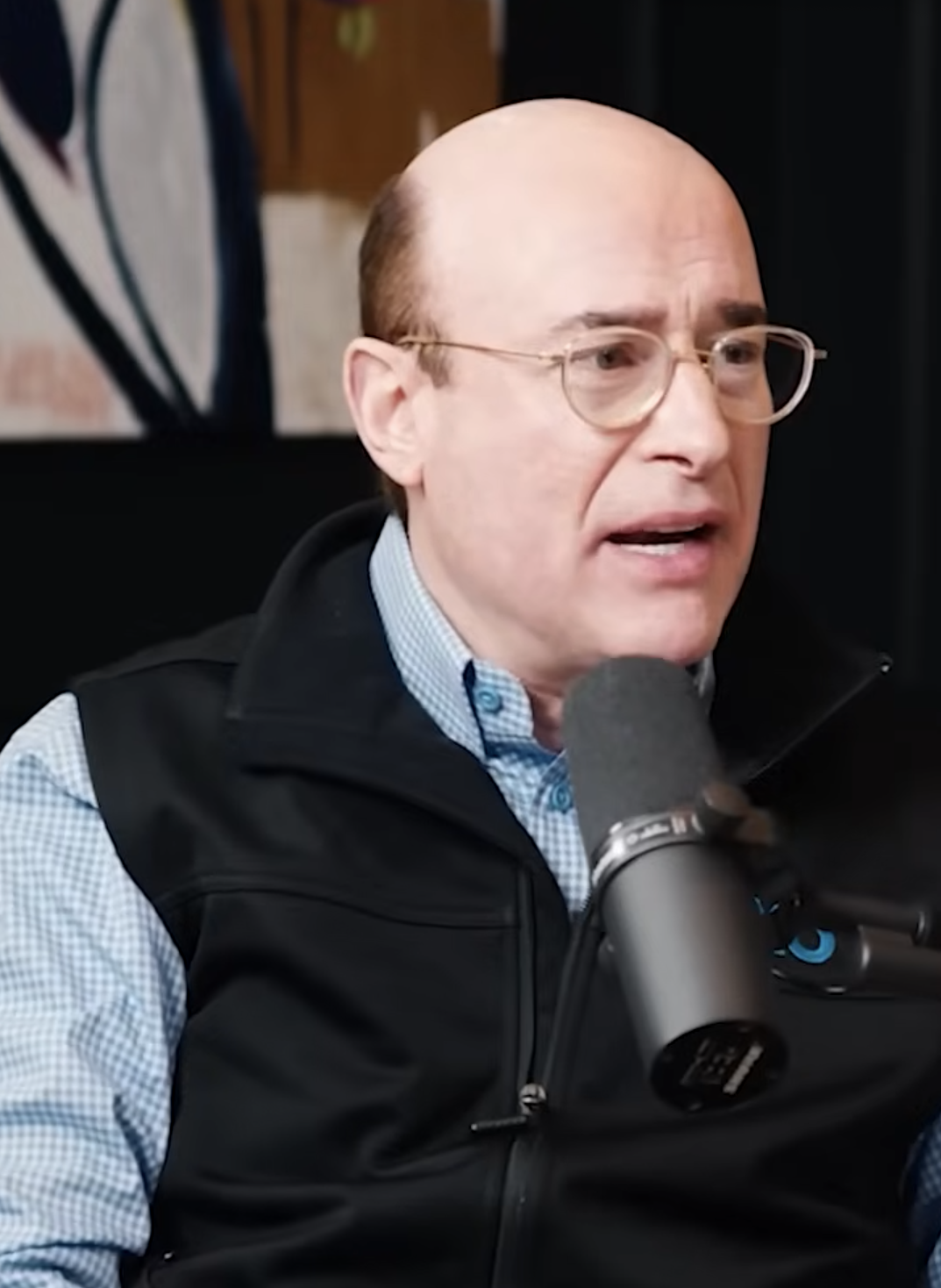
THE BRAD JACOBS PLAYBOOK
YOUTUBE SUMMARY : THE KNOWLEDGE PROJECT PODCAST
CHAPTER INDEX
THE BRAD JACOBS PLAYBOOK
THINK CLEARLY. BUILD SYSTEMS. GROW WITH DISCIPLINE.
How do you repeatedly build businesses at enormous scale?
Study the market, understand the economics, recruit capable people and turn operational improvements into measurable results.
This StackSlide reorganizes Brad Jacobs’s interview into a practical guide, with researched context, limitations and original founder exercises.
HOW TO READ THIS PLAYBOOK
EVIDENCE, INTERPRETATION AND APPLICATION
Jacobs’s approach = his account of what worked.
Verified record = documented events.
Research = findings with stated limits.
Synthesis = our interpretation.
Original exercise = a practical adaptation.
[S1] refers to the supplied transcript. Other source IDs point to the reference pages. Historical figures retain their original context.
UNDERSTAND THE BUSINESS BUILDER
CHAPTER 1
WHO IS BRAD JACOBS?
VERIFIED RECORD | [S2, S3]
Jacobs is a serial business builder associated with oil brokerage and trading, waste services, equipment rental, logistics and building-products distribution.
QXO’s biography credits him with eight billion-dollar or multibillion-dollar companies and approximately 500 acquisitions completed with his teams. These are career-wide figures.
WHAT “EIGHT COMPANIES” MEANS
A USEFUL CLARIFICATION | [S2, S3]
The count includes United Waste Systems, United Rentals, XPO, GXO, RXO and QXO, alongside his earlier private businesses.
GXO separated from XPO in 2021 and RXO in 2022. Those businesses inherited existing operations. The headline groups together different company-building paths, including spin-offs, acquisitions and organic growth.
A RECORD HAS LIMITS AS EVIDENCE
SYNTHESIS | AVOID SURVIVORSHIP BIAS
Repeated success makes Jacobs worth studying. It cannot establish that every technique caused the results or that another founder will reproduce them.
His record also reflects capable teams, financing access, industry conditions and timing. Test the mechanisms against your own constraints and examine examples where similar strategies failed.
THE SYSTEM BEHIND THE STORY
SYNTHESIS OF THE INTERVIEW | [S1]
1. Select a market with room to grow.
2. Find businesses you can improve.
3. Pay a disciplined price.
4. Integrate people and systems.
5. Improve customer service and economics.
6. Reinvest with care.
The pieces reinforce one another. Weak integration, poor financing or bad customer outcomes can interrupt the whole process.
DEFINE SUCCESS BEFORE SCALING
JACOBS’S APPROACH | [S1]
Professionally, Jacobs judges success through shareholder returns, including performance against a benchmark. Personally, he emphasizes family, friends and meaningful relationships.
For your business, define the outcome you are optimizing, the period you will measure and the commitments you must honor while pursuing it.
IMPROVE THE QUALITY OF YOUR THINKING
CHAPTER 2
"I ABSOLUTELY VIEW MYSELF AS A STUDENT OF LIFE."
__ BRAD JACOBS
STAY A STUDENT AS YOU SUCCEED
JACOBS’S APPROACH | QUOTE AND CONTEXT: [S1]
Jacobs keeps asking questions even when he has experience, researchers and advisers. He studies businesses directly to understand how they developed.
Practical application: before defending your answer, ask what you still need to learn. Write down one assumption that a customer, employee or competitor could help you test.
SEPARATE AN EVENT FROM ITS INTERPRETATION
ORIGINAL EXERCISE INSPIRED BY [S1]
Use four lines when a setback triggers a strong reaction:
1. Event: what actually happened?
2. Interpretation: what am I assuming?
3. Evidence: what supports or challenges it?
4. Action: what useful step follows?
Example: one rejected proposal may reveal a poor fit, a budget constraint or an unclear offer. Ask before concluding.
KEEP THE PSYCHOLOGY HISTORY ACCURATE
RESEARCH CONTEXT | [S11]
The interview loosely groups Albert Ellis and Aaron Beck together. Ellis developed rational emotive behavior therapy. Beck developed cognitive therapy and acknowledged Ellis among his influences.
These are related traditions within the broader cognitive-behavioral field. Jacobs’s personal combination of practices is his own account.
CALM CREATES ROOM FOR A BETTER RESPONSE
JACOBS’S APPROACH | [S1]
Jacobs describes reflection, meditation and therapy as influences on how he handles unexpected events. His claim is that composure helps him evaluate opportunities under pressure.
This is personal testimony. The useful business habit is to pause long enough to check the facts, identify the decision and avoid reacting before you understand it.
COMBINE ANALYSIS WITH IMPROVISATION
JACOBS’S ANALOGY | [S1]
He connects mathematics with finding patterns and simplifying complexity. He connects ensemble music with listening, coordination and adapting when circumstances change.
The analogy suggests a useful discipline: maintain clear goals while revising the route as evidence changes. His musical background alone cannot prove a business advantage.
MAKE CONTRARIAN THINKING TESTABLE
ORIGINAL DECISION EXERCISE
Before taking an unpopular position, write:
1. What does the prevailing view assume?
2. What evidence do I interpret differently?
3. What must happen for my thesis to work?
4. What would disprove it?
5. How much can I lose while finding out?
Set a review date. Confidence becomes more useful when it includes a clear test and a limit on exposure.
FIND THE TREND AND THE CUSTOMER
CHAPTER 3
STUDY THE WIDER CONTEXT
JACOBS’S APPROACH | [S1]
Jacobs asks how a situation began, what shapes it today and which forces could change its direction. He deliberately spends time on major trends.
A growing market can support a business, but industry growth does not guarantee that your particular offer will earn attractive margins. Connect the trend to a specific customer problem.
TURN A TREND INTO A COMMERCIAL THESIS
ORIGINAL FRAMEWORK
Complete this chain:
A change is happening → a customer faces a new problem → existing solutions leave a gap → we can solve it → the customer will pay → delivery leaves a sustainable margin.
If a link is missing, the opportunity needs more investigation. A large audience or fashionable technology alone does not complete the chain.
BUILD AN EVIDENCE MAP
ORIGINAL RESEARCH WORKFLOW
Gather four kinds of evidence:
1. Customer interviews: needs and trade-offs.
2. Operating data: frequency and cost of the problem.
3. Competitor evidence: alternatives and pricing.
4. External records: market structure and changes.
Record the date, source and uncertainty. Separate what customers say they want from what they actually purchase.
ASK THE PEOPLE DOING THE WORK
JACOBS’S APPROACH | [S1]
Use individual conversations, small groups, surveys and town halls to discover friction. Jacobs repeatedly asks what the organization should improve and where it already performs well.
Speak with customers and frontline employees as well as senior managers. Compare their accounts to locate gaps between the plan and daily reality.
UNDERSTAND BEFORE CHALLENGING
JACOBS’S APPROACH | [S1]
Jacobs emphasizes focused attention and an atmosphere where people can speak openly. He tries to understand both the message and the feeling behind it before challenging an interpretation.
Application: summarize what you heard, ask whether you understood correctly and then explore alternatives. This sequence can reveal information you would otherwise miss.
AN SME EXAMPLE: SLOW QUOTATIONS
ORIGINAL EXAMPLE | A HYPOTHESIS TO TEST
A small distributor suspects customers lose time waiting for quotes.
Interview ten buyers. Measure current response time, missing product data, quote errors and conversion. Test a faster quotation workflow on a limited set of products.
The opportunity becomes credible if buyers use it, accuracy holds and additional profit exceeds the delivery cost.
FIND VALUE INSIDE OPERATIONAL COMPLEXITY
CHAPTER 4
THE CON-WAY OPPORTUNITY
VERIFIED TRANSACTION + JACOBS’S INTERPRETATION | [S1, S4]
In 2015, XPO announced the acquisition of Con-way at about $3.0 billion, including net debt. Con-way included trucking and logistics operations.
Jacobs describes seeing duplicated functions, organizational silos and room to improve profit. His investment thesis depended on making those operations work better after the acquisition.
WHAT THE TRANSACTION RECORD CONFIRMS
HISTORICAL FIGURES | [S4]
XPO’s September 2015 announcement put the deal at about 5.7 times Con-way’s estimated 2015 EBITDA of $528 million.
It targeted $170 million to $210 million of additional annual operating profit within two years. These were announcement-date estimates and targets. They describe the original case for the acquisition, not verified realized returns.
USE THE ORG CHART TO INVESTIGATE
JACOBS’S APPROACH | [S1]
Look for duplicated work, unclear reporting, excessive handoffs and teams isolated from customers. Jacobs sees organizational structure as a way to uncover improvement opportunities.
A practical review asks who owns each outcome, who makes each decision and where work waits. Confirm the problem in operating data before redesigning roles.
DISTINGUISH WASTE FROM NECESSARY CAPABILITY
SYNTHESIS
A visually simple org chart does not establish that a business works well. Some specialist roles, controls and local differences are necessary.
For each proposed simplification, identify the customer benefit, cost saving, implementation expense and capability at risk. Keep the functions that protect reliable service and sound decisions.
CHECK THE FULL RETURN CALCULATION
SYNTHESIS | CONTEXT FOR [S1, S4]
Jacobs gives approximate retrospective returns for Con-way in the interview. A rigorous calculation would need dated equity contributions, debt changes, distributions, asset sales, spin-off values and the final valuation.
Avoid combining those figures into a precise return without consistent definitions and a complete cash-flow timeline.
IMPROVE ONE BROKEN HANDOFF
ORIGINAL EXERCISE
Choose a recurring delay between two teams. Map the request, required information, owner and completion criteria.
Measure waiting time and rework for one week. Introduce a clearer handoff, then measure again. Include the setup cost.
This small exercise tests the same broad idea: operational disorder may contain value that disciplined execution can release.
CHOOSE AN INDUSTRY YOU CAN IMPROVE
CHAPTER 5
THE INDUSTRY COMES BEFORE THE DEAL
JACOBS’S APPROACH | [S1]
Jacobs studies industries before choosing acquisition targets. His questions include market size, fragmentation, benefits of scale, technology gaps and fit with his operating methods.
An attractive company can still be the wrong acquisition if its industry economics or integration requirements do not fit the business you intend to build.
SIX QUESTIONS FOR INDUSTRY SELECTION
REORGANIZED FROM THE INTERVIEW | [S1]
1. Is the market large enough for the goal?
2. Are enough suitable businesses available?
3. Does scale improve the economics?
4. Can technology create a measurable advantage?
5. Can our management approach work here?
6. Do we understand the business well enough?
Gather evidence for every answer. A large total market is only one part of the case.
EXPLAIN EXACTLY WHY SCALE HELPS
ORIGINAL ANALYSIS CHECKLIST
Possible benefits include denser delivery routes, better equipment utilization, shared systems, wider product availability and lower purchasing costs.
Possible costs include coordination delays, service disruption and added management layers.
Estimate the net effect for the specific business. More revenue can coexist with worse unit economics.
QXO’S ORIGINAL MARKET THESIS
HISTORICAL AMBITION | [S1, S5]
Jacobs chose building-products distribution for its scale, fragmentation and perceived opportunity to improve technology and operations. He discussed an $800 billion market across North America and Western Europe and a $50 billion revenue ambition.
These are his market framing and growth goal, not a guarantee of addressable demand or future performance.
CHECK THE MARKET-SHARE ARITHMETIC
CALCULATED ILLUSTRATION USING INTERVIEW FIGURES
$50 billion ÷ $800 billion = 6.25%.
The interview’s “6%” is a rounded estimate. Even a correct percentage does not establish an executable growth plan.
Products, geography, acquisition prices, customer retention, financing and competitors determine how much of a broad market the company can realistically serve.
A DOCUMENTED STEP AFTER THE INTERVIEW
VERIFIED MILESTONE | [S5, S6]
On April 29, 2025, QXO completed its acquisition of Beacon Roofing Supply at $124.35 per share, with an announced transaction value of approximately $11 billion.
QXO and its transaction counsel both document the closing. This demonstrates execution of the acquisition strategy; the closing itself does not establish long-term value creation.
ACQUIRE WITH A CLEAR ECONOMIC PURPOSE
CHAPTER 6
KNOW WHAT M&A MEANS
PLAIN-LANGUAGE EXPLANATION
M&A means mergers and acquisitions: combining businesses or purchasing control of a business. A roll-up combines several businesses in an industry.
Organic growth comes from expanding the existing operation. Jacobs uses both. Acquisitions can add customers, capabilities and capacity, while operating improvements help the combined business grow.
WRITE A COMPELLING ACQUISITION REASON
JACOBS’S APPROACH | [S1]
Before buying, explain how the target improves the combined business and why the result will benefit customers.
Ask how it fits the existing operations, what can improve and how integration will work. A low asking price or an opportunity to report higher revenue is an incomplete reason to commit capital and management attention.
"IF THIS WAS YOUR MONEY, WOULD YOU BUY THIS COMPANY?"
__ BRAD JACOBS
INTERVIEW THE PEOPLE CLOSEST TO THE BUSINESS
JACOBS’S APPROACH | QUOTE AND CONTEXT: [S1]
Jacobs describes interviewing roughly the top 15 people individually during diligence. He asks whether they would buy the business themselves and what they would change.
The aim is to understand how the business earns money, how it developed and what management believes could improve. Compare the answers with customer and financial evidence.
ASK WHAT MUST BE PRESERVED
JACOBS’S APPROACH | [S1]
Ask what already works so well that changing it could damage the acquisition. Explore customer relationships, specialist knowledge, local service practices and capable employees.
An integration plan should identify strengths to protect alongside inefficiencies to remove. The target’s existing success contains information about its future potential.
TURN DILIGENCE INTO FIVE WORKSTREAMS
ORIGINAL ACQUISITION CHECKLIST
1. Customers: retention, concentration and pricing.
2. Finances: earnings quality, cash and liabilities.
3. Operations: capacity, service and investment needs.
4. People: capabilities, incentives and retention.
5. Systems: data quality, integration cost and security.
List unresolved issues, evidence needed and an accountable owner for each workstream.
UNDERSTAND THE VALUATION SPREAD
JACOBS’S APPROACH WITH QUALIFICATION | [S1]
Jacobs describes raising capital on attractive terms and buying businesses at lower profit multiples as an important source of value. He also emphasizes improving the acquired operation.
A favorable multiple gap depends on market confidence and comparable earnings. It can narrow, and financing costs, dilution or integration expenses can absorb the benefit.
A SIMPLE ACQUISITION MODEL
ORIGINAL EXAMPLE | USD MILLIONS
Assume a business earns $2m EBITDA and costs $12m: a 6× entry multiple.
If EBITDA grows to $3m and the valuation remains 6×, enterprise value becomes $18m. If the multiple falls to 4×, value is $12m.
This simplified example excludes debt, taxes, fees and integration costs. It shows how operating improvement and valuation both affect the outcome.
SET A MAXIMUM PRICE BEFORE NEGOTIATING
ORIGINAL DECISION RULE
Model the target under conservative assumptions, including integration costs, required investment and customer losses. Set the highest price that still meets the required return.
Decide which unresolved findings would stop the deal. Update the price when the evidence changes. Keep a written record so enthusiasm does not quietly rewrite the assumptions.
PROTECT CAPITAL AND FINANCIAL FLEXIBILITY
CHAPTER 7
UNDERSTAND THE MONEY VOCABULARY
EDUCATIONAL DEFINITIONS | [S7]
Revenue: sales before expenses.
Profit: what remains after the expenses included in that measure.
EBITDA: earnings before interest, taxes, depreciation and amortization.
EBITDA is a non-GAAP measure. It leaves out important costs and cannot tell you by itself how much cash is available to repay debt or fund expansion.
FOLLOW THE CASH
FINANCIAL CONTEXT | [S7]
Cash can be tied up in receivables, inventory and equipment even when a business reports profit.
Free cash flow commonly means operating cash flow less capital expenditure, but definitions vary. It may still exclude mandatory debt repayments.
Read the definition and reconciliation before comparing companies or assuming cash is available to spend.
KNOW WHAT A LEVERAGE RATIO MEASURES
INTERVIEW CONTEXT + CALCULATED EXAMPLE | [S1]
Debt ÷ annual EBITDA is one leverage measure. Jacobs discussed a one-to-two-times target for QXO at the interview date.
Example: $2m debt ÷ $1m EBITDA = 2×. If EBITDA falls to $0.5m, the ratio rises to 4× without new borrowing.
A target ratio is context-specific. Cash needs, debt terms and volatility still matter.
PROTECT THE ABILITY TO WITHSTAND SETBACKS
SYNTHESIS
Debt can magnify gains and losses. The interview’s suggestion that bankruptcy only follows excessive debt is too broad. Cash shortages and unpaid obligations can arise through operating losses, legal liabilities or sudden disruptions.
Review liquidity, interest payments, maturities and cash demands under adverse conditions before committing to growth.
KEEP CAPACITY FOR FUTURE OPPORTUNITIES
JACOBS’S APPROACH | [S1]
Jacobs describes reducing leverage after large acquisitions by improving earnings, generating cash and selling selected assets. He also describes periods focused on integration without further acquisitions.
Financial flexibility gives management more options when conditions change. Treat time spent consolidating earlier gains as part of the growth strategy.
COMPARE USES OF CAPITAL
ORIGINAL ALLOCATION EXERCISE
Compare an acquisition with improving the current business, developing a product, reducing debt or retaining cash.
For each option, estimate cash invested, timing, potential return, downside and management effort.
A project must justify the resources it consumes against the other available uses. Revisit the comparison when circumstances change.
STRESS-TEST A CASH FORECAST
ORIGINAL FOUNDER EXERCISE
Build a rolling 13-week cash forecast with a base case and an adverse case. Test slower customer payments, lower sales, higher input costs and an unexpected repair.
Identify the lowest cash balance, payments at risk and actions available before a shortage. The exercise makes the consequences of growth decisions visible in time to respond.
INTEGRATE PEOPLE, DATA AND OPERATIONS
CHAPTER 8
THE INTEGRATION BEGINS WITH THE ACQUISITION THESIS
JACOBS’S APPROACH | [S1, S8]
Jacobs emphasizes preparing integration early and executing after ownership transfers. The work includes systems, culture, shared services and customer communication.
In his 2022 McKinsey interview, he said most of his acquisitions occurred at United Waste and United Rentals; XPO had made 18. The roughly 500-deal headline spans his career.
GIVE THE ORGANIZATION A COMMON INFORMATION BASE
JACOBS’S APPROACH | [S1]
He favors standardized finance systems, people records, customer information and operating dashboards.
Shared definitions allow managers to compare locations and understand performance. If teams calculate the same metric differently, a dashboard can create false confidence. Agree the definition, data owner and reporting schedule before benchmarking.
FOUR SYSTEMS AND THEIR JOBS
REORGANIZED FROM THE INTERVIEW | [S1]
ERP: coordinate core business records and processes.
HRIS: organize employee and workforce information.
CRM: track customers, opportunities and interactions.
Internal communication: connect people across teams.
The objective is reliable shared information. Select tools around the required work and the organization’s ability to maintain them.
USE COMMON STANDARDS WITH LOCAL KNOWLEDGE
JACOBS’S APPROACH + SYNTHESIS | [S1]
Jacobs allows some decentralization close to customers while favoring common systems across the organization.
Specify what every location must share, such as reporting definitions, and where teams need discretion, such as local service arrangements. Make decision rights explicit so standardization supports the customer experience.
AN INTEGRATION PLAN IN THREE STAGES
ORIGINAL OPERATING TEMPLATE
Before closing: map systems, identify key people and plan changes using authorized information.
At closing: communicate leadership, service continuity and immediate priorities.
After closing: migrate in stages, validate data and track customer retention, costs and service.
Give each change an owner, acceptance criteria and a recovery plan.
RETAIN THE KNOWLEDGE YOU ACQUIRED
JACOBS’S APPROACH | [S1]
Jacobs emphasizes starting relationships well, retaining strong talent and communicating repeatedly. Employees need to understand the combined company and their place within it.
Identify who holds critical customer relationships or operating knowledge. Listen to their concerns and involve them in decisions that depend on that knowledge.
MEASURE WHETHER INTEGRATION DELIVERS VALUE
ORIGINAL DASHBOARD
Track customer retention, service errors, employee departures, migration cost, cash generation and realized savings.
Separate savings already achieved from planned savings. Show implementation costs alongside the benefits.
Review whether the acquisition is meeting its original economic case and whether the customer experience is improving.
BUILD A TEAM THAT SPEAKS HONESTLY
CHAPTER 9
"YOU NO LONGER HAVE THE OPTION OF LEADING THROUGH FEAR OR MANAGING THROUGH FEAR"
__ AMY EDMONDSON
PSYCHOLOGICAL SAFETY SUPPORTS LEARNING
RESEARCH | QUOTE: [S10]; STUDY: [S9]
Amy Edmondson’s 1999 study of 51 manufacturing teams found an association between psychological safety and learning behavior. It does not establish a universal formula for profit.
The practical implication is to make it easier to report errors, ask for help and question assumptions, while keeping clear expectations for performance.
GIVE SPECIFIC, SINCERE APPRECIATION
JACOBS’S APPROACH | [S1]
Jacobs begins performance discussions by recognizing concrete contributions. He warns that people detect false praise.
Name what the person did, why it mattered and the effect it had. Then discuss the improvement needed with the same level of specificity. An honest conversation requires both acknowledgment and a clear description of the problem.
USE THREE WINS AND THREE IMPROVEMENTS
JACOBS’S PRACTICE | [S1]
He asks people to identify three achievements and three things they could improve. The structure encourages reflection on strengths and gaps.
Turn the discussion into an agreed next action, support needed and a review date. Avoid forcing equal weight when a serious issue needs more attention. The format should serve the conversation.
RECOVER A DAMAGED CUSTOMER RELATIONSHIP
APPLICATION OF JACOBS’S APPROACH | [S1]
1. Listen without interruption.
2. Clarify what failed and its impact.
3. Confirm what the customer needs now.
4. Agree a remedy, owner and deadline.
5. Follow up and check the result.
Jacobs emphasizes understanding the customer’s emotion as well as the operational problem. A response becomes credible when the promised action happens.
REWARD OUTCOMES AND COLLABORATION
JACOBS’S APPROACH | [S1]
Jacobs favors compensation connected to shareholder outcomes and rewards for helping colleagues succeed. For senior executives, he discusses equity linked to relative total shareholder return.
His example thresholds are illustrations from the conversation. They should not be treated as the current compensation policy of every company he has led.
DESIGN INCENTIVES WITH A WIDER VIEW
ORIGINAL SME EXAMPLE
A sales bonus based only on revenue may encourage discounting or unsuitable customers. Test a design that includes collected gross profit, retention and service quality.
Check what employees can control and how the measures could be manipulated. Keep the plan understandable. Review whether it rewards the behavior the business actually needs.
MAKE ROOM FOR DIFFERENT MOTIVATIONS
SYNTHESIS OF THE INTERVIEW
Jacobs prefers financially motivated people in his businesses and also recognizes that artists, academics and others may value different outcomes.
For your team, understand the actual mix: income, mastery, autonomy, purpose, security and recognition. Match expectations openly. An interview preference does not establish a universal rule for hiring.
TURN MEETINGS INTO DECISIONS
CHAPTER 10
GIVE THE SPEAKER FULL ATTENTION
JACOBS’S APPROACH | [S1]
Jacobs asks meeting participants to stop side conversations, put devices aside and focus on one speaker at a time.
He wants people to understand the contribution before responding. Practical application: distribute essential information beforehand, state the decision needed and make space for information that challenges the initial view.
USE THE RIGHT PEOPLE FOR THE DECISION
JACOBS’S APPROACH | [S1]
He brings finance, operations and people leaders together when a decision crosses those disciplines. He avoids consuming senior attention on small matters.
For each decision, name an accountable owner, identify the expertise needed and set a deadline. A group can improve the input while clear responsibility keeps the action moving.
MAKE FP&A A DECISION PARTNER
JACOBS’S APPROACH | [S1]
FP&A means financial planning and analysis. Jacobs uses it to turn proposed actions into numbers, forecasts and probabilities.
The team compares actual results with expectations, detects unrealistic assumptions and helps allocate capital and time. The purpose is to understand the likely outcome well enough to act and adjust.
CALIBRATE FORECASTS WITH ACTUAL RESULTS
JACOBS’S APPROACH | [S1]
Some managers systematically overpromise; others set expectations too low. Jacobs describes reviewing their forecasting history when evaluating new projections.
Track the original prediction, assumptions and result. Investigate the cause of misses. Use ranges and explicit probabilities when uncertainty is material instead of disguising it as precision.
USE EXPECTED VALUE CAREFULLY
ORIGINAL EXAMPLE | USD
A project has a 30% chance of producing $50,000 and a 70% chance of producing $0. It costs $10,000 in either case.
Expected net value = 0.30 × $50,000 − $10,000 = $5,000.
That average is not a promised result. You could lose $10,000. Also consider cash timing, the reliability of the probabilities and the value of management time.
MAKE THE BOARD WELL INFORMED
JACOBS’S APPROACH | [S1]
Jacobs wants directors to see customer feedback, employee feedback and operating information. He favors informed questioning and direct access to people who understand the work.
His account describes a management practice. Formal governance requirements still depend on the company. The useful lesson is to give oversight access to inconvenient facts.
END WITH CLARITY AND GENUINE RECOGNITION
JACOBS’S APPROACH + PRACTICAL ADAPTATION | [S1]
Jacobs sometimes closes difficult meetings by asking whose contribution raised others’ respect and why.
Before the meeting ends, also confirm decisions, owners and deadlines. Keep appreciation specific and voluntary. Adapt the format to the team; the interview’s descriptions of very long sessions are examples of his practice, not a productivity standard.
APPLY TECHNOLOGY TO A DEFINED PROBLEM
CHAPTER 11
FIND A TECHNOLOGY GAP WORTH CLOSING
JACOBS’S APPROACH | [S1]
Jacobs looks for industries where better technology can improve how the business operates. He pairs that search with willingness to invest in people and systems.
Define the economic mechanism: fewer errors, faster service, better utilization or more successful sales. Then identify the data and operating changes needed to realize the benefit.
TREAT AI AS A MEASURABLE EXPERIMENT
ORIGINAL FOUNDER APPLICATION
Select one narrow workflow, such as drafting a quote from approved product data. Record today’s time, error rate and cost.
Run a limited pilot with human review and compare the results. Include software, setup, supervision and correction costs. Expand when the measured benefit holds under real operating conditions.
DISTINGUISH AI FORECASTS FROM FINDINGS
INTERVIEW INTERPRETATION + RESEARCH CONTEXT | [S1, S12]
Jacobs expresses optimism about AI, machine empathy and a future merging of humans with technology. These are speculative views.
Butlin and colleagues’ 2023 report proposes theory-based indicators for assessing AI consciousness. It stresses uncertainty: satisfying indicators would not establish consciousness. It does not verify Jacobs’s forecast.
KEEP THE BUSINESS CASE INDEPENDENT OF SPECULATION
SYNTHESIS
A useful deployment can be justified through observable outcomes such as accuracy, time saved and customer satisfaction.
Claims about machines feeling emotions or humanity becoming a new species require different evidence. Keep those assumptions outside the operating forecast unless the decision truly depends on them and the uncertainty is explicit.
BUILD A LEARNING LOOP AROUND THE TOOL
ORIGINAL WORKFLOW
Observe the work → choose a task → establish a baseline → test → review errors → measure net benefit → revise.
Assign a person to own the outcome. Keep a record of exceptions and provide a way to recover from failure. Technology becomes easier to improve when the surrounding process makes its strengths and limitations visible.
APPLY THE PLAYBOOK AT YOUR OWN SCALE
CHAPTER 12
"RETURN ON CAPITAL AND RETURN ON TIME."
__ BRAD JACOBS
MANAGE TWO SCARCE RESOURCES
JACOBS’S EMPHASIS | QUOTE AND CONTEXT: [S1]
Jacobs repeatedly asks how money and attention are being used. A project can consume little cash yet absorb weeks of valuable work.
For each initiative, record investment, people-hours, expected benefit and review date. Identify what will receive less attention if this project goes ahead. Compare the outcome with that opportunity cost.
BUILD A ONE-PAGE OPERATING THESIS
ORIGINAL FOUNDER TEMPLATE
Customer: who has the problem?
Problem: what costs them money or time?
Offer: what outcome will we deliver?
Advantage: why can we deliver it well?
Economics: what margin and cash remain?
Execution: who owns each step?
Risk: what could invalidate the plan?
Evidence: what must we test next?
Keep the answers concrete enough for someone else to challenge.
WEEK 1: UNDERSTAND THE CURRENT REALITY
ORIGINAL 30-DAY IMPLEMENTATION PLAN
Interview customers and the people delivering the service. Map one recurring workflow and its biggest friction points.
Establish baseline measures for response time, errors, conversion and cash collection. Write down the assumptions you still cannot verify.
Deliverable: a problem statement, process map and evidence list.
WEEK 2: CHOOSE ONE IMPROVEMENT
ORIGINAL 30-DAY IMPLEMENTATION PLAN
Compare three possible improvements by customer impact, cost, time required and uncertainty. Select one manageable experiment.
Set an owner, budget, success measure and stop condition. Identify what already works and must be preserved.
Deliverable: a short test plan with the expected result and the evidence needed to evaluate it.
WEEK 3: EXECUTE WITH FEEDBACK
ORIGINAL 30-DAY IMPLEMENTATION PLAN
Run the test with a small, defined customer or operating group. Hold brief reviews of results, errors and unexpected effects.
Record actual costs and time. Ask participants what to keep, change or stop. Keep the original baseline visible.
Deliverable: observed results and a list of changes needed before wider use.
WEEK 4: DECIDE WHAT DESERVES EXPANSION
ORIGINAL 30-DAY IMPLEMENTATION PLAN
Compare the outcome with the initial case. Check customer benefit, service quality, costs, time and cash effects.
Decide whether to expand, revise or stop. Document the working method and assign an owner for continued measurement.
Deliverable: a decision supported by evidence and the next execution plan.
BUILD SPEED AND QUALITY INTO THE SAME PROCESS
JACOBS’S EMPHASIS + APPLICATION | [S1]
Jacobs argues for moving quickly while maintaining quality through planning and understanding inefficiency.
Practical measures include cycle time and defects together. If delivery gets faster but rework rises, investigate the whole process. Remove unnecessary waiting, clarify requirements and check quality at the point where errors occur.
TURN THE LESSON INTO A WORKFLOW
YOUR NEXT ACTION INSIDE AGENTX.ID
Use this prompt:
“Help me improve [business or service]. My target customer is [customer]. The recurring problem is [problem]. Create a 30-day WorkFlow with research steps, one measurable experiment, owners, tools, budget, success criteria and a weekly review.”
Save the validated method as a StackSlide and update it when new evidence changes the plan.
SOURCES AND EVIDENCE NOTES
CHAPTER 13
WHAT WAS CHECKED AND WHAT REMAINS UNCERTAIN
RESEARCH NOTES | CHECKED SEPTEMBER 12, 2026
Company records confirm selected transactions and spin-offs. A separate transaction participant corroborates Beacon’s closing. Research adds context on team learning and AI consciousness.
Jacobs’s methods and personal stories primarily remain interview testimony. Exact lifetime returns and a complete deal-by-deal acquisition count were not independently audited.
EDITORIAL AND QUOTATION NOTES
HOW THE TRANSCRIPT WAS TRANSFORMED
Advertising and repeated introductions were removed. Related ideas were combined into a learning sequence. No timestamps are displayed because the material is reorganized.
Brad Jacobs quotes are short verbatim excerpts from the supplied transcript. The Amy Edmondson quote comes from [S10]. Original exercises and calculations are explicitly labeled.
S1: BRAD JACOBS INTERVIEW
SOURCE REFERENCE
The Knowledge Project with Shane Parrish. User-supplied transcript of “I did it 8 Times!” Primary source for Jacobs’s methods, anecdotes and quote excerpts.
https://www.youtube.com/watch?v=pduZ-bfcKAQ
S2: QXO LEADERSHIP BIOGRAPHY
SOURCE REFERENCE
QXO’s corporate biography of Brad Jacobs. Supports the company’s eight-business description and approximate career acquisition count. Company-authored account.
https://www.qxo.com/qxo-leadership/brad-jacobs
S3: XPO CORPORATE HISTORY
SOURCE REFERENCE
XPO 2023 proxy and annual-report materials. Documents Jacobs’s earlier companies and the GXO and RXO spin-offs. Historical roles should be read at the document date.
https://investors.xpo.com/static-files/4860cb8d-651f-498d-9346-3f8526011402
S4: CON-WAY ACQUISITION ANNOUNCEMENT
SOURCE REFERENCE
XPO, September 9, 2015. Transaction value, valuation multiple and intended operating improvements. Forecasts in this announcement are historical targets.
https://investors.xpo.com/news-releases/news-release-details/xpo-logistics-acquire-con-way/
S5: QXO COMPLETES BEACON ACQUISITION
SOURCE REFERENCE
QXO, April 29, 2025. Confirms completion, per-share price and approximate transaction value. Also states the company’s revenue ambition.
https://investors.qxo.com/news/news-details/2025/QXO-Completes-Acquisition-of-Beacon-Roofing-Supply/default.aspx
S6: BEACON TRANSACTION CORROBORATION
SOURCE REFERENCE
Paul, Weiss, April 29, 2025. Transaction counsel separately confirms its role in the completed acquisition and financing. A transaction participant, not a disinterested evaluator.
https://www.paulweiss.com/insights/client-news/qxo-acquires-beacon-roofing-supply-in-11-billion-deal
S7: EBITDA AND CASH-FLOW DEFINITIONS
SOURCE REFERENCE
US SEC, Non-GAAP Financial Measures. Sections 102.07 and 103 explain free cash flow, EBITDA and important presentation limits.
https://www.sec.gov/corpfin/non-gaap-financial-measures
S8: JACOBS ON BUILDING THROUGH M&A
SOURCE REFERENCE
McKinsey interview with Andy West, November 8, 2022. Jacobs clarifies where most acquisitions occurred and discusses integration. Another interview with the same speaker, not independent proof.
https://www.mckinsey.com/capabilities/strategy-and-corporate-finance/our-insights/xpos-brad-jacobs-on-building-businesses-through-m-and-a
S9: PSYCHOLOGICAL SAFETY: ORIGINAL RESEARCH
SOURCE REFERENCE
Amy Edmondson, 1999. Psychological Safety and Learning Behavior in Work Teams, Administrative Science Quarterly 44:350–383. Study of 51 manufacturing teams; supports an association with learning behavior.
https://web.mit.edu/curhan/www/docs/Articles/15341_Readings/Organizational_Learning_and_Change/Edmondson_1999_Psychological_safety.pdf
S10: AMY EDMONDSON: LEADERSHIP AND FEAR
SOURCE REFERENCE
Harvard Business School, June 14, 2023. Interview-based article featuring Edmondson. Source of her quote used in Chapter 9.
https://www.library.hbs.edu/working-knowledge/four-steps-to-build-the-psychological-safety-that-high-performing-teams-need-today
S11: AARON BECK ON HIS INFLUENCES
SOURCE REFERENCE
Beck Institute, June 8, 2021. Aaron Beck discusses influences on cognitive therapy, including Albert Ellis. Used to clarify the interview’s simplified historical account.
https://beckinstitute.org/blog/the-influence-of-behavior-therapy-and-neo-freudism-on-the-development-of-cognitive-therapy/
S12: AI CONSCIOUSNESS: RESEARCH AND UNCERTAINTY
SOURCE REFERENCE
Butlin and colleagues, 2023. Consciousness in Artificial Intelligence: Insights from the Science of Consciousness. Theory-based assessment framework with explicit limitations.
https://arxiv.org/abs/2308.08708
ALL SOURCES AT A GLANCE
SOURCE INDEX | FULL REFERENCES ON PRECEDING PAGES
S1: Jacobs / The Knowledge Project
S2: QXO biography
S3: XPO corporate history
S4: XPO / Con-way announcement
S5: QXO / Beacon closing
S6: Paul, Weiss / Beacon
S7: SEC / Non-GAAP measures
S8: McKinsey / Jacobs interview
S9: Edmondson / 1999 study
S10: HBS / Edmondson interview
S11: Beck Institute / therapy history
S12: Butlin et al. / AI consciousness