
CHAPTER INDEX
WHY CUSTOMER CONVERSATIONS FAIL
INTRODUCTION
Talking to customers should stop us from building products nobody wants. Yet bad conversations often create false confidence.
The problem is rarely a lack of conversation. It is asking questions that invite compliments, speculation, and polite lies.
THE TRUTH IS FRAGILE
CUSTOMER LEARNING IS EXCAVATION
Customer truth is buried beneath assumptions, politeness, and incomplete memories.
Push too hard and people tell you what you want to hear. Stay too cautious and you learn nothing. The goal is to dig deeply with questions that do not contaminate the evidence.
FALSE POSITIVES ARE DANGEROUS
BAD DATA FEELS REASSURING
A useless conversation wastes an hour. A misleading conversation can waste months of cash, product work, and team energy.
Praise such as “great idea” feels like validation, but it does not prove that the problem matters or that anyone will buy the solution.
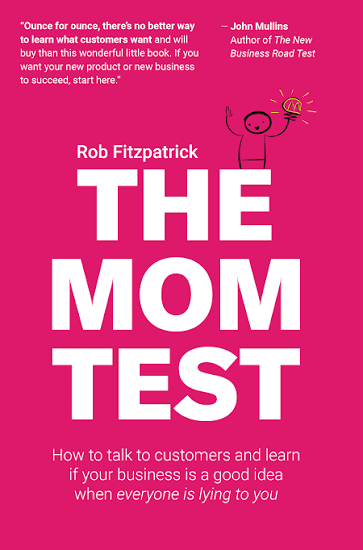
THE MOM TEST
CHAPTER 1
THE MOM TEST
CHAPTER 1
You should not ask your mother—or anyone else—whether your business is a good idea.
The Mom Test is a set of rules for asking questions about a person’s real life so clearly that even someone who loves you cannot distort the answer to protect your feelings.
NEVER ASK FOR APPROVAL
THE MARKET DECIDES
“Do you think this is a good idea?” invites opinion, kindness, and guesswork.
Instead, study how the person currently handles the problem: what happened last time, what they tried, what failed, what it cost, and whether they are actively searching for something better.
HOW A BAD CONVERSATION WORKS
PITCHING CREATES THE ANSWER
1. Explain the idea.
2. Ask a hypothetical question.
3. Defend the price.
4. Add features until they agree.
5. Treat politeness as proof.
The founder leaves encouraged. The customer leaves without making any commitment. Nothing reliable was learned.
“DOING IT WRONG IS WORSE THAN DOING NOTHING AT ALL.”
__ROB FITZPATRICK
HOW A USEFUL CONVERSATION WORKS
STUDY REAL BEHAVIOR
Ask what they did recently. Follow unexpected details. Explore what they bought, ignored, searched for, or received as a gift.
Without presenting the product, you can uncover customer segments, existing habits, acquisition channels, price expectations, and the risks hidden inside your original idea.
A USEFUL CONVERSATION PRODUCES FACTS
EVIDENCE IMPROVES THE BUSINESS
Good customer learning gives you concrete facts about people’s lives and worldviews.
Those facts help answer difficult questions: Who has the strongest need? What do they already do? How will you reach them? What alternatives exist? Which assumption could destroy the business?
THE THREE RULES
THE MOM TEST IN ONE PAGE
1. Talk about their life instead of your idea.
2. Ask about specific events in the past instead of opinions or predictions about the future.
3. Talk less and listen more.
REPLACE WEAK QUESTIONS
MOVE FROM OPINION TO EVIDENCE
Instead of “Would you buy it?” ask “How do you solve this now?”
Instead of “How much would you pay?” ask “What does this problem currently cost?”
Instead of “What should I build?” ask “Why is that important, and what happened the last time?”
“THEY OWN THE PROBLEM. YOU OWN THE SOLUTION.”
__ROB FITZPATRICK
AVOIDING BAD DATA
CHAPTER 2
AVOIDING BAD DATA
CHAPTER 2
Even when you begin with good questions, conversations can drift into misleading territory.
Bad data creates false negatives and false positives. Learn to recognize its three common forms: compliments, fluff, and ideas.
1. COMPLIMENTS
PRAISE IS NOT EVIDENCE
Compliments usually mean the person wants to encourage you, end the pitch politely, or protect your feelings.
Do not collect praise. Redirect it toward facts: Why do they like it? What would it replace? When did the problem last occur? What money, time, or risk would it save?
“COMPLIMENTS ARE THE FOOL’S GOLD OF CUSTOMER LEARNING.”
__ROB FITZPATRICK
2. FLUFF
GENERICS, HYPOTHETICALS, AND PROMISES
Fluff sounds like: “I always…,” “I would…,” or “I might…”
Anchor it to a real event. Ask when it last happened, then request a walkthrough. Specific past behavior reveals frequency, urgency, workarounds, cost, and whether the person genuinely cares enough to act.
3. IDEAS
UNDERSTAND REQUESTS; DO NOT OBEY THEM
Feature requests contain useful signals, but customers are not responsible for designing the solution.
Dig beneath every request. Ask why they want it, what they could do afterward, how they cope without it, and why the current workaround is inadequate. The motivation matters more than the feature.
KEEP YOUR EGO OUT
PROTECT THE QUALITY OF THE ANSWER
Once people notice that your identity, savings, or reputation depend on the idea, they become kinder and less honest.
Delay the pitch. If you reveal too much, return the focus to their life. Approval does not improve the business. Facts, commitments, and hard truths do.
TALK LESS
SILENCE CREATES LEARNING
Do not interrupt an important signal to explain that your product already handles it. Do not correct the customer’s mental model while they are revealing it.
Listen, take the clue, and keep digging. Every minute spent pitching is a minute in which you cannot learn.
ASKING IMPORTANT QUESTIONS
CHAPTER 3
ASKING IMPORTANT QUESTIONS
CHAPTER 3
Non-biased questions are not automatically useful. A safe question can still be irrelevant.
Your conversations must attack the uncertainties that could change, weaken, or kill the business—not merely collect interesting details.
ASK THE SCARY QUESTION
FACE THE RISK DIRECTLY
The most important question is often the one you hope not to ask: Is the problem serious? Is there a budget? Who can block the purchase? Why has nobody solved it?
If an answer could invalidate the business, you need it early—before more money and time are committed.
“YOU SHOULD BE TERRIFIED OF AT LEAST ONE OF THE QUESTIONS YOU’RE ASKING.”
__ROB FITZPATRICK
LEARN TO LOVE BAD NEWS
REJECTION CREATES PROGRESS
A strong “no” can save months. A lukewarm “maybe” keeps weak ideas alive.
Bad news helps you narrow the segment, change the product, or stop. Search for evidence that proves you wrong. A business cannot be built on polite excitement that never becomes action.
START BROAD, THEN ZOOM
FIND THE STRONG SIGNAL FIRST
Begin with the person’s goals, workflow, constraints, and existing behavior. Zoom into a problem only after you detect urgency or emotion.
Premature detail can make a minor inconvenience look important. First establish that the problem matters. Then investigate how it works.
LOOK AT THE ELEPHANT
DE-RISK THE WHOLE BUSINESS
Do not spend every conversation confirming one convenient assumption while ignoring the larger threat.
Map the business risks: customer need, buying authority, budgets, adoption barriers, channels, partners, regulations, and technical feasibility. Ask questions that reduce the biggest uncertainty first.
PREPARE THREE BIG QUESTIONS
GIVE EVERY CONVERSATION A PURPOSE
Before speaking with a specific type of person, write the three things you most need to learn.
This keeps the conversation focused, makes scary questions harder to avoid, and prevents comfortable trivia from consuming the time. Update the list as your beliefs change.
KEEPING IT CASUAL
CHAPTER 4
KEEPING IT CASUAL
CHAPTER 4
Early learning works well as a natural conversation. Formal interviews create pressure, scripts, and socially desirable answers.
A short chat at an event, café, workplace, or industry gathering can reveal as much as a scheduled meeting—often with less bias.
AVOID THE MEETING ANTI-PATTERN
DO NOT CREATE UNNECESSARY FORMALITY
A formal meeting makes the other person feel they are doing you a favor. It can turn curiosity into an interview and a conversation into a pitch.
Use existing moments. Ask one relevant question, follow the signal, and stop when you have learned what you need.
KEEP EARLY CHATS SHORT
LEARNING SHOULD FIT REAL LIFE
Early questions are broad and can often be answered within minutes. Conversations become longer only as you understand the market and need details about workflows, integrations, procurement, or implementation.
The right length is the shortest conversation that resolves the learning goal.
NUDGE WITHOUT PITCHING
REVEAL ONLY WHAT IS NECESSARY
You may need to guide the discussion toward a relevant topic. Give enough context to make the question natural, then return attention to the customer.
Share as little as possible about the idea while still moving the conversation in a useful direction.
COMMITMENT AND ADVANCEMENT
CHAPTER 5
COMMITMENT AND ADVANCEMENT
CHAPTER 5
Eventually, you must show the product and test whether interest is real. Compliments become even less reliable at this stage.
Separate genuine customers from friendly observers by asking them to give something valuable or move to a clear next step.
COMMITMENT HAS A COST
SERIOUSNESS REQUIRES SACRIFICE
Real validation involves giving up something valuable:
• Time to test or collaborate
• Reputation through an introduction
• Internal effort to involve a decision-maker
• Money through a deposit, preorder, or purchase
The greater the cost, the stronger the signal.
ADVANCEMENT MOVES THE DEAL
EVERY MEETING NEEDS A DESTINATION
A meeting succeeds when it advances to a defined next step: another stakeholder, a technical review, a trial, a proposal, procurement, or payment.
“Let’s stay in touch” is not advancement. Decide what progress should look like before the meeting begins.
“IF YOU DON’T KNOW WHAT HAPPENS NEXT, THE MEETING WAS POINTLESS.”
__ROB FITZPATRICK
GIVE THEM A CHANCE TO REJECT YOU
A REAL LEAD MUST DECIDE
Interest remains imaginary until the person can say no to a concrete request.
Ask for the next meeting, introduction, trial, access, deposit, preorder, or purchase. Rejection is useful information. Endless friendliness without commitment creates a pipeline of zombie leads.
IN EARLY SALES, LEARNING COMES FIRST
REVENUE IS EVIDENCE
Start sales conversations with open learning. Understand this buyer’s priorities before presenting the solution. Then ask for commitment.
Early revenue matters because it proves behavior, clarifies the buying process, and exposes objections. It is also a by-product of learning well.
FINDING CONVERSATIONS
CHAPTER 6
FINDING CONVERSATIONS
CHAPTER 6
Knowing how to ask good questions is useless if you cannot reach the right people.
Customer conversations can come from casual encounters, communities, teaching, content, events, introductions, advisors, universities, investors, and early signups.
GO WHERE CUSTOMERS ALREADY GATHER
IMMERSE YOURSELF IN THEIR WORLD
Attend their conferences, meetups, workplaces, online groups, and professional communities. Teach, speak, volunteer, or organize an event around a topic they care about.
Proximity creates repeated conversations, sharper industry understanding, and credibility before you have a finished product.
BRING THEM TO YOU
CREATE A REASON TO ENGAGE
Organize a meetup, publish industry insights, teach a workshop, offer office hours, or launch a focused landing page.
These activities attract relevant people and make them more willing to help. The goal is not vanity metrics; it is a stream of qualified conversations.
WARM INTRODUCTIONS WIN
BORROW TRUST FROM THE NETWORK
Ask friends, advisors, professors, investors, colleagues, and existing contacts who they know. Make the introduction easy by explaining who you need, why the conversation matters, and how little time it requires.
A few degrees of connection can reach almost anyone.
FRAME THE MEETING
VISION · FRAMING · WEAKNESS · PEDESTAL · ASK
1. Vision: Name the problem or change you pursue.
2. Framing: Explain your stage and that you are learning.
3. Weakness: State what you do not understand.
4. Pedestal: Explain why this person can help.
5. Ask: Request a specific conversation.
USE THE ADVISORY FLIP
SEARCH FOR INSIGHT, NOT APPROVAL
Enter the room evaluating whether this person could become a valuable industry advisor.
That mindset reduces neediness, keeps you curious, and helps you control the conversation. You are looking for knowledgeable people who understand the market and care about the problem.
STOP WHEN LEARNING REPEATS
CONVERSATION COUNT IS NOT THE GOAL
Continue talking until you stop hearing important new information. A focused segment may reach this point after only three to five conversations.
If ten conversations still produce wildly different answers, the segment is probably too broad. Tighten it before collecting more data.
CHOOSING YOUR CUSTOMERS
CHAPTER 7
CHOOSING YOUR CUSTOMERS
CHAPTER 7
Startups rarely suffer from too few possibilities. They drown in too many customers, features, and directions.
Segmentation turns mixed feedback into a coherent problem. Before serving everyone, become extremely useful to someone.
BROAD SEGMENTS CREATE NOISE
DIFFERENT CUSTOMERS WANT DIFFERENT PRODUCTS
“Students,” “advertisers,” or “small businesses” may contain dozens of groups with different goals, budgets, workflows, and constraints.
Twenty interviews across twenty types of customer are not twenty confirmations. They are one conversation about twenty different business ideas.
SLICE UNTIL THE SEGMENT IS FINDABLE
MOVE FROM BROAD MARKET TO SPECIFIC GROUP
Ask repeatedly:
1. Who wants this most?
2. What problem or goal motivates them?
3. What do they already do about it?
4. Where do those people gather?
5. Can you reach them now?
If you cannot locate them, keep slicing.
CHOOSE A WHO–WHERE PAIR
A USEFUL SEGMENT IS ACTIONABLE
Select a group you can describe and locate. Then evaluate it using three criteria:
• Reachable: You can speak with them efficiently.
• Profitable: Their problem supports a business.
• Rewarding: You want to spend years serving them.
TALK TO EVERY CRITICAL STAKEHOLDER
USERS ARE NOT ALWAYS BUYERS
A product may involve users, buyers, managers, administrators, parents, partners, distributors, IT, finance, or regulators.
Map everyone who can benefit, pay, approve, block, distribute, or influence adoption. Understand each group’s goals and constraints.
RUNNING THE PROCESS
CHAPTER 8
RUNNING THE PROCESS
CHAPTER 8
Good questions still fail without a repeatable process. Customer learning needs preparation, shared participation, useful notes, team review, and updated decisions.
The objective is to move learning out of one founder’s head and into the company.
PREVENT THE LEARNING BOTTLENECK
CUSTOMER TRUTH BELONGS TO THE TEAM
When one person attends every meeting and summarizes from memory, their interpretation becomes unquestionable. The team hears conclusions without evidence.
Share direct observations, quotes, context, and commitments promptly so product decisions use the whole team’s judgment.
PREPARE BEFORE THE CONVERSATION
ONE HOUR IS ENOUGH
• Agree on the three big learning goals.
• Identify the scary question.
• Research facts available online.
• Write your current assumptions.
• Decide the ideal commitment or next step.
• Choose the right person to speak with.
BRING THE TEAM INTO THE ROOM
FOUNDERS CANNOT OUTSOURCE LEARNING
Two people often work best: one leads the conversation while the other listens and takes notes. Technical decision-makers should attend some meetings and hear reactions firsthand.
Until the business model is repeatable, founders must remain close to customer truth.
WRITE DOWN SIGNALS
CAPTURE EVIDENCE THAT CAN BE REVIEWED
Record exact quotes when useful, plus context: emotions, obstacles, workarounds, current tools, budgets, purchasing criteria, people mentioned, and follow-up tasks.
Use a system that is searchable, sortable, shared, and simple enough that the team will actually review it.
BEFORE, DURING, AFTER
THE COMPLETE OPERATING LOOP
Before: choose the segment, learning goals, people, and desired commitment.
During: frame casually, ask about real behavior, deflect compliments, anchor fluff, dig into signals, and request next steps.
After: review notes, update beliefs, and define the next three questions.
CUSTOMER LEARNING SHOULD INCREASE SPEED
DO ENOUGH TO MOVE FORWARD
Spend hours preparing, not weeks. Use one or two focused weeks to gain direction, then put something in front of customers that allows commitment.
Continue learning alongside building and selling. Customer conversations are a tool for progress, not a substitute for progress.
FROM CONVERSATION TO ACTION
CONCLUSION
You will still ask bad questions and slip into pitch mode. Review the mistake, correct the conversation, and improve as a team.
The Mom Test is valuable because it helps expose weak assumptions quickly—so you can refine the idea, choose a customer, and return to building.
“GO BUILD YOUR DANG COMPANY ALREADY.”
__ROB FITZPATRICK
THE MOM TEST CHEAT SHEET
USE THIS IN EVERY CONVERSATION
1. Ask about their life.
2. Ask about specific past events.
3. Listen more than you speak.
4. Avoid compliments, fluff, and feature obedience.
5. Face one scary question.
6. Seek commitment or advancement.
7. Record evidence.
8. Update the plan.
WHAT A GOOD MEETING PRODUCES
FACTS · COMMITMENT · ADVANCEMENT
Facts: Concrete evidence about what people do and why.
Commitment: They give something valuable—time, reputation, access, or money.
Advancement: The relationship moves to the next step.
If none appears, the meeting probably did not create meaningful progress.
ASK BETTER. LEARN FASTER. BUILD SMARTER.
THE FINAL PRINCIPLE
Customer conversations are not a search for encouragement. They are a disciplined way to reduce uncertainty.
Study real behavior. Find the strongest problem. Choose a reachable customer. Ask for commitment. Share the evidence. Then act on what you learned.