
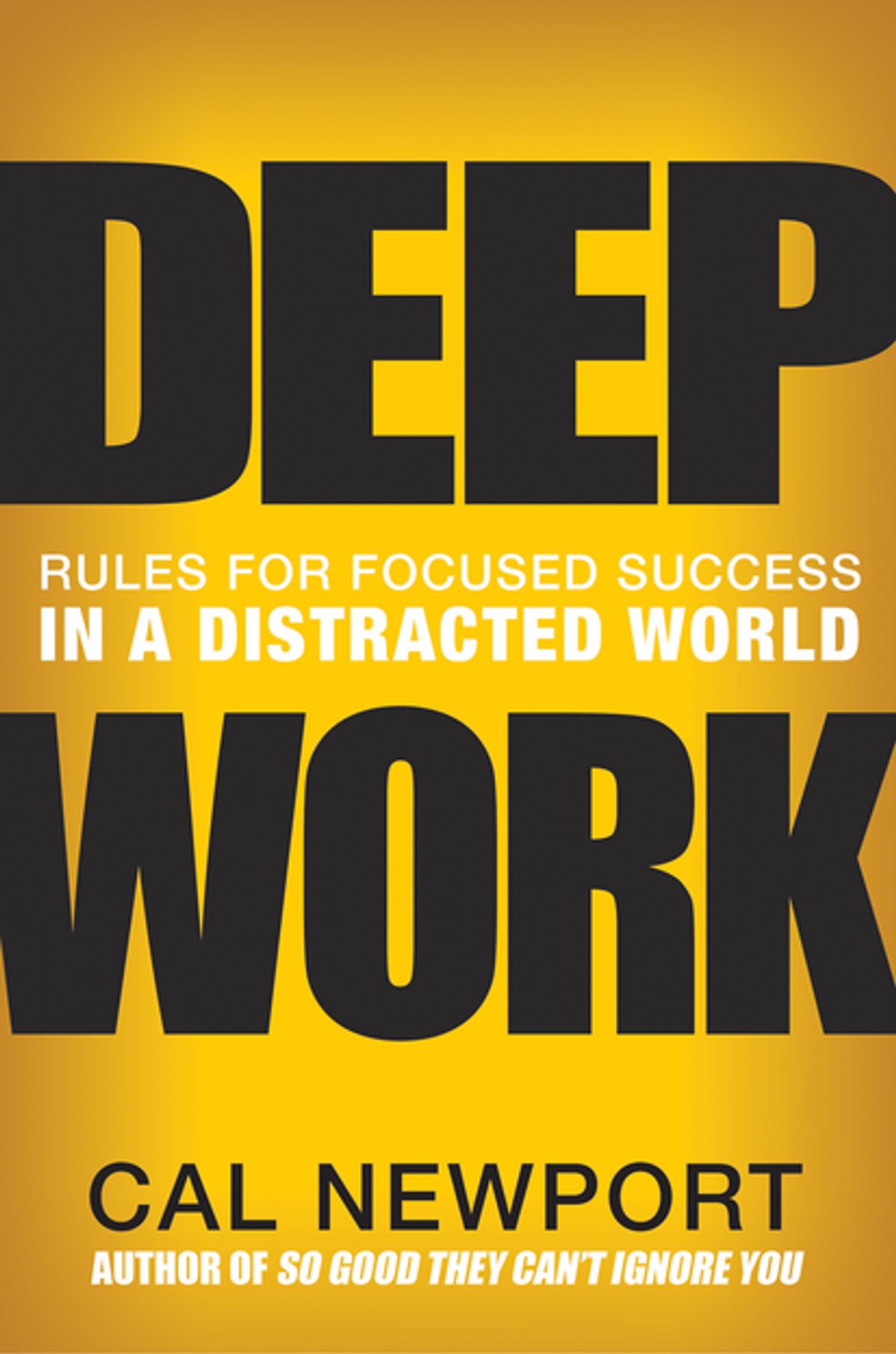
DEEP WORK
THE SUPERPOWER OF FOCUS
We live in a world designed to interrupt us.
Notifications. Messages. Meetings. Endless scrolling.
Deep Work is the ability to shut out that noise and focus intensely on work that actually matters.
WHY DEEP WORK MATTERS
BUSY IS NOT THE SAME AS PRODUCTIVE
You can work all day and still make little meaningful progress.
Deep Work means sustained, distraction-free concentration on cognitively demanding tasks.
It is where learning, mastery, creativity, strategy, and breakthrough work happen.
THE DEEP WORK HYPOTHESIS
WHY FOCUS IS BECOMING MORE VALUABLE
A RARE SKILL
THE WORLD IS BECOMING MORE DISTRACTED
Cal Newport's central argument:
Deep Work is becoming increasingly rare at exactly the same time it is becoming increasingly valuable.
People who build this capability gain an advantage over people trapped in constant distraction.
THE 2 ABILITIES THAT MATTER
WHAT DEEP WORK HELPS YOU BUILD
To thrive in a knowledge economy, Newport highlights two critical abilities:
1. Learn difficult things quickly.
2. Produce at an elite level.
Both require sustained concentration.
ATTENTION IS SCARCE
INFORMATION IS EVERYWHERE
Technology made information abundant.
But attention became scarce.
Most people skim, switch tabs, answer messages, and react all day.
Mastery and innovation require staying with one difficult problem long enough to understand it deeply.
EXAMPLE: CARL JUNG
BUILD YOUR OWN FOCUS SANCTUARY
Carl Jung built a stone tower in Bollingen, Switzerland, where he could think and write in isolation.
You do not need a tower.
You need protected space where distractions cannot constantly reach you.
START WITH AWARENESS
MEASURE YOUR DEEP WORK
Track how much deep work you actually do.
Record the minutes or hours spent in true focused work each day.
Then connect those sessions to results: ideas created, problems solved, chapters written, skills learned, or projects completed.
DEEP VS SHALLOW WORK
KNOW WHICH WORK ACTUALLY MATTERS
WHAT IS SHALLOW WORK?
WORK THAT KEEPS YOU BUSY
Shallow work is usually:
- Easy to replicate
- Administrative
- Reactive
- Low cognitive effort
- Often performed while distracted
Examples: routine emails, low-impact meetings, status updates, and endless message checking.
WHAT IS DEEP WORK?
WORK THAT CREATES REAL VALUE
Deep work is:
- Cognitively demanding
- Difficult to replicate
- Done with full concentration
- Proactive and purposeful
- Connected to high-value output
Examples: coding, writing, designing, learning, solving complex problems, or building strategy.
THE PRODUCTIVITY ILLUSION
ACTIVITY CAN LOOK LIKE PROGRESS
A full calendar can make you feel productive.
But answering emails, attending meetings, and completing small tasks may leave your most important project untouched.
Shallow work creates the appearance of progress.
Deep work creates actual progress.
AUDIT YOUR WORK
DEEP OR SHALLOW?
Review your calendar and task list.
Label every activity:
DEEP - requires concentration and creates meaningful value.
SHALLOW - reactive, logistical, repeatable, or easy to do while distracted.
Then ask what can be eliminated, automated, delegated, or batched.
RULE 1 - WORK DEEPLY
DESIGN FOCUS INSTEAD OF HOPING FOR IT
DEEP WORK IS DESIGNED
FOCUS DOES NOT HAPPEN BY ACCIDENT
The world is built to pull your attention away.
So deep work needs structure.
Decide:
1. When you will work deeply.
2. Where you will do it.
3. What you will work on.
4. How you will protect the session.
1. CREATE A RITUAL
MAKE FOCUS REPEATABLE
A deep work ritual should answer three questions:
WHERE will you work?
WHEN will the session happen?
WHAT result will define success?
Example: 8:00-9:30 AM, library desk, finish 1,000 words.
2. SET BOUNDARIES
PROTECT THE SESSION
During a deep block:
- Turn off notifications
- Close unnecessary tabs
- Put your phone away
- Use Do Not Disturb
- Tell people you are unavailable
Deep work needs temporary isolation from incoming demands.
3. MEASURE OUTPUT
GIVE FOCUS A FINISH LINE
Do not schedule vague focus time.
Define an output:
- Write 1,000 words
- Solve 3 problems
- Finish one design
- Study one chapter
- Build one feature
Clear targets keep your attention connected to progress.
EXAMPLE: J.K. ROWLING
CHANGE THE ENVIRONMENT
While finishing Harry Potter and the Deathly Hallows, J.K. Rowling moved into a hotel to escape distractions and focus entirely on writing.
The lesson is not luxury.
It is environment design: create a place associated with one important task.
4. USE A SHUTDOWN RITUAL
END WORK INTENTIONALLY
At the end of the day:
1. Review what was completed.
2. Capture unfinished tasks.
3. Plan tomorrow.
4. Stop working.
A clear shutdown helps your brain release work instead of carrying unfinished thoughts through the evening.
DEPTH OVER DURATION
YOU DO NOT NEED EIGHT FOCUSED HOURS
Deep work is mentally demanding.
Start with one focused session of 60-90 minutes.
One hour of concentrated effort can produce more valuable output than hours of scattered multitasking.
Build the capacity gradually.
RULE 2 - EMBRACE BOREDOM
TRAIN YOUR BRAIN TO STAY FOCUSED
IF YOU CANNOT BE BORED
YOU WILL STRUGGLE TO GO DEEP
Every time boredom appears, many people immediately reach for a phone.
That trains the brain to expect constant novelty.
Deep work requires staying with one thought even when the task becomes difficult, slow, or uncomfortable.
1. SCHEDULE INTERNET USE
STOP CHECKING AUTOMATICALLY
Instead of going online whenever you feel an impulse, create specific times for email, social media, and browsing.
The goal is intentional consumption.
Teach your brain that boredom does not automatically earn a new source of stimulation.
2. PRODUCTIVE MEDITATION
THINK WHILE WALKING
Take a walk without your phone, music, or podcast.
Choose one problem to think about.
When your mind wanders, bring it back.
You are training yourself to hold one idea in your attention long enough to discover deeper connections.
3. PRACTICE STILLNESS
STOP FILLING EVERY EMPTY MOMENT
Waiting in line?
Sitting in a car?
Walking somewhere?
Do not automatically pull out your phone.
Allow some moments to remain empty.
Those small periods of boredom train the attention muscle deep work depends on.
4. CREATE REFLECTION TIME
GIVE YOUR MIND ROOM TO THINK
Set aside 30-60 minutes occasionally with no incoming information.
Use a notebook and ask:
What am I working toward?
What is blocking me?
What deserves more attention?
Depth also comes from thinking, not only producing.
RULE 3 - QUIT SOCIAL MEDIA
BE INTENTIONAL WITH YOUR TOOLS
THE CRAFTSMAN APPROACH
NOT EVERY TOOL DESERVES YOUR ATTENTION
Newport suggests evaluating tools like a craftsman.
Do not use something simply because it offers some benefit.
Use it when its positive impact on goals substantially outweighs its negative impact on your attention, time, and ability to focus.
ASK THIS ABOUT EVERY PLATFORM
DOES IT EARN ITS PLACE?
For each app or platform, ask:
1. Which important goal does this support?
2. How much value does it actually create?
3. What attention does it consume?
4. Could I get the same result another way?
Attention should be allocated deliberately.
TRY A 7-DAY DETOX
RUN THE EXPERIMENT
For seven days:
1. Log out.
2. Remove the apps.
3. Notice what changes.
4. Measure your available time.
5. Review what you actually missed.
Then decide which platforms deserve to return.
RULE 4 - DRAIN THE SHALLOWS
STOP LETTING SMALL WORK CONSUME THE DAY
SHALLOW WORK EXPANDS
UNLESS YOU DELIBERATELY CONTAIN IT
Emails, meetings, requests, admin, and small tasks will consume whatever time you give them.
They are not always useless.
The problem begins when they dominate your schedule and leave no capacity for the work that actually creates value.
TIME BLOCK YOUR DAY
GIVE EVERY HOUR A PURPOSE
Instead of reacting to a to-do list all day, divide the day into blocks.
Example:
8-10 Deep Work
10-11 Email + admin
11-12 Meetings
1-3 Deep Work
3-4 Shallow tasks
Your calendar becomes a plan for attention.
CAP SHALLOW WORK
PUT A CEILING ON LOW-VALUE TASKS
The summary recommends limiting shallow work to roughly 30-40% of the workday.
Batch emails, admin, and updates together.
Do not let them repeatedly interrupt deep sessions throughout the day.
ELIMINATE. DELEGATE. DEFER.
CREATE ROOM FOR DEPTH
When reviewing shallow work, ask:
Can I eliminate it?
Can I automate it?
Can I delegate it?
Can I delay or batch it?
Protecting deep work often requires saying no to work that feels urgent but contributes little.
DELIBERATE PRACTICE
USE DEEP WORK TO LEARN FASTER
PRACTICE WITH INTENTION
REPETITION ALONE IS NOT MASTERY
Deliberate practice means focused effort designed to improve a specific weakness.
You stretch beyond your current ability, receive feedback, correct mistakes, and repeat.
Deep work provides the concentration needed for that process.
THE DELIBERATE PRACTICE SYSTEM
SIX STEPS
1. Set a stretch goal.
2. Work in uninterrupted blocks.
3. Target weaknesses.
4. Get feedback.
5. Track progress.
6. Rest intentionally.
The objective is not simply spending more hours practicing. It is making each hour more effective.
EXAMPLE: ELITE VIOLINISTS
TOP PERFORMERS PRACTICE DIFFERENTLY
The summary describes research on violinists showing that stronger performers spent more time in focused, deliberate practice.
They practiced difficult areas with clear goals, concentration, feedback, and recovery.
How you practice matters.
FOCUS ON WEAKNESS
COMFORT DOES NOT CREATE MASTERY
Most people naturally repeat what they already do well.
Deliberate practice targets what is still difficult.
For writing, coding, sales, design, music, or strategy:
Find the weak point.
Work on it deeply.
Get feedback.
Repeat.
MAKE DEEP WORK A LIFESTYLE
BUILD HABITS, NOT PRODUCTIVITY HACKS
DEEP WORK IS A PHILOSOPHY
DEPTH BECOMES PART OF HOW YOU LIVE
The strongest results appear when deep work becomes a permanent part of your life.
Your schedule, workspace, routines, technology, and boundaries begin supporting focus automatically.
Depth stops being something you occasionally try.
IDENTITY DRIVES BEHAVIOR
WHO ARE YOU BECOMING?
Instead of asking how to be more productive, ask who you want to become.
A writer writes deeply.
A programmer solves deeply.
A founder thinks deeply.
A student learns deeply.
Your identity guides your systems.
EXAMPLE: ADAM GRANT
BATCH SHALLOW OBLIGATIONS
The summary describes Adam Grant batching teaching into one semester so another part of the year could be dedicated more heavily to research, writing, and thinking.
The principle: cluster obligations so meaningful work receives larger uninterrupted blocks.
BUILD YOUR DEEP WORK SYSTEM
SEVEN COMPONENTS
1. Define your identity.
2. Design your environment.
3. Create rituals.
4. Schedule deep blocks.
5. Track deep hours.
6. Audit distractions regularly.
7. Tell people when focus time is protected.
Turn focus into infrastructure.
OVERCOMING RESISTANCE
CONSISTENCY BEATS MOTIVATION
RESISTANCE IS NORMAL
DEEP WORK IS SUPPOSED TO FEEL DIFFICULT
The moment you begin difficult work, resistance appears.
Check the phone.
Answer that email.
Do something easier.
Take another break.
Deep work requires systems that prevent those impulses from controlling the session.
6 WAYS TO STAY CONSISTENT
PROTECT THE HABIT
1. Set measurable goals.
2. Track your sessions.
3. Create accountability.
4. Review progress weekly.
5. Celebrate small wins.
6. Design an environment with fewer distractions.
Make showing up easier than deciding again every day.
CONSISTENCY BEATS MOTIVATION
SHOW UP EVEN WHEN YOU DO NOT FEEL READY
Motivation changes from day to day.
Systems remain.
Every completed deep session strengthens your capacity to focus and makes the next session easier.
The objective is to make deep work a default behavior instead of an occasional burst of productivity.
THE 30-DAY DEEP WORK CHALLENGE
TURN THE IDEAS INTO A SYSTEM
STEP 1 - CHOOSE ONE GOAL
DEFINE WHAT DESERVES YOUR FOCUS
Pick one high-value outcome.
Writing.
Coding.
Studying.
Designing.
Building a business.
Learning a skill.
Avoid trying to improve everything simultaneously.
Depth begins by deciding what deserves your best attention.
STEP 2 - BLOCK THE TIME
CREATE A RECURRING DEEP SESSION
Choose a realistic daily or weekly commitment.
Start with 60-90 minutes if possible.
Schedule it before shallow work fills your calendar.
Treat that block like an important appointment that cannot casually be moved.
STEP 3 - REMOVE THE NOISE
MAKE DISTRACTION DIFFICULT
Before each session:
- Silence notifications
- Put the phone away
- Close unnecessary tabs
- Prepare required tools
- Tell others you are unavailable
Do not rely on willpower when you can redesign the environment.
STEP 4 - DEFINE THE OUTPUT
KNOW WHAT SUCCESS LOOKS LIKE
Every deep session needs a finish line.
Examples:
Finish 1 feature.
Write 1,000 words.
Solve 5 problems.
Read and summarize 1 chapter.
Complete 1 strategy document.
Measure output, not just time spent.
STEP 5 - TRACK THE STREAK
BUILD EVIDENCE OF CONSISTENCY
Record every completed deep work session for 30 days.
At the end of each week ask:
What helped me focus?
What distracted me?
What should I change next week?
Improve the system instead of depending on motivation.
THE DEEP WORK FORMULA
A SIMPLE OPERATING SYSTEM
THE FORMULA
QUESTION TO FOCUS TO OUTPUT
1. Identify the highest-value task.
2. Schedule uninterrupted time.
3. Remove distractions.
4. Define a measurable result.
5. Work deeply.
6. Review the output.
7. Repeat consistently.
YOU DO NOT NEED MORE TIME
YOU NEED BETTER ATTENTION
The goal of Deep Work is not to work every waking hour.
It is to give your most important work your best concentration.
One truly focused hour each day, repeated consistently, can compound into skills, projects, ideas, and results that shallow work rarely produces.
YOUR DEEP WORK LIFE STARTS NOW
PROTECT WHAT DESERVES YOUR ATTENTION
Start small.
Choose one important task.
Block one uninterrupted hour.
Remove the noise.
Define the result.
Go deep.
Your attention is one of your most valuable resources.
Decide deliberately where it goes.