
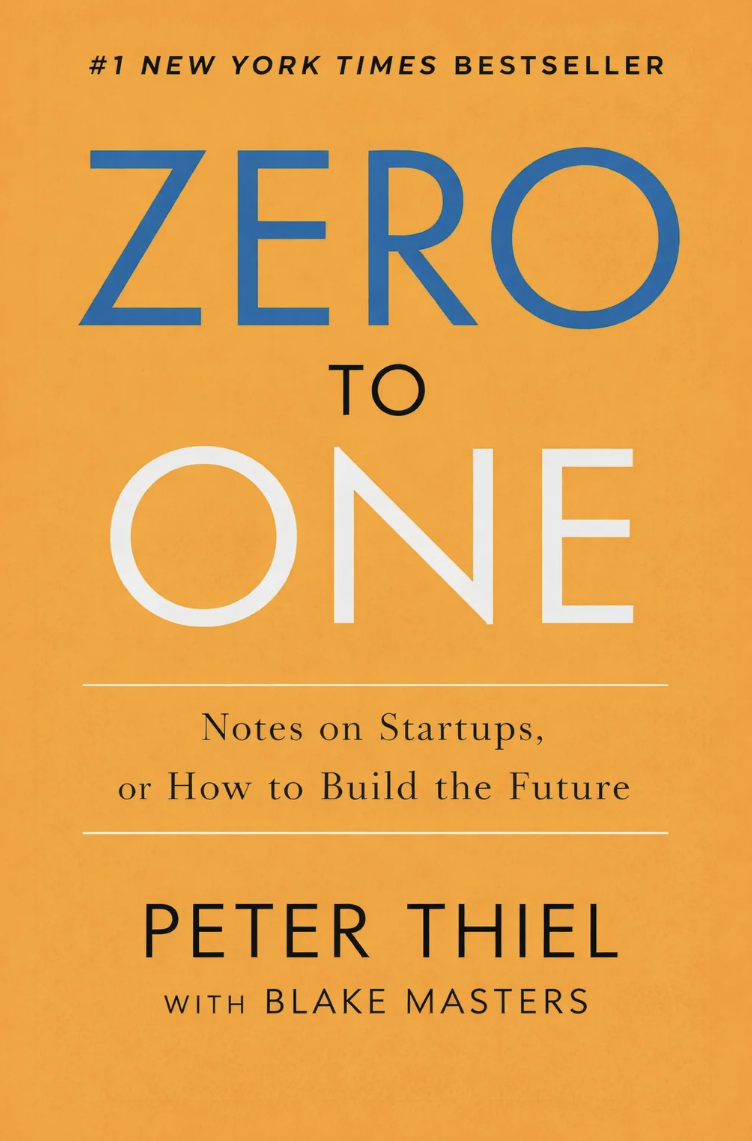
ZERO TO ONE
BUILD WHAT DOES NOT EXIST YET
The biggest opportunities do not come from copying what already works.
They come from creating something new: a product, system, market, or technology that moves the world from zero to one.
THE CENTRAL QUESTION
THINK INDEPENDENTLY
What important truth do very few people agree with you on?
A strong answer usually follows this structure:
Most people believe X, but the truth is the opposite.
Great companies often begin with such a contrarian insight.
THE CHALLENGE OF THE FUTURE
CHAPTER 1
FROM 1 TO N
HORIZONTAL PROGRESS
Horizontal progress means copying something that already works.
One successful store becomes one hundred stores. One existing product enters more countries.
This creates scale, but not necessarily a new future.
FROM 0 TO 1
VERTICAL PROGRESS
Vertical progress means creating something genuinely new.
Building another typewriter is 1 to N. Building the first word processor is 0 to 1.
Technology is any new and better way of doing things.
WHY STARTUPS MATTER
SMALL TEAMS CREATE CHANGE
Large organizations often move slowly. Individuals working alone have limited capacity.
A startup combines both advantages: enough people to build something meaningful, while remaining small enough to think and move differently.
PARTY LIKE IT’S 1999
CHAPTER 2
QUESTION PAST LESSONS
BUBBLES DISTORT THINKING
After the dot-com crash, the startup world adopted defensive rules: move incrementally, stay flexible, copy existing markets, and rely only on product-led growth.
These lessons became dogma.
THINK BEYOND DOGMA
THE OPPOSITE MAY BE STRONGER
Boldness can be better than triviality.
A weak plan can be better than no plan. Competitive markets can destroy profits. Sales can matter as much as product.
The real lesson is to think for yourself.
PAYPAL’S URGENCY
MOVE BEFORE THE WINDOW CLOSES
PayPal paid users to join and refer friends, producing rapid growth but enormous costs.
The team knew the funding window would close. They raised capital before the crash, buying enough time to build a sustainable business.
ALL HAPPY COMPANIES ARE DIFFERENT
CHAPTER 3
CREATE AND CAPTURE VALUE
REVENUE IS NOT ENOUGH
A company can create enormous value without keeping much of it.
Airlines move millions of passengers but operate with thin profits. A differentiated technology company can serve fewer transactions while capturing far more value.
ESCAPE COMPETITION
BUILD A CREATIVE MONOPOLY
Perfect competition pushes prices and profits toward zero.
A creative monopoly offers something so distinct that no close substitute exists.
The goal is not exploitation. It is solving a unique problem better than anyone else.
OWN A REAL MARKET
AVOID FICTIONAL DIFFERENTIATION
Weak businesses define their market narrowly to appear unique.
A restaurant may claim to dominate British food in one neighborhood while ignoring every other dining option.
Your differentiation must matter to customers.
THE IDEOLOGY OF COMPETITION
CHAPTER 4
COMPETITION DISTRACTS
RIVALS BECOME THE STRATEGY
Companies often become obsessed with competitors because they are similar.
They copy features, match prices, and fight for familiar opportunities.
Meanwhile, they stop asking whether the market is worth fighting for.
CHOOSE YOUR BATTLES
CREATION MATTERS MORE
Winning a meaningless battle still wastes resources.
Avoid unnecessary competition. When a fight is unavoidable, act decisively and finish it quickly.
The larger objective is to create value, not remain permanently at war.
PAYPAL AND X.COM
MERGE INSTEAD OF DESTROY
PayPal and X.com competed aggressively while the technology bubble expanded.
Both teams realized the market crash could destroy them before either side won. They merged, survived the crash, and built a stronger company together.
LAST MOVER ADVANTAGE
CHAPTER 5
BUILD FOR DURABILITY
FUTURE CASH FLOW MATTERS
A company’s value comes from the cash it can generate in the future.
Fast growth today means little when competitors can easily replace you tomorrow.
Ask whether the company can remain valuable ten or twenty years from now.
FOUR MONOPOLY ADVANTAGES
BUILD DEFENSIBILITY
Durable monopolies usually combine:
Proprietary technology.
Network effects.
Economies of scale.
Strong branding.
Brand becomes powerful when it reinforces real underlying advantages.
START SMALL
DOMINATE A FOCUSED NICHE
The ideal startup market is a small, concentrated group with a strong need and little competition.
PayPal succeeded by serving eBay power sellers before expanding.
Dominate one niche, then move into adjacent markets.
YOU ARE NOT A LOTTERY TICKET
CHAPTER 6
DESIGN THE FUTURE
REPLACE CHANCE WITH AGENCY
A definite person believes the future can be shaped through planning and execution.
An indefinite person keeps every option open and waits for events to unfold.
Startups require definite optimism: a clear vision supported by deliberate action.
A BAD PLAN BEATS NO PLAN
ITERATION NEEDS DIRECTION
Lean methods can improve an existing idea, but endless iteration may only reach a local maximum.
A company cannot move from zero to one through random experimentation alone.
Intelligent design requires a bold destination.
FOUNDER AGENCY
MASTER A SMALL PART OF THE WORLD
A startup is one of the few institutions where a small group can still design a concrete future.
Founders cannot control everything, but they can shape a focused and meaningful part of the world.
FOLLOW THE MONEY
CHAPTER 7
THE POWER LAW
OUTCOMES ARE UNEQUAL
A small number of investments, companies, products, and decisions produce most of the value.
The best investment in a successful venture fund can outperform every other investment in the portfolio combined.
FOCUS ON THE OUTLIER
DIVERSIFICATION CAN HIDE WEAKNESS
Venture investors need companies capable of returning the value of the entire fund.
Founders face the same reality.
One market, one product, or one distribution channel may matter more than everything else combined.
LIFE IS NOT A PORTFOLIO
CHOOSE DELIBERATELY
You cannot build dozens of companies simultaneously and hope one works.
You also cannot pursue dozens of careers with equal commitment.
Think carefully about where your time could create disproportionate future value.
SECRETS
CHAPTER 8
LOOK FOR HIDDEN TRUTHS
HARD BUT ACHIEVABLE
A secret is an important truth that is unknown but discoverable.
It sits between an easy convention and an impossible mystery.
Every valuable company is built around a secret that others have overlooked.
WHERE OTHERS ARE NOT LOOKING
EXPLORE NEGLECTED FIELDS
The best opportunities often exist in important fields that have not been fully studied, standardized, or institutionalized.
Ask what nature has not revealed and what people are unwilling or unable to say.
BUILD AROUND THE SECRET
CREATE A TRUSTED CONSPIRACY
Do not broadcast every important insight to everyone.
Share it with the people required to build the solution.
A great company is a group of people united around a hidden truth and a plan to change the world.
FOUNDATIONS
CHAPTER 9
GET THE BEGINNING RIGHT
EARLY MISTAKES COMPOUND
Wrong co-founders, ownership structures, incentives, and governance decisions are extremely difficult to repair later.
The founder’s first responsibility is to establish a strong foundation.
OWNERSHIP, POSSESSION, CONTROL
ALIGN THE COMPANY
Ownership means holding equity.
Possession means operating the company.
Control means formally governing it.
Startups become unstable when these groups pursue conflicting time horizons or incentives.
THINK LONG TERM
USE EQUITY CAREFULLY
High cash compensation can encourage people to defend the present.
Equity can align employees with future value because its worth depends on the company’s long-term success.
The allocation must still be handled carefully.
THE MECHANICS OF MAFIA
CHAPTER 10
CULTURE IS THE COMPANY
PERKS ARE NOT CULTURE
Beanbags, free food, and stylish offices cannot create meaningful culture.
Culture is what a team on a mission looks like from the inside.
Strong relationships and shared purpose outlast superficial benefits.
RECRUIT CONSPIRATORS
MISSION AND TEAM
Talented people have many options.
Give them a specific reason to join: an important mission no other company will complete and a team they genuinely want to work beside.
Generic promises will not differentiate you.
ONE PERSON, ONE MISSION
REDUCE INTERNAL CONFLICT
At PayPal, each employee was responsible for one clearly defined function.
Distinct ownership reduced competition between teammates.
Internal peace allowed the company to focus its energy on external challenges.
IF YOU BUILD IT, WILL THEY COME?
CHAPTER 11
DISTRIBUTION IS ESSENTIAL
PRODUCTS DO NOT SELL THEMSELVES
A superior product can still fail when customers never discover, understand, or adopt it.
Distribution should be designed as carefully as the product.
Poor sales is often a greater threat than poor technology.
MATCH THE SALES MODEL
PRICE DETERMINES DISTRIBUTION
Large contracts require complex, founder-led sales.
Mid-sized deals require repeatable personal sales. Mass-market products may use advertising or viral growth.
Customer lifetime value must exceed acquisition cost.
ONE CHANNEL MUST WORK
DISTRIBUTION FOLLOWS A POWER LAW
Most businesses do not need many average distribution channels.
They need one channel that works exceptionally well.
Trying sales, advertising, partnerships, and virality without mastering one usually produces no reliable growth.
MAN AND MACHINE
CHAPTER 12
COMPLEMENT HUMANS
COMPUTERS ARE TOOLS
Humans and computers are good at different things.
Computers process enormous amounts of data. Humans form plans, understand context, and make judgments.
The strongest systems combine both capabilities.
THE HYBRID ADVANTAGE
PAYPAL FRAUD DETECTION
PayPal’s automated fraud system could not adapt quickly enough to changing attacks.
The company built software that flagged suspicious transactions, then let human analysts make final decisions.
Together, they outperformed either approach alone.
EMPOWER, DO NOT REPLACE
BUILD BETTER HUMAN SYSTEMS
The most valuable technology companies will not only automate existing work.
They will help people solve problems that were previously too complex, expensive, or difficult to address.
SEEING GREEN
CHAPTER 13
SEVEN STARTUP QUESTIONS
EVERY BUSINESS MUST ANSWER
Can you build breakthrough technology?
Is the timing right? Can you dominate a small market? Is the team right? Can you distribute it? Is it durable? Have you found a unique secret?
GOOD CAUSES ARE NOT ENOUGH
NEED DOES NOT GUARANTEE BUSINESS
Many clean-technology companies addressed important environmental problems but lacked superior technology, distribution, defensibility, or clear markets.
A major social need does not automatically create a viable company.
TESLA’S INTEGRATED ANSWER
SOLVE THE COMPLETE SYSTEM
Tesla combined technology, timing, market focus, engineering, sales, brand, and expansion strategy.
It began with a small luxury sports-car market, established superiority, then expanded toward broader categories.
THE FOUNDER’S PARADOX
CHAPTER 14
FOUNDERS ARE DIFFERENT
EXTREME TRAITS CREATE ENERGY
Many founders combine traits that appear contradictory: insider and outsider, charismatic and difficult, wealthy on paper and poor in cash.
Their unusual perspective can help them imagine what conventional managers cannot.
THE POWER OF A FOUNDER
SINGULAR VISION MATTERS
A distinctive founder can make long-term decisions, inspire loyalty, and maintain a coherent vision.
Steve Jobs returned to Apple and focused the company on a small number of products that reshaped multiple industries.
DO NOT BELIEVE YOUR MYTH
FOUNDER POWER HAS LIMITS
Public admiration can quickly turn into blame or hostility.
Founders matter because they bring out the best work of a team, not because they are self-sufficient heroes.
Losing perspective can destroy both the leader and the company.
THE ZERO-TO-ONE PLAYBOOK
BUILD THE FUTURE
Find a truth others overlook.
Create a 10x solution. Start with a focused market. Build durable advantages. Recruit a mission-driven team. Master one distribution channel. Plan for the long term.
THE FINAL PRINCIPLE
CREATION OVER IMITATION
The future does not arrive automatically.
It is created by people who question convention, discover secrets, design definite plans, and build solutions that did not exist before.
Do not only compete for the future. Create it.