

STARTUP BUSINESS MODELS AND PRICING
YOUTUBE SUMMARY : YCOMBINATOR
CHAPTER INDEX
STARTUP BUSINESS MODELS & PRICING
BUILD A MODEL THAT CAN SCALE
A strong product still needs a strong way to make money.
This StackSlide explains nine proven startup business models, what YC’s biggest winners teach us, how durable companies build moats, and how founders can price products to learn and grow.
CHOOSE THE ENGINE
CHAPTER 1
WHAT IS A BUSINESS MODEL?
HOW YOUR COMPANY MAKES MONEY
A business model is the system your company uses to earn revenue.
Many startups struggle because they build a product without choosing a clear money-making engine. Growth stalls, investors hesitate, and the team cannot explain how the business becomes large.
NINE PROVEN MODELS
MOST LARGE STARTUPS FIT ONE
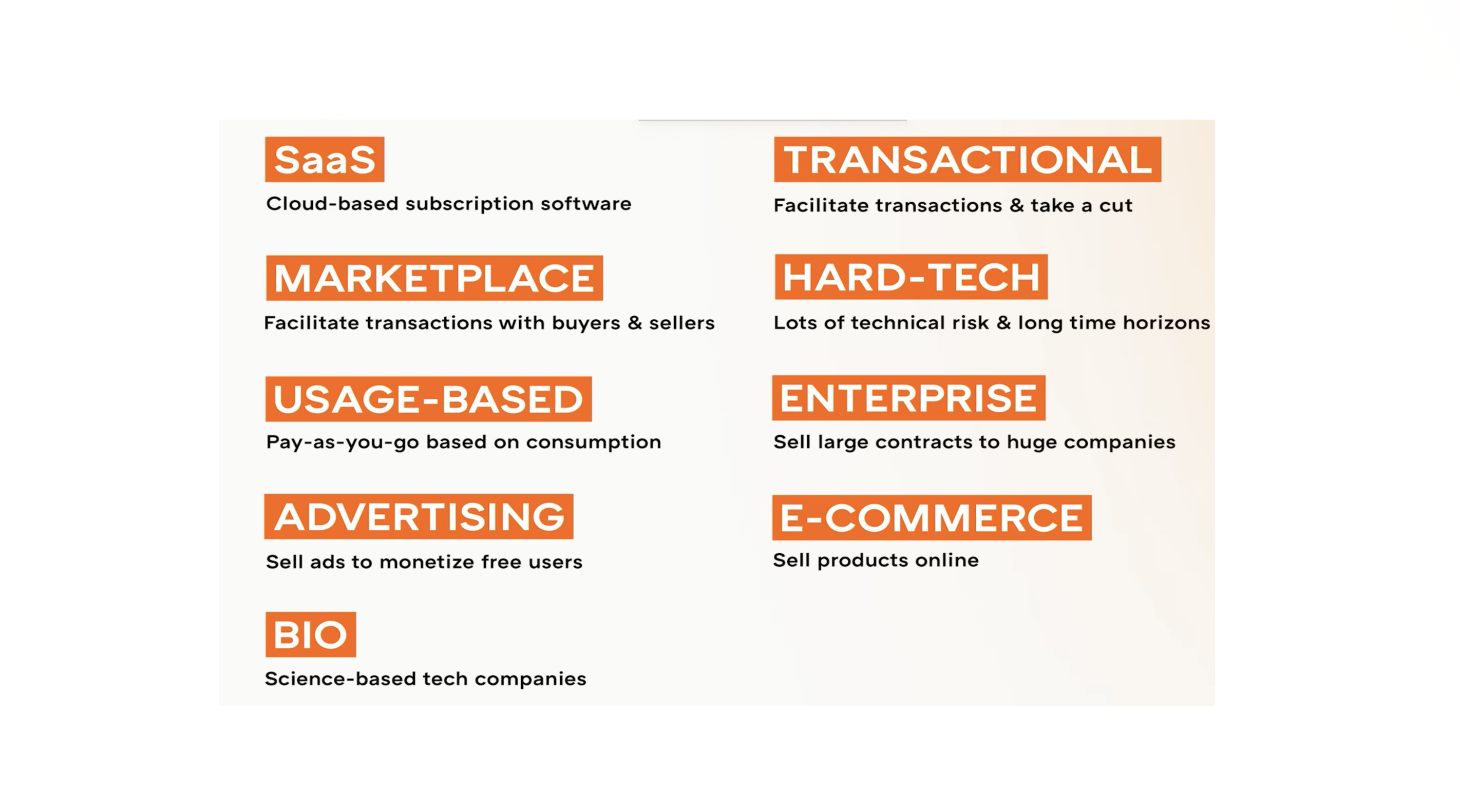
Most billion-dollar companies use one of nine models:
• SaaS
• Transactional
• Marketplace
• Usage-based
• Enterprise
• Advertising
• E-commerce
• Hard tech
• Bio
The product can be new. The money model usually should be proven.
USE ONE PRIMARY MODEL
FOCUS BEFORE EXPANSION
Large companies may combine several models later.
An early-stage startup should focus on one primary model. This makes pricing, metrics, customer acquisition, product priorities, and investor communication easier to understand.
COPY THE MODEL, INNOVATE THE PRODUCT
DO NOT REINVENT EVERYTHING
Founders often try to invent both a new product and a new way to make money.
That creates unnecessary risk. Use a business model customers already understand, then focus innovation on the product, experience, technology, or market insight.
SAAS
CHAPTER 2
WHAT IS SAAS?
SOFTWARE SOLD THROUGH SUBSCRIPTIONS
Software as a Service gives customers continuous access to cloud-based software.
Customers usually pay monthly or annually. The company keeps earning as long as the product continues solving an important and recurring problem.
HOW SAAS MAKES MONEY
RECURRING REVENUE POWERED BY RETENTION
Revenue comes from subscriptions based on users, features, storage, or company size.
Key metrics:
• Monthly recurring revenue
• Churn
• Retention
• Lifetime value
• Acquisition cost
The main challenge is keeping customers subscribed.
WHEN SAAS WORKS BEST
SOLVE AN ONGOING PROBLEM
SaaS works best when customers need the product repeatedly.
Examples include accounting, customer management, collaboration, security, and workflow software. The product should become part of the customer’s routine and improve over time.
TRANSACTIONAL
CHAPTER 3
WHAT IS A TRANSACTIONAL MODEL?
EARN FROM THE FLOW OF MONEY
A transactional business helps customers receive, send, manage, or process money.
The company earns a fixed fee or percentage whenever a transaction happens. Stripe, Coinbase, and Brex are examples highlighted in the Startup School lesson.
HOW TRANSACTIONAL MAKES MONEY
TAKE A CUT FROM EVERY TRANSACTION
Revenue grows with the number and value of transactions processed.
Key metrics:
• Transaction volume
• Take rate
• Revenue per transaction
• Payment losses
• Customer retention
The strongest products become critical financial infrastructure.
WHY TRANSACTIONAL MODELS WIN
STAY CLOSE TO THE MONEY
The closer a company is to the transaction, the easier it is to capture value.
When customers depend on a platform to receive or move money, switching becomes painful. Embedded workflows and high switching costs make the business durable.
MARKETPLACE
CHAPTER 4
WHAT IS A MARKETPLACE?
CONNECT BUYERS AND SELLERS
A marketplace brings two groups together so they can exchange products, services, assets, or information.
Airbnb connects travelers with hosts. DoorDash connects customers with restaurants and delivery workers. The platform becomes more valuable as participation grows.
HOW MARKETPLACES MAKE MONEY
CAPTURE VALUE FROM SUCCESSFUL MATCHES
Marketplaces charge commissions, listing fees, service fees, subscriptions, or payment fees.
Key metrics:
• Gross transaction value
• Take rate
• Supply growth
• Demand growth
• Match rate
• Repeat transactions
THE MARKETPLACE CHALLENGE
SOLVE BOTH SIDES AT ONCE
A marketplace cannot grow by serving only buyers or only sellers.
It must create enough supply to attract demand and enough demand to retain supply. This chicken-and-egg problem makes marketplaces difficult to launch.
THE MARKETPLACE ADVANTAGE
NETWORK EFFECTS CREATE DOMINANCE
Once the marketplace reaches liquidity, each new participant can increase value for everyone else.
More supply attracts more demand. More demand attracts more supply. This loop can create a winner-take-most market.
USAGE-BASED
CHAPTER 5
WHAT IS USAGE-BASED PRICING?
PAY FOR ACTUAL CONSUMPTION
A usage-based business charges according to what customers consume.
The unit may be API calls, computing time, storage, messages, transactions, generated outputs, or data processed. Customer spending grows naturally when usage increases.
HOW USAGE-BASED MAKES MONEY
REVENUE EXPANDS WITH ACTIVITY
The company defines a measurable unit and charges for each unit consumed.
Key metrics:
• Usage volume
• Revenue per unit
• Gross margin
• Expansion revenue
• Customer concentration
Pricing must remain understandable and predictable.
WHEN USAGE-BASED WORKS BEST
VALUE RISES WITH CONSUMPTION
This model works when usage closely reflects customer value.
A customer processing more payments, storing more data, or generating more outputs usually receives more benefit. The company earns more without forcing an immediate plan upgrade.
ENTERPRISE
CHAPTER 6
WHAT IS AN ENTERPRISE MODEL?
SELL TO LARGE ORGANIZATIONS
Enterprise companies sell products to corporations, governments, institutions, or other large organizations.
Customers may require security reviews, integrations, procurement approval, training, contracts, and dedicated support.
HOW ENTERPRISE MAKES MONEY
LARGE CONTRACTS AND RENEWALS
Revenue may come from annual licenses, multi-year contracts, implementation fees, support, or usage commitments.
Key metrics:
• Contract value
• Sales cycle
• Renewal rate
• Expansion revenue
• Implementation cost
THE ENTERPRISE TRADE-OFF
LONG SALES, STRONG RETENTION
Enterprise sales can take months because several decision-makers are involved.
Once installed, the product may become deeply connected to the organization’s systems and data. This can reduce churn and create high switching costs.
ADVERTISING
CHAPTER 7
WHAT IS AN ADVERTISING MODEL?
MONETIZE AUDIENCE ATTENTION
Advertising businesses build an audience, then sell access to that audience.
Advertisers pay to place messages, promoted content, listings, or campaigns in front of users. The model works best with massive reach, engagement, and frequent usage.
HOW ADVERTISING MAKES MONEY
CONVERT TRAFFIC INTO REVENUE
Revenue may be based on impressions, clicks, views, leads, or completed actions.
Key metrics:
• Active users
• Time spent
• Ad impressions
• Revenue per user
• Advertiser retention
WHY ADVERTISING IS DIFFICULT
SCALE MUST COME FIRST
Advertising usually produces little revenue until the platform reaches a large audience.
The product needs strong organic distribution or virality. Ads should rarely be the primary model unless the company can become a major destination for users.
E-COMMERCE
CHAPTER 8
WHAT IS E-COMMERCE?
SELL PRODUCTS DIRECTLY ONLINE
An e-commerce business sells physical or digital products through an online store or platform.
The company controls product selection, pricing, customer experience, and distribution. Revenue is generated whenever a customer completes an order.
HOW E-COMMERCE MAKES MONEY
EARN MARGIN FROM EVERY PRODUCT
Profit comes from the difference between the selling price and the total cost of producing, acquiring, marketing, and delivering the product.
Key metrics:
• Order value
• Gross margin
• Repeat order rate
• Acquisition cost
• Inventory turnover
WHAT MAKES E-COMMERCE STRONG
REPEAT ORDERS IMPROVE ECONOMICS
The first purchase may be expensive to acquire.
A strong e-commerce business brings customers back through product quality, replenishment, brand trust, bundles, memberships, or new releases. Repeat orders increase lifetime value.
HARD TECH
CHAPTER 9
WHAT IS HARD TECH?
BUILD DIFFICULT PHYSICAL TECHNOLOGY
Hard-tech companies solve problems through advanced engineering, hardware, robotics, energy, transportation, manufacturing, or infrastructure.
Products may require years of research, testing, certification, and capital before commercial launch.
HOW HARD TECH MAKES MONEY
PRODUCTS, CONTRACTS, AND LICENSING
Revenue may come from product sales, long-term contracts, licensing, maintenance, or infrastructure usage.
Key metrics:
• Development milestones
• Manufacturing cost
• Gross margin
• Capital requirements
• Production capacity
THE HARD-TECH MOAT
DIFFICULTY PROTECTS THE LEAD
Long development cycles can become a competitive advantage.
A rival cannot copy years of engineering, testing, supplier relationships, patents, and regulatory work overnight. Technical depth can create a durable moat.
BIO
CHAPTER 10
WHAT IS A BIO BUSINESS?
COMMERCIALIZE BIOLOGICAL INNOVATION
Bio companies apply biology to medicine, healthcare, agriculture, food, materials, diagnostics, or industrial production.
Products may require scientific research, laboratory development, clinical validation, regulatory approval, and intellectual property.
HOW BIO MAKES MONEY
PRODUCTS, LICENSING, AND MILESTONES
Bio companies may earn through product sales, treatments, testing, licensing, partnerships, or milestone payments.
Key metrics:
• Research progress
• Trial results
• Approval milestones
• Intellectual property
• Development capital
THE BIO MOAT
SCIENCE CREATES DEFENSIBILITY
Breakthrough science, patents, proprietary data, specialized teams, and regulatory approvals can create strong protection.
Development takes time and capital, but successful innovation can produce valuable and difficult-to-copy businesses.
WHAT THE BIGGEST WINNERS TEACH
CHAPTER 11
THE YC TOP 100 PATTERN
THREE MODELS DOMINATE
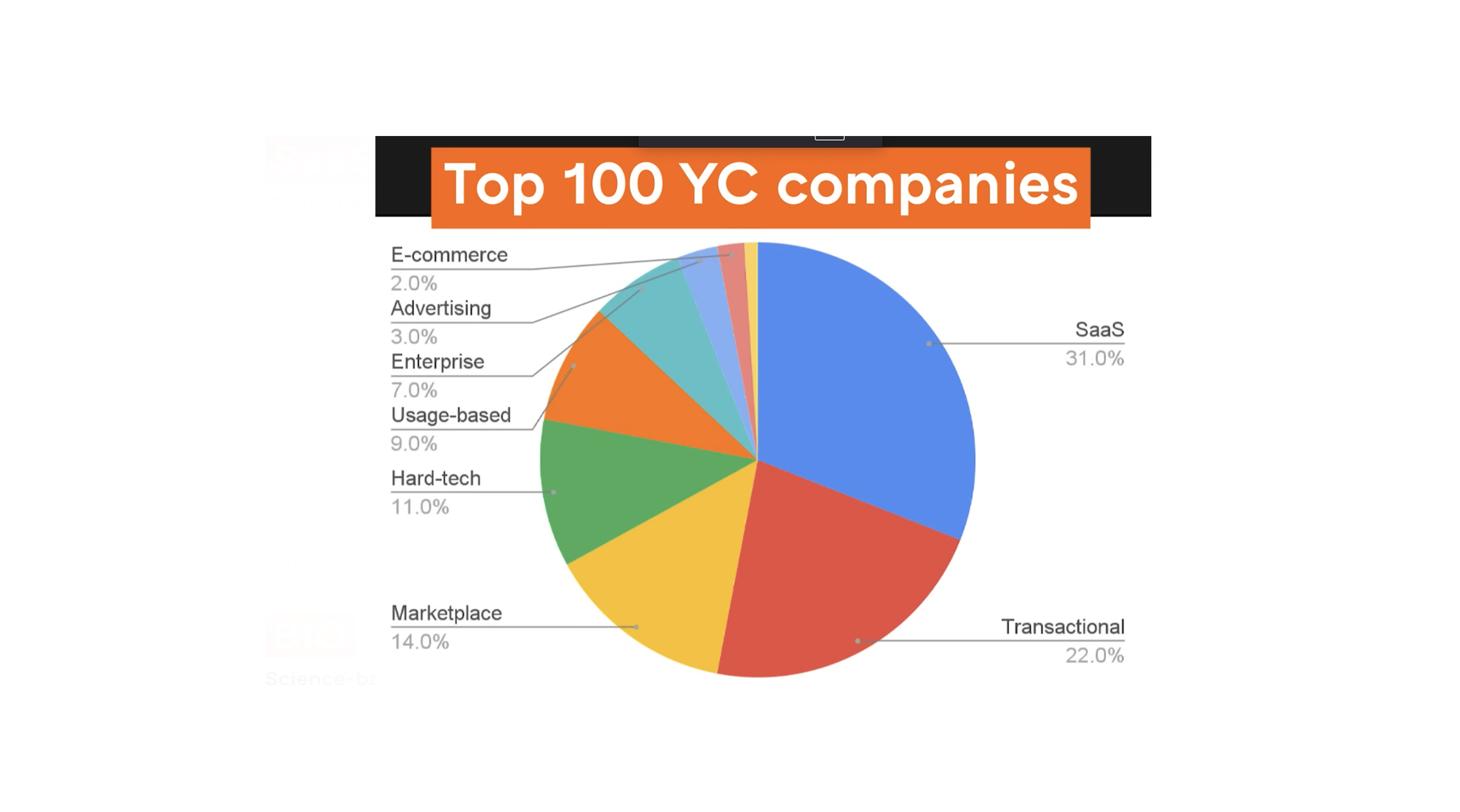
Among YC’s top 100 companies:
• SaaS: 31%
• Transactional: 22%
• Marketplaces: 14%
Together, these three models represent 67% of the list. They repeatedly produce scalable revenue and durable customer relationships.
THE POWER LAW
A FEW COMPANIES CREATE MOST VALUE
Startup outcomes are not evenly distributed.
In the YC data discussed, roughly half of the total value of the top 100 companies came from only the top ten. A small number of dominant companies can outperform the rest by orders of magnitude.
MARKETPLACES BUILD HUGE WINNERS
DOMINANCE AFTER LIQUIDITY
Marketplaces represented a smaller share of the top 100 but a much larger share of total value.
Companies such as Airbnb, DoorDash, and Instacart show how network effects can create category leaders once supply and demand reinforce each other.
TRANSACTIONAL MODELS OUTPERFORM
INFRASTRUCTURE CAPTURES VALUE
Transactional companies outperform because they sit directly inside the flow of funds.
They become difficult to remove and often solve a top-three customer problem. Every payment, transfer, or purchase creates another monetization opportunity.
SAAS APPEARS MOST OFTEN
RECURRING REVENUE COMPOUNDS
SaaS represents the largest share of YC’s top 100.
Predictable subscriptions support planning, hiring, product investment, and compounding growth. The model becomes powerful when retention remains high.
ADVERTISING HAS FEW WINNERS
VIRALITY IS REQUIRED
Advertising created only a small number of top YC companies.
Successful examples became major internet destinations with strong communities or content networks. Without massive organic traffic, advertising is difficult to monetize at venture scale.
MODELS WITH STRUCTURAL LIMITS
CHAPTER 12
SERVICES AND CONSULTING
USEFUL FOR LEARNING, HARDER TO SCALE
Services can help founders understand customer problems and generate early revenue.
The limitation is that delivery usually scales with people, hours, and projects. Margins remain lower, and revenue may not repeat automatically.
AFFILIATE BUSINESSES
TOO FAR FROM THE TRANSACTION
Affiliate businesses acquire a user, send them elsewhere, then wait for another company to complete the sale.
Because the business does not control the transaction, revenue is delayed, uncertain, and usually limited.
TRADITIONAL HARDWARE
CAPITAL AND MARGIN PRESSURE
Standard hardware businesses require money for parts, manufacturing, inventory, logistics, and support.
Physical costs reduce margins and make scaling expensive. Hard tech can still win when deep technical innovation creates a strong moat.
PLATFORM-DEPENDENT BUSINESSES
GROWTH CAN DISAPPEAR OVERNIGHT
A startup built entirely on another platform faces platform risk.
The larger platform can change rules, restrict access, copy the feature, or capture the revenue. A useful distribution channel should not become the only foundation of the business.
BUILD A DURABLE BUSINESS
CHAPTER 13
RECURRING REVENUE NEEDS RETENTION
DO NOT SCALE A LEAKING BUCKET
Subscriptions only work when customers continue receiving value.
If users leave quickly, recurring revenue becomes an illusion. The product must solve an ongoing problem, become part of a routine, or improve over time.
SMALL CHURN CREATES A BIG LOSS
MONTHLY RETENTION COMPOUNDS
With 95% monthly retention, 100 customers become about 54 after one year.
With 90% monthly retention, only about 28 remain.
A five-point monthly difference can determine whether a startup compounds or constantly replaces lost users.
BUILD A MOAT
MAKE THE BUSINESS HARD TO COPY
Strong companies defend themselves through:
• Network effects
• Switching costs
• Customer data
• Technical innovation
• Economies of scale
• Better margins
• Organic distribution
GET CLOSE TO THE TRANSACTION
CAPTURE VALUE DIRECTLY
The strongest position is where customers already exchange money or depend on your product to complete important work.
Being close to the transaction makes monetization clearer and can turn the product into critical infrastructure.
SCALE WITH SOFTWARE
GROWTH SHOULD NOT MATCH HEADCOUNT
Software can serve more customers without adding people at the same rate.
Human support may still matter, but the core delivery should become repeatable, automated, and increasingly efficient. This improves margins as the company grows.
EARN ORGANIC DISTRIBUTION
LET USERS CREATE GROWTH
Word of mouth, referrals, collaboration, shared outputs, and user-generated content can reduce acquisition costs.
A company that gains users organically can grow faster than a competitor that must pay for every customer.
THE BEST BUSINESS PATTERN
A PRACTICAL CHECKLIST
The strongest startup businesses usually:
• Generate recurring revenue
• Retain customers
• Build defensible moats
• Stay close to transactions
• Scale through software
• Use a proven model
PRICING IS A LEARNING TOOL
CHAPTER 14
START CHARGING
PAYMENT REVEALS REAL DEMAND
Founders often delay charging because they fear rejection.
Payment is one of the clearest signals of value. It shows who truly wants the product, which segment cares most, and whether the problem is important enough to justify spending.
A NO IS USEFUL DATA
REJECTION IMPROVES DIRECTION
When customers refuse to pay, the product may lack value, target the wrong segment, solve a weak problem, or carry the wrong price.
Charging converts opinions into evidence and helps founders learn faster.
FIND THE RIGHT MAGNITUDE
DO NOT OVER-ENGINEER EARLY PRICING
Early pricing does not need perfect formulas.
The first goal is to find the correct order of magnitude. If customers will pay $100 and you charge $10, the gap matters. If they will pay $15 and you charge $10, you are already close.
PRICE ON VALUE
DO NOT START FROM COST-PLUS
Cost is what you spend to serve the customer.
Price is what the customer pays.
Value is what the result is worth to them.
Your margin sits between cost and price. Your pricing opportunity sits between price and perceived value.
FOUR SOURCES OF VALUE
UNDERSTAND THE OUTCOME
Customers usually pay because a product helps them:
• Make more money
• Reduce costs
• Move faster
• Avoid risk
Ask which result matters most, then connect pricing to the economic or strategic value created.
RAISE UNTIL YOU LEARN
PUSHBACK IS NOT FAILURE
Increase prices gradually and observe customer reactions.
The useful range is often where customers hesitate, ask questions, or negotiate, yet still decide to pay. Instant acceptance from everyone may mean the price is too low.
MOST STARTUPS UNDERCHARGE
CHEAP IS NOT A DURABLE ADVANTAGE
A low price can signal low value and reduce the money available for product, service, and customer acquisition.
Large competitors can often cut prices further. Build a stronger product and charge for the value created.
HIGHER PRICES EXPAND OPTIONS
MARGIN FUNDS GROWTH
Higher margins allow a startup to invest more in acquisition, product quality, support, and distribution.
A price increase can grow revenue faster than acquiring the same number of new customers, provided the product supports it.
WHEN USERS WILL NOT PAY MORE
INCREASE VALUE OR SOLVE A BIGGER PROBLEM
Resistance to higher pricing usually means the product needs more value or the problem is too small.
Move toward a top-three customer problem connected to revenue, cost, speed, risk, or a critical workflow.
DISCOUNT WITH A REASON
TRADE PRICE FOR STRATEGIC VALUE
A lower price can make sense when it secures:
• The first user
• A strong reference
• A recognizable logo
• Valuable feedback
• Future expansion
• Long-term lock-in
Discount intentionally, not automatically.
PRICING CAN CHANGE
YOU ARE NOT LOCKED FOREVER
Pricing evolves as the product improves.
You can raise prices for new customers, grandfather existing customers, provide advance notice, or introduce higher-value plans. Early pricing is a starting point, not a permanent decision.
KEEP PRICING SIMPLE
REDUCE BUYING FRICTION
Too many plans, discounts, crossed-out prices, and conditions create confusion.
Use a small number of clear options. Explain who each plan is for, what value it provides, and what it costs.
THE SEGMENT PRICING LESSON
ASK FOR A BIGGER NUMBER
Segment first considered charging only $120 per year.
After stronger sales guidance, an early deal closed at $18,000 per year. Founders cannot discover willingness to pay without asking for a meaningful price.
FIVE PRICING RULES
CHAPTER 15
THE PRICING PLAYBOOK
SIMPLE RULES FOR EARLY FOUNDERS
1. Charge early.
2. Price based on value.
3. Assume you may be undercharging.
4. Change pricing as you learn.
5. Keep the buying decision simple.
Pricing is a system for discovering demand.
BUILD, CHARGE, LEARN
YOUR NEXT ACTION
Choose one proven business model.
Identify the ongoing value customers receive.
Set a simple price, ask real users to pay, and study their response.
Then improve the product, retention, moat, and pricing with every cycle.