
CHAPTER INDEX
HOW STARTUP FUNDRAISING ACTUALLY WORKS
SEVEN MYTHS FOUNDERS SHOULD STOP BELIEVING
Fundraising is one of the hardest parts of building a startup.
It becomes easier when founders understand what the process really looks like, what investors actually care about, and how to create leverage before asking for money.
THE REAL FUNDRAISING GAME
CHAPTER 1
FUNDRAISING IS NOT GLAMOROUS
IT IS A LONG SERIES OF CONVERSATIONS
Fundraising rarely looks like Shark Tank.
There is usually no dramatic stage, rapid-fire bidding, or perfect presentation.
Most rounds are built through repeated one-on-one conversations in cafés, offices, and Zoom calls.
EXPECT A GRIND
MANY MEETINGS CREATE A FEW CHECKS
A founder may speak with dozens or even hundreds of investors before closing a round.
Each meeting creates a chance for feedback, an introduction, or a check.
The process is simple, but emotionally and operationally demanding.
FRESHPAINT’S FUNDRAISING MAP
160 INVESTORS FOR A $1.6M ROUND
Freshpaint met 160 investors and received 39 commitments.
Checks ranged from $5,000 to $200,000. The full process took more than four months.
The lesson: fundraising works like a pipeline that founders must manage carefully.
RUN IT LIKE SALES
TRACK EVERY INVESTOR CONVERSATION
Build an investor list.
Track introductions, meetings, objections, follow-ups, check sizes, and decisions.
Momentum comes from running many conversations close together and moving interested investors toward a clear commitment.
BUILD BEFORE YOU RAISE
CHAPTER 2
DO NOT WAIT FOR FUNDING
START WITH THE SMALLEST WORKING VERSION
Many founders believe they need capital before they can begin.
Strong founders usually build a small version first, put it in front of users, and learn whether it creates value.
Funding should accelerate progress that has already started.
MOTION CREATES LEVERAGE
INVESTORS PREFER A MOVING TRAIN
A prototype and a few users change the conversation.
You are no longer selling only an idea. You can show what works, what users want, and what you have learned.
Investors are more comfortable joining momentum than funding a standing start.
BUILD SMALLER THAN PLANNED
PROVE THE CORE BEFORE SCALING IT
A capital-intensive idea can often begin with a tiny experiment.
Test the core mechanism at the smallest possible scale.
A working miniature can prove more than a large presentation because it shows technical ability, speed, and founder resourcefulness.
SOLUGEN STARTED ON A DESK
SMALL REACTOR, REAL CUSTOMERS
Solugen first built a reactor small enough to fit on a desk.
They later produced enough hydrogen peroxide to sell to hot-tub supply stores, reaching about $10,000 in monthly revenue.
That early proof helped them raise their first major funding.
YOUR FIRST FUNDRAISING ASSET
PRODUCT, USAGE, AND EVIDENCE
Before building a pitch deck, create evidence.
Evidence can be a working prototype, active users, revenue, signed pilots, repeat usage, or clear customer demand.
The stronger the evidence, the less the founder must rely on promises.
CONVINCE, DO NOT IMPRESS
CHAPTER 3
STARTUPS LOOK WEAK EARLY
INVESTORS ALREADY UNDERSTAND THIS
Many great startups sound unimpressive at the beginning.
Airbnb looked like renting an air mattress. DoorDash looked like suburban food delivery. OpenSea looked like digital collectibles bought with internet money.
Early weirdness can still contain a huge opportunity.
PLAIN LANGUAGE WINS
EXPLAIN THE BUSINESS LIKE A HUMAN
Investors need a clear explanation of what you built, who wants it, why users care, and how the opportunity can become much larger.
Simple language creates confidence. Rehearsed hype and complicated jargon usually hide the real business.
SHOW THE PRODUCT
DEMONSTRATION CAN REPLACE PERSUASION
Retool’s founder opened his laptop, built a simple internal tool in minutes, and explained why early customers valued it.
The live product made the opportunity visible and helped investors understand how the company could scale.
MAKE THE STARTUP BETTER
THE PITCH CANNOT REPAIR WEAK EVIDENCE
When investors remain unconvinced, improve the company itself.
Strengthen the product. Speak with users. Increase usage. Find stronger demand. Clarify the market.
A more investable company creates a stronger fundraising story.
MAKE THE UPSIDE BELIEVABLE
SHOW HOW A SMALL START BECOMES LARGE
Investors know the current startup is small.
Your job is to explain the path from today’s narrow use case to a very large outcome.
Show the wedge, the market expansion, the repeatable growth engine, and why your team can keep executing.
SEED ROUNDS CAN BE SIMPLE
CHAPTER 4
THE HEADLINES MISLEAD FOUNDERS
LARGE ROUNDS ARE NOT THE STARTING POINT
Tech news focuses on giant Series A, Series B, and growth rounds.
Those deals can take months and involve extensive legal work.
A first round is usually smaller, faster, quieter, and built from angels or early-stage funds.
WHAT A SEED ROUND LOOKS LIKE
ENOUGH CAPITAL TO REACH THE NEXT PROOF
A seed round may range from hundreds of thousands to a few million dollars.
Choose the amount required to reach a meaningful milestone and strengthen the company’s next stage.
Every extra dollar also creates additional dilution and expectations.
THE SAFE CHANGED FUNDRAISING
A SIMPLER EARLY-STAGE AGREEMENT
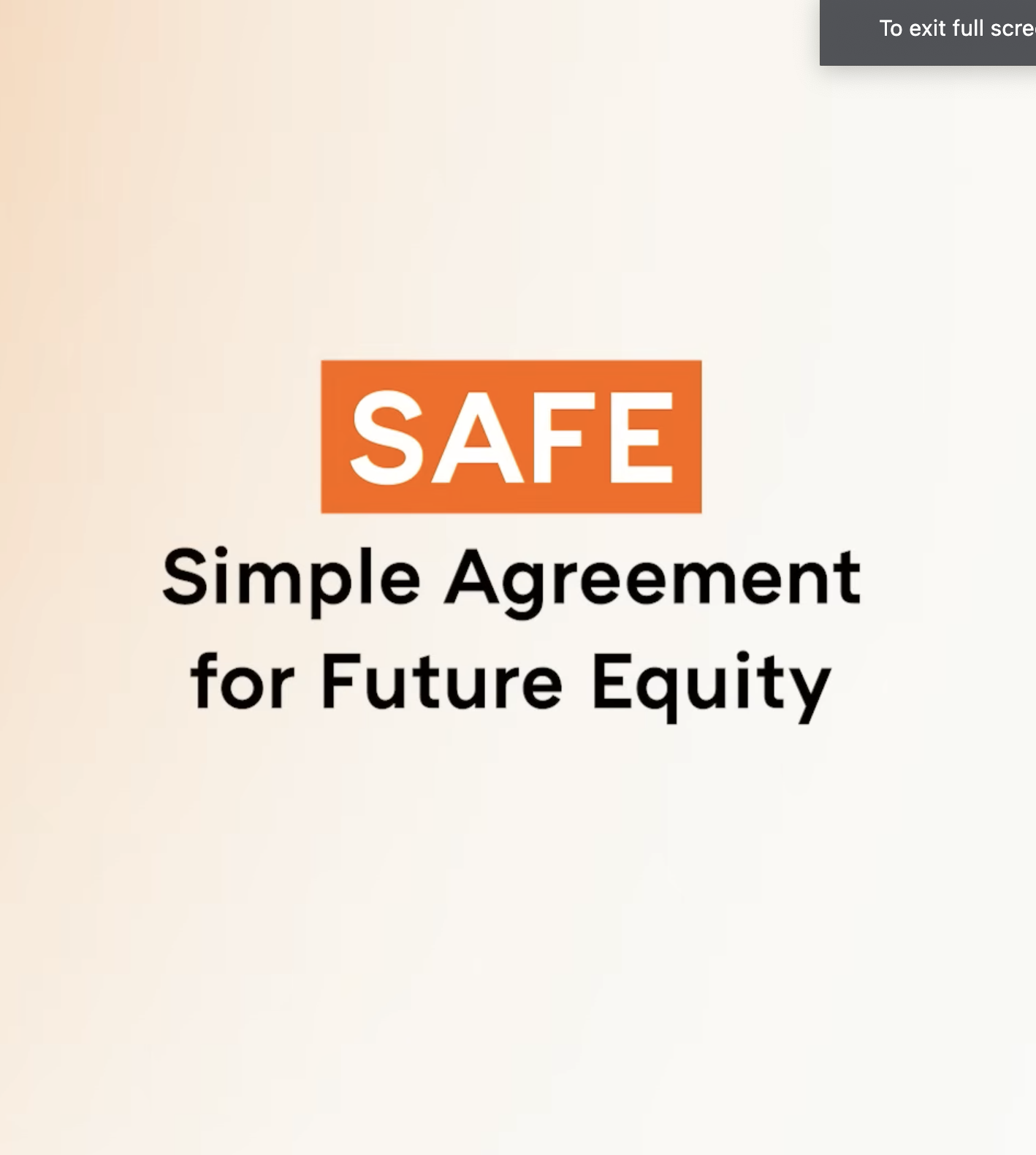
YC introduced the SAFE: Simple Agreement for Future Equity.
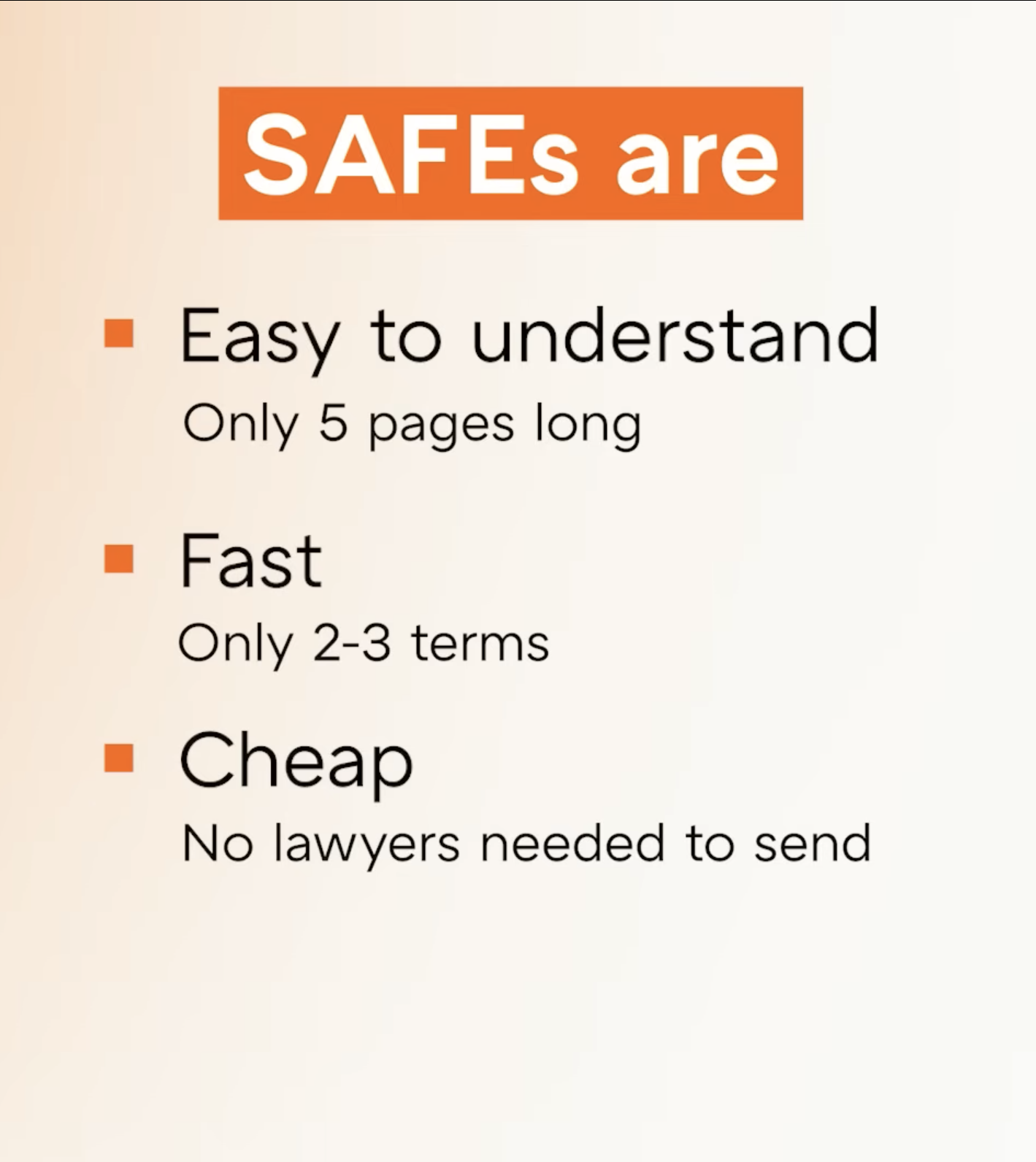
It allows startups to raise money with a short standard document and fewer terms.
This makes early fundraising faster and cheaper than negotiating a full priced equity round.
THE MAIN SAFE TERMS
INVESTMENT AMOUNT AND VALUATION CAP
A SAFE normally focuses on the investment amount and valuation cap.
The investor receives equity when a future financing converts the SAFE.
Founders should still understand dilution, conversion mechanics, local law, and the total effect of multiple SAFEs.
RAISE IN STEPS
USE EARLY CAPITAL TO CREATE MORE LEVERAGE
A smaller early round can finance the next technical, commercial, or regulatory milestone.
Once that milestone is reached, the startup can approach larger investors with stronger evidence and better negotiating power.
ASTRA RAISED BEFORE THE BIG ROUND
EARLY SAFES ACCELERATED BIOTECH PROGRESS
Astra, a biotech startup, used early SAFE funding from angels to accelerate laboratory progress.
That initial capital helped the team produce stronger evidence before approaching larger pharmaceutical investors.
Progress improved their leverage.
CONTROL AND BOOTSTRAPPING
CHAPTER 5
EARLY CAPITAL AND CONTROL
DEAL STRUCTURE DETERMINES GOVERNANCE
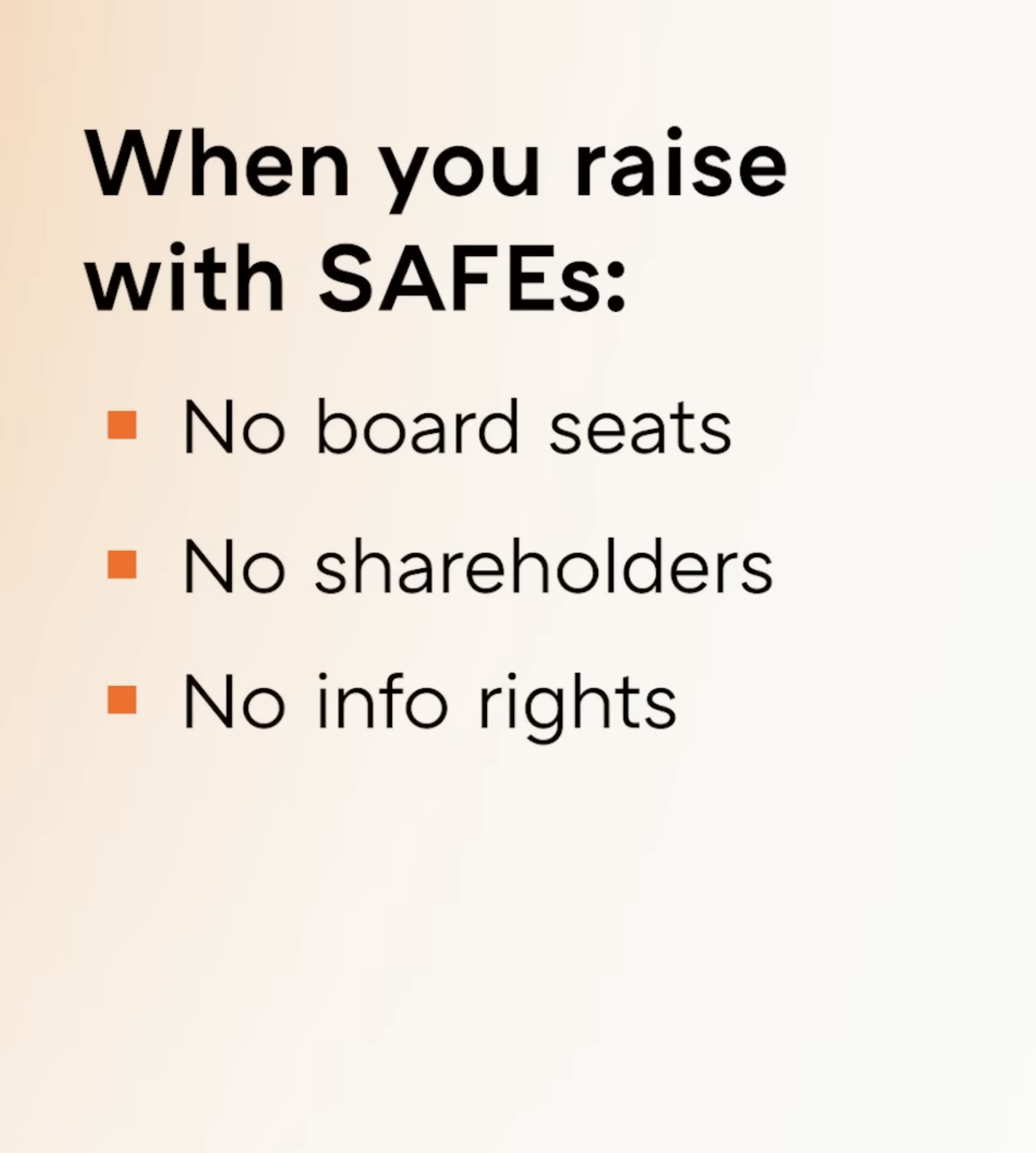
A SAFE usually grants no board seat at signing.
Founders can continue operating while the SAFE converts during a future financing.
Control still depends on ownership, financing terms, governance documents, and cumulative dilution.
DILUTION MUST BE PLANNED
EVERY CHECK CHANGES FUTURE OWNERSHIP
Raising money means selling part of the future company.
Model how each SAFE, option pool, and later round affects founder ownership.
Capital is useful when the value it helps create is greater than the ownership given away.
ZAPIER CHOSE ITS OWN PATH
ONE ROUND, THEN CUSTOMER-FUNDED GROWTH
Zapier raised an early round, built the company remotely, and later stopped raising.
The founders used outside capital to gain stability, then grew through customer revenue.
Fundraising served as a temporary tool supporting a long-term independent path.
BOOTSTRAPPING HAS A COST
REVENUE PRESSURE CAN LIMIT STRATEGIC CHOICES
Bootstrapping can preserve ownership, but it may also create constant cash pressure.
Founders may delay hiring, take consulting work, or prioritize short-term revenue over the core product.
The correct path depends on the business and market.
CHOOSE THE FUNDING MODEL
MATCH CAPITAL TO THE COMPANY
Bootstrap when the business can grow efficiently from customer revenue.
Raise when speed, research, infrastructure, regulation, or market timing requires more capital.
Choose the model that gives the company the strongest path toward durability.
YOU DO NOT NEED A FANCY NETWORK
CHAPTER 6
TRACTION OPENS DOORS
EVIDENCE CAN OUTPERFORM PEDIGREE
Investors may notice schools, employers, and personal connections.
They care more about the possibility of a strong return.
A product people want, growing revenue, strong retention, or unusual execution can overcome a limited network.
PODIUM STARTED FAR AWAY
SALES TRACTION CREATED CREDIBILITY
Podium began by selling customer-review software to tire shops.
The founders came from Utah without a major Silicon Valley network, but they were strong at sales and already generating revenue.
Performance made investors pay attention.
BUILD YOUR OWN NETWORK
EVERY USEFUL CONVERSATION CAN COMPOUND
Start with founders, operators, customers, accelerators, angels, and industry experts.
Ask for advice before asking for money. After a useful conversation, request one relevant introduction.
A network can be built through execution.
OWN THE INVESTOR RELATIONSHIP
FOUNDERS SHOULD LEAD THE MEETINGS
Someone may offer to raise money for you because they know investors.
Ask them for introductions, then lead the meetings yourself.
Investors are evaluating the founders, and the long-term relationship should begin directly with the people building the company.
REJECTION IS PART OF THE PROCESS
CHAPTER 7
REJECTION IS ONE DECISION
INVESTORS CAN MISJUDGE THE OPPORTUNITY
Strong startups are rejected constantly.
An investor may dislike the market, timing, business model, valuation, geography, or risk profile.
Their decision reflects their own strategy and conviction. The company’s future remains open.
ENVISION WAS REJECTED 50+ TIMES
ONE CHECK CREATED THE OPENING
Envision struggled to secure its first investment and faced more than 50 rejections.
The founder eventually raised an initial $25,000 check, completed a $500,000 first round, and kept building.
The company was later acquired for $275 million.
WHATNOT RAISED LESS THAN EXPECTED
EARLY INVESTORS MISSED THE SCALE
Whatnot had early traction but investors still disliked the opportunity.
The company raised only a fraction of its target seed round.
A few years later, it reached a multibillion-dollar valuation, showing how differently the future can unfold.
FIND ENOUGH BELIEVERS
FUNDRAISING IS NOT A POPULARITY CONTEST
A fundraising round needs enough aligned investors to finance the next stage.
Target people who understand the market, company type, stage, and risk.
A focused list creates better conversations and a higher chance of conviction.
LEARN WITHOUT LOSING CONVICTION
SEPARATE SIGNAL FROM NOISE
Track recurring objections.
One rejection may mean little. The same objection from many qualified investors may reveal a real weakness.
Use feedback to improve the business while preserving conviction that is supported by customer evidence.
THE FOUNDER FUNDRAISING SYSTEM
CHAPTER 8
STEP 1: BUILD SOMETHING PEOPLE WANT
START WITH REAL CUSTOMER VALUE
Create the smallest product that solves a meaningful problem.
Put it in front of users quickly. Observe behavior, usage, retention, revenue, and repeat demand.
These signals become the foundation of the fundraising story.
STEP 2: DEFINE THE MILESTONE
KNOW WHAT THE MONEY MUST ACHIEVE
State exactly what the round will unlock.
Examples: ship the product, reach 100 paying customers, complete a clinical milestone, enter a new market, or prove repeatable acquisition.
Capital without a milestone becomes expensive time.
STEP 3: PREPARE THE EVIDENCE
MAKE THE COMPANY EASY TO UNDERSTAND
Prepare a clear story, short deck, product demo, traction metrics, financial plan, cap table, and fundraising target.
Use simple language.
Every material should help an investor understand the opportunity and evaluate it quickly.
STEP 4: RUN A TIGHT PROCESS
CREATE MOMENTUM ACROSS MEETINGS
Build a qualified investor list and schedule meetings close together.
Track every conversation and follow up quickly. Share meaningful progress during the process.
Momentum improves focus, creates urgency, and reduces months of distraction.
STEP 5: CLOSE THE RIGHT CAPITAL
CHOOSE ALIGNMENT, NOT ONLY MONEY
Evaluate the investor’s reputation, speed, stage fit, decision process, terms, and ability to help.
Understand the legal documents before signing.
The best investor strengthens the company while respecting the founder’s ability to execute.
THE CORE LESSON
BUILD FIRST. RAISE WITH LEVERAGE.
Start building before seeking permission or capital.
Create a useful product, collect evidence, explain the opportunity clearly, and speak with many investors.
Expect rejection. Keep improving. Raise when capital can accelerate a specific path toward a stronger company.