FOLDER
LEARN STARTUPS | BUSINESS MODEL
CONTENT

HOW ASSET-LIGHT BUSINESSES SCALE
FROM SOMEWHERE
CHAPTER INDEX
OWN THE SYSTEM
HOW BUSINESSES SCALE THROUGH ASSETS, EXPERTISE AND NETWORKS
A business can serve millions of customers by coordinating resources supplied by others.
Explore the models, economics and operating responsibilities behind this strategy.
THE BUSINESS BEHIND THE BUSINESS
CHAPTER 1
WHAT THE HEADLINE REALLY MEANS
ASSET-LIGHT BUSINESSES STILL OWN VALUABLE ASSETS
These companies invest in software, intellectual property, brands, relationships and operating capabilities.
Partners supply much of the physical capacity or labor.
The opportunity is to build a valuable role in how customers discover, purchase and receive an outcome.
START WITH THE CUSTOMER'S OUTCOME
PEOPLE PAY TO SOLVE A PROBLEM
A traveler needs a suitable stay.
A passenger needs reliable transport.
A chip company needs usable technology.
An SME needs completed work.
A system earns revenue when it makes that outcome easier, more dependable or more economical.
SEVEN LAYERS OF A BUSINESS
MAP WHERE VALUE IS CREATED
1. Resources: assets, skills and IP.
2. Production: making or delivering.
3. Distribution: reaching customers.
4. Coordination: organizing the work.
5. Trust: reducing uncertainty.
6. Transactions: billing and payments.
7. Relationships: encouraging repeat use.
CHOOSE YOUR ROLE IN THE CHAIN
SPECIALIZATION CAN IMPROVE CAPITAL EFFICIENCY
A company can build several layers and use partners for the others.
A booking platform might focus on discovery, payments and trust. Property owners provide accommodation.
Ask which activities your company can perform exceptionally well and which partners can deliver sustainably.
THE SYSTEM MUST EARN ITS FEE
A USEFUL TEST FOR EVERY INTERMEDIARY
What improves because your business exists?
Customers might save time, gain confidence or find better options. Suppliers might gain sales, reduce idle capacity or simplify administration.
The fee needs a clear relationship to value delivered.
FOUR MODELS OF COORDINATION
CHAPTER 2
PLATFORM AND MARKETPLACE
THE TERMS OVERLAP
A platform enables interactions or complementary activity.
A marketplace is a platform that helps buyers and sellers transact.
Airbnb and Uber both illustrate marketplace economics. The carousel's separate labels should not be read as mutually exclusive business categories.
MODEL 1: MARKETPLACE
ORGANIZE FRAGMENTED SUPPLY AND DEMAND
Suppliers provide an offering. Customers bring demand. The marketplace enables discovery, matching and transactions.
Revenue can come from transaction fees, subscriptions or other services.
Performance depends on relevant availability and successful exchanges.
AIRBNB: ACCOMMODATION ACCESS
SERVICE FEES SUPPORT THE EXCHANGE
Airbnb charges a service fee when a booking is confirmed.
Hosts supply accommodation. The platform helps organize bookings and supports the exchange.
Fee structures vary and can change. A single assumed percentage should not be treated as a universal rate.
THE AIRBNB LESSON
MAKE DISTRIBUTED SUPPLY EASIER TO PURCHASE
A useful accommodation marketplace needs accurate listings, suitable availability and a dependable booking experience.
Strategic interpretation: organizing scattered inventory can create value when customers otherwise struggle to discover and evaluate it.
UBER: REAL-TIME COORDINATION
AVAILABILITY MUST MATCH PLACE AND TIME
Uber connects customers with transport and delivery providers.
Its filings also disclose substantial costs involving insurance, payments and incentives.
A business can rely on partner capacity while still carrying significant operating costs.
THE UBER LESSON
MEASURE AVAILABILITY WHERE THE CUSTOMER NEEDS IT
A worldwide provider count says little about whether a customer can find help nearby at the required time.
For any marketplace, measure suitable matches, response time and fulfillment within the actual category or location being served.
MODEL 2: FRANCHISE
REPLICATE A BRAND AND OPERATING FORMAT
A franchisee invests in and operates a business under agreed brand rights and standards.
The franchisor supplies a business format, brand and support under contract.
Fees can include initial charges and ongoing royalties. Both parties need viable economics.
MODEL 3: MANAGEMENT
OPERATE CAPACITY FINANCED BY SOMEONE ELSE
An owner supplies the property or underlying investment.
A management company supplies operating expertise under an agreement.
Management fees may include a base component and a performance component. The contract defines responsibilities and incentives.
MARRIOTT: SEVERAL MODELS TOGETHER
FRANCHISING AND MANAGEMENT COEXIST
Marriott's system includes franchised, managed and licensed properties, alongside owned or leased hotels.
Its reported strategy includes minimizing invested capital through arrangements such as asset sales with long-term franchise or management agreements.
A TRUSTED BRAND MUST PERFORM
CONSISTENCY SUPPORTS THE BUSINESS MODEL
Strategic interpretation: owners benefit when a hotel system helps attract bookings and supports dependable operations.
Franchise and management arrangements assign different operating duties.
The practical lesson is to make standards, responsibilities and performance measurable.
MODEL 4: TECHNOLOGY LICENSING
EARN FROM REUSABLE INTELLECTUAL PROPERTY
A technology owner grants specified rights to use its IP.
Customers integrate that technology into their own products or operations.
Revenue may combine access fees and usage-based royalties. Continued engineering and support help preserve the technology's usefulness.
ARM: LICENSING AND ROYALTIES
TECHNOLOGY EMBEDDED IN CUSTOMERS' CHIPS
Arm's licensing business provides processor technology and related IP.
Its disclosed royalty arrangements can use a share of chip selling price or a fixed fee per chip.
The model spreads technology development across many downstream products. This describes its licensing business, not every possible company activity.
"ARM ONLY SUCCEEDS WHEN PARTNERS SUCCEED."
__WILL ABBEY
Verified excerpt from Will Abbey's Arm article, published November 1, 2023.
THE LICENSING LESSON
REUSE NEEDS CONTINUING INVESTMENT
Reusable IP can support revenue across many customers and product generations.
Its economic value depends on performance, relevance, integration and support.
A licensor must continue earning adoption as alternatives and customer requirements evolve.
HOW SCALE CREATES VALUE
CHAPTER 3
PARTNERS FINANCE CAPACITY
INVESTMENT IS DISTRIBUTED ACROSS THE ECOSYSTEM
Property owners fund buildings. Providers invest in equipment and skills. Manufacturers finance production.
This can reduce the central company's direct investment per unit of capacity.
Partners still need sufficient earnings to maintain and expand what they supply.
SHARED INFRASTRUCTURE
ONE CAPABILITY CAN SERVE MANY EXCHANGES
Search, billing, reputation systems and operating standards can support many participants.
Some fixed costs are spread across more activity.
Support, payment processing, insurance and computing may still grow with usage. Measure the actual cost curve.
BETTER UTILIZATION
HELP USEFUL CAPACITY FIND DEMAND
An empty room, unfilled appointment or available professional hour has limited earning power until demand arrives.
A coordination system can improve utilization by making that capacity discoverable and purchasable.
Value depends on incremental business and the cost of generating it.
POTENTIAL NETWORK EFFECTS
PARTICIPATION CAN IMPROVE THE SERVICE
More relevant suppliers can improve availability.
Better availability can attract customers.
More demand can improve supplier earnings.
Better earnings can attract suppliers.
This loop requires quality, relevance and successful matching. Growth alone does not establish a network effect.
DENSITY BEFORE BREADTH
A FOCUSED MARKET CAN BECOME USEFUL SOONER
A marketplace needs enough relevant activity within a specific need, category or location.
Ten dependable providers serving a clear customer need may produce a useful experience.
A huge directory with weak availability may still leave customers unable to transact.
REPEAT USE COMPOUNDS LEARNING
RECURRING NEEDS SUPPORT IMPROVEMENT
Repeated work creates opportunities to refine briefs, matching, delivery and review.
A monthly process can reveal where delays and revisions occur.
Repeat usage becomes valuable when it improves customer outcomes and generates sustainable contribution.
THE ECONOMICS OF THE SYSTEM
CHAPTER 4
THREE NUMBERS TO SEPARATE
VOLUME, REVENUE AND PROFIT
Transaction volume: total value exchanged through the platform.
Revenue: the amount recognized by the company under its business and accounting arrangements.
Profit: what remains after applicable costs.
A large volume figure alone cannot establish profitability.
TAKE RATE: A SIMPLIFIED EXAMPLE
HYPOTHETICAL FIGURES FROM THE CAROUSEL
Transaction volume: $1 billion.
Assumed platform share: 25%.
$1 billion × 25% = $250 million.
This is hypothetical fee revenue before expenses under the assumed model. It is not a statement of Uber's universal fee or reported revenue.
ROYALTY REVENUE: AN ILLUSTRATION
THE ASSUMED ROYALTY RATE MATTERS
Royalty-bearing sales: $500 million.
Assumed royalty rate: 5%.
$500 million × 5% = $25 million.
This illustrates the mathematics. It does not establish Arm's actual rate for any contract.
A SMALL MARKETPLACE EXAMPLE
HYPOTHETICAL MONTHLY ECONOMICS
1,000 transactions × $100 = $100,000 volume.
At a 15% platform fee:
Revenue = $15,000.
Assume payment costs of $3,000, variable support of $2,000 and incentives of $2,000.
Contribution before fixed costs = $8,000.
CONTRIBUTION MUST COVER THE BUSINESS
FIXED COSTS REMAIN
The example's $8,000 contribution still needs to support salaries, product development, administration and other fixed costs.
Include the operating costs your model actually incurs.
Growing transactions with negative contribution can increase the cash required to operate.
CAPITAL EFFICIENCY
HOW MUCH INVESTMENT PRODUCES THE RESULT?
Company A earns $20 million operating profit using $200 million capital: 10%.
Company B earns $20 million using $50 million: 40%.
These hypothetical pre-tax operating returns illustrate different capital requirements.
UNDERSTAND THE MEASURE
THE CAROUSEL USES A SIMPLIFIED RETURN
A common ROIC definition uses after-tax operating profit divided by invested capital, often averaged over the period.
The carousel uses operating profit and operating capital as a simpler comparison.
Compare businesses using consistent definitions and periods.
INTANGIBLE INVESTMENT COMPLICATES COMPARISONS
ACCOUNTING DOES NOT CAPTURE EVERY INVESTMENT EQUALLY
Research, software, brand-building and customer acquisition can involve significant expenditure.
Some spending is expensed rather than shown as a lasting balance-sheet asset.
A small capital base can therefore understate the economic investment needed to build the business.
ASK ABOUT THE NEXT 100 CUSTOMERS
INCREMENTAL ECONOMICS GUIDE EXPANSION
Estimate the additional cash, provider capacity, support and computing required.
Will delivery improve or become harder?
Will contribution remain positive?
Will new customers return?
Historical returns are useful context. Expansion requires its own evidence.
BUILD A DURABLE ADVANTAGE
CHAPTER 5
RELIABLE DEMAND
SUPPLIERS NEED WORTHWHILE OPPORTUNITIES
A platform becomes useful to suppliers when it repeatedly connects them with suitable paying customers.
Measure completed sales, repeat demand and supplier earnings after costs.
A large audience matters most when it produces relevant business.
RELEVANT SUPPLY
CUSTOMERS NEED USABLE CHOICES
Track whether customers can find providers who meet their scope, budget, timing and quality requirements.
Useful measures include response time, match success and fulfillment.
Supply quality should be assessed at the level of the customer's actual need.
TRUST THROUGH EVIDENCE
MAKE PERFORMANCE EASIER TO EVALUATE
Verified work, clear deliverables and consistent review practices can reduce uncertainty.
Separate identity verification from demonstrated competence.
Build reputation around observable performance, including revisions, acceptance and reliability.
EMBEDDED OPERATIONS
HELP PEOPLE COMPLETE RECURRING WORK
Briefs, schedules, files, decisions and reviews can form a useful operating record.
When a system makes ongoing work easier, customers have practical reasons to keep using it.
Preserve clear access and portability so retention rests on continuing usefulness.
STANDARDS THAT IMPROVE DELIVERY
TURN EXPERTISE INTO REPEATABLE PRACTICE
Define what good work includes:
Required inputs.
Delivery format.
Quality criteria.
Review process.
Completion evidence.
Standards create value when they reduce uncertainty and rework without blocking necessary judgment.
CUSTOMER CHOICE REMAINS
PARTICIPATION MUST BE EARNED REPEATEDLY
Customers and suppliers can use several platforms or work directly together.
A defensible system keeps improving discovery, coordination, payments or support.
Ask what participants would lose if they stopped using it, and whether that value justifies the fee.
RISKS AND LIMITS
CHAPTER 6
THE INITIAL PARTICIPATION PROBLEM
EACH SIDE WAITS FOR THE OTHER
Customers want available providers. Providers want paying customers.
A practical response is to begin with one specific use case and coordinate early transactions manually.
Record repeated friction before automating the process.
INDEPENDENT DELIVERY CREATES QUALITY RISK
THE CUSTOMER EXPERIENCES ONE OUTCOME
A provider's missed deadline can damage trust in the platform.
Use clear scope, realistic availability, acceptance criteria and a defined escalation process.
Measure failures and rework alongside successful transactions.
TRANSACTIONS CAN MOVE ELSEWHERE
THE INTRODUCTION IS ONLY ONE PART OF VALUE
After meeting, a buyer and supplier may arrange future work directly.
Useful project records, convenient repeat purchases, payments and dispute support can encourage continued participation.
Test whether these services justify the ongoing fee.
SUPPLIER ECONOMICS CONSTRAIN FEES
THE ECOSYSTEM NEEDS SUSTAINABLE DELIVERY
Providers need enough earnings to cover their time, equipment and operating costs.
Aggressive fees or unpredictable demand can weaken supply quality and retention.
Track provider outcomes alongside platform revenue.
ACQUISITION CAN CONSUME THE MARGIN
LOW PHYSICAL INVESTMENT CAN COEXIST WITH HIGH SPENDING
Advertising, incentives and sales effort can make customer growth expensive.
Measure acquisition cost against contribution from retained customers.
Account for refunds, support and repeated incentives when assessing payback.
DEPENDENCIES AND OPERATING OBLIGATIONS
PARTNER CAPACITY CREATES ONGOING RESPONSIBILITIES
Outside payment, distribution and technology services can affect access and cost.
Contracts, local operating requirements and customer protections also shape the model.
Map actual dependencies and responsibilities for the category you serve.
PHYSICAL OWNERSHIP CAN CREATE VALUE
CHOOSE THE STRUCTURE THAT FITS DELIVERY
Direct asset ownership may help secure scarce capacity, control quality or integrate complex production.
Evaluate reliability, investment needs and operating expertise together.
Asset-light structure is one strategic choice. Its suitability depends on the business.
SOURCES AND EVIDENCE
CHAPTER 7
HOW TO READ THIS STACKSLIDE
FACTS, INTERPRETATION AND EXAMPLES
Company descriptions are supported by linked primary sources.
Business frameworks are analytical interpretations.
All sample financial figures are illustrative.
The opening carousel supplied the theme; it is not treated as independent proof.
PRIMARY SOURCES: AIRBNB AND UBER
FEES, OPERATING MODEL AND COSTS
Airbnb's service-fee documentation explains its booking charges.
Uber's 2025 annual report describes its business and operating costs.
Use the page source links for company-specific evidence. Fee arrangements and business activities can change.
PRIMARY SOURCES: MARRIOTT AND ARM
OPERATING ARRANGEMENTS AND LICENSING
Marriott's 2025 annual report describes its hotel arrangements and capital strategy.
Arm's June 2026 filing describes licensing and royalties.
Will Abbey's 2023 Arm article supplies the verified quotation.
EVIDENCE HAS LIMITS
USE THE MODELS WITH CONTEXT
Company disclosures are authoritative about reported operations but reflect company perspectives.
Several primary sources support the comparison; they do not independently prove that asset-light businesses always outperform.
Strategic proposals need customer and operating evidence.
HOW STAR.FUN WORKS
FROM STARTUP IDEA TO PROGRAMMABLE OWNERSHIP
Star lets a founder design a token, raise USDC from internet backers and operate ownership after the raise through trading, governance, rewards and follow-on funding.
THE SHORT ANSWER
WHAT STAR CHANGES
Star compresses fundraising, ownership design, token issuance and community coordination into one onchain system. A startup becomes both an operating company and a liquid ownership network.
THE NEW FUNDING MODEL
CHAPTER 1
WHAT STAR IS
A PROGRAMMABLE-OWNERSHIP PLATFORM
Star describes itself as a platform where founders design a token, raise against it and then use it for revenue sharing, rewards, governance and later funding. Its primary control interface is a command-line tool.
THE CORE LOOP
DESIGN → RAISE → GRADUATE → OPERATE
1. Choose an ownership structure. 2. Configure a token and raise. 3. Sell tokens for USDC. 4. Graduate into a trading pool. 5. Run the treasury, incentives and future funding around the token.
THE SHIFT
FROM TOKEN LAUNCHPAD TO OWNERSHIP SYSTEM
Older Star material described utility-token fundraising. Current documentation goes further: tokens may carry revenue rights, replace a cap table, link to equity or convert into equity. The present model is materially broader.
WHAT FOUNDERS RECEIVE
CAPITAL, LIQUIDITY AND DISTRIBUTION
Founders can raise initial USDC, earn part of later trading fees, unlock more capital as market value grows and turn holders into users, promoters and contributors. The exact rights depend on the chosen structure.
WHAT BACKERS RECEIVE
A TOKEN WITH STRUCTURE-SPECIFIC RIGHTS
Backers receive a tradable token. Depending on the model, it may carry revenue exposure, ownership of an offshore DAO, equity backing or an optional route into equity. It still carries startup and market risk.
“BUILD A BUSINESS AND RAISE MONEY FROM YOUR LAPTOP WITHOUT VC INTROS.”
— ADAM BERGEMAN, STAR FOUNDER
FOUR OWNERSHIP STRUCTURES
CHAPTER 2
STRUCTURE DEFINES THE DEAL
THE CHOICE IS FIXED BEFORE THE ROUND
Star documents four models: revenue share only, Offshore DAO, Bedrock and ACE. The choice determines what the token contains, what remains on the company cap table and which funding paths remain possible later.
1. REVENUE SHARE
TOKEN RECEIVES ECONOMIC VALUE THROUGH BUYBACKS
The startup commits a fixed percentage of sales. A smart contract converts that value into onchain token buybacks. It can stand alone or accompany another structure. Star lists it as available on request.
REVENUE-SHARE CHOICES
TERMS THAT MUST BE DECIDED BEFORE LAUNCH
Set the revenue percentage, start trigger, cadence and whether repurchased tokens are burned or held in treasury. A day-one trigger gives holders earlier value; a later milestone preserves more operating cash.
2. OFFSHORE DAO
THE TOKEN BECOMES THE CAP TABLE
An offshore entity holds the project IP. The token represents ownership of the project and decision markets govern major choices. There is no separate conventional equity class, so a normal VC equity path is no longer available.
3. BEDROCK
A TOKEN LINKED TO MINORITY COMPANY EQUITY
Bedrock links the token to 1–30% of company equity, typically through preference shares held by a Cayman structure. Founders retain the remaining equity and operational control. Star states a standard 10% link.
HOW BEDROCK PRICES EQUITY
VALUATION = GRADUATION CAP ÷ EQUITY LINK
At Star’s documented Standard graduation cap of about $352K, a 10% equity link implies a valuation near $3.52M. A 5% link implies about $7.04M. These are mechanical implied valuations, not independent appraisals.
BEDROCK PROTECTION
LEGAL RECOURSE DOES NOT REMOVE STARTUP RISK
Star says the structure creates a legal counterparty, assigns IP to the company and funds enforcement for fraud or misuse. It does not protect holders from ordinary failure, weak execution or a falling token price.
4. ACE
TOKENS CAN CONVERT INTO A MODIFIED SAFE
Eligible holders may exchange selected tokens for an ACE SAFE denominated in the token. They keep unconverted tokens and receive a non-transferable certificate for the SAFE position. KYC, sanctions and eligibility checks apply.
CHOOSE BY FUTURE PATH
THE STRATEGIC DECISION
Revenue share preserves the cap table. Offshore DAO suits a fully onchain company. Bedrock combines a token with minority equity backing. ACE keeps early ownership liquid while offering some holders a later equity route.
FORMATION FOLLOWS SUCCESS
LEGAL SETUP OCCURS AFTER GRADUATION
Star says the selected structure is declared before the raise, while incorporation or legal implementation happens only after a successful raise. If the round fails to graduate, nothing is formed or signed.
HOW THE RAISE WORKS
CHAPTER 3
TWO RAISE MECHANISMS
CURVE OR PRESALE
A curve is a live market with changing price and immediate liquidity. A presale uses one fixed price, a defined window and a minimum target. Star states that a round uses one mechanism or the other.
CURVE ROUND
OPTIMIZED FOR SPEED AND PRICE DISCOVERY
Backers buy and sell during the raise. Price rises as demand buys along the bonding curve. The round ends at a graduation market cap, then liquidity moves into a live trading pool.
CURVE PRESETS
DOCUMENTED STANDARD CONFIGURATIONS
Micro: founder target $10K; graduation near $190K. Standard: $25K; near $352K. Pro: $50K; near $622K. Star says larger rounds require direct configuration.
WHY MORE IS COLLECTED
PART OF THE CAPITAL SEEDS LIQUIDITY
The curve collects more than the founder’s take-home target. Some proceeds pair with tokens to create post-graduation market liquidity. This reserve gives later buyers and sellers a pool to trade against.
STANDARD CURVE SUPPLY
ONE BILLION SPL TOKENS
Star documents a fixed 1B supply: 60% for the public sale, 20% for the team and 20% for graduation liquidity. The team allocation is locked under a disclosed vesting schedule.
PRESALE
FIXED PRICE AND SELECTED PARTICIPANTS
Participants deposit USDC during a set window, usually five days. If the minimum is missed, deposits are refunded. Oversubscription is refunded pro rata. Successful participants claim tokens after launch.
PRESALE PARAMETERS
THE FOUNDER CONFIGURES THE ROUND
Set the minimum raise, treasury allowance, public allocation, liquidity allocation and team performance package. Lock periods may vary by allocation tier. Star lists presales as available on request.
PRE-COMMIT CAMPAIGN
MEASURE DEMAND BEFORE THE ROUND
Participants commit before launch and may receive a larger allocation. The founder enters the public round with visible demand. Star lists this mechanism as available on request, with CLI support still in development.
FROM SETUP TO LAUNCH
CHAPTER 4
THE CLI IS THE CONTROL LAYER
DASHBOARD FOR VISIBILITY; CLI FOR OPERATION
Star’s current workflow centers on its command-line interface. Founders can inspect requirements, authenticate, preview a launch payload, approve it and wait for the token to become live.
FOUNDER DECISIONS
NO SILENT DEFAULTS
Current docs require an ownership structure and also describe decisions for raise tier, equity-link percentage, compensation bands and launch rewards. Missing decisions should stop the launch and request explicit input.
AGENT-ASSISTED LAUNCH
AN AI AGENT CAN OPERATE THE WORKFLOW
The agent reads Star’s requirements, asks for founder decisions, initiates sign-in, previews the exact payload and waits for approval. Star says agents do not receive wallet secrets or private keys.
PROOF BEFORE PROMOTION
WHAT BACKERS CHECK
Connect X, GitHub and LinkedIn. Link a live product, beta or 60–90 second demo. Prepare a clear launch post explaining what exists, why the timing matters and what the raise unlocks.
LAUNCH DAY
CONCENTRATE ATTENTION IN THE FIRST HOURS
Publish across core channels, pin the main post, start a livestream, demonstrate the product and answer questions publicly. Star treats live interaction as a central trust and conversion mechanism.
THE FIRST 48 HOURS
MAKE MOMENTUM VISIBLE
Stay responsive, share 25% and 50% funding milestones, highlight product usage, thank backers publicly and stream again on day two. The launch behaves like a coordinated product release and capital campaign.
AFTER THE RAISE
CHAPTER 5
GRADUATION
THE SALE BECOMES A MARKET
When a curve reaches its graduation market cap, the token moves into a live Solana trading pool. From that point, holders can trade on compatible decentralized exchanges and secondary-market fees begin.
TRADING-FEE MODEL
STAR EARNS FROM ACTIVITY, NOT THE RAISE
During the raise, each trade carries 1%: 0.8% to Star and 0.2% to Meteora. After graduation: 0.7% to the founder, 0.1% to Star and 0.2% to Meteora. Star says failed rounds pay no fee.
TEAM VESTING
STANDARD CURVE SCHEDULE
The standard team allocation is 20% of supply. Star documents a three-month cliff followed by linear vesting over nine months. Tokens stay transfer-locked until vested, and the terms are disclosed before purchase.
CAPITAL UNLOCKS
GROWTH RELEASES MORE OPERATING CAPITAL
Star places token positions higher on the price curve. As demand buys them, proceeds unlock to the team. Documented cumulative unlocks rise from $10K at a $2M market cap to a maximum $8.6M at $160M.
DECISION MARKETS
MARKET-MEDIATED TREASURY GOVERNANCE
A holder with at least 5% of supply may open a proposal. Participants put capital behind outcomes, and the market result determines whether a major treasury or structural action executes. Daily operations remain with founders.
MONTHLY ALLOWANCES
RUNWAY WITHIN GOVERNED BOUNDARIES
Raised funds, trading fees and revenues sit in the project treasury. The team receives scheduled operating allowances. Larger spending, allowance changes, follow-on funding and structural changes require proposals.
REWARDS CAMPAIGNS
PAY TOKENS FOR VERIFIED GROWTH ACTIONS
A project can reward referrals, signups, orders or other actions. Star supports leaderboard points and fixed action rewards. Tokens are escrowed before earning begins, and server-side events verify completed actions.
USERS CAN EARN FIRST
WALLET COMES LATER
Participants can earn without a Star account or wallet, then verify a Solana wallet when claiming. Star states that app-side identities remain in the startup’s database rather than being sent to Star.
HOLDERS BECOME DISTRIBUTION
OWNERSHIP IS ALSO A GROWTH LOOP
Founders keep holders informed through updates and livestreams, ask for feedback and amplification, then reward valuable contributions. This can turn financial alignment into customer acquisition and product participation.
FOLLOW-ON FUNDING
FUTURE TOKEN ISSUANCE REQUIRES APPROVAL
Star documents later fundraising through proposal-approved minting. New supply can fund the next stage, with amount and valuation stated in the proposal. Existing holders therefore face a possible future dilution decision.
ECONOMICS AND INCENTIVES
CHAPTER 6
FOUNDER ECONOMICS
THREE POSSIBLE CAPITAL STREAMS
A curve founder may receive the initial raise target, 0.7% of post-graduation trading and milestone-based capital unlocks. Revenue-share commitments, incorporation costs and treasury rules reduce unrestricted cash.
BACKER ECONOMICS
RIGHTS VARY; RETURNS ARE NEVER GUARANTEED
A backer’s outcome may come from token price, buyback demand, ownership rights or optional equity conversion. Each source depends on structure, execution, liquidity, law and future demand. None guarantees recovery or profit.
THE ALIGNMENT THESIS
CAPITAL + COMMUNITY + MARKET
Star’s thesis is that backers become owners, early users and promoters; founders gain funding and distribution; and Star earns when trading continues. The loop works only if a useful company grows beneath the token.
LIQUIDITY HAS TWO FACES
ACCESS AND VOLATILITY ARRIVE TOGETHER
Day-one trading gives holders an exit route and produces price discovery. It also lets speculation, thin liquidity and sentiment reprice the startup continuously, often faster than the underlying business changes.
MARKET CAP IS NOT CASH
DO NOT CONFUSE VALUATION WITH RUNWAY
A token’s market capitalization is price multiplied by supply. It does not mean the treasury holds that amount. Selling a large position can move price sharply when liquidity is limited.
RISKS AND OPEN QUESTIONS
CHAPTER 7
STARTUP RISK REMAINS
PROGRAMMABILITY CANNOT CREATE PRODUCT-MARKET FIT
The company can still fail from weak demand, poor execution, competition, founder conflict or insufficient runway. Legal rights and transparent contracts improve structure; they do not make an early-stage company safe.
TOKEN AND SMART-CONTRACT RISK
CODE, CUSTODY AND MARKET MECHANICS MATTER
Backers face contract bugs, wallet mistakes, liquidity shocks, governance attacks and volatile pricing. Public documentation explains intended mechanics, yet it is not a substitute for audits, onchain verification and risk review.
LEGAL LABELS ARE NOT ENOUGH
THE TOKEN AND ITS TRANSACTION REQUIRE ANALYSIS
Under current U.S. SEC guidance, a crypto asset may be non-security property yet become subject to an investment contract through issuer promises, purchaser expectations and reliance on essential managerial efforts.
EQUITY CONVERSION IS RESTRICTED
ACE ELIGIBILITY DEPENDS ON SECURITIES RULES
Star says the MetaLeX pilot uses Regulation S for verified non-U.S. persons, while U.S. participation may use Regulation D for accredited investors. Founder and investor counsel must validate the applicable route.
GOVERNANCE CAN CONCENTRATE
THE PROPOSAL THRESHOLD IS 5% OF SUPPLY
A 5% proposal threshold limits spam, yet it also favors large holders. Readers should verify voting-market design, manipulation resistance, execution safeguards and what happens during disputed or low-liquidity outcomes.
CAPABILITIES HAVE DIFFERENT STATUS
LIVE, ON REQUEST AND IN DEVELOPMENT
Current docs show curve launches and rewards through the CLI. Presales, pre-commit campaigns and revenue share are on request. Token utility is in development. Product evaluation must keep these categories separate.
DOCUMENTATION NEEDS RECONCILIATION
ONE VISIBLE SUPPLY TABLE IS INTERNALLY INCONSISTENT
The $STAR page lists total supply as 272,762,996, then calls that both 100% and 70%, while adding a 116,910,117 team allocation. Those amounts sum to 389,673,113. Verify onchain data before relying on the table.
EVIDENCE QUALITY
WHAT IS VERIFIED AND WHAT REMAINS A CLAIM
Mechanics, statuses and fees come from Star’s current documentation. The 2025 origin story is independently reported. Legal enforceability, audit quality, operational adoption and future features were not independently proven here.
WHEN STAR FITS
BEST FOR PUBLIC, COMMUNITY-NATIVE STARTUPS
Star fits founders comfortable with public building, token liquidity, transparent economics and shared major decisions. It is less suitable when the company needs confidentiality, a simple cap table or predictable private financing.
FOUNDER DUE DILIGENCE
BEFORE OPENING A ROUND
1. Choose the long-term ownership path. 2. Obtain legal and tax advice. 3. Verify contracts and costs. 4. Model treasury runway. 5. Plan disclosures. 6. Prepare a working product and an audience.
BACKER DUE DILIGENCE
BEFORE BUYING A PROJECT TOKEN
Check the founders, product, ownership structure, token allocation, vesting, liquidity, treasury, legal documents, contract addresses, audits and holder concentration. Treat every purchase as high-risk startup exposure.
THE REAL PRODUCT
A STARTUP OPERATING SYSTEM FOR OWNERSHIP
Star’s deeper product is the connection between capital, ownership, liquidity, governance and distribution. Its success depends on whether that system funds durable companies rather than short-lived token markets.
SOURCES
CHAPTER 8
PRIMARY SOURCES I
CURRENT STAR DOCUMENTATION
https://docs.star.fun/llms.txt
https://docs.star.fun/founders/overview
https://docs.star.fun/founders/structures
https://docs.star.fun/quickstart
PRIMARY SOURCES II
OWNERSHIP AND FUNDRAISING
https://docs.star.fun/founders/ownership
https://docs.star.fun/founders/offshore-dao
https://docs.star.fun/founders/ace
https://docs.star.fun/founders/fundraising
PRIMARY SOURCES III
ECONOMICS AND OPERATIONS
https://docs.star.fun/about/fees
https://docs.star.fun/founders/capital-unlocks
https://docs.star.fun/founders/decision-markets
https://docs.star.fun/founders/rewards
PRIMARY SOURCES IV
LAUNCH AND POST-LAUNCH OPERATIONS
https://docs.star.fun/founders/presales
https://docs.star.fun/founders/launch-guide
https://docs.star.fun/founders/team-vesting
https://docs.star.fun/founders/post-launch
PRIMARY SOURCES V
ECONOMIC FEATURES AND HISTORICAL DOCUMENTATION
https://docs.star.fun/founders/revenue-share
https://docs.star.fun/founders/token-utility
https://docs.star.fun/about/what-is-$star
https://star-fun.gitbook.io/star
SUPPORTING SOURCES
INDEPENDENT, TECHNICAL AND REGULATORY CONTEXT
https://blockworks.com/news/starfun-vc-capital
https://solana.com/docs/tokens/basics
https://www.sec.gov/rules-regulations/2026/03/s7-2026-09
https://www.sec.gov/resources-small-businesses/capital-raising-building-blocks/assessing-accredited-investors-under-regulation-d
HOW STARTUP WORKS : SIDESHIFT.APP (2026)
HARIO SETO
CHAPTER INDEX
HOW SIDESHIFT WORKS
CREATOR CAMPAIGNS, OPERATIONS AND STARTUP LESSONS
A practical breakdown of sideshift.app.
Learn the brand journey, creator journey, revenue model and developer platform.
Based on public sources checked on 11 September 2026. Company claims, analysis and original examples are identified separately.
THE BUSINESS BEHIND SIDESHIFT
CHAPTER 1
WHAT SIDESHIFT DOES
DOCUMENTED POSITIONING | [1]
SideShift connects brands with content creators and supports campaign execution: recruiting, coordination, tracking and payouts.
Its central promise is simpler administration across the full creator relationship.
WHO USES IT?
DOCUMENTED USERS | [2][3]
Brands run creator campaigns.
Creators find paid opportunities and manage delivery.
Teams can choose self-service plans or a managed enterprise service.
Each side has a different goal: dependable campaign output or dependable paid work.
WHAT UGC MEANS HERE
WORKING DEFINITION
UGC means user-generated content. In this commercial context, brands commission creator-made material such as demonstrations, reviews or short videos.
A campaign should specify who publishes the content and how the brand may reuse it.
THE PRODUCT'S STRATEGIC SHAPE
ANALYSIS
SideShift combines three functions:
1. A marketplace to find collaborators.
2. Software to coordinate their work.
3. Infrastructure to record results and move payments.
The strategic opportunity is repeated use across successive campaigns.
THE BRAND JOURNEY
CHAPTER 2
1. PUBLISH THE OPPORTUNITY
DOCUMENTED WORKFLOW | [1]
Brands post a brief or role and creators apply.
SideShift also advertises automated applicant screening and scheduling.
Its promise of 50+ qualified applications within 24 hours is a marketing claim; this research did not test it.
2. DEFINE THE ASSIGNMENT
RECOMMENDED BRIEF STRUCTURE
Specify:
1. Product and audience.
2. Content format and quantity.
3. Publishing account and deadline.
4. Approval and revision process.
5. Compensation and bonus rules.
6. Usage rights.
These are suggested brief fields, not a verified screenshot of SideShift's form.
3. SELECT AND COORDINATE CREATORS
DOCUMENTED WORKFLOW | [1][3]
The platform supports hiring, messaging and briefing creators.
Briefs, conversations, approvals and payments are grouped around creator relationships.
Operationally, this gives the team a common place to coordinate campaign delivery.
4. MEASURE AND PAY
DOCUMENTED FEATURES | [1]
SideShift advertises dashboards for views, engagement and costs, plus bulk payouts and view-based bonuses.
Contracts, invoices and US 1099 administration are also advertised.
Exact availability and payment conditions should be checked for the intended account.
THE CREATOR JOURNEY
CHAPTER 3
1. BUILD A PROFILE
DOCUMENTED ONBOARDING | [2]
Create a free account and complete a profile.
Add personal or UGC social handles and examples of strong videos.
SideShift also offers a free UGC course under Badges, with a completion badge intended to signal preparation to brands.
2. APPLY AND DELIVER
DOCUMENTED WORKFLOW | [2]
Browse campaigns and apply to suitable opportunities.
Use the platform to manage briefs and approvals.
Creators can monitor content performance and earnings from their dashboard.
An application does not establish that a creator will be hired.
3. BUILD EVIDENCE FOR FUTURE WORK
ANALYSIS
A useful creator profile should show relevant examples, reliability and completed outcomes.
For repeat work, track accepted deliverables, revision frequency and on-time completion alongside audience metrics.
These are recommended evaluation criteria, not confirmed SideShift ranking factors.
HOW SIDESHIFT MAKES MONEY
CHAPTER 4
SUBSCRIPTION PLUS CREATOR BUDGET
PUBLISHED HOMEPAGE PRICING | [1]
The homepage lists platform access from US$299 per month and a 7-day trial.
Creator compensation is a separate budget. It also lists a 3% payout processing fee.
Pricing was checked on 11 September 2026; the checkout amount was not tested.
PLANS EXPAND WITH WORKLOAD
PUBLISHED PLAN LIMITS | [3]
Starter: up to 5 creators, 1 listing and 30 invites.
Growth: up to 15 creators, 2 listings and 100 invites.
Scale: uncapped creators, 3 listings and unlimited invites.
The retrieved pricing page did not expose readable numeric subscription prices.
A MANAGED SERVICE TIER
PUBLISHED ENTERPRISE OFFER | [3]
Enterprise offers a campaign manager who hires creators, prepares briefs and sets compensation.
The service includes weekly review and reuse of successful videos in paid advertising, with usage rights described in the offer.
Pricing is custom.
AN ILLUSTRATIVE MONTHLY BUDGET
ORIGINAL CALCULATION USING [1]
Assume US$299 platform access and US$2,000 in creator payouts.
3% of US$2,000 = US$60.
Illustrative total: US$2,359.
This excludes taxes, advertising, production extras and any other fees. It is a budgeting example, not a quote.
WHAT REVENUE REMAINS UNKNOWN
EVIDENCE BOUNDARY
Public pricing supports a subscription business with payment-related charges and managed services.
The reviewed sources do not establish audited revenue, profitability, customer acquisition cost or how much processing-fee income SideShift retains.
THE TECHNOLOGY LAYER
CHAPTER 5
THREE DEVELOPER PRODUCTS
OFFICIAL DOCUMENTATION | [4]
SideShift documents three surfaces:
1. Platform API: campaign operations.
2. Connect: embedded payments.
3. Scraper: social-platform data.
These expose functionality to other software. They do not reveal the company's complete internal technology stack.
PLATFORM API
OFFICIAL DOCUMENTATION | [5]
The current API supports campaign operations including contracts, posts, payouts and analytics.
An internal company integration uses scoped API keys. Third-party apps use OAuth 2.1 authorization.
Access requires an active company subscription.
AI AGENTS CAN USE MCP
OFFICIAL DOCUMENTATION | [5]
SideShift documents a remote MCP server at:
https://app.sideshift.app/api/mcp
MCP lets compatible AI clients use scoped platform tools through OAuth.
The docs describe confirmation guidance for sensitive tools and restrictions on test-mode side effects.
INTEGRATION DETAILS THAT MATTER
OFFICIAL DOCUMENTATION | [5]
The current Platform API uses /api/oauth/v1. Its older /api/v1 platform surface is deprecated.
Money-moving writes require an idempotency key to prevent duplicate execution.
Keep credentials on the backend and request only the permissions the integration needs.
CONNECT: PAYMENTS INSIDE ANOTHER APP
OFFICIAL DOCUMENTATION | [6]
Connect provides user accounts, wallets, transfers and embedded pay-in or payout interfaces.
A platform creates accounts through its backend and generates short-lived widget sessions.
Webhooks report payment events so the platform can update its own records.
CONNECT: OPERATIONAL BOUNDARIES
OFFICIAL DOCUMENTATION | [6]
Connect requires enablement on the SideShift account.
Its documentation covers identity verification, test keys and transfer metadata linking payments to commercial obligations.
Availability for an AgentX.ID deployment in Hong Kong or Indonesia was not established in this review.
SCRAPER: SOCIAL DATA ACCESS
OFFICIAL DOCUMENTATION | [7]
The Scraper API covers TikTok, Instagram, YouTube, Facebook, Snapchat, X and LinkedIn.
It provides common formats for profiles and posts, plus some platform-specific resources.
It uses separate credentials and credit-based billing. Data coverage varies by endpoint.
RESULTS AND EVIDENCE QUALITY
CHAPTER 6
THE SCALE SIDESHIFT REPORTS
COMPANY-REPORTED FIGURES | [2]
The creator page reports:
• 1M+ creators onboarded.
• 3,000+ brands actively hiring.
• US$100M+ paid to creators.
• 5B views over the last 90 days.
These are promotional figures observed on the site, not independently audited findings.
BREX: A PUBLISHED CAMPAIGN EXAMPLE
COMPANY CASE STUDY | [8]
SideShift reports that Brex generated 500+ videos in four weeks and 5.1M+ organic views at a CPM below US$3.
The described content used humorous workplace and expense scenarios. Successful clips were later reused for paid advertising.
WHAT THAT EXAMPLE DEMONSTRATES
ANALYSIS OF [8]
The case illustrates a high-volume creative testing approach: publish many variations, observe response and reuse strong material.
It does not establish how many qualified buyers became customers or how much incremental revenue the campaign generated.
READ PERFORMANCE CLAIMS CAREFULLY
MEASUREMENT GUIDANCE
Ask how views were counted, which expenses the reported CPM includes and how conversions were attributed.
Assess customer quality, contribution margin and repeat purchases alongside reach.
A published success story provides an example; it cannot establish expected results for every brand.
WHAT THIS RESEARCH DID NOT VERIFY
RESEARCH LIMITATIONS
This review used public pages and documentation, without testing a logged-in campaign or moving money.
Actual creator quality, payout speed, dispute outcomes and conversion attribution remain untested.
Technical documentation confirms a described interface, not its operational performance.
STARTUP LESSONS
CHAPTER 7
1. CHOOSE A REPEATABLE PAID PROBLEM
STRATEGIC INFERENCE
Creator campaigns have recurring coordination needs: briefs, people, deadlines, approvals and payments.
Lesson : Choose one customer group with frequent work and measurable delivery requirements.
A focused first use case makes quality and repeat usage easier to evaluate.
2. MAKE THE WORK RECORD VALUABLE
STRATEGIC INFERENCE
A marketplace relationship becomes more useful when each job preserves its brief, decisions, deliverables and payment status.
Lesson : attach these records to the relevant WorkStep and Assignment so clients can manage execution and repeat successful work.
3. CONNECT HUMAN AND AI WORK
PROPOSED AGENTX.ID APPLICATION
Use a WorkFlow for the campaign plan.
Create WorkSteps for briefing, production, review and reporting.
Lesson : Assign creator production through Gigs and Assignments. Use Ops for suitable AI-assisted tasks such as draft briefs or report preparation.
Keep review responsibility explicit.
4. START WITH ONE COMPLETE CAMPAIGN
ORIGINAL AGENTX.ID PILOT
Pilot: a local café needs 12 short videos in one month.
Recruit 3 creators, each producing 4 videos. Define audience, deadlines, revisions, rights and payment before production.
Track every deliverable inside WorkManagement and record the client's decision to commission another campaign.
5. MEASURE COMPLETION AND REPEAT DEMAND
SUGGESTED PILOT METRICS
Track:
1. Time to first suitable applicant.
2. Percentage of deliverables accepted on time.
3. Cost per accepted video.
4. Time from approval to payment.
5. Clients commissioning another campaign.
For marketing impact, add tracked leads or purchases where attribution is feasible.
6. EVALUATE INTEGRATIONS AFTER THE PILOT
STRATEGIC RECOMMENDATION
SideShift's APIs suggest possible integration paths for campaign operations, payments and data.
Before adopting one, validate access, regional coverage, costs and required capabilities.
Lesson : For immediate next step, run one complete creator campaign and use its bottlenecks to prioritize development.
SOURCES: PRODUCT AND PRICING
REFERENCES [1]–[4] | CHECKED 11 SEPTEMBER 2026
[1] Homepage
https://sideshift.app/
[2] Creator journey
https://sideshift.app/creators
[3] Plans
https://sideshift.app/pricing
[4] Developer overview
https://docs.sideshift.app/
SOURCES: TECHNOLOGY AND CASE STUDY
REFERENCES [5]–[8] | CHECKED 11 SEPTEMBER 2026
[5] Platform API and MCP
https://docs.sideshift.app/platform
[6] Connect
https://docs.sideshift.app/connect
[7] Scraper
https://docs.sideshift.app/scraper
[8] Brex case study
https://sideshift.app/casestudies/brex
HOW STARTUP WORKS : DELPHI.AI (2026)
HARIO SETO
CHAPTER INDEX
HOW DELPHI.AI WORKS
FROM HUMAN KNOWLEDGE TO AN INTERACTIVE DIGITAL MIND
THE EXPERTISE BOTTLENECK
CHAPTER 1
EXPERTISE DOES NOT SCALE
ONE PERSON. LIMITED TIME.
Experts accumulate valuable knowledge through years of experience.
But they cannot personally answer every question, attend every meeting or advise every person who needs them.
CONTENT SCALES, CONVERSATION DOES NOT
THE LIMITATION OF TRADITIONAL MEDIA
Books, videos, podcasts and newsletters can reach millions.
But they remain static. People cannot explain their specific situation, ask follow-up questions or receive personalized answers.
THE SHIFT TO CONVERSATIONAL MEDIA
CONTENT BECOMES INTERACTIVE
Delphi transforms an expert’s existing content into an AI people can talk to.
Instead of searching through hundreds of videos, users ask one question and receive a contextual answer based on the expert’s knowledge.
"OUR MINDS ARE OUR MOST UNIQUE ASSET."
__DARA LADJEVARDIAN
BUILDING A DIGITAL MIND
CHAPTER 2
1. CONNECT THE EXPERT'S KNOWLEDGE
START WITH EXISTING CONTENT
The creator connects sources that represent how they think:
1. Books and documents
2. Websites and newsletters
3. YouTube and podcasts
4. Social-media content
5. Notion and internal materials
6. Direct interview answers
2. INDEX THE CONTENT
TURN MEDIA INTO SEARCHABLE KNOWLEDGE
Delphi processes the source material, transcribes audio and video, separates content into meaningful sections and identifies important topics, principles, stories, relationships and opinions.
3. BUILD A KNOWLEDGE GRAPH
CONNECT IDEAS INSTEAD OF STORING ISOLATED TEXT
Delphi organizes knowledge as connected relationships.
For example:
SMEs need systems
→ WorkFlow creates structure
→ structure enables execution
→ execution produces measurable outcomes.
THE GRAPH REMEMBERS TIME
OPINIONS CAN EVOLVE
Delphi describes its architecture as temporally indexed.
It can track when an expert expressed an idea, recognize newer positions and potentially distinguish between what the person believed previously and what they believe today.
THE GRAPH ALSO STORES CONFIDENCE
NOT EVERY IDEA HAS EQUAL CERTAINTY
The system evaluates how strongly the source material supports a response.
This helps Delphi decide whether it should answer confidently, make a careful inference or acknowledge that the expert has never addressed the subject.
4. CALIBRATE THE PERSONALITY
MAKE THE ANSWER SOUND LIKE THE EXPERT
The creator defines tone, language, boundaries, response style and preferred calls to action.
Delphi can also interview the creator to fill knowledge gaps and use a short voice recording to reproduce their speaking voice.
THREE RESPONSE MODES
CONTROL HOW FAR THE AI CAN REASON
1. Strict
Answer only from directly supported knowledge.
2. Adaptive
Apply the expert’s principles to new situations.
3. Creative
Use the expert’s knowledge with broader AI assistance.
THE CONVERSATION ENGINE
CHAPTER 3
A USER ASKS A QUESTION
THE INTERACTION BEGINS
The audience can describe a specific situation instead of searching through content.
Example:
“How should I build a content system for my small café with only one employee?”
RETRIEVE, REASON, RESPOND
THE ANSWER PIPELINE
1. Understand the question
2. Read the user’s context
3. Retrieve relevant knowledge
4. Connect supporting principles
5. Generate a personalized answer
6. Apply the expert’s voice
7. Cite the original sources
AVAILABLE ACROSS CHANNELS
THE DIGITAL MIND FOLLOWS THE AUDIENCE
A Delphi can operate through:
1. Public profile
2. Website embed
3. Text chat
4. Voice calling
5. Video interaction
6. Slack
7. SMS and WhatsApp
8. API-powered applications
TRUST IS PART OF THE PRODUCT
REAL PEOPLE NEED STRONG GUARDRAILS
A wrong answer could damage the expert’s reputation.
Delphi uses identity verification, response boundaries, source citations, confidence controls and anti-hallucination measures to protect the represented person.
FROM CONVERSATION TO BUSINESS
CHAPTER 4
EVERY QUESTION REVEALS INTENT
CONVERSATION IS RICHER THAN PAGE VIEWS
Website analytics show what people clicked.
Conversations reveal what they need, what they cannot solve, what they want to buy and how urgently they need help.
CAPTURE QUALIFIED LEADS
TURN CURIOSITY INTO OPPORTUNITY
During a conversation, the Digital Mind can request contact information, identify the user’s problem and classify whether they may be a customer, partner, candidate, journalist or valuable connection.
RECOMMEND THE NEXT ACTION
MOVE BEYOND ANSWERING
The Digital Mind can recommend:
1. A relevant article
2. A book or course
3. A product or service
4. A consultation
5. A community
6. A notification when an offer becomes available
ALERT THE HUMAN WHEN IT MATTERS
PROTECT THE EXPERT’S REAL TIME
The expert does not need to review every conversation.
Delphi can surface important signals and notify the creator when a high-value lead, partnership, customer problem or unusual opportunity appears.
CONVERSATIONS BECOME RESEARCH
THE AUDIENCE IMPROVES THE DIGITAL MIND
Delphi can identify:
1. Frequently asked questions
2. Emerging audience problems
3. Missing content
4. Product opportunities
5. High-performing ideas
6. Conversations requiring human attention
THE DELPHI GROWTH LOOP
KNOWLEDGE IMPROVES THROUGH USAGE
Creator publishes knowledge
→ audience asks questions
→ Delphi detects demand
→ creator builds better content and products
→ new knowledge enters the Digital Mind
→ future answers become stronger.
THE BUSINESS MODEL
CHAPTER 5
CREATORS PAY FOR INFRASTRUCTURE
A VERTICAL AI SAAS MODEL
Delphi primarily charges experts, creators and organizations to build and operate Digital Minds.
The free plan supports experimentation. Paid plans expand knowledge capacity, distribution, analytics, customization and integrations.
THE PRICING LADDER
EXPAND WITH AUDIENCE SIZE
Free — $0/month
Test one Digital Mind.
Builder — $79/month
For professionals and creators.
Scaler — $299/month
For larger audiences and CRM usage.
Immortal — Custom
For celebrities and enterprises.
CREATORS CAN MONETIZE ACCESS
SELL SCALABLE ACCESS TO EXPERTISE
Creators can provide free access, paid memberships or usage-based experiences.
This allows a coach, author or consultant to serve significantly more people without adding the same amount of human time.
WHAT DELPHI REALLY SELLS
CHAPTER 6
1. SCALABLE EXPERTISE
ONE MIND SERVING UNLIMITED CONVERSATIONS
Delphi separates access to knowledge from access to the expert’s calendar.
The audience receives immediate guidance while the human reserves their energy for important relationships and complex decisions.
2. CONVERSATIONAL DISTRIBUTION
A NEW FORM OF MEDIA
Traditional content distributes the same message to everyone.
Conversational media reorganizes the expert’s knowledge around each user’s specific question, context and level of understanding.
3. OPPORTUNITY FILTERING
A GATEKEEPER FOR HUMAN ATTENTION
The Digital Mind handles repetitive interactions and identifies the conversations that deserve human involvement.
It becomes the intelligent layer between public access and the expert’s limited personal time.
4. AUDIENCE INTELLIGENCE
PRIVATE QUESTIONS EXPOSE REAL DEMAND
Public likes and views measure attention.
Private questions reveal problems, urgency, objections and purchasing intent. This data can guide the creator’s next product, article, service or business decision.
DELPHI'S STRATEGIC MOAT
MORE THAN AN AI INTERFACE
Its defensibility comes from:
1. Verified human identities
2. Personalized knowledge graphs
3. Historical creator knowledge
4. Audience conversation data
5. Continuous corrections
6. Creator distribution and trust
WHERE DELPHI STOPS
ADVICE STILL NEEDS EXECUTION
Delphi can explain, recommend, qualify and sell.
But after receiving an answer, the user must still determine the steps, choose the tools, hire the right people and manage the work until completion.
CHAPTER INDEX
HOW POLYMARKET WORKS
A MARKET FOR THE FUTURE
Polymarket turns questions about future events into markets people can trade.
Users buy YES or NO positions based on what they believe will happen.
The result is more than a betting platform. It becomes a real-time information system powered by money, incentives, and collective intelligence.
THE BIG IDEA
CHAPTER 1
THE PROBLEM
INFORMATION IS OFTEN UNRELIABLE
People make important decisions using polls, news, social media, and expert opinions.
But these sources can be slow, biased, emotional, or incomplete.
People can say anything when being wrong has no direct cost.
THE SHIFT
OPINIONS BECOME FINANCIAL POSITIONS
Polymarket asks people to support their predictions with money.
Someone saying an event has a 70% chance means little.
Someone buying thousands of dollars of YES shares at 70 cents sends a stronger signal because they lose money when wrong.
THE SOLUTION
A MARKETPLACE FOR PROBABILITIES
Polymarket creates tradable markets around clear future events.
Examples:
Will a candidate win?
Will Bitcoin reach a price?
Will a company launch a product?
Will a team win a match?
THE CORE PRODUCT
TRADE WHAT YOU BELIEVE
Every market asks one measurable question.
Users can buy YES when they believe the event will happen.
They can buy NO when they believe it will not happen.
The market price changes as new information and trading activity enter the system.
TWO PRODUCTS IN ONE
TRADING AND INFORMATION
For traders, Polymarket is a place to profit from being correct.
For everyone else, it is a place to see what the market currently believes.
Trading produces probability data.
Probability data attracts more attention and more traders.
HOW TRADING WORKS
CHAPTER 2
YES AND NO SHARES
TWO POSSIBLE OUTCOMES
A basic Polymarket market has two positions:
YES and NO.
Each share trades between $0 and $1.
When the event ends, the winning share becomes worth $1. The losing share becomes worth $0.
PRICE BECOMES PROBABILITY
READ THE MARKET
A YES price of $0.65 represents an implied probability of approximately 65%.
A price of $0.20 represents approximately 20%.
Polymarket does not manually decide this probability. It emerges from buy and sell orders placed by users.
A SIMPLE EXAMPLE
BUYING YES
Question:
Will Company X launch before October?
YES trades at $0.40.
You buy 100 YES shares for $40 because you believe the real probability is much higher.
WHEN YOU ARE CORRECT
SETTLEMENT AT $1
Company X launches before October.
Each YES share becomes worth $1.
Your 100 shares become worth $100.
Position cost: $40.
Gross profit: $60 before applicable fees.
WHEN YOU ARE WRONG
SETTLEMENT AT $0
Company X does not launch before October.
Each YES share becomes worth $0.
Your $40 position loses its value.
The trader who bought the correct NO position receives the winning payout.
YOU CAN EXIT EARLY
TRADE BEFORE THE RESULT
You do not always need to wait for the event to finish.
Suppose YES rises from $0.40 to $0.70 after positive news.
You can sell your shares at the higher price and take the trading profit before final settlement.
THE ORDER BOOK
BUYERS MEET SELLERS
Polymarket uses an order book.
Buyers submit the maximum price they are willing to pay.
Sellers submit the minimum price they will accept.
When prices match, the trade executes.
MAKER AND TAKER
TWO TRADING ROLES
A maker places an order and waits for someone to accept it.
A taker immediately accepts an existing order.
Makers add liquidity to the market.
Takers remove liquidity by executing against available orders.
WHERE THE MONEY GOES
CHAPTER 3
FULLY COLLATERALIZED
THE PAYOUT IS ALREADY BACKED
Polymarket does not need to use company money to pay every winner.
YES and NO positions are backed by deposited collateral.
Together, one complete YES and NO pair always represents $1 of underlying value.
CREATING POSITIONS
$1 BECOMES TWO TOKENS
$1 of collateral can be split into:
One YES token
One NO token
The two tokens can then be sold to different traders based on their beliefs about the future event.
AFTER RESOLUTION
VALUE MOVES TO THE WINNER
When the event is resolved:
The correct token becomes worth $1.
The incorrect token becomes worth $0.
The original collateral is transferred to holders of the winning position.
POLYMARKET IS AN EXCHANGE
USERS TRADE WITH USERS
Polymarket generally operates as a marketplace between participants.
It connects people who disagree about future outcomes.
One side buys YES. Another side buys NO.
The platform provides the market infrastructure.
MARKET RESOLUTION
WHO DECIDES THE WINNER?
Every market needs clear rules before trading starts.
The rules define:
What counts as YES
What source determines the result
The exact deadline
What happens when the outcome is delayed or unclear
THE ORACLE
VERIFYING THE REAL-WORLD RESULT
Polymarket uses external resolution infrastructure to verify outcomes.
A result is proposed after the event.
Participants can dispute an incorrect result.
Once finalized, winning positions become redeemable.
WHY WORDING MATTERS
AMBIGUITY CREATES CONFLICT
A market such as 'Will Company X launch?' can be unclear.
Does launch mean announcement, beta access, public availability, or first customer delivery?
Good market design removes ambiguity before users put money at risk.
HOW POLYMARKET MAKES MONEY
CHAPTER 4
TRADING FEES
REVENUE FROM ACTIVITY
Polymarket can earn revenue when users execute trades.
Fees may vary by market category, product, and jurisdiction.
The business grows when more people trade, trade more frequently, and return to trade new events.
WHY CHARGE TAKERS
REWARD LIQUIDITY CREATION
Takers receive immediate execution because makers already placed orders in the market.
Charging takers allows Polymarket to monetize convenience while encouraging makers to keep adding liquidity.
MAKER INCENTIVES
PART OF REVENUE SUPPORTS LIQUIDITY
Some collected fees can be returned to market makers through rebates or rewards.
This reduces short-term margin.
But it improves the product by creating tighter prices, deeper markets, and faster execution.
DATA AS A PRODUCT
PROBABILITY HAS COMMERCIAL VALUE
Polymarket produces real-time probability data about politics, sports, finance, technology, and culture.
This data can be useful to media companies, financial platforms, researchers, analysts, and AI systems.
DISTRIBUTION PARTNERSHIPS
MARKETS CAN APPEAR EVERYWHERE
Polymarket can distribute its probabilities through media, sports platforms, websites, APIs, and embedded products.
These partnerships increase reach without requiring every user to discover Polymarket directly.
DEVELOPER INFRASTRUCTURE
BUILD ON TOP OF THE MARKET
Developers can use market data and trading infrastructure to create:
Trading terminals
News applications
AI forecasting agents
Analytics tools
Portfolio trackers
Embedded prediction products
THE GROWTH ENGINE
CHAPTER 5
THE LIQUIDITY LOOP
MORE USERS IMPROVE THE PRODUCT
More traders create more orders.
More orders create deeper liquidity.
Deeper liquidity produces tighter spreads and better prices.
Better markets attract more traders.
This loop strengthens the platform over time.
THE INFORMATION LOOP
DATA ATTRACTS ATTENTION
Trading produces real-time probability data.
Media and social platforms share that data.
More people discover the market.
Some become traders.
Their trades improve the probability signal and generate more attention.
EVENTS CREATE INVENTORY
THE WORLD SUPPLIES THE CONTENT
Polymarket does not need to manufacture physical products.
New market opportunities appear whenever the world produces elections, sports matches, product launches, economic decisions, awards, price movements, and major news events.
SPORTS INCREASE FREQUENCY
NEW MARKETS EVERY DAY
Political elections happen occasionally.
Sports happen every day.
Every match can create multiple markets, live updates, repeated trading, and predictable demand.
This can significantly increase user frequency and transaction volume.
NEWS IS FREE MARKETING
PROBABILITY BECOMES A HEADLINE
When media reports that a candidate has a 65% market probability, Polymarket receives distribution.
The probability becomes content.
The content sends people back to the market where the probability was created.
THE MAIN COSTS
CHAPTER 6
LIQUIDITY INCENTIVES
MARKETS NEED ACTIVE CAPITAL
A market without buyers and sellers is not useful.
Polymarket may need to reward market makers for maintaining competitive prices and sufficient order-book depth, especially in new or less popular markets.
TECHNOLOGY COSTS
THE SYSTEM BEHIND EVERY TRADE
Polymarket must operate trading engines, order books, wallets, APIs, databases, deposits, withdrawals, blockchain settlement, monitoring systems, security infrastructure, and customer support.
COMPLIANCE COSTS
OPERATING FINANCIAL MARKETS
The platform must handle identity verification, anti-money-laundering controls, restricted regions, market surveillance, insider trading, manipulation, consumer protection, and regulatory reporting.
CUSTOMER ACQUISITION
BRINGING TRADERS INTO THE MARKET
Growth costs can include referrals, promotions, sponsorships, creator partnerships, sports partnerships, media distribution, educational content, and incentives for new depositors.
RESOLUTION OPERATIONS
TRUST REQUIRES PRECISION
Every market must be researched, written, monitored, and resolved.
Unclear events may require disputes and human review.
Bad resolution damages trust across the entire platform, not only one market.
THE COMPETITIVE MOAT
CHAPTER 7
LIQUIDITY IS THE MOAT
TRADERS GO WHERE TRADERS ARE
A competitor can copy the interface.
It cannot instantly copy active traders, market makers, available capital, order-book depth, and trading history.
Liquidity attracts liquidity.
BRAND AND TRUST
THE MARKET MUST BE BELIEVED
Users must trust that funds are secure, prices are real, rules are clear, and outcomes will be resolved fairly.
Brand trust becomes critical when users are placing money on uncertain future events.
HISTORICAL DATA
EVERY MARKET BECOMES AN ASSET
Over time, Polymarket builds a unique database of prices, probabilities, volume, trader behavior, news reactions, and final outcomes.
This history can improve analytics, market creation, risk detection, and future products.
REGULATORY INFRASTRUCTURE
HARD TO BUILD AND HARD TO COPY
Licenses, compliance systems, surveillance tools, legal relationships, and regulatory experience take years to develop.
This creates a barrier for new competitors entering the same market.
DEVELOPER ECOSYSTEM
OTHERS EXPAND THE PLATFORM
When developers build products using Polymarket data and infrastructure, they create new distribution channels.
Every external application can bring more users, volume, use cases, and market data back into the ecosystem.
THE MAIN RISKS
CHAPTER 8
REGULATORY RISK
DIFFERENT COUNTRIES, DIFFERENT RULES
Prediction markets may be classified as derivatives, gambling, sports betting, financial contracts, or another regulated product.
Each classification creates different licensing and operating requirements.
INSIDER INFORMATION
SOME TRADERS KNOW MORE
People may trade using confidential information about government decisions, company launches, economic data, sports injuries, or political campaigns.
The platform needs surveillance and enforcement systems.
MANIPULATION RISK
PRICES CAN BE INFLUENCED
A trader may attempt to move a market price to create a misleading public signal.
Thin markets are especially vulnerable.
Deep liquidity and transparent order books make manipulation more expensive.
LIQUIDITY RISK
A PRICE NEEDS DEPTH
A market showing 80% is not automatically reliable.
The amount of money available near that price matters.
An 80% market with deep liquidity sends a stronger signal than one created by a few small trades.
RESOLUTION RISK
ONE UNCLEAR RESULT CAN DAMAGE TRUST
When market wording is vague, both sides may believe they won.
Even a technically correct decision can create backlash when users interpreted the question differently.
Clear rules are part of the product.
REPUTATION RISK
NOT EVERY EVENT SHOULD BECOME A MARKET
Markets involving war, death, disasters, crime, or public tragedy may attract criticism.
Polymarket must decide where to balance open information markets with responsible product standards.
STARTUP LESSONS
CHAPTER 9
BUILD A MARKETPLACE
DO NOT OWN EVERY TRANSACTION
Polymarket creates the infrastructure for other people to exchange value.
The platform does not need to produce every market opinion or take the opposite side of every trade.
It organizes participants.
TURN ACTIVITY INTO DATA
EVERY TRANSACTION CREATES INTELLIGENCE
The strongest platforms produce valuable data as a side effect of normal user activity.
Polymarket users come to trade.
Their trades generate probabilities that are useful even to people who never trade.
SUBSIDIZE THE BOTTLENECK
LIQUIDITY IS MORE IMPORTANT THAN EARLY PROFIT
A prediction market fails when users cannot trade easily.
Polymarket can spend on market makers and liquidity rewards because liquidity improves every other part of the business.
CREATE A GROWTH LOOP
THE PRODUCT DISTRIBUTES ITSELF
Trades create probabilities.
Probabilities become news.
News attracts users.
Users create more trades.
The best growth loops make product usage generate the next wave of distribution.
MAKE SUPPLY INFINITE
NEW EVENTS CREATE NEW MARKETS
Polymarket's supply is connected to real-world events.
As long as the world keeps producing uncertainty, the platform has new inventory.
This allows the product to stay fresh without manufacturing physical goods.
TRUST IS THE PRODUCT
TECHNOLOGY ALONE IS NOT ENOUGH
Users are not only trusting the interface.
They are trusting the market rules, collateral, settlement, resolution process, security, compliance, and fairness.
Every layer must protect confidence.
THE REAL BUSINESS
AN INFORMATION EXCHANGE
The visible product is prediction trading.
The deeper business is converting millions of beliefs into continuously updated probabilities.
Those probabilities can power media, finance, research, sports, AI, and decision-making.
THE POLYMARKET FLYWHEEL
TRADING CREATES INFORMATION
More markets create more trading.
More trading creates better probability data.
Better data attracts media, users, and developers.
More users deepen liquidity.
Deeper liquidity makes the next market more valuable.
FINAL TAKEAWAY
THE MARKET FOR WHAT HAPPENS NEXT
Polymarket turns uncertainty into a product.
It connects people with different beliefs, uses money to measure conviction, and transforms trading activity into public information.
Its long-term advantage is the combination of liquidity, data, distribution, regulation, and trust.
STARTUP BUSINESS MODELS AND PRICING
YOUTUBE SUMMARY : YCOMBINATOR
CHAPTER INDEX
STARTUP BUSINESS MODELS & PRICING
BUILD A MODEL THAT CAN SCALE
A strong product still needs a strong way to make money.
This StackSlide explains nine proven startup business models, what YC’s biggest winners teach us, how durable companies build moats, and how founders can price products to learn and grow.
CHOOSE THE ENGINE
CHAPTER 1
WHAT IS A BUSINESS MODEL?
HOW YOUR COMPANY MAKES MONEY
A business model is the system your company uses to earn revenue.
Many startups struggle because they build a product without choosing a clear money-making engine. Growth stalls, investors hesitate, and the team cannot explain how the business becomes large.
NINE PROVEN MODELS
MOST LARGE STARTUPS FIT ONE
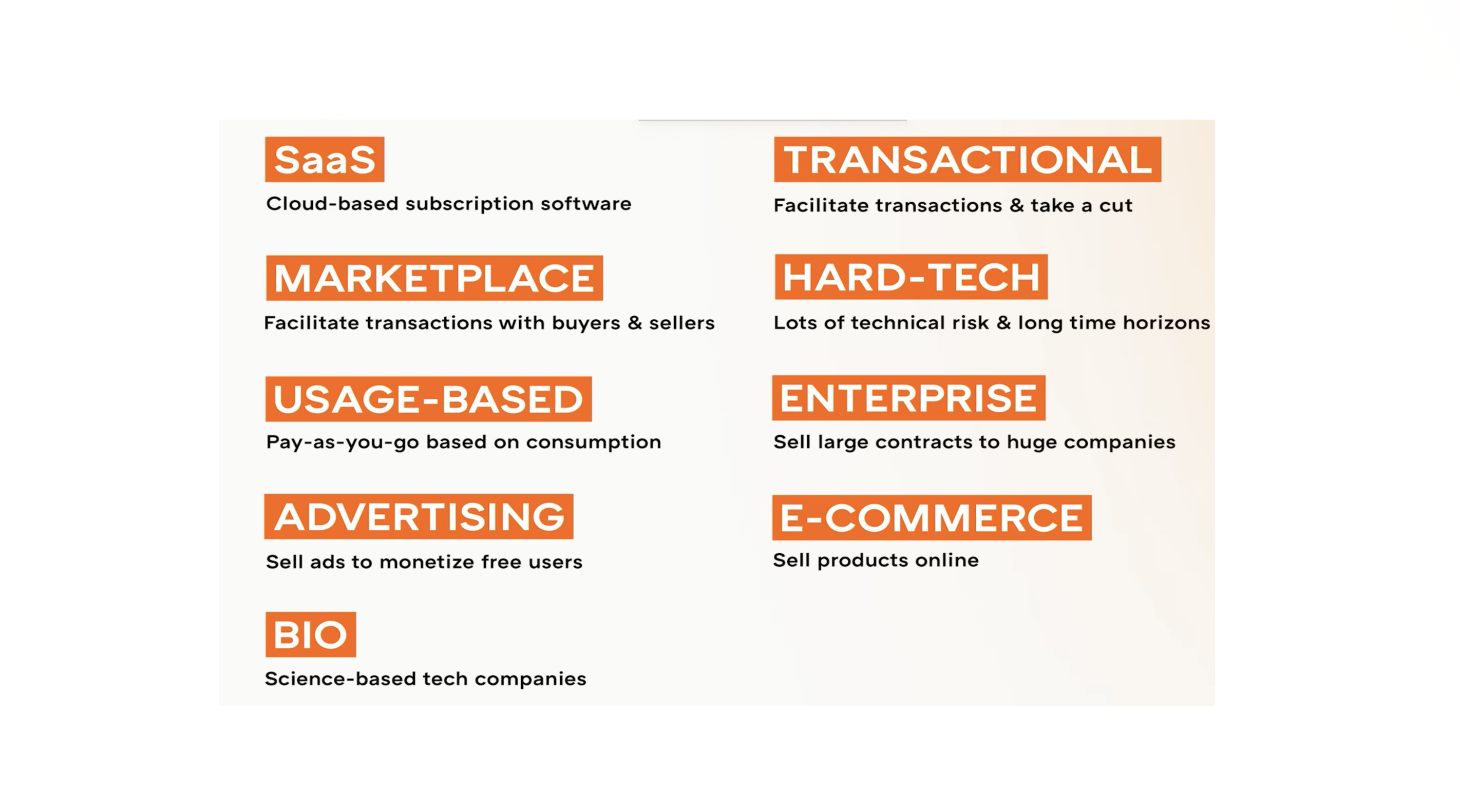
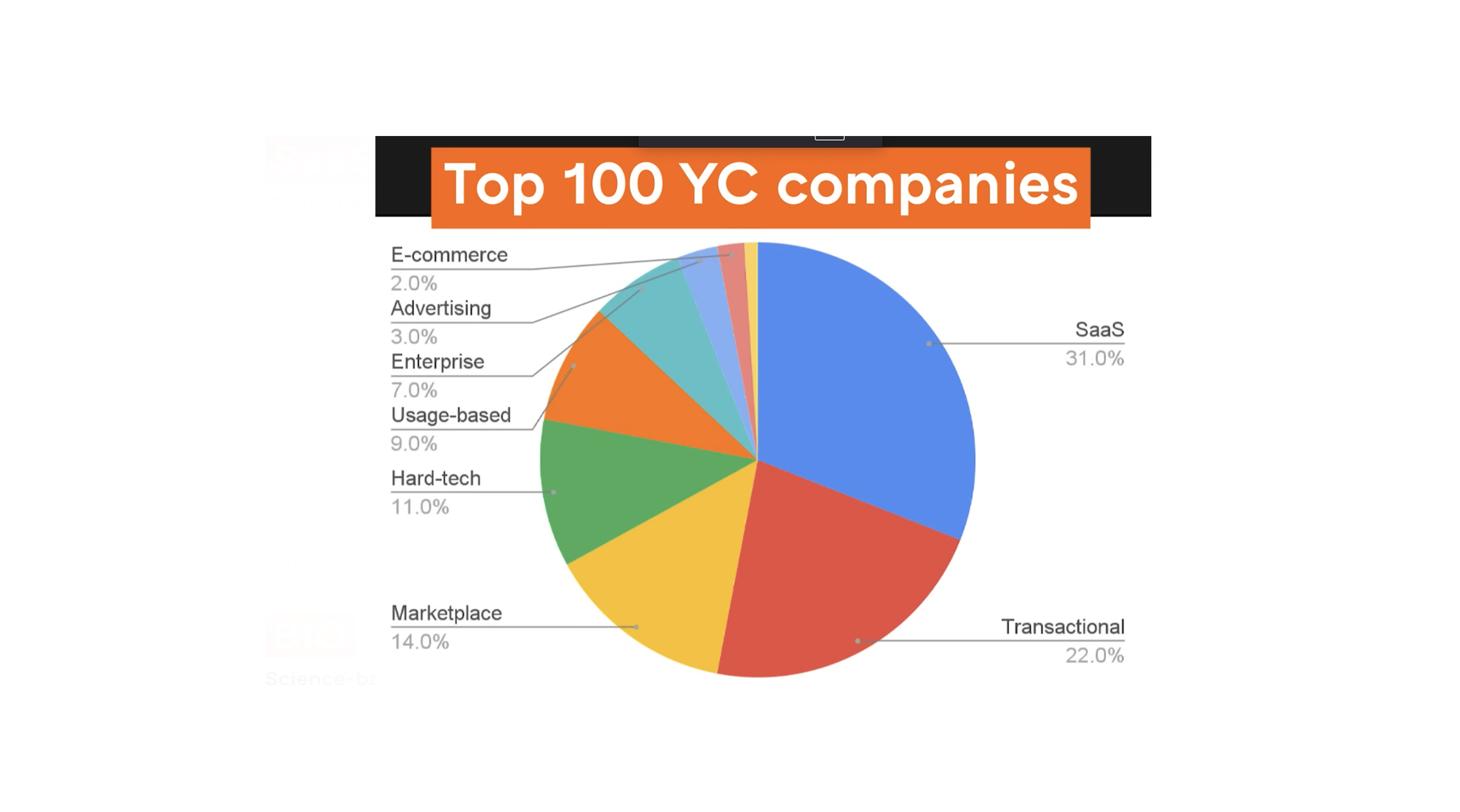
Most billion-dollar companies use one of nine models:
• SaaS
• Transactional
• Marketplace
• Usage-based
• Enterprise
• Advertising
• E-commerce
• Hard tech
• Bio
The product can be new. The money model usually should be proven.
USE ONE PRIMARY MODEL
FOCUS BEFORE EXPANSION
Large companies may combine several models later.
An early-stage startup should focus on one primary model. This makes pricing, metrics, customer acquisition, product priorities, and investor communication easier to understand.
COPY THE MODEL, INNOVATE THE PRODUCT
DO NOT REINVENT EVERYTHING
Founders often try to invent both a new product and a new way to make money.
That creates unnecessary risk. Use a business model customers already understand, then focus innovation on the product, experience, technology, or market insight.
SAAS
CHAPTER 2
WHAT IS SAAS?
SOFTWARE SOLD THROUGH SUBSCRIPTIONS
Software as a Service gives customers continuous access to cloud-based software.
Customers usually pay monthly or annually. The company keeps earning as long as the product continues solving an important and recurring problem.
HOW SAAS MAKES MONEY
RECURRING REVENUE POWERED BY RETENTION
Revenue comes from subscriptions based on users, features, storage, or company size.
Key metrics:
• Monthly recurring revenue
• Churn
• Retention
• Lifetime value
• Acquisition cost
The main challenge is keeping customers subscribed.
WHEN SAAS WORKS BEST
SOLVE AN ONGOING PROBLEM
SaaS works best when customers need the product repeatedly.
Examples include accounting, customer management, collaboration, security, and workflow software. The product should become part of the customer’s routine and improve over time.
TRANSACTIONAL
CHAPTER 3
WHAT IS A TRANSACTIONAL MODEL?
EARN FROM THE FLOW OF MONEY
A transactional business helps customers receive, send, manage, or process money.
The company earns a fixed fee or percentage whenever a transaction happens. Stripe, Coinbase, and Brex are examples highlighted in the Startup School lesson.
HOW TRANSACTIONAL MAKES MONEY
TAKE A CUT FROM EVERY TRANSACTION
Revenue grows with the number and value of transactions processed.
Key metrics:
• Transaction volume
• Take rate
• Revenue per transaction
• Payment losses
• Customer retention
The strongest products become critical financial infrastructure.
WHY TRANSACTIONAL MODELS WIN
STAY CLOSE TO THE MONEY
The closer a company is to the transaction, the easier it is to capture value.
When customers depend on a platform to receive or move money, switching becomes painful. Embedded workflows and high switching costs make the business durable.
MARKETPLACE
CHAPTER 4
WHAT IS A MARKETPLACE?
CONNECT BUYERS AND SELLERS
A marketplace brings two groups together so they can exchange products, services, assets, or information.
Airbnb connects travelers with hosts. DoorDash connects customers with restaurants and delivery workers. The platform becomes more valuable as participation grows.
HOW MARKETPLACES MAKE MONEY
CAPTURE VALUE FROM SUCCESSFUL MATCHES
Marketplaces charge commissions, listing fees, service fees, subscriptions, or payment fees.
Key metrics:
• Gross transaction value
• Take rate
• Supply growth
• Demand growth
• Match rate
• Repeat transactions
THE MARKETPLACE CHALLENGE
SOLVE BOTH SIDES AT ONCE
A marketplace cannot grow by serving only buyers or only sellers.
It must create enough supply to attract demand and enough demand to retain supply. This chicken-and-egg problem makes marketplaces difficult to launch.
THE MARKETPLACE ADVANTAGE
NETWORK EFFECTS CREATE DOMINANCE
Once the marketplace reaches liquidity, each new participant can increase value for everyone else.
More supply attracts more demand. More demand attracts more supply. This loop can create a winner-take-most market.
USAGE-BASED
CHAPTER 5
WHAT IS USAGE-BASED PRICING?
PAY FOR ACTUAL CONSUMPTION
A usage-based business charges according to what customers consume.
The unit may be API calls, computing time, storage, messages, transactions, generated outputs, or data processed. Customer spending grows naturally when usage increases.
HOW USAGE-BASED MAKES MONEY
REVENUE EXPANDS WITH ACTIVITY
The company defines a measurable unit and charges for each unit consumed.
Key metrics:
• Usage volume
• Revenue per unit
• Gross margin
• Expansion revenue
• Customer concentration
Pricing must remain understandable and predictable.
WHEN USAGE-BASED WORKS BEST
VALUE RISES WITH CONSUMPTION
This model works when usage closely reflects customer value.
A customer processing more payments, storing more data, or generating more outputs usually receives more benefit. The company earns more without forcing an immediate plan upgrade.
ENTERPRISE
CHAPTER 6
WHAT IS AN ENTERPRISE MODEL?
SELL TO LARGE ORGANIZATIONS
Enterprise companies sell products to corporations, governments, institutions, or other large organizations.
Customers may require security reviews, integrations, procurement approval, training, contracts, and dedicated support.
HOW ENTERPRISE MAKES MONEY
LARGE CONTRACTS AND RENEWALS
Revenue may come from annual licenses, multi-year contracts, implementation fees, support, or usage commitments.
Key metrics:
• Contract value
• Sales cycle
• Renewal rate
• Expansion revenue
• Implementation cost
THE ENTERPRISE TRADE-OFF
LONG SALES, STRONG RETENTION
Enterprise sales can take months because several decision-makers are involved.
Once installed, the product may become deeply connected to the organization’s systems and data. This can reduce churn and create high switching costs.
ADVERTISING
CHAPTER 7
WHAT IS AN ADVERTISING MODEL?
MONETIZE AUDIENCE ATTENTION
Advertising businesses build an audience, then sell access to that audience.
Advertisers pay to place messages, promoted content, listings, or campaigns in front of users. The model works best with massive reach, engagement, and frequent usage.
HOW ADVERTISING MAKES MONEY
CONVERT TRAFFIC INTO REVENUE
Revenue may be based on impressions, clicks, views, leads, or completed actions.
Key metrics:
• Active users
• Time spent
• Ad impressions
• Revenue per user
• Advertiser retention
WHY ADVERTISING IS DIFFICULT
SCALE MUST COME FIRST
Advertising usually produces little revenue until the platform reaches a large audience.
The product needs strong organic distribution or virality. Ads should rarely be the primary model unless the company can become a major destination for users.
E-COMMERCE
CHAPTER 8
WHAT IS E-COMMERCE?
SELL PRODUCTS DIRECTLY ONLINE
An e-commerce business sells physical or digital products through an online store or platform.
The company controls product selection, pricing, customer experience, and distribution. Revenue is generated whenever a customer completes an order.
HOW E-COMMERCE MAKES MONEY
EARN MARGIN FROM EVERY PRODUCT
Profit comes from the difference between the selling price and the total cost of producing, acquiring, marketing, and delivering the product.
Key metrics:
• Order value
• Gross margin
• Repeat order rate
• Acquisition cost
• Inventory turnover
WHAT MAKES E-COMMERCE STRONG
REPEAT ORDERS IMPROVE ECONOMICS
The first purchase may be expensive to acquire.
A strong e-commerce business brings customers back through product quality, replenishment, brand trust, bundles, memberships, or new releases. Repeat orders increase lifetime value.
HARD TECH
CHAPTER 9
WHAT IS HARD TECH?
BUILD DIFFICULT PHYSICAL TECHNOLOGY
Hard-tech companies solve problems through advanced engineering, hardware, robotics, energy, transportation, manufacturing, or infrastructure.
Products may require years of research, testing, certification, and capital before commercial launch.
HOW HARD TECH MAKES MONEY
PRODUCTS, CONTRACTS, AND LICENSING
Revenue may come from product sales, long-term contracts, licensing, maintenance, or infrastructure usage.
Key metrics:
• Development milestones
• Manufacturing cost
• Gross margin
• Capital requirements
• Production capacity
THE HARD-TECH MOAT
DIFFICULTY PROTECTS THE LEAD
Long development cycles can become a competitive advantage.
A rival cannot copy years of engineering, testing, supplier relationships, patents, and regulatory work overnight. Technical depth can create a durable moat.
BIO
CHAPTER 10
WHAT IS A BIO BUSINESS?
COMMERCIALIZE BIOLOGICAL INNOVATION
Bio companies apply biology to medicine, healthcare, agriculture, food, materials, diagnostics, or industrial production.
Products may require scientific research, laboratory development, clinical validation, regulatory approval, and intellectual property.
HOW BIO MAKES MONEY
PRODUCTS, LICENSING, AND MILESTONES
Bio companies may earn through product sales, treatments, testing, licensing, partnerships, or milestone payments.
Key metrics:
• Research progress
• Trial results
• Approval milestones
• Intellectual property
• Development capital
THE BIO MOAT
SCIENCE CREATES DEFENSIBILITY
Breakthrough science, patents, proprietary data, specialized teams, and regulatory approvals can create strong protection.
Development takes time and capital, but successful innovation can produce valuable and difficult-to-copy businesses.
WHAT THE BIGGEST WINNERS TEACH
CHAPTER 11
THE YC TOP 100 PATTERN
THREE MODELS DOMINATE
Among YC’s top 100 companies:
• SaaS: 31%
• Transactional: 22%
• Marketplaces: 14%
Together, these three models represent 67% of the list. They repeatedly produce scalable revenue and durable customer relationships.
THE POWER LAW
A FEW COMPANIES CREATE MOST VALUE
Startup outcomes are not evenly distributed.
In the YC data discussed, roughly half of the total value of the top 100 companies came from only the top ten. A small number of dominant companies can outperform the rest by orders of magnitude.
MARKETPLACES BUILD HUGE WINNERS
DOMINANCE AFTER LIQUIDITY
Marketplaces represented a smaller share of the top 100 but a much larger share of total value.
Companies such as Airbnb, DoorDash, and Instacart show how network effects can create category leaders once supply and demand reinforce each other.
TRANSACTIONAL MODELS OUTPERFORM
INFRASTRUCTURE CAPTURES VALUE
Transactional companies outperform because they sit directly inside the flow of funds.
They become difficult to remove and often solve a top-three customer problem. Every payment, transfer, or purchase creates another monetization opportunity.
SAAS APPEARS MOST OFTEN
RECURRING REVENUE COMPOUNDS
SaaS represents the largest share of YC’s top 100.
Predictable subscriptions support planning, hiring, product investment, and compounding growth. The model becomes powerful when retention remains high.
ADVERTISING HAS FEW WINNERS
VIRALITY IS REQUIRED
Advertising created only a small number of top YC companies.
Successful examples became major internet destinations with strong communities or content networks. Without massive organic traffic, advertising is difficult to monetize at venture scale.
MODELS WITH STRUCTURAL LIMITS
CHAPTER 12
SERVICES AND CONSULTING
USEFUL FOR LEARNING, HARDER TO SCALE
Services can help founders understand customer problems and generate early revenue.
The limitation is that delivery usually scales with people, hours, and projects. Margins remain lower, and revenue may not repeat automatically.
AFFILIATE BUSINESSES
TOO FAR FROM THE TRANSACTION
Affiliate businesses acquire a user, send them elsewhere, then wait for another company to complete the sale.
Because the business does not control the transaction, revenue is delayed, uncertain, and usually limited.
TRADITIONAL HARDWARE
CAPITAL AND MARGIN PRESSURE
Standard hardware businesses require money for parts, manufacturing, inventory, logistics, and support.
Physical costs reduce margins and make scaling expensive. Hard tech can still win when deep technical innovation creates a strong moat.
PLATFORM-DEPENDENT BUSINESSES
GROWTH CAN DISAPPEAR OVERNIGHT
A startup built entirely on another platform faces platform risk.
The larger platform can change rules, restrict access, copy the feature, or capture the revenue. A useful distribution channel should not become the only foundation of the business.
BUILD A DURABLE BUSINESS
CHAPTER 13
RECURRING REVENUE NEEDS RETENTION
DO NOT SCALE A LEAKING BUCKET
Subscriptions only work when customers continue receiving value.
If users leave quickly, recurring revenue becomes an illusion. The product must solve an ongoing problem, become part of a routine, or improve over time.
SMALL CHURN CREATES A BIG LOSS
MONTHLY RETENTION COMPOUNDS
With 95% monthly retention, 100 customers become about 54 after one year.
With 90% monthly retention, only about 28 remain.
A five-point monthly difference can determine whether a startup compounds or constantly replaces lost users.
BUILD A MOAT
MAKE THE BUSINESS HARD TO COPY
Strong companies defend themselves through:
• Network effects
• Switching costs
• Customer data
• Technical innovation
• Economies of scale
• Better margins
• Organic distribution
GET CLOSE TO THE TRANSACTION
CAPTURE VALUE DIRECTLY
The strongest position is where customers already exchange money or depend on your product to complete important work.
Being close to the transaction makes monetization clearer and can turn the product into critical infrastructure.
SCALE WITH SOFTWARE
GROWTH SHOULD NOT MATCH HEADCOUNT
Software can serve more customers without adding people at the same rate.
Human support may still matter, but the core delivery should become repeatable, automated, and increasingly efficient. This improves margins as the company grows.
EARN ORGANIC DISTRIBUTION
LET USERS CREATE GROWTH
Word of mouth, referrals, collaboration, shared outputs, and user-generated content can reduce acquisition costs.
A company that gains users organically can grow faster than a competitor that must pay for every customer.
THE BEST BUSINESS PATTERN
A PRACTICAL CHECKLIST
The strongest startup businesses usually:
• Generate recurring revenue
• Retain customers
• Build defensible moats
• Stay close to transactions
• Scale through software
• Use a proven model
PRICING IS A LEARNING TOOL
CHAPTER 14
START CHARGING
PAYMENT REVEALS REAL DEMAND
Founders often delay charging because they fear rejection.
Payment is one of the clearest signals of value. It shows who truly wants the product, which segment cares most, and whether the problem is important enough to justify spending.
A NO IS USEFUL DATA
REJECTION IMPROVES DIRECTION
When customers refuse to pay, the product may lack value, target the wrong segment, solve a weak problem, or carry the wrong price.
Charging converts opinions into evidence and helps founders learn faster.
FIND THE RIGHT MAGNITUDE
DO NOT OVER-ENGINEER EARLY PRICING
Early pricing does not need perfect formulas.
The first goal is to find the correct order of magnitude. If customers will pay $100 and you charge $10, the gap matters. If they will pay $15 and you charge $10, you are already close.
PRICE ON VALUE
DO NOT START FROM COST-PLUS
Cost is what you spend to serve the customer.
Price is what the customer pays.
Value is what the result is worth to them.
Your margin sits between cost and price. Your pricing opportunity sits between price and perceived value.
FOUR SOURCES OF VALUE
UNDERSTAND THE OUTCOME
Customers usually pay because a product helps them:
• Make more money
• Reduce costs
• Move faster
• Avoid risk
Ask which result matters most, then connect pricing to the economic or strategic value created.
RAISE UNTIL YOU LEARN
PUSHBACK IS NOT FAILURE
Increase prices gradually and observe customer reactions.
The useful range is often where customers hesitate, ask questions, or negotiate, yet still decide to pay. Instant acceptance from everyone may mean the price is too low.
MOST STARTUPS UNDERCHARGE
CHEAP IS NOT A DURABLE ADVANTAGE
A low price can signal low value and reduce the money available for product, service, and customer acquisition.
Large competitors can often cut prices further. Build a stronger product and charge for the value created.
HIGHER PRICES EXPAND OPTIONS
MARGIN FUNDS GROWTH
Higher margins allow a startup to invest more in acquisition, product quality, support, and distribution.
A price increase can grow revenue faster than acquiring the same number of new customers, provided the product supports it.
WHEN USERS WILL NOT PAY MORE
INCREASE VALUE OR SOLVE A BIGGER PROBLEM
Resistance to higher pricing usually means the product needs more value or the problem is too small.
Move toward a top-three customer problem connected to revenue, cost, speed, risk, or a critical workflow.
DISCOUNT WITH A REASON
TRADE PRICE FOR STRATEGIC VALUE
A lower price can make sense when it secures:
• The first user
• A strong reference
• A recognizable logo
• Valuable feedback
• Future expansion
• Long-term lock-in
Discount intentionally, not automatically.
PRICING CAN CHANGE
YOU ARE NOT LOCKED FOREVER
Pricing evolves as the product improves.
You can raise prices for new customers, grandfather existing customers, provide advance notice, or introduce higher-value plans. Early pricing is a starting point, not a permanent decision.
KEEP PRICING SIMPLE
REDUCE BUYING FRICTION
Too many plans, discounts, crossed-out prices, and conditions create confusion.
Use a small number of clear options. Explain who each plan is for, what value it provides, and what it costs.
THE SEGMENT PRICING LESSON
ASK FOR A BIGGER NUMBER
Segment first considered charging only $120 per year.
After stronger sales guidance, an early deal closed at $18,000 per year. Founders cannot discover willingness to pay without asking for a meaningful price.
FIVE PRICING RULES
CHAPTER 15
THE PRICING PLAYBOOK
SIMPLE RULES FOR EARLY FOUNDERS
1. Charge early.
2. Price based on value.
3. Assume you may be undercharging.
4. Change pricing as you learn.
5. Keep the buying decision simple.
Pricing is a system for discovering demand.
BUILD, CHARGE, LEARN
YOUR NEXT ACTION
Choose one proven business model.
Identify the ongoing value customers receive.
Set a simple price, ask real users to pay, and study their response.
Then improve the product, retention, moat, and pricing with every cycle.