CONTENT

THE FOUNDER PRODUCTIVITY SYSTEM
YOUTUBE SUMMARY : YCOMBINATOR
CHAPTER INDEX
PRODUCTIVITY IS NOT DOING MORE
IT IS CHOOSING WHAT MATTERS
Founders have unlimited possible tasks but limited time, energy, and attention.
The goal is not to complete more tasks. The goal is to identify the few actions that can change the trajectory of the company.
Real productivity means working on the right problem at the right time.
PRODUCTIVITY IS PRIORITY
START WITH THE REAL GOAL
BUSY IS NOT PRODUCTIVE
ACTIVITY CAN HIDE STAGNATION
A founder can spend the entire day answering messages, organizing documents, attending meetings, and testing tools.
It feels like work, but the startup may remain in the same position.
Measure productivity by progress toward the company's most important outcome, not by the number of tasks completed.
CHOOSE ONE MAIN GOAL
GIVE THE COMPANY DIRECTION
Ask one simple question:
What is the most important result the company must achieve right now?
It may be revenue, active users, retention, customer interviews, product usage, or a successful launch.
One clear goal helps the team evaluate every project, request, and opportunity.
FIND THE BOTTLENECK
SOLVE WHAT LIMITS GROWTH
If growth is slow, identify the constraint.
Is the product weak?
Are customers unable to discover it?
Are users trying it but not returning?
The bottleneck determines the work. Building more features will not fix a sales problem. More marketing will not fix a product people abandon.
AUDIT YOUR CALENDAR
YOUR SCHEDULE REVEALS PRIORITIES
Write down the company's top priority. Then review how you spent the previous seven days.
How many hours directly supported that priority?
A founder may claim that customer acquisition is critical while spending most of the week redesigning internal systems.
Your calendar shows what you truly prioritize.
CONNECT TASKS TO OUTCOMES
EVERY TASK NEEDS A REASON
Before beginning a task, define the intended result.
What will become different after this work is completed?
A customer call should produce insight. A feature should improve a user behavior. A campaign should test a distribution channel.
Without a measurable outcome, work easily becomes motion without progress.
THE DANGER OF FAKE WORK
WORK THAT FEELS USEFUL
FAKE WORK FEELS RESPONSIBLE
THAT IS WHY IT IS DANGEROUS
Watching entertainment for four hours clearly feels unproductive.
Fake work is harder to detect because it feels serious. You may build dashboards, restructure folders, compare productivity apps, or polish presentations.
The activity consumes effort, but it does not create customers, improve the product, or validate an important assumption.
THE ACCESSIBLE-WORK TRAP
EASY TASKS REPLACE IMPORTANT TASKS
Founders often avoid difficult work by choosing tasks that are easier to begin.
It may feel better to experiment with a new AI tool than to contact ten potential customers who might reject the offer.
The important task is frequently uncomfortable, uncertain, repetitive, and emotionally demanding.
PRODUCTIVITY PORN
CONSUMING ADVICE IS NOT EXECUTION
Reading productivity advice can create the feeling of improvement without producing actual progress.
A perfect morning routine, complex note-taking system, or new task manager cannot replace direct execution.
The best productivity system is often simple: know the priority, remove distractions, and work on it consistently.
SYSTEMS CAN BECOME AVOIDANCE
DO NOT ORGANIZE TOO EARLY
Before product-market fit, founders should remain close to customers and product problems.
Building complicated documentation, processes, and operating systems too early can become sophisticated procrastination.
Create only enough structure to support execution. Add more process when repeated work and team complexity genuinely require it.
USE SIMPLE TOOLS
CLARITY MATTERS MORE THAN SOFTWARE
You do not need a complex productivity stack.
A notes app, calendar, spreadsheet, or simple task list may be enough.
Tools should reduce friction and help you think. When a system forces you to spend more time maintaining the system than doing the work, simplify it.
STAY CLOSE TO CUSTOMERS
THE SOURCE OF USEFUL TRUTH
START WITH CUSTOMER PROBLEMS
MAKE SOMETHING PEOPLE WANT
A startup succeeds by solving a problem that customers care about.
Ask:
Who has the problem?
How painful is it?
How do they solve it today?
What result would make them change behavior or pay?
Customer understanding should guide product, marketing, and sales priorities.
STAY CLOSE TO THE METAL
DIRECT CONTACT CREATES INSIGHT
Early founders should remain directly connected to users.
Read support messages. Watch customers use the product. Conduct sales calls. Observe where people hesitate, misunderstand, or leave.
Secondhand reports remove important details. Direct exposure helps founders notice problems and opportunities that dashboards may never reveal.
WORK THROUGH HYPOTHESES
TURN ACTIVITY INTO LEARNING
Every major action should test a belief.
We believe this customer has this problem.
We believe this solution will help.
We believe this channel can reach them.
We believe they will return or pay.
Define the hypothesis, run the smallest useful test, study the result, and decide what to change.
CUSTOMER VALIDATION WINS
ATTENTION IS NOT PROOF
Press coverage, followers, likes, and public recognition can make a startup look successful.
The stronger proof comes from customers using, returning, recommending, and paying for the product.
Do not confuse the public image of the company with its operational reality. Customer behavior remains the most reliable signal.
USE SOCIAL MEDIA STRATEGICALLY
CONNECT CONTENT TO DISTRIBUTION
Social media is useful when your customers are there and it supports the go-to-market strategy.
Use it to demonstrate the product, reach users, collect problems, build trust, or distribute useful ideas.
Posting without a business objective can become another source of validation, distraction, and fake progress.
DESIGN THE FOUNDER SCHEDULE
PROTECT THE RIGHT KIND OF TIME
MAKER SCHEDULE
TIME FOR DEEP PRODUCTION
Maker work includes coding, writing, designing, researching, and solving complex product problems.
This work requires long, uninterrupted blocks of concentration.
A thirty-minute gap between meetings is rarely enough. Protect several hours where the founder can enter the problem deeply and produce meaningful output.
MANAGER SCHEDULE
TIME FOR COORDINATION
Manager work includes meetings, sales calls, interviews, reviews, decisions, and team communication.
These activities fit more naturally into shorter scheduled blocks.
Group them together instead of spreading them across the entire day. A scattered calendar constantly interrupts concentration and reduces the quality of maker work.
DO NOT MIX CONSTANTLY
CONTEXT SWITCHING DESTROYS MOMENTUM
Switching between coding, messages, calls, writing, and administration creates cognitive friction.
Every interruption forces the brain to reload context.
Separate the day into clear modes. For example, use mornings for meetings and customer calls, then reserve afternoons and evenings for uninterrupted building.
PROTECT DEEP-WORK BLOCKS
TREAT THEM AS COMMITMENTS
Schedule deep work before the calendar becomes crowded.
Turn off unnecessary notifications. Close unrelated tabs. Define the specific output you want to complete.
Do not surrender these blocks to every incoming request. The company needs time for concentrated creation, not only communication and coordination.
STOP MULTITASKING
HYPERFOCUS CREATES SPEED
Most people are not effective multitaskers.
They are rapidly switching attention between tasks and paying a performance cost each time.
Choose one important problem. Work on it until you reach a clear milestone. Then move to the next priority.
Focused execution usually produces more than fragmented activity.
STACK-RANK EVERYTHING
FORCE DIFFICULT CHOICES
RANK PROJECTS IN ORDER
ONE PRIORITY MUST BE FIRST
When every project is important, nothing is truly prioritized.
List all current projects and rank them from first to last.
Do not allow ties. The ranking forces the team to discuss expected impact, urgency, dependencies, and strategic value.
It also makes clear what should receive resources first.
EXPECT TO COMPLETE THE TOP THREE
CAPACITY IS ALWAYS LIMITED
A quarterly list may contain ten ambitious projects, but the company may only have enough capacity to complete three well.
Plan around reality.
Give the highest-ranked projects enough attention to succeed. Starting ten initiatives and finishing none creates more complexity without creating meaningful results.
FOCUS MEANS SAYING NO
PROTECT THE CHOSEN DIRECTION
Time has unlimited demand and limited supply.
Every invitation, request, partnership, feature idea, meeting, and message competes with the startup's main priority.
Saying no may disappoint people, but accepting everything weakens execution.
A clear strategy requires deliberate exclusion.
CREATE A NOT-NOW LIST
PRESERVE IDEAS WITHOUT DISTRACTION
Some ideas are valuable but poorly timed.
Move them into a not-now list instead of immediately turning them into projects.
Review the list during monthly or quarterly planning. This allows the company to preserve opportunities while keeping the current team focused on the work already chosen.
PRIORITIZE BY IMPACT
URGENCY SHOULD NOT DECIDE EVERYTHING
The easiest, newest, or loudest request often captures attention first.
Evaluate work by expected impact on the main company goal.
Ask:
Will this create learning?
Will it remove the bottleneck?
Will it improve customer behavior?
Will it generate revenue?
Prioritize the strongest contribution.
USE FOUNDER LEVERAGE
SPEND TIME WHERE YOU ARE STRONGEST
KNOW YOUR UNIQUE WORK
SOME PROBLEMS REQUIRE THE FOUNDER
Identify the work where your involvement creates exceptional value.
It may be product direction, technical architecture, recruiting, sales, partnerships, storytelling, or customer discovery.
Protect time for the problems that match your strengths and cannot yet be solved as effectively by someone else.
DELEGATE OUTSIDE YOUR STRENGTHS
EMPOWER CAPABLE PEOPLE
Self-awareness is a productivity advantage.
Recognize the work you perform poorly, slowly, or without energy. Find people with the right ability and give them clear ownership, context, tools, and decision authority.
Delegation creates leverage when responsibility moves with the task.
DO NOT BUILD DEPENDENCY
THE COMPANY NEEDS MULTIPLIERS
A startup needs people who increase the output of the entire system.
Your contribution should help the company move faster, learn faster, or execute at a higher standard.
Document repeated knowledge, improve tools, remove blockers, and develop other people so progress does not depend on one person doing everything.
EFFORT STILL MATTERS
THERE IS NO SUBSTITUTE FOR WORK
No productivity method can replace sustained effort.
Founders still need to spend the hours required to understand customers, build the product, sell, recruit, and solve difficult problems.
The objective is not to avoid work. It is to direct serious effort toward the activities with the highest probability of creating progress.
THE WEEKLY FOUNDER SYSTEM
TURN PRINCIPLES INTO EXECUTION
STEP 1: CHOOSE THE METRIC
DEFINE THE WEEKLY RESULT
Select one number or outcome that represents meaningful progress this week.
Examples:
Complete 20 customer interviews.
Generate HKD 50,000 in new sales.
Increase activation from 20% to 30%.
Ship the onboarding flow.
Make the target specific enough to guide daily decisions.
STEP 2: IDENTIFY THE BOTTLENECK
FIND WHAT BLOCKS THE TARGET
Ask why the target has not already been achieved.
List the possible constraints and use available evidence to identify the strongest one.
The bottleneck may be awareness, trust, product quality, pricing, onboarding, sales capacity, or retention.
Choose the constraint that deserves immediate attention.
STEP 3: STACK-RANK ACTIONS
SELECT THE HIGHEST-IMPACT WORK
List every action that could remove the bottleneck.
Rank them by expected impact, speed of learning, cost, and effort.
Choose the top three. Assign ownership and define the expected output.
Move the remaining actions to the not-now list so they do not fragment attention.
STEP 4: DESIGN THE CALENDAR
RESERVE TIME BEFORE WORK BEGINS
Place customer calls, meetings, and coordination into manager blocks.
Reserve uninterrupted maker blocks for building, writing, analysis, or problem-solving.
Schedule the highest-priority work first. Leave limited space for unexpected issues.
Do not allow low-value requests to consume the entire week.
STEP 5: REVIEW REAL PROGRESS
STUDY OUTCOMES, NOT EFFORT
At the end of the week, review the target.
What changed?
What produced the strongest result?
What created no value?
What did customers reveal?
What is now the main bottleneck?
Use the answers to set the next priority. Productivity becomes a continuous learning system.
THE FOUNDER PRODUCTIVITY RULE
PRIORITY BEFORE TOOLS
Choose one important outcome.
Find the bottleneck preventing it.
Work closely with customers.
Stack-rank the possible actions.
Protect uninterrupted execution time.
Say no to distractions and fake work.
Then put in the focused hours required to move the company forward.

HOW TO CONVERT CUSTOMERS WITH COLD EMAILS
YOUTUBE SUMMARY : YCOMBINATOR
CHAPTER INDEX
COLD EMAILS THAT CONVERT
FROM FIRST CONTACT TO CUSTOMER
Cold email works when it feels relevant, personal, and easy to act on.
The objective is not to close the sale immediately. Move the recipient to the next step: reply, introduction, demo, call, or trial.
This playbook shows how to build the funnel, write stronger emails, and improve results.
START WARM WHEN POSSIBLE
THE HIGHEST-CONVERTING OUTREACH
The best cold-email hack is avoiding cold outreach entirely.
Ask friends, former colleagues, alumni, investors, customers, or mutual contacts for an introduction. A warm intro can convert two to three times better because trust already exists before the first message arrives.
TURN OVER EVERY STONE
SEARCH YOUR NETWORK FIRST
Before contacting someone cold, search LinkedIn, alumni groups, former workplaces, communities, and mutual connections.
Look for anyone who can introduce you or provide context. Even when an introduction is impossible, this research can reveal useful details for a more relevant message.
BUILD THE FUNNEL
CHAPTER 1
WORK BACKWARD FROM ONE CUSTOMER
START WITH THE FINAL OUTCOME
Define the goal, then calculate the activity required at every earlier step.
Example:
1 customer needs 10 demos.
10 demos need 40 replies.
40 replies need 400 opens.
400 opens may need 800 emails.
Your real numbers will differ, but the method stays the same.
THE FIRST EMAIL HAS ONE JOB
ADVANCE TO THE NEXT STEP
A cold email does not need to complete the sale.
Its job is to create the next action in the funnel: get a reply, secure an introduction, book a demo, collect feedback, or start a trial.
Measure success by whether the recipient moves forward, not whether they buy immediately.
VOLUME MATTERS
A HANDFUL OF EMAILS IS NOT A SYSTEM
Meaningful results may require dozens of targeted emails each day.
Low volume creates slow learning and unreliable conclusions. Consistent volume gives you enough data to see patterns, test messages, and improve conversion rates.
Quality must remain high while volume increases.
START MANUALLY
LEARN BEFORE AUTOMATING
Write the first emails yourself and personalize them one by one.
Manual outreach teaches you which audiences respond, which problems matter, which words create interest, and which calls to action work.
Automation should scale a proven process, not hide an unproven one.
TRACK EVERY STAGE
FIND THE WEAKEST CONVERSION POINT
Measure sent, opened, replied, booked, attended, and converted.
A weak open rate usually points to poor targeting, sender identity, or subject lines. A weak reply rate points to the message. A weak demo conversion points to the offer, qualification, or sales process.
Fix the biggest leak first.
WIN THE OPEN
CHAPTER 2
TARGETING IS THE BIGGEST LEVER
FIND PEOPLE WHO ALREADY NEED IT
Better targeting improves both opens and replies.
One hundred relevant emails can outperform one thousand generic emails. Define the customer, situation, pain, timing, and reason your offer matters now.
The closer the recipient is to the problem, the less persuasion the email needs.
QUALIFY BEFORE YOU WRITE
RESEARCH SAVES WASTED OUTREACH
Confirm that the recipient can realistically use what you sell.
Study the company, role, product, workflow, recent activity, and likely pain. A perfectly written email sent to the wrong person still fails.
Strong qualification makes personalization easier and conversion more likely.
SEND AS A PERSON
USE YOUR REAL NAME
The inbox usually shows only the sender, subject line, and first sentence.
Use your personal name rather than a company-style sender. Early-stage buyers are often betting on the founder's attention, judgment, and commitment.
Human identity creates more trust than a faceless outreach account.
KEEP SUBJECTS SIMPLE
SHORT, RELEVANT, AND NATURAL
Use subject lines that sound like something a real person would send.
Examples:
Quick question
Can I get your advice?
Help a fellow founder
Hello from [company]
Avoid heavy sales language. The subject should earn curiosity without creating suspicion.
CHOOSE THE RIGHT CHANNEL
EMAIL USUALLY LEADS
Email is often stronger than LinkedIn for professional outreach, but the best channel depends on the audience.
Some people ignore LinkedIn because it feels crowded. Others rarely receive messages there and notice them.
Use text messaging only with permission because unsolicited texts can feel invasive.
WRITE FOR REPLIES
CHAPTER 3
1. SET ONE SPECIFIC GOAL
ONE EMAIL, ONE ACTION
Choose one desired action: reply, book, click, introduce, review, or try.
Multiple requests create friction and uncertainty. Every sentence should support the same outcome.
Delete anything that does not help the recipient understand the value or take the next step.
2. SOUND HUMAN
WRITE HOW YOU SPEAK
Use natural language, warmth, and real emotion.
Phrases such as “I’d love to,” “I’d appreciate it,” and “this would mean a lot” can feel personal when they are sincere.
Read the email aloud. Any sentence that sounds awkward in conversation should be rewritten.
3. PERSONALIZE WITH PROOF
SPECIFIC BEATS GENERIC
Using the recipient’s name is only the beginning.
Mention a product feature, launch, article, customer, role, shared experience, or detail that proves real research.
“Love what you are doing” feels automated. A precise observation shows effort and gives the recipient a reason to keep reading.
FIND UNCOMMON COMMONALITIES
CREATE A GENUINE CONNECTION
Look for specific experiences you share: the same school, community, former employer, niche interest, market, customer problem, or career path.
Common ground works when it is meaningful and not obvious.
The goal is not manipulation. It is showing why this person was intentionally selected.
4. KEEP IT SHORT
MAKE REPLYING EASY ON MOBILE
A wall of text creates delay.
The recipient should understand the message quickly and reply without heavy thinking. Use short paragraphs, direct language, and enough context to make the action clear.
If the message requires careful rereading, it is probably too long.
5. ESTABLISH CREDIBILITY
REDUCE THE PERCEIVED RISK
Use credible signals that matter to the recipient: relevant experience, known customers, shared connections, useful data, strong results, or respected institutions.
Keep proof concise. The purpose is to answer one question: why should this person trust you enough to take the next step?
6. MAKE IT ABOUT THE READER
LEAD WITH THEIR PROBLEM AND BENEFIT
Rewrite “I,” “we,” and “our” into “you” and “your” wherever possible.
Explain the recipient’s problem, the cost of leaving it unsolved, and the useful outcome you can create.
Use the same words customers use to describe the problem. Familiar language makes the value easier to recognize.
7. END WITH A CLEAR CTA
STATE THE NEXT STEP ALONE
Finish with one concrete request in its own paragraph.
Examples:
Interested in trying it?
Could you introduce me to the right person?
Would Tuesday or Wednesday work for a 15-minute call?
The recipient should know exactly what to do and be able to do it quickly.
FOLLOW UP WITHOUT SPAMMING
CHAPTER 4
ONE EMAIL IS OFTEN NOT ENOUGH
PERSISTENCE CREATES MORE CHANCES
People miss emails because they are busy, travelling, distracted, or not ready.
Follow up manually two, three, or four times when appropriate. Leave a few days between messages and add a useful angle, new proof, clearer benefit, or simpler call to action.
Do not send the same message repeatedly.
BE CREATIVE, NOT ANNOYING
EARN ATTENTION WITH RELEVANCE
A follow-up can use a fresh subject, useful resource, short video, relevant insight, or thoughtful gesture.
Persistence works when each message adds value or reduces effort. Pressure, guilt, or demands damage trust.
Nobody owes you a response. Know when to pause and revisit later.
LEARN FROM BAD EMAILS
WRONG TARGETING CANNOT BE RESCUED
Common failures include:
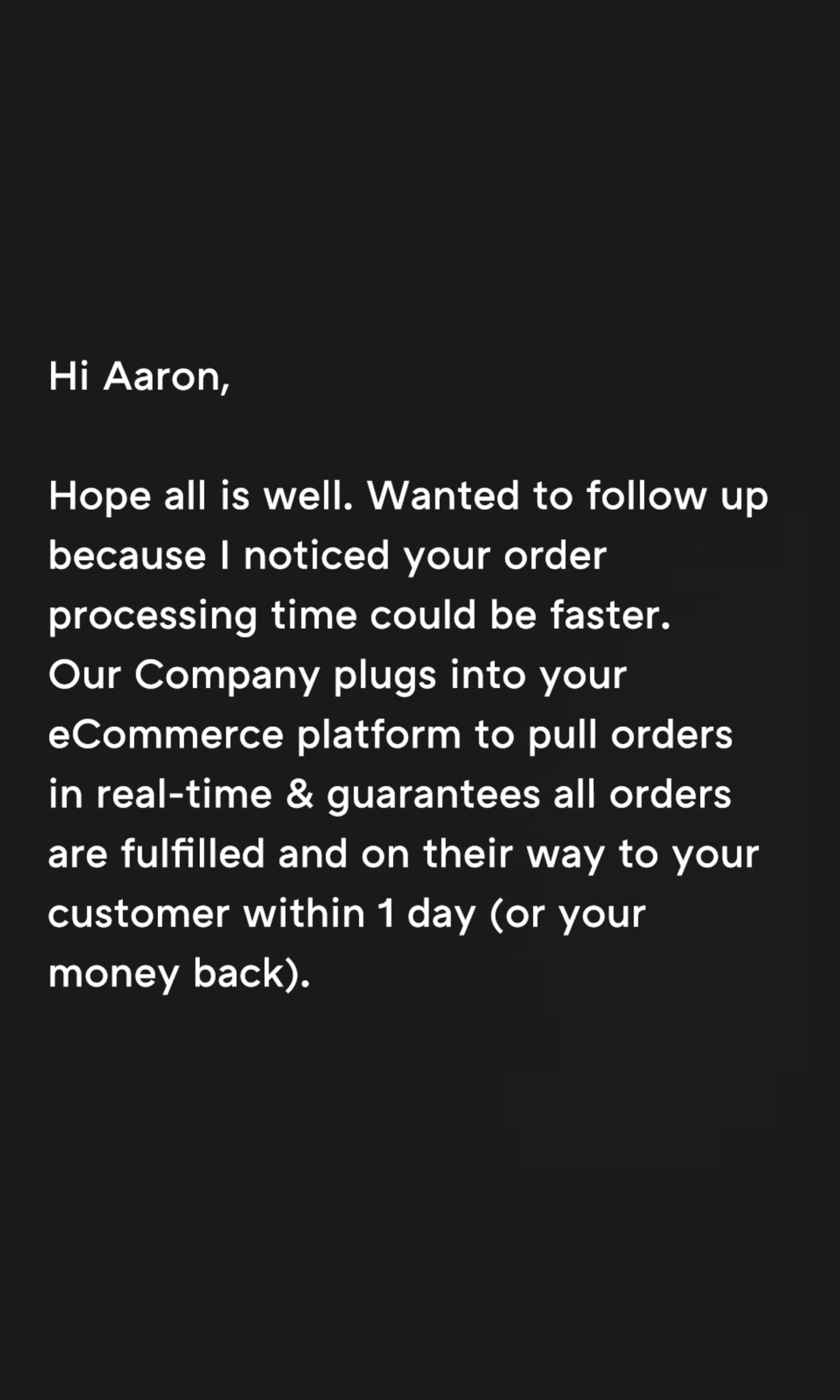
• Selling to someone who cannot use the product
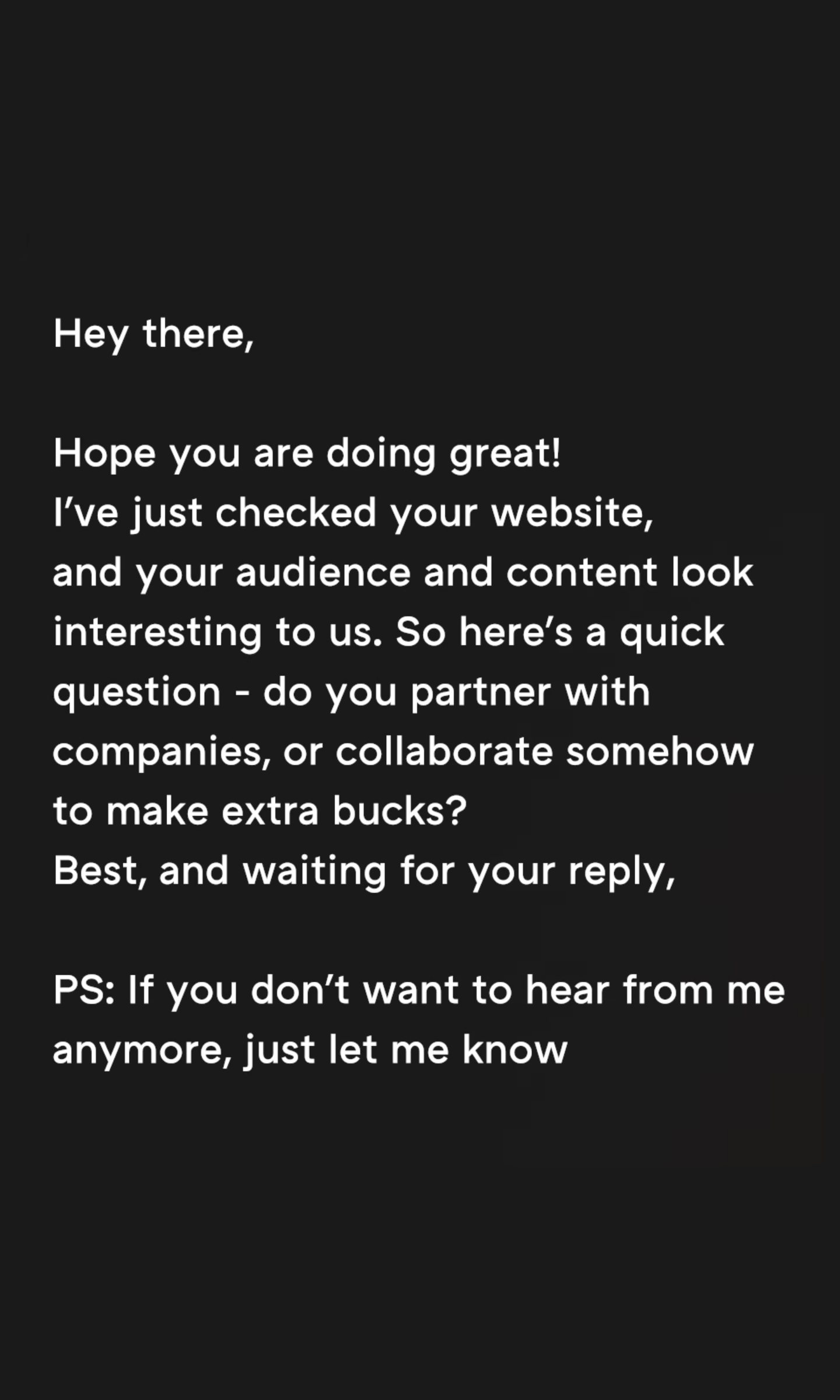
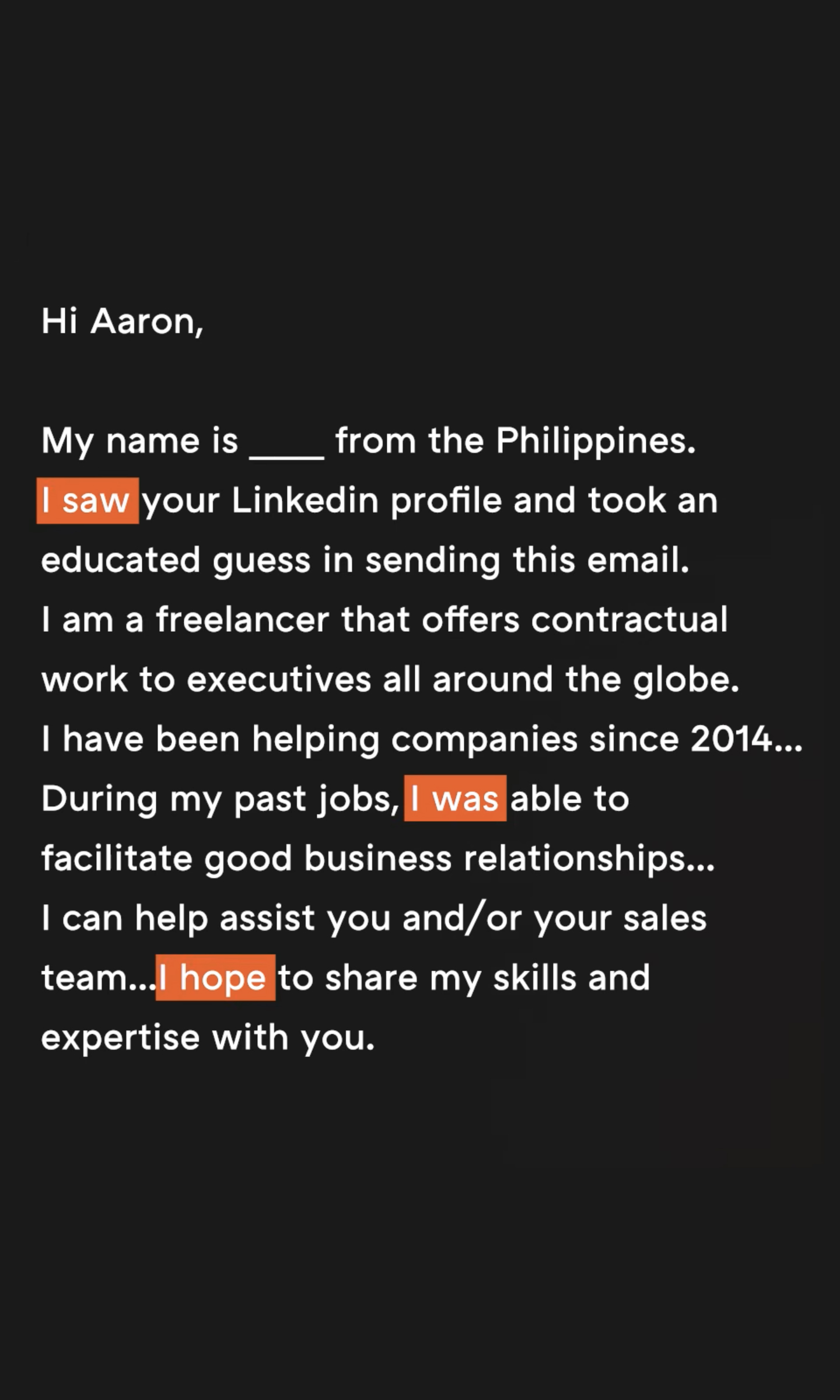
• Generic greetings and fake personalization
• Unclear or vague requests
• Messages focused entirely on the sender
• No name, credibility, or specific next step
Fix targeting before polishing copy.
LEARN FROM GOOD EMAILS
MAKE THE OFFER EASY TO ACCEPT
Strong emails combine relevance, credibility, a clear benefit, and a simple action.
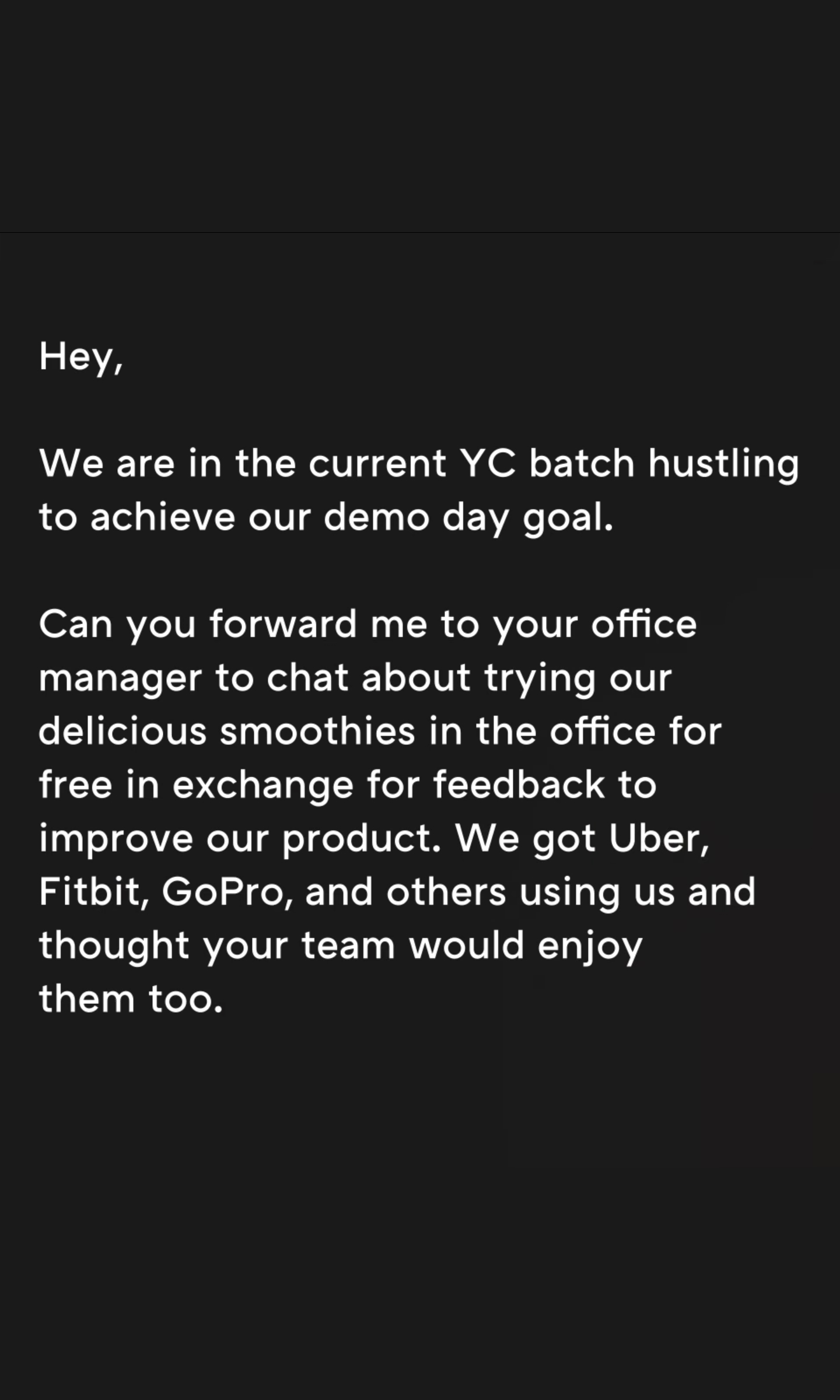
A request for help works better when shared context is real. A product invitation works better when it feels exclusive. A sales offer works better when the immediate benefit is obvious, such as a free team experience.
SELL THE IMMEDIATE BENEFIT
LEAD WITH WHAT THE RECIPIENT GETS
“Help us reach our goal” asks the recipient to care about you.
“Let us host a free smoothie party for your team” gives them a reason to respond now.
Frame the first step around a clear, low-risk benefit. The sales conversation can happen after interest and trust are established.
FOUNDER OUTBOUND SYSTEM
CHAPTER 5
THE FOUNDER SHOULD SEND
PERSONAL ATTENTION IS AN ADVANTAGE
Early customers are more likely to respond when the founder reaches out directly.
Founder-led email signals commitment, access, and accountability. It also creates faster learning because feedback reaches the decision-maker without layers.
Your small size can become a service advantage.
BLOCK TIME EVERY DAY
TREAT OUTBOUND AS CORE WORK
When cold email is an important growth channel, reserve focused time for research, writing, follow-up, and measurement.
Do not treat it as leftover work. Consistent founder attention produces better targeting, stronger messages, and faster learning.
The work compounds when insights are documented.
SCALE ONLY WHAT WORKS
SYSTEMIZE AFTER REPEATABLE RESULTS
Once the audience, message, offer, and call to action convert consistently, build templates, tools, automation, and team processes around them.
Keep the parts that require judgment and personalization human.
Scale should preserve relevance, not turn a strong message into mass spam.
THE COLD EMAIL CHECKLIST
BEFORE YOU PRESS SEND
Ask:
Is this the right person?
Is the message clearly for them?
Is there one goal?
Does it sound human?
Is it short?
Is the credibility relevant?
Is the benefit about the reader?
Is the next step obvious?
If any answer is no, revise before sending.
PERSONALIZE. MEASURE. IMPROVE.
THE EXECUTION PRINCIPLE
Cold email converts through disciplined iteration.
Target people with a real need. Write like a thoughtful human. Make the benefit clear. Ask for one simple next step. Follow up respectfully. Track every stage and improve the weakest point.
Do the work manually, then scale what repeatedly works.

HOW TO GET YOUR FIRST 10 CUSTOMERS
YOUTUBE SUMMARY : YCOMBINATOR
CHAPTER INDEX
YOUR FIRST 10 CUSTOMERS
A FOUNDER-LED SALES PLAYBOOK
Your first customers rarely come from a perfect funnel or expensive software.
They come from knowing exactly who needs your product, finding where they already spend time, earning trust, and doing the manual work others avoid.
The goal is not scale yet.
The goal is learning what makes a real customer say yes.
START WITH THE BUYER
CHAPTER 1
WHERE DO THEY SPEND TIME?
PICK CHANNELS FROM BEHAVIOR
Do not begin with email, LinkedIn, or any channel simply because it is convenient.
First understand the buyer’s working day:
• Where are they physically?
• Which platforms do they check?
• Who influences their decisions?
• How do they discover new services?
Sell where attention already exists.
MATCH THE CHANNEL
DIFFERENT BUYERS LIVE DIFFERENTLY
A sales leader may live in email and LinkedIn.
A restaurant owner may spend the day on-site, answer WhatsApp, follow supplier groups, and trust recommendations from other owners.
A contractor may prefer phone calls or trade events.
The right channel depends on the customer’s routine, not the founder’s comfort.
STUDY THEIR DAY
ONE HOUR OF BUYER RESEARCH
Write down a realistic day in your customer’s life.
When do they check messages? What problems interrupt their work? Which communities, events, newsletters, or friends guide their purchases?
When these answers are unclear, pause outreach.
Talk to more real customers until their behavior becomes concrete.
CHANNELS ARE A HYPOTHESIS
TEST REALITY, NOT ASSUMPTIONS
Poor email results do not always mean outbound sales is broken.
The buyer may simply ignore email.
One founder spent months refining online outreach, then closed more business in three days at a trade show than in three months online.
Change the channel before changing the entire sales strategy.
START WITH TRUST
CHAPTER 2
CUSTOMERS 1–3
USE YOUR WARM NETWORK FIRST
Your first buyers are taking two risks:
• A new product
• A new company
They often buy because they trust the founder before they fully trust the product.
Start with former colleagues, classmates, industry friends, previous clients, and people one introduction away.
Trust shortens the distance to a real conversation.
MAP YOUR NETWORK
WORK FROM CLOSEST TO WIDEST
Search in this order:
1. People you already know
2. People your contacts can introduce
3. Extended networks found through professional tools
Do not treat warm outreach casually.
List names, relevance, possible introducers, and the specific problem each person may have.
Your existing network is your first prospect database.
MAKE INTROS EASY
REMOVE WORK FOR THE CONNECTOR
A vague request creates friction.
Send the connector:
• The exact person you want to meet
• Why that person may care
• A short message they can forward
• The specific conversation you are requesting
The easier the introduction is to execute, the more likely it happens quickly and with the right context.
DELAY AUTOMATION
TOOLS MATTER AFTER PROOF
Prospecting systems become useful after you understand who buys and why.
Before reaching roughly 10–20 quality customers, complex automation can hide weak positioning behind activity.
Exhaust warm introductions first.
A founder with twenty relevant second-degree connections does not need a larger database yet. They need focused conversations.
SHOW UP IN PERSON
CHAPTER 3
GET IN THE SAME ROOM
PRESENCE BUILDS DISPROPORTIONATE TRUST
Early sales is often won through proximity.
Visit the customer’s office. Attend the small event they value. Meet them where the work happens.
It can feel slow, awkward, and inefficient.
That is precisely why it works: few competitors are willing to invest the same effort before a contract exists.
PERSIST WITH RESPECT
CONSISTENCY SIGNALS COMMITMENT
Some buyers reschedule, delay, or reject the first attempt.
Follow up and keep showing up without becoming careless or intrusive.
The objective is not pressure.
It is to demonstrate that the problem matters enough for you to invest time, understand their environment, and remain available when their timing becomes right.
USE SMALL CONFERENCES
PRIORITIZE CONCENTRATED RELEVANCE
A small industry-specific conference can outperform thousands of generic messages.
Before the event:
• Get the attendee list
• Invite relevant people to 15-minute meetings
• Stack meetings throughout the day
• Follow up during the event
One real conversation can carry more trust than repeated cold emails.
HOST MICRO-EVENTS
CREATE HIGH-TRUST CONVERSATIONS
Invite six to ten ideal customers to a focused dinner, workshop, or roundtable.
Keep the group small enough for every person to speak.
Discuss one shared operational problem rather than delivering a long pitch.
After spending meaningful time together, follow-up becomes warmer, introductions become easier, and the product has context.
FIND PUBLIC PAIN
CHAPTER 4
GO WHERE PEOPLE COMPLAIN
PAIN REVEALS ACTIVE DEMAND
For consumer products and small-business tools, customers often describe their problems publicly.
Search:
• Reddit discussions
• Facebook groups
• Discord communities
• YouTube comments
• Industry forums
• Trade-association boards
Do not arrive as a spammer.
Show up as a useful person who understands the problem.
USE OLD CONVERSATIONS
PAST COMPLAINTS REMAIN VALUABLE
A complaint does not expire when the post becomes old.
Search historical threads for people describing the exact problem you solve.
Read the context, respond thoughtfully, and contact relevant participants individually.
Useful answers can also remain discoverable through search for years, turning manual community work into a lasting acquisition asset.
EXPECT PUBLIC CRITICISM
COMMENTS ARE NOT THE WHOLE AUDIENCE
A product post may attract harsh comments and still generate customers.
Visible critics are only one part of the audience.
Many people read silently, understand the value, and sign up without commenting.
Use criticism to improve the product, but measure the outcome through conversations, signups, activation, and purchases—not applause alone.
CONTRIBUTE CONSISTENTLY
COMMUNITY TRUST COMPOUNDS
Community acquisition requires repeated participation.
Answer questions, explain trade-offs, share useful examples, and follow each community’s rules.
Two to five valuable contributions a day can create more trust than one promotional launch.
Your reputation grows when people repeatedly see you helping before asking them to buy.
BUILD TARGETED OUTBOUND
CHAPTER 5
DEFINE THE RIGHT ACCOUNT
BUILD A PRECISE PROSPECT LIST
Outbound begins with three decisions:
1. Which companies match your ideal customer profile?
2. Which person inside each company owns the problem?
3. What evidence shows the problem is relevant now?
A large list with weak fit creates noise.
A small list with clear reasons for contact gives the founder something specific to say.
USE TOOLS AT THE RIGHT STAGE
DATABASE FIRST, ENRICHMENT LATER
A lead database can help find companies, roles, and contact details.
Advanced enrichment becomes useful when qualification depends on signals such as hiring, software usage, recent posts, expansion, or compliance changes.
Start with the simplest tool that creates a usable list.
Add complexity only when a proven sales process requires it.
FRAME THE CONVERSATION
LEAD WITH GENUINE LEARNING
Early outreach does not always need to begin as a product pitch.
You can request:
• Product feedback
• Expert advice
• A whiteboard session
• A workflow review
• A research interview
The request must be honest.
Enter ready to learn, create value, and build a relationship—not to disguise a sales call.
RESEARCH BEFORE BUILDING
TURN DISCOVERY INTO PIPELINE
Speak with potential customers while the product is still being shaped.
Test one hypothesis at a time:
• Which problem hurts most?
• How is it solved today?
• What would make switching worthwhile?
• Who approves the purchase?
When the product is ready, you already know the language, needs, objections, and people to contact again.
WRITE HUMAN OUTREACH
CHAPTER 6
KEEP IT UNDER 75 WORDS
MAKE THE MESSAGE EASY TO PROCESS
A strong first message is short enough to understand in seconds.
Include:
• Why you chose this person
• The relevant problem or observation
• What value you can provide
• One clear request
Remove company history, exaggerated claims, and generic compliments.
The message should sound like one person speaking to another.
USE ONE CLEAR CTA
TELL THEM WHAT HAPPENS NEXT
Do not make the prospect guess what you want.
Ask for one action:
• Reply with their current approach
• Review a short finding
• Join a 15-minute call
• Try a focused demo
• Introduce the problem owner
A specific, low-friction request reduces uncertainty and makes responding easier.
READ IT OUT LOUD
A ONE-MINUTE QUALITY TEST
Read the outreach message to another person.
Any phrase you would never say naturally should be rewritten.
Remove inflated language, long sentences, empty personalization, and anything that sounds generated.
The best early-sales message feels informed and direct.
It proves you studied the customer without pretending to know everything.
GIVE BEFORE YOU ASK
CREATE EVIDENCE OF USEFULNESS
Invest 20 minutes before requesting 30 minutes.
Examples:
• Review a prospect’s onboarding
• Identify a website issue
• Prepare a short audit
• Suggest an operational improvement
• Map a workflow bottleneck
Specific value earns attention because the prospect can see your capability before committing to a meeting.
FOLLOW UP
SILENCE IS NOT ALWAYS REJECTION
Send three or four thoughtful follow-ups across a couple of weeks.
Each follow-up should be short and useful.
Add a new observation, clarify the value, share a relevant example, or make the next step easier.
Stop when the person declines or the message is clearly irrelevant.
Persistence works best when paired with respect.
THE CUSTOMER LADDER
CHAPTER 7
CUSTOMERS 1–3
TRUST BEFORE PROCESS
Start with people who already know you or can be introduced by someone they trust.
Your priorities are:
• Get honest conversations
• Confirm the problem
• Charge for the solution
• Observe how buyers decide
• Deliver personally
These customers provide the first proof that the problem, product, and founder can earn commitment.
CUSTOMERS 4–10
DO THINGS THAT DO NOT SCALE
This stage is intentionally manual.
Travel to meetings. Send researched messages. Join niche communities. Host a small dinner. Offer a free working session. Follow up personally.
The inefficiency creates learning.
Every conversation sharpens the customer profile, offer, objections, pricing, and proof needed for repeatable growth.
CUSTOMERS 10–50
SCALE WHAT ALREADY WORKS
Automation becomes useful after you have:
• A clear customer profile
• A message that earns replies
• A refined pitch
• Repeatable customer outcomes
• Case studies
• Known objections
Now lead databases, enrichment, sequences, and higher-volume outreach can amplify a process that has already produced customers.
THE FOUNDER ADVANTAGE
CARE CANNOT BE AUTOMATED
Established competitors may have more money, staff, and brand awareness.
Your advantage is direct founder commitment.
You can study one customer deeply, respond immediately, customize the solution, and stay close to the problem.
That effort signals something automation cannot imitate: you care enough to personally make the solution work.
GET THE FIRST CONVERSATION
START MANUALLY, LEARN RAPIDLY
Do not wait for a perfect acquisition machine.
Choose ten realistic prospects today.
Start with the warmest three. Ask for introductions. Visit one place where customers gather. Find one public discussion about the problem. Prepare one useful insight before reaching out.
The next milestone is simple:
Earn one real conversation, then repeat.