CONTENT
CHAPTER INDEX
STARTUP FUNDING HAZARDS
INVESTMENT HAZARDS | PRE-SEED TO SERIES C
A founder's field guide to 72 funding hazards.
Understand investor selection, ownership, control, financing obligations and exit proceeds.
Each numbered hazard has an explanation and a founder-review page. Keep these numbers when developing the future standalone StackSlides.
HOW TO READ THIS STACKSLIDE
MECHANISMS, JUDGMENTS AND EXAMPLES
Sourced pages explain financing mechanisms. Founder Review pages contain original questions and negotiation suggestions.
Worked examples use invented figures and state their assumptions. They illustrate mechanics, not predictions or market benchmarks.
Earlier-stage hazards remain relevant in later rounds.
SCOPE AND EVIDENCE
READ EVERY TERM IN ITS ACTUAL LEGAL CONTEXT
The terminology mainly follows US venture financing. Documents and enforceability vary across Hong Kong, Indonesia, Singapore and other jurisdictions.
Sources include YC, NVCA, the SEC and law-firm guidance. Older material supports enduring mechanics, not claims about current market frequency.
Research checked on 8 October 2026. Obtain local advice for an actual deal.
FOUR QUESTIONS FOR EVERY ROUND
A PRACTICAL FRAMEWORK
1. Ownership: what percentage remains after every security converts?
2. Control: who can approve, block or compel decisions?
3. Obligations: what must the company fund, report or achieve?
4. Exit: how much reaches each stakeholder under different outcomes?
PRE-SEED: INVESTORS AND FOUNDATIONS
CHAPTER 1
01. FUNDING MODEL MISMATCH
PRE-SEED | HAZARD 01 OF 72
A funding relationship can reshape growth targets, spending and exit plans.
An investor seeking a very large exit may have different priorities from a founder building a durable, profitable company. The hazard is accepting capital before agreeing what success should look like.
01. FOUNDER REVIEW
FUNDING MODEL MISMATCH
Ask: what return, growth rate and exit path does this investor expect?
Compare those expectations with customer demand, margins and your preferred company size.
Write a financing brief explaining the milestone, amount required and acceptable trade-offs. Consider revenue funding, grants or borrowing where suitable.
02. CHOOSING MAINLY BY VALUATION
PRE-SEED | HAZARD 02 OF 72
The offered price is one part of the deal. Investor conduct and contract rights also affect the founder's outcome.
Compare ownership, governance and distributions at plausible exits before choosing an offer.
02. FOUNDER REVIEW
CHOOSING MAINLY BY VALUATION
Build a scorecard for each investor:
1. Relevant experience.
2. Behaviour during setbacks.
3. Decision-making speed.
4. Economics and control rights.
5. Ability to support the next stage.
Use written evidence and references. Treat promised introductions as uncertain until they occur.
03. INSUFFICIENT INVESTOR REFERENCES
PRE-SEED | HAZARD 03 OF 72
Success stories reveal only part of an investor relationship. The more informative test may be what happened when a portfolio company missed its plan.
A founder should investigate reliability, candour and conflict handling before entering a long relationship.
03. FOUNDER REVIEW
INSUFFICIENT INVESTOR REFERENCES
Speak with founders from successful, struggling and closed companies.
Ask: did the investor help during a cash shortage? Change agreed terms late? Respect confidentiality? Support a reasonable sale?
Request specific incidents and distinguish repeated patterns from one disputed account.
04. FUND SIZE AND RETURN EXPECTATIONS
PRE-SEED | HAZARD 04 OF 72
A company can be commercially successful while producing an outcome that is too small for a particular fund's ambitions.
Fund size, ownership targets and portfolio strategy can influence the growth and exit outcomes an investor encourages.
04. FOUNDER REVIEW
FUND SIZE AND RETURN EXPECTATIONS
Ask what proceeds from your company would count as a meaningful success.
Original example: 10% ownership at a $50m exit gives $5m before preferences, fees and dilution. Discuss whether that outcome suits the investor.
Do not infer a fund's actual target from its size alone.
05. FUND AGE AND LIQUIDITY PRESSURE
PRE-SEED | HAZARD 05 OF 72
The specific investment vehicle matters. Its remaining life and internal liquidity expectations may differ from the startup's timetable.
Potential pressure to sell, transfer shares or seek liquidity should be discussed before it becomes urgent.
05. FOUNDER REVIEW
FUND AGE AND LIQUIDITY PRESSURE
Ask which fund will hold the shares, when it began, and how extensions or transfers work.
Discuss your expected time to liquidity and a slower alternative.
Confirm how a partner departure or fund restructuring would affect your board contact and decision-making process.
06. UNCLEAR INVESTMENT AUTHORITY
PRE-SEED | HAZARD 06 OF 72
Enthusiasm from a partner may precede final approval. Your financing plan becomes fragile if you treat an exploratory commitment as available cash.
Track the actual decision chain and remaining closing conditions.
06. FOUNDER REVIEW
UNCLEAR INVESTMENT AUTHORITY
Ask: has the investment committee approved the amount and terms? Who may sign? What diligence remains?
Maintain a closing checklist with owners and dates.
Avoid irreversible spending based solely on verbal support or an unsigned document. Track received cash separately from commitments.
07. ASSUMED FOLLOW-ON SUPPORT
PRE-SEED | HAZARD 07 OF 72
An investor's ability and willingness to participate in later rounds may change. Reserves, fund rules, performance and partner support can all matter.
A statement of intention should be tested for how dependable it is.
07. FOUNDER REVIEW
ASSUMED FOLLOW-ON SUPPORT
Ask for the follow-on policy, decision criteria and examples of participation during difficult rounds.
Model a next round with zero funding from existing investors.
If future funding is contractually promised, review conditions, expiry and remedies with counsel before relying on it.
08. COMPETING PORTFOLIO INTERESTS
PRE-SEED | HAZARD 08 OF 72
An investor may hold interests in businesses pursuing the same customers, talent or technology.
The practical concern is how sensitive information travels and how conflicted decisions are managed. Assess the actual overlap instead of relying on a portfolio label.
08. FOUNDER REVIEW
COMPETING PORTFOLIO INTERESTS
Map direct competitors and overlapping markets.
Discuss board recusals, observer access, confidentiality and information exclusions.
Stage access to customer-level data and technical detail. Ask who inside the fund and its affiliates may receive the material.
09. STRATEGIC-INVESTOR RESTRICTIONS
PRE-SEED | HAZARD 09 OF 72
A corporate investor may seek commercial or acquisition rights alongside equity. Exclusivity or a sale-matching right can affect later partnerships and buyer interest.
Evaluate those rights as a separate economic bargain.
09. FOUNDER REVIEW
STRATEGIC-INVESTOR RESTRICTIONS
Ask whether you can sell to the investor's competitors, switch suppliers and entertain competing acquisition offers.
Negotiate clear scope, duration and termination triggers for commercial restrictions.
Price any exclusive licence or acquisition advantage explicitly.
10. INVESTOR AND INTERMEDIARY CREDIBILITY
PRE-SEED | HAZARD 10 OF 72
A convincing brand or introduction is insufficient evidence of funding authority or available capital.
Unclear intermediary incentives and unusual payment demands deserve investigation before documents, sensitive information or money change hands.
10. FOUNDER REVIEW
INVESTOR AND INTERMEDIARY CREDIBILITY
Verify the legal investing entity, signatory, references and source of instructions.
Document broker or adviser compensation and ask counsel whether their role requires authorization.
Independently confirm changed bank details. Investigate requests to pay an unexplained fee to unlock funding.
11. INFORMAL OWNERSHIP PROMISES
PRE-SEED | HAZARD 11 OF 72
Equity promised in conversations, emails or adviser arrangements can conflict with the recorded ownership table.
Unresolved claims complicate diligence and may create disagreement about who has already earned shares.
11. FOUNDER REVIEW
INFORMAL OWNERSHIP PROMISES
Create a register of every equity promise, including recipients, percentage basis, vesting and approval status.
Resolve discrepancies openly and document the agreed treatment.
Reconcile contracts, corporate approvals and the cap table before describing the company's ownership to investors.
12. FOUNDER DEPARTURE AND DEAD EQUITY
PRE-SEED | HAZARD 12 OF 72
A founder who leaves early may retain a large stake while the remaining team carries the work. Vesting and repurchase arrangements can address this risk.
The result depends on the signed documents, including vesting credit and departure provisions.
12. FOUNDER REVIEW
FOUNDER DEPARTURE AND DEAD EQUITY
Agree roles, vesting start dates, cliffs, repurchase price and decision authority.
Discuss voluntary departure, dismissal, disability and death.
Original example: under simple monthly four-year vesting, leaving after 18 months leaves 37.5% vested. A cliff or other clause can change that result.
13. INCOMPLETE IP OWNERSHIP
PRE-SEED | HAZARD 13 OF 72
Paying someone to create software or designs does not by itself resolve every intellectual-property ownership issue. Written assignments are especially important for contractor work.
Unclear ownership can affect the assets an investor expects the company to control.
13. FOUNDER REVIEW
INCOMPLETE IP OWNERSHIP
Collect founder, employee and contractor assignments.
List prior-employer work, third-party code, model licences, datasets and open-source components.
Record what the company owns, licences or cannot transfer. For an AI product, check commercial-use and data-use permissions separately.
14. ENTITY AND JURISDICTION MISTAKES
PRE-SEED | HAZARD 14 OF 72
The issuer, its operating subsidiaries and investor location shape the legal review. In the US, securities offerings require registration or an applicable exemption.
A familiar foreign template does not establish compliance in another jurisdiction.
14. FOUNDER REVIEW
ENTITY AND JURISDICTION MISTAKES
Map the holding company, operating entities, IP owner and cash recipient.
Ask local advisers about share issuance, foreign ownership, tax, investment screening and fundraising communications.
Confirm the exact entity the investor will own and the assets and liabilities within that structure.
PRE-SEED COMPLETION CHECK
ORIGINAL WORKING CHECKLIST
Prepare:
1. Investor reference notes.
2. A funding-purpose and milestone brief.
3. Reconciled founder ownership.
4. Signed vesting and IP documents.
5. Entity and compliance review.
Resolve foundational ambiguities while the number of parties is still manageable.
SEED: INSTRUMENTS AND DILUTION
CHAPTER 2
15. PRE-MONEY AND POST-MONEY CONFUSION
SEED | HAZARD 15 OF 72
In a simple priced round, post-money valuation equals pre-money valuation plus new primary investment.
Original example: $8m pre-money plus $2m investment gives $10m post-money and 20% for the new investor. Conversions, pools and other terms require a fuller calculation.
15. FOUNDER REVIEW
PRE-MONEY AND POST-MONEY CONFUSION
Request the price per share and the fully diluted share count used to derive it.
Identify whether the pool increase, warrants, SAFEs and notes are included.
Compare offers using founder shares and percentage after closing, with each assumption shown.
16. TREATING A SAFE CAP AS CURRENT VALUE
SEED | HAZARD 16 OF 72
A SAFE cap affects conversion pricing. It does not promise a buyer will pay that value for the company.
Separate a contractual conversion input from a negotiated priced-round valuation or a realizable exit value.
16. FOUNDER REVIEW
TREATING A SAFE CAP AS CURRENT VALUE
Ask for calculations at a priced round above, near and below the cap.
Check the defined capitalization and the rights of shares issued on conversion.
Avoid using a cap alone to describe employee equity value or future investor returns.
17. STACKING MULTIPLE SAFES
SEED | HAZARD 17 OF 72
Each additional SAFE adds a claim on future equity. Different caps and side letters make mental estimates unreliable.
Track all instruments together as you raise, including the proposed next cheque.
17. FOUNDER REVIEW
STACKING MULTIPLE SAFES
Update a single conversion model before accepting more capital.
Show existing founders, all SAFEs, the new priced round and the employee pool.
Original example: two cap-only post-money SAFEs at $500k/$5m and $500k/$10m imply 10% plus 5% before new-round dilution, assuming both convert at their caps.
18. MIXING SAFE GENERATIONS
SEED | HAZARD 18 OF 72
Pre-money and post-money SAFEs define their conversion capitalization differently. Later instruments can therefore affect holders differently.
For a post-money cap SAFE, the relevant measurement occurs before the new priced-round money.
18. FOUNDER REVIEW
MIXING SAFE GENERATIONS
Identify the exact form and version of every SAFE.
Have the model follow each document's definitions, including options and other convertibles.
Run the calculation with and without a proposed additional SAFE. Document who absorbs the difference.
19. CAP-AND-DISCOUNT MISUNDERSTANDINGS
SEED | HAZARD 19 OF 72
A discount lowers the conversion price relative to the priced round. A cap can provide a separate price calculation.
If a document contains both, read its selection rule. Combining the benefits automatically can overstate the investor's entitlement.
19. FOUNDER REVIEW
CAP-AND-DISCOUNT MISUNDERSTANDINGS
Original example: new shares cost $1; a 20% discount gives $0.80. If the cap gives $0.60 and the contract uses the lower price, conversion occurs at $0.60.
Check whether the document states a discount percentage or a discount-rate multiplier. Read the operative calculation.
20. MOST-FAVOURED-NATION CLAUSES
SEED | HAZARD 20 OF 72
An MFN provision can allow later financing terms to affect an earlier investment. Its scope, exclusions and adoption mechanics depend on the document.
Model the consequences for existing MFN holders before issuing a new instrument.
20. FOUNDER REVIEW
MOST-FAVOURED-NATION CLAUSES
List which later securities trigger the clause and which terms may be adopted.
Check notice duties, investor elections or automatic operation, expiry and exclusions.
Ask whether adopting a lower cap also imports other provisions. Review the signed wording instead of relying on the MFN label.
21. CONVERTIBLE-NOTE MATURITY
SEED | HAZARD 21 OF 72
A convertible note is debt with a maturity date. A standard YC SAFE has no maturity or interest.
For a note, reaching maturity before a financing can require repayment, extension or conversion under the actual terms.
21. FOUNDER REVIEW
CONVERTIBLE-NOTE MATURITY
Build the maturity date into the cash forecast.
Ask who can extend it, whether a majority can bind other holders, and what happens if agreement fails.
Review default consequences and any security or personal guarantee. Start extension discussions before cash becomes critical.
22. ACCRUED NOTE INTEREST
SEED | HAZARD 22 OF 72
Interest can increase the amount repayable or convertible under a note. The calculation depends on the rate, accrual basis, compounding and conversion provisions.
Include these amounts when modelling the financing.
22. FOUNDER REVIEW
ACCRUED NOTE INTEREST
Original example: $500k at 8% simple annual interest for two years accrues $80k. If all interest converts, the conversion amount is $580k.
Confirm day-count rules and whether interest converts at the same price as principal. Check for default interest and fees.
23. CONVERSION THRESHOLDS AND TRIGGER GAPS
SEED | HAZARD 23 OF 72
Review the events that cause each instrument to convert or pay out. Some notes require a minimum qualifying financing.
The standard YC post-money SAFE has no minimum financing amount for its defined equity-financing trigger.
23. FOUNDER REVIEW
CONVERSION THRESHOLDS AND TRIGGER GAPS
Test four situations:
1. A small priced financing.
2. A sale before conversion.
3. A shutdown.
4. No priced financing for years.
Identify approval rights, cash obligations and unresolved instruments in each. Confirm amendments needed before the transaction begins.
24. UNEXPECTED EARLY-EXIT PAYOUTS
SEED | HAZARD 24 OF 72
A sale before conversion may activate a cash-out or as-converted entitlement under the instrument. Payment priority matters when proceeds are limited.
Calculate the distribution before agreeing to an early acquisition.
24. FOUNDER REVIEW
UNEXPECTED EARLY-EXIT PAYOUTS
Ask counsel to model each SAFE and note alongside debt and other equity.
Show both sufficient-proceeds and shortfall cases.
Check who selects an available payout option, what counts as a liquidity event, and whether non-cash sale consideration changes the result.
25. PRO RATA AND SUPER PRO RATA RIGHTS
SEED | HAZARD 25 OF 72
Pro rata rights let an investor buy additional shares to maintain ownership in a later round. Super pro rata rights can permit a larger allocation.
These rights affect the space available for a new lead investor.
25. FOUNDER REVIEW
PRO RATA AND SUPER PRO RATA RIGHTS
Map every participation entitlement before negotiating round allocation.
Ask about qualifying rounds, exclusions, notice periods, minimum holdings and expiry.
Original example: a 10% holder maintaining 10% in a simple $5m round invests $500k. Additional pool dilution can alter the required amount.
26. OVERSIZED EMPLOYEE OPTION POOL
SEED | HAZARD 26 OF 72
A pre-money pool increase reduces the ownership of existing holders before the new investor enters.
An unnecessarily large reserve can materially change the founder's effective deal even when headline valuation stays the same.
26. FOUNDER REVIEW
OVERSIZED EMPLOYEE OPTION POOL
Prepare a hiring budget by role, expected grant and timing.
Separate granted options from the unallocated reserve. Clarify the pool's measurement date.
Original example: with only founders, a new investor taking 20% and a pre-money-created pool equal to 10% post-close leaves founders with 70%.
27. SIDE-LETTER ACCUMULATION
SEED | HAZARD 27 OF 72
Rights negotiated outside the main document can become difficult to track. An apparently small investment may carry continuing information, consent or participation obligations.
Compare the whole rights package across holders.
27. FOUNDER REVIEW
SIDE-LETTER ACCUMULATION
Maintain a side-letter register with investor, right, trigger, deadline and expiry.
Check each new letter against existing commitments.
Before the next round, identify rights requiring amendment or waiver and obtain those consents through the proper process.
28. UNMANAGEABLE SHAREHOLDER STRUCTURE
SEED | HAZARD 28 OF 72
A fragmented ownership structure can make communication, approvals and records harder to manage. Nominees or special-purpose vehicles introduce their own governance and cost questions.
Evaluate the actual decision structure.
28. FOUNDER REVIEW
UNMANAGEABLE SHAREHOLDER STRUCTURE
Identify the legal holder, beneficial owners and person authorized to vote or sign.
Check administration fees, transfer rights, investor reporting and replacement of a vehicle manager.
Simulate an urgent approval: who must respond, within what period, and what happens if someone cannot be reached?
SEED DILUTION IN TWO STEPS
ORIGINAL SIMPLIFIED EXAMPLE
Assume a $500k cap-only post-money SAFE converts at its $5m cap.
Before new-round money: SAFE 10%, founders 90%.
A priced round then sells 20% of the company: SAFE 8%, founders 72%, new investors 20%.
This example excludes option-pool changes, other securities, fees and special conversion terms.
SEED COMPLETION CHECK
ORIGINAL WORKING CHECKLIST
Deliver a conversion table showing each instrument separately.
Include principal, interest where applicable, cap, discount, conversion trigger, share class, side letters and resulting shares.
Test a high-priced round, low-priced round and early sale. Record assumptions beside the numbers.
SERIES A: ECONOMICS AND CONTROL
CHAPTER 3
29. LIQUIDATION-PREFERENCE MULTIPLE
SERIES A | HAZARD 29 OF 72
A liquidation preference determines priority among shareholders. A multiple increases the amount entitled to priority, subject to available proceeds.
Creditors generally rank ahead of equity. The preference can matter in an ordinary company sale, not just a shutdown.
29. FOUNDER REVIEW
LIQUIDATION-PREFERENCE MULTIPLE
Identify the multiple, invested amount, relevant events and conversion option.
Ask for investor and common-holder proceeds at several exit values.
A possible negotiating starting point is 1x non-participating preferred. Evaluate the full agreement and available financing alternatives.
30. PARTICIPATING PREFERRED SHARES
SERIES A | HAZARD 30 OF 72
Participating preferred can receive its preference and then share in remaining proceeds. Non-participating preferred generally takes its preference or converts for the common-equivalent payout.
Participation changes who benefits from the same sale price.
30. FOUNDER REVIEW
PARTICIPATING PREFERRED SHARES
Model participation at low, medium and high exit values.
Check which remaining proceeds participate, whether there is a cap, and whether participation includes accrued dividends.
Ask how this structure would behave if later rounds receive equivalent or more senior rights.
31. PARTICIPATION-CAP MISUNDERSTANDING
SERIES A | HAZARD 31 OF 72
A participation cap limits a specified preferred payout, but voluntary conversion may produce more than the cap.
Check whether the cap includes the initial preference and what other payments count toward it.
31. FOUNDER REVIEW
PARTICIPATION-CAP MISUNDERSTANDING
Ask for the exact formula and conversion crossover.
Original example: a $2m investment with a 3x total participation cap has a $6m capped preferred payout. At a $40m exit, a 20% as-converted share is $8m, so conversion may be better.
Assume one class and no other adjustments.
32. PREFERENCE SENIORITY
SERIES A | HAZARD 32 OF 72
Seniority determines payment order between preferred classes. Pari passu classes rank equally under the applicable allocation rule.
New senior preferences can reduce the proceeds available to earlier investors and common holders.
32. FOUNDER REVIEW
PREFERENCE SENIORITY
Draw the order of payment for every class.
Original example: $10m distributable proceeds, $8m senior preference and $5m junior preference. If both take their preferences, the senior class receives $8m, the junior class $2m and common zero.
Model conversion alternatives separately.
33. BROAD LIQUIDATION-EVENT DEFINITIONS
SERIES A | HAZARD 33 OF 72
A financing document may treat specified acquisitions, mergers or asset transfers as liquidation events. That definition decides when preferential distributions apply.
Check transaction definitions and exclusions before assuming a routine restructuring has no effect.
33. FOUNDER REVIEW
BROAD LIQUIDATION-EVENT DEFINITIONS
List transactions that trigger the clause, including asset and control sales.
Ask about internal reorganizations, subsidiary transactions and non-cash consideration.
Identify the approval required to waive the treatment. Have counsel test your likely exit and restructuring routes.
34. PRICE-BASED ANTI-DILUTION PROTECTION
SERIES A | HAZARD 34 OF 72
A covered lower-priced issuance can adjust preferred conversion rights, increasing the common shares represented by existing preferred.
Weighted-average adjustments consider issuance size and price. Full ratchet responds to the lower price without that size weighting.
34. FOUNDER REVIEW
PRICE-BASED ANTI-DILUTION PROTECTION
Request a down-round model for each protected class.
Compare broad-based weighted average, narrow-based weighted average and full ratchet.
Review excluded issuances, option treatment, amendment thresholds and waivers. A right to buy more shares is a separate mechanism.
35. CUMULATIVE DIVIDENDS
SERIES A | HAZARD 35 OF 72
Cumulative dividends build an unpaid entitlement over time. Depending on the contract, that amount can increase preferred distributions or create other payment obligations.
Compounding and payment triggers require separate review.
35. FOUNDER REVIEW
CUMULATIVE DIVIDENDS
Original example: $5m with 8% simple cumulative dividends over three years accrues $1.2m. If added to a 1x preference, the priority amount is $6.2m.
Ask whether dividends compound, require declaration, or count toward participation caps. Model a delayed exit.
36. BOARD-CONTROL CHANGES
SERIES A | HAZARD 36 OF 72
Board appointment and removal arrangements determine who participates in key company decisions. Ownership percentage alone does not describe board control.
The founder's seat may depend on holding shares, employment or another condition.
36. FOUNDER REVIEW
BOARD-CONTROL CHANGES
Map each seat: appointer, remover, eligibility and vacancy rules.
Ask who selects an independent director and how a replacement is chosen.
Test what happens if the founder ceases to be CEO. Review observer access, confidentiality and any committee authority.
37. PROTECTIVE PROVISIONS AND VETOES
SERIES A | HAZARD 37 OF 72
Investor consent may be required for specified actions, including new share classes, borrowing or a sale. Some restrictions operate through charter-amendment approvals.
Translate each clause into the decisions it can block.
37. FOUNDER REVIEW
PROTECTIVE PROVISIONS AND VETOES
Build an approval matrix for budgets, financing, hiring, debt, acquisitions and exits.
Negotiate thresholds suitable for normal operations and ownership-based expiry where appropriate.
Check whether approval is by the preferred class collectively or by particular investors.
38. QUORUM AND DEADLOCK TRAPS
SERIES A | HAZARD 38 OF 72
Decision-making can fail even when the expected voting majority agrees. Attendance rules, vacancies and special approvals may prevent a valid meeting or resolution.
Treat governance as a process to simulate.
38. FOUNDER REVIEW
QUORUM AND DEADLOCK TRAPS
Test an absent investor director, an empty independent seat and a disputed urgent financing.
Ask counsel about adjourned-meeting rules, notice periods and escalation procedures.
Identify which decisions may use written consent and whether the same approval barriers remain.
39. FOUNDER VESTING RESET
SERIES A | HAZARD 39 OF 72
An investor may seek renewed vesting as part of a financing. This can place founder shares under repurchase restrictions for additional time.
Review credit for prior service and the effect on shares already vested.
39. FOUNDER REVIEW
FOUNDER VESTING RESET
Ask how many shares are immediately vested at closing and how many remain restricted.
Compare monthly schedules before and after the proposal.
Model departure after 6, 12 and 24 months. Negotiate prior-service credit and relevant termination protection.
40. BAD-LEAVER AND TERMINATION DEFINITIONS
SERIES A | HAZARD 40 OF 72
Leaver provisions can require a departing holder to transfer shares, sometimes at a reduced price. Labels and consequences vary by contract and jurisdiction.
Read the treatment of vested and unvested shares separately.
40. FOUNDER REVIEW
BAD-LEAVER AND TERMINATION DEFINITIONS
Review resignation, dismissal, misconduct, illness and disability.
Ask who determines leaver status, what evidence is needed, whether cure or appeal is available, and how price is calculated.
Have local counsel review enforceability and alignment with employment documents.
41. WEAK ACCELERATION PROTECTION
SERIES A | HAZARD 41 OF 72
Acceleration brings forward vesting when specified events occur. A double-trigger arrangement generally requires a change of control and a qualifying employment event within a defined period.
The trigger definitions determine the protection.
41. FOUNDER REVIEW
WEAK ACCELERATION PROTECTION
Ask about termination without cause, resignation for good reason, timing windows and the percentage accelerated.
Review what happens if an acquirer does not assume the award.
Test an immediate dismissal, role reduction and relocation request against the actual language.
42. DRAG-ALONG OBLIGATIONS
SERIES A | HAZARD 42 OF 72
A drag-along can require holders to support an approved sale. The trigger may combine investor, shareholder and board approvals.
Review both who can activate it and what a dragged holder must promise or pay.
42. FOUNDER REVIEW
DRAG-ALONG OBLIGATIONS
Check the approval thresholds and treatment across classes.
Ask whether liability is capped at proceeds, whether holders answer only for their own representations, and whether non-competes can be imposed.
Review powers of attorney and any obligation to sign future sale documents.
43. TRANSFER RESTRICTIONS AND CO-SALE RIGHTS
SERIES A | HAZARD 43 OF 72
A right of first refusal can give another party an opportunity to buy shares offered for sale. Co-sale rights can let other holders join a transaction.
These mechanisms affect the founder's ability to obtain liquidity.
43. FOUNDER REVIEW
TRANSFER RESTRICTIONS AND CO-SALE RIGHTS
Test a founder secondary sale, estate-planning transfer and transfer to a family entity.
Check approval requirements, notice deadlines, matching terms and permitted-transfer exceptions.
Distinguish rights over an individual's shares from acquisition rights over the entire company.
44. FOUNDER PERSONAL LIABILITY
SERIES A | HAZARD 44 OF 72
Separate company obligations from anything the founder personally signs. Guarantees, warranties, indemnities and repayment undertakings may create individual exposure.
Ask for a precise explanation of the maximum plausible personal consequence.
44. FOUNDER REVIEW
FOUNDER PERSONAL LIABILITY
List each personal promise and its beneficiary.
Review knowledge qualifiers, disclosure exceptions, liability caps, claim periods and fraud language.
Ask whether liability is individual or shared with other founders. Obtain separate advice where company and founder interests diverge.
LIQUIDATION PREFERENCE: EXAMPLE SETUP
ORIGINAL EXAMPLE | SAME COMPANY, DIFFERENT TERMS
$2m invested for 20% as-converted ownership.
The company distributes $10m to shareholders after debt and transaction costs.
Assume one preferred class, no dividends and no other adjustments. The remaining 80% is held by common shareholders.
Compare three terms on the following pages.
1X NON-PARTICIPATING
ORIGINAL CALCULATION | HAZARD 29
Preference option: $2m.
As-converted option: 20% x $10m = $2m.
Investor receives $2m.
Common shareholders receive $8m.
At a $20m distribution, conversion would yield $4m, exceeding the $2m preference. The investor would generally choose conversion.
2X NON-PARTICIPATING
ORIGINAL CALCULATION | HAZARD 29
Preference option: 2 x $2m = $4m.
As-converted option: 20% x $10m = $2m.
Investor receives $4m.
Common shareholders receive $6m.
The ownership percentage is unchanged, but the payout at this exit is different.
1X UNCAPPED PARTICIPATING
ORIGINAL CALCULATION | HAZARD 30
First pay the investor's $2m preference.
Remaining proceeds: $8m.
Investor also receives 20% x $8m = $1.6m.
Total investor payout: $3.6m.
Common shareholders receive $6.4m.
This calculation assumes uncapped participation and one preferred class.
ANTI-DILUTION: THREE VARIANTS
MECHANISM SUMMARY | HAZARD 34
Broad-based weighted average uses a wider defined share base.
Narrow-based weighted average uses a smaller base and generally produces a stronger adjustment.
Full ratchet can reset the protected conversion price to the new lower issue price regardless of round size.
Compare the actual definitions and exclusions.
FULL RATCHET: NUMERICAL EFFECT
ORIGINAL EXAMPLE | CONVERSION RIGHTS
An investor holds 1m preferred shares bought at $2 each, initially converting 1:1.
A covered issue at $1 resets the conversion price to $1 under the assumed full-ratchet clause.
The shares now convert into 2m common shares: $2m / $1.
That increases as-converted ownership. It does not automatically double the liquidation preference.
WEIGHTED AVERAGE: NUMERICAL EFFECT
ORIGINAL EXAMPLE | SIMPLIFIED BROAD-BASE FORMULA
Assume old conversion price = $2; defined share base A = 10m; new money = $2m; new shares C = 2m.
B = new money / old price = 1m.
New price = $2 x (A + B) / (A + C)
= $2 x 11/12 = $1.8333.
A 1m-share preferred holding converts into about 1.0909m common shares. Actual contracts define the inputs.
RIGHTS WORK TOGETHER
ORIGINAL SCENARIO | CONTROL AND FOUNDER EQUITY
Imagine three clauses operating together:
1. Investors can appoint a board majority.
2. The founder's board seat ends with employment.
3. A new vesting schedule permits repurchase after departure.
Review the combined effect of termination on authority and ownership. Evaluating each clause alone misses that interaction.
"SHOW THE VC THAT YOU WILL STAND UP FOR THE IMPORTANT ISSUES."
__COOLEY GO
Exact verified quotation from Negotiating Term Sheets; institutional attribution
SERIES A COMPLETION CHECK
ORIGINAL WORKING CHECKLIST
Have counsel and the finance lead produce:
1. Before-and-after ownership.
2. Several exit waterfalls.
3. A board and veto map.
4. A founder departure calculation.
5. A personal-liability summary.
Record the specific compromises accepted and why the overall financing remains worthwhile.
SERIES B: SCALING AND FINANCING PRESSURE
CHAPTER 4
45. PREFERENCE-STACK GROWTH
SERIES B | HAZARD 45 OF 72
Successive rounds can build a substantial amount payable ahead of common shareholders. A larger sale price may still leave common holders with little after those claims.
Track the preference stack alongside valuation and ownership.
45. FOUNDER REVIEW
PREFERENCE-STACK GROWTH
Maintain a schedule of original investment, multiple, dividends, participation and seniority for each class.
At each proposed round, calculate common proceeds across a range of exit values.
Ask when conversion becomes attractive to each class and how that changes the distribution.
46. NEW SENIORITY OVER EARLIER ROUNDS
SERIES B | HAZARD 46 OF 72
A new round can receive priority over existing preferred shares. That changes which investors bear losses at a modest exit.
Consider how the revised payout order could influence decisions about refinancing or accepting a sale.
46. FOUNDER REVIEW
NEW SENIORITY OVER EARLIER ROUNDS
Run the same exit assumptions under senior and equal-ranking alternatives.
Original example: a new $6m senior preference and an old $4m preference share only $7m of proceeds. With both taking preference, the new class gets $6m, the old class $1m and common zero.
Check required approvals.
47. DOWN-ROUND DILUTION CASCADE
SERIES B | HAZARD 47 OF 72
A lower-priced round can dilute holders through both newly issued shares and adjustments to protected preferred shares. Pool increases and convertibles may add further effects.
A single headline dilution percentage may conceal several mechanisms.
47. FOUNDER REVIEW
DOWN-ROUND DILUTION CASCADE
Calculate each step separately:
1. Existing conversion adjustments.
2. Notes and SAFEs.
3. Employee-pool changes.
4. New investment.
5. Warrants or additional incentives.
Reconcile the final shares, ownership and preference rights to the proposed documents.
48. PAY-TO-PLAY PROVISIONS
SERIES B | HAZARD 48 OF 72
Pay-to-play ties retention of specified investor rights to participation in a financing. A non-participant can lose protections or face conversion into a different security.
The precise consequence determines its economic impact.
48. FOUNDER REVIEW
PAY-TO-PLAY PROVISIONS
Ask who must invest, how much, by when and on what terms.
Model participation and non-participation for every affected class.
Check whether small holders can realistically participate, whether exceptions exist, and what approvals and disclosures are required.
49. INSIDER-LED FINANCING CONFLICTS
SERIES B | HAZARD 49 OF 72
Existing investors may influence both the company's financing decision and the terms offered to it. A distressed company can have limited alternatives.
Process, conflicts and disclosure deserve explicit legal attention.
49. FOUNDER REVIEW
INSIDER-LED FINANCING CONFLICTS
Ask counsel to map interested decision-makers and the applicable approval standard.
Document available alternatives, negotiation history and the basis for the price.
Consider independent advice or a special process where appropriate. A label such as independent committee does not by itself resolve every issue.
50. CRAM-DOWN OR RECAPITALIZATION
SERIES B | HAZARD 50 OF 72
A restructuring may substantially reduce existing ownership or replace prior securities with different rights. The term cram-down is used for several structures.
Read the actual exchange and financing steps to understand the outcome.
50. FOUNDER REVIEW
CRAM-DOWN OR RECAPITALIZATION
Prepare a holder-by-holder comparison of shares, preferences and control before and after the proposal.
Ask what happens without the financing, which alternatives were considered, and whose approval is required.
Review employee incentives and dissenting-holder treatment with counsel.
51. CONDITIONAL FUNDING TRANCHES
SERIES B | HAZARD 51 OF 72
A financing can deliver cash in instalments linked to time or milestones. The announced amount may therefore exceed the cash initially available.
Ambiguous conditions make runway planning difficult.
51. FOUNDER REVIEW
CONDITIONAL FUNDING TRANCHES
Specify the measurement, evidence, decision-maker, funding date and dispute process for each tranche.
Ask what happens if the investor fails to fund or the milestone is narrowly missed.
Model runway using only the initial cash and separately show contingent funding.
52. UNREALISTIC GROWTH COMMITMENTS
SERIES B | HAZARD 52 OF 72
Aggressive targets can encourage hiring and spending before the operating model is dependable. A missed target may also affect the next financing or a conditional tranche.
Translate the plan into measurable operating assumptions.
52. FOUNDER REVIEW
UNREALISTIC GROWTH COMMITMENTS
Stress-test slower sales, delayed customer payments and rising acquisition cost.
Set leading indicators and decisions to take if results deteriorate.
Distinguish management forecasts from contractual promises. Review how investors can respond to missed milestones.
53. VENTURE-DEBT REPAYMENT PRESSURE
SERIES B | HAZARD 53 OF 72
Borrowing creates payment obligations that compete with operating cash needs. Principal, interest and fees can become due before the company raises more equity.
Model the repayment schedule against cash receipts.
53. FOUNDER REVIEW
VENTURE-DEBT REPAYMENT PRESSURE
Ask the finance lead for a monthly cash plan through maturity.
Test a delayed equity round and reduced revenue.
Identify the date on which debt service prevents essential operating payments. Discuss refinancing assumptions and an alternative funding or cost plan.
54. DEBT COVENANTS AND DRAW CONDITIONS
SERIES B | HAZARD 54 OF 72
A facility's total size does not necessarily equal immediately usable cash. Draw conditions and ongoing covenants can restrict access or trigger default consequences.
Understand what must remain true after closing.
54. FOUNDER REVIEW
DEBT COVENANTS AND DRAW CONDITIONS
Create a monitoring sheet for each test, calculation date, reporting deadline and cure provision.
Ask which assumptions control access to an undrawn tranche.
Model a covenant failure before cash exhaustion. Review whether waivers require fees or additional concessions.
55. SECURITY INTERESTS AND DEFAULT REMEDIES
SERIES B | HAZARD 55 OF 72
Secured lending can give a lender rights over specified company assets following default, subject to the agreement and law.
Review collateral and enforcement alongside restrictions on future borrowing and transactions.
55. FOUNDER REVIEW
SECURITY INTERESTS AND DEFAULT REMEDIES
Ask counsel to explain collateral coverage, IP treatment and cross-default language.
Identify who may accelerate the debt, what cure period applies and what enforcement can affect.
Test the impact on a future equity round, acquisition or refinancing.
56. DEBT WARRANTS AND ADDITIONAL FEES
SERIES B | HAZARD 56 OF 72
Debt may include warrants and fees beyond ordinary interest. These change the cash cost and possible dilution of the financing.
A low headline rate is insufficient for comparison.
56. FOUNDER REVIEW
DEBT WARRANTS AND ADDITIONAL FEES
Prepare a total-cost schedule covering cash payments and warrant outcomes.
Compare early repayment, full-term repayment and default scenarios.
Check warrant exercise price, expiry, adjustment clauses and sale treatment. Ask how fees affect usable cash at closing.
57. MULTIPLE INVESTOR VETO POINTS
SERIES B | HAZARD 57 OF 72
Successive rounds can add separate class and investor approvals. A proposal supported by most shareholders may still face a distinct contractual consent requirement.
Keep one map of all approval routes.
57. FOUNDER REVIEW
MULTIPLE INVESTOR VETO POINTS
For an urgent financing, list every required vote and signature.
Identify duplicate consents, holders with very small stakes and rights that no longer serve their original purpose.
Discuss workable thresholds, response procedures and negotiated cleanup during the next round.
58. RIGHTS THAT SURVIVE TOO LONG
SERIES B | HAZARD 58 OF 72
Rights can continue after the commercial reason for granting them has changed, including after a substantial reduction in ownership.
Review duration, transferability and termination conditions rather than assuming rights expire automatically.
58. FOUNDER REVIEW
RIGHTS THAT SURVIVE TOO LONG
For each board, information, veto and participation right, record a termination rule.
Ask whether affiliates may aggregate holdings and whether transferees inherit the right.
Test the result after an investor sells most of its stake or transfers shares to a competitor.
TRANCHES: RUNWAY REALITY
ORIGINAL SIMPLIFIED EXAMPLE | HAZARD 51
A financing announces $6m:
$2m at closing and $4m after a milestone.
At $250k monthly net burn, the initial $2m supports eight months, ignoring minimum cash, fees and timing changes.
If the milestone takes ten months, the company needs a different spending plan or additional committed funds before that date.
DEBT: CASH STRESS TEST
ORIGINAL SIMPLIFIED EXAMPLE | HAZARD 53
$1m borrowed; assume $40k principal repayment per month plus $10k interest and fees in the first tested month.
If operating net burn is $150k, that month uses $200k in total.
Model later months individually as balances and rates change. Identify the first cash or covenant shortfall.
SERIES B COMPLETION CHECK
ORIGINAL WORKING CHECKLIST
Produce three integrated scenarios:
1. Growth on plan.
2. Next round delayed.
3. Financing at a lower price.
For each, show cash, covenants, ownership, preference claims and approvals.
Name the person monitoring each leading indicator and the decision date for corrective action.
SERIES C: STRUCTURED CAPITAL AND EXITS
CHAPTER 5
59. HEADLINE VALUATION AND SPECIAL TERMS
SERIES C | HAZARD 59 OF 72
A preferred share with strong downside protection has different economics from ordinary common equity. Headline valuation can obscure those differences.
Inspect the rights attached to the price when comparing offers or describing employee equity value.
59. FOUNDER REVIEW
HEADLINE VALUATION AND SPECIAL TERMS
Ask for an offer comparison using identical company outcomes.
List extra shares, preferred returns, participation, redemption and IPO price protection.
Have the finance lead show both ownership and proceeds. Treat a preferred financing price as one input to a broader valuation analysis.
60. REDEMPTION RIGHTS
SERIES C | HAZARD 60 OF 72
Redemption provisions may permit investors to require the company to repurchase shares after specified conditions. Actual payment is subject to contractual and legal restrictions.
Examine the cash obligation and leverage created by the request.
60. FOUNDER REVIEW
REDEMPTION RIGHTS
Ask when redemption may be requested, by whom, at what price and in how many instalments.
Review dividends, default consequences and available-funds limitations.
Model the company's ability to respond without a new round or sale. Obtain advice on local capital-maintenance rules.
61. MINIMUM-RETURN OR IRR PROVISIONS
SERIES C | HAZARD 61 OF 72
A term linked to a minimum return can increase an investor's entitlement with time. Specify whether it affects a redemption amount, exit distribution or another payment.
The label alone does not reveal the calculation.
61. FOUNDER REVIEW
MINIMUM-RETURN OR IRR PROVISIONS
Original example: $10m accruing at a 15% annual compounded return grows to $15.20875m after three years, before any offsets.
Ask whether prior payments reduce the claim, whether the amount is capped, and whether conversion remains available. Identify who bears the additional amount.
62. IPO RATCHETS AND PRICE PROTECTION
SERIES C | HAZARD 62 OF 72
Some late-stage securities provide extra shares or other protection if IPO pricing falls below an agreed benchmark. Such terms have appeared in historical venture financings.
Their effect depends on the actual trigger and formula.
62. FOUNDER REVIEW
IPO RATCHETS AND PRICE PROTECTION
Calculate the additional shares at several IPO prices and dates.
Review any guaranteed return, maximum adjustment and sunset date.
Ask how the provision interacts with ordinary anti-dilution and conversion. Do not assume all protections apply cumulatively.
63. QUALIFIED-IPO THRESHOLDS
SERIES C | HAZARD 63 OF 72
Preferred conversion can depend on an IPO meeting specified conditions. If the planned offering falls outside them, additional investor approval may be needed.
Read the automatic-conversion provision alongside the offering plan.
63. FOUNDER REVIEW
QUALIFIED-IPO THRESHOLDS
Check minimum proceeds, share price, exchange and offering definitions.
Test a smaller IPO, a different listing route and a delayed offering.
Identify the vote needed to waive the thresholds and negotiate an achievable process before financing choices narrow.
64. REGISTRATION RIGHTS AND LIQUIDITY PRESSURE
SERIES C | HAZARD 64 OF 72
Registration rights can let eligible holders request steps toward a registered share offering, subject to negotiated conditions.
They do not guarantee an immediate sale or a successful public offering.
64. FOUNDER REVIEW
REGISTRATION RIGHTS AND LIQUIDITY PRESSURE
Review who may initiate a request, minimum size, timing, company expenses and postponement rights.
Ask how competing investor requests are coordinated.
Include lockups, market conditions and legal restrictions when forecasting when holders could actually sell.
65. SECONDARY SALES AND COMPANY PROCEEDS
SERIES C | HAZARD 65 OF 72
In a primary issuance, the company sells new shares and receives funds. In a secondary sale, an existing holder receives payment for transferred shares.
A combined round announcement can include both.
65. FOUNDER REVIEW
SECONDARY SALES AND COMPANY PROCEEDS
Require a sources-and-uses schedule separating primary, secondary and fees.
Original example: a $30m transaction with $20m primary and $10m secondary provides $20m to the company before expenses.
Build runway from the company's net receipts and disclose the split clearly.
66. UNEQUAL LIQUIDITY ACCESS
SERIES C | HAZARD 66 OF 72
Selective secondary opportunities can raise concerns among founders, employees and investors. Allocation, eligibility and transfer restrictions determine who can participate.
Plan the process and communication before requesting approvals.
66. FOUNDER REVIEW
UNEQUAL LIQUIDITY ACCESS
Set documented eligibility, sale limits and allocation rules.
Check participation rights, option exercise, withholding, disclosure and approvals with advisers.
Explain what is available, what remains uncertain and how an oversubscribed secondary opportunity will be handled.
67. SALE-PROCESS CONTROL
SERIES C | HAZARD 67 OF 72
Sale approval can depend on a combination of board votes, class consents and drag-along obligations. Some documents also address who may initiate a sale process.
Map these mechanisms before a buyer approaches.
67. FOUNDER REVIEW
SALE-PROCESS CONTROL
Ask who can appoint advisers, negotiate exclusivity, reject a bid or compel shareholder support.
Test a sale favoured by preferred holders but unattractive to common.
Review conflict procedures, disclosure and the relationship between contractual rights and legal duties.
68. STRATEGIC ACQUISITION RIGHTS
SERIES C | HAZARD 68 OF 72
An acquisition right of first refusal or matching right may change a buyer's incentive to spend time on diligence and bidding.
It grants a strategic advantage that can extend beyond the investor's equity ownership.
68. FOUNDER REVIEW
STRATEGIC ACQUISITION RIGHTS
Ask which transactions trigger the right, what information must be disclosed and how long matching may take.
Model a competing bidder's experience.
Discuss removing, narrowing or time-limiting the right and excluding sensitive bidder information where appropriate.
69. EXIT-PROCEEDS DEDUCTIONS
SERIES C | HAZARD 69 OF 72
A headline transaction value may include amounts that will not be distributed to shareholders at closing. Debt, costs, adjustments and deferred consideration can affect receipts.
Prepare a bridge from announced value to cash available for the equity waterfall.
69. FOUNDER REVIEW
EXIT-PROCEEDS DEDUCTIONS
Separate enterprise value, equity purchase price and distributable closing proceeds.
List debt treatment, cash adjustments, fees, escrow, holdbacks and management arrangements.
Confirm the contract's definitions to avoid deducting the same amount twice. Model shareholder tax separately.
70. EARN-OUTS AND RETENTION CONDITIONS
SERIES C | HAZARD 70 OF 72
An earn-out makes part of consideration depend on future milestones or performance. Retention payments may instead depend on continued service.
Buyer control after closing and precise definitions affect the chance of receiving contingent payments.
70. FOUNDER REVIEW
EARN-OUTS AND RETENTION CONDITIONS
Separate guaranteed closing consideration, performance payments and employment compensation.
Ask who controls budgets, staffing, accounting and product priorities.
Review measurement, audit access, dispute resolution and termination treatment. Calculate the outcome if contingent payments are zero.
71. EMPLOYEE EQUITY LOSING INCENTIVE VALUE
SERIES C | HAZARD 71 OF 72
Employee ownership percentages can look attractive while expected payouts are limited by preference claims and exercise costs.
The company should understand the likely economic value of incentives at plausible outcomes.
71. FOUNDER REVIEW
EMPLOYEE EQUITY LOSING INCENTIVE VALUE
Model representative grants through the full waterfall, including exercise price and vesting.
Seek advice on tax and any repricing or replacement plan.
Explain risks and assumptions accurately. Review whether incentives still support retention after a difficult financing.
72. CROSS-BORDER AND REGULATORY CLOSING RISK
SERIES C | HAZARD 72 OF 72
Cross-border financing can require review of investment rules, securities requirements and other restrictions. NVCA's updated models flag US outbound-investment and bulk-data issues among relevant developments.
The applicable analysis depends on the parties and business.
72. FOUNDER REVIEW
CROSS-BORDER AND REGULATORY CLOSING RISK
Map investor ownership, company jurisdictions, operating locations, technology and data access.
Ask advisers which approvals or filings affect signing and closing.
Assign responsibility and a timetable. Include a lawful alternative if approval is delayed or unavailable.
AN EXIT CAN LEAVE COMMON WITH ZERO
ORIGINAL SIMPLIFIED EXAMPLE | HAZARDS 45 AND 69
$25m is available to shareholders after debt and transaction costs.
Preferred investors have $30m of applicable preferences and choose preference payouts.
All $25m goes to preferred holders according to priority. Common receives zero.
A founder's 20% ownership therefore does not yield $5m in this scenario.
EXIT VALUE TO CLOSING CASH
ORIGINAL SIMPLIFIED EXAMPLE | HAZARD 69
Start with $50m enterprise value.
Add $2m cash; subtract $8m debt.
Illustrative equity value: $44m.
If sellers bear $2m fees and $4m is withheld in escrow, $38m is available at closing before the applicable shareholder allocation.
This assumes no other adjustments. Escrow may later be released or used for claims.
SERIES C COMPLETION CHECK
ORIGINAL WORKING CHECKLIST
Request:
1. Rights-adjusted offer comparison.
2. Primary and secondary proceeds split.
3. Redemption and return calculations.
4. IPO and sale approval map.
5. Closing and contingent exit waterfalls.
Check how long the company can operate if expected liquidity is delayed.
CONTRACTS: WHERE THE RIGHTS LIVE
CHAPTER 6
READ THE DOCUMENTS AS ONE SYSTEM
A TERM MAY DEPEND ON ANOTHER AGREEMENT
The NVCA model suite includes a charter, stock purchase agreement, investors' rights agreement, voting agreement and ROFR/co-sale agreement.
Actual transactions may use different names or combine documents.
Cross-check definitions, approval thresholds and priority provisions. Treat models as starting points requiring adaptation.
TERM SHEET
RESOLVE ECONOMICS AND CONTROL EARLY
Mark each provision as binding, non-binding or requiring legal interpretation.
Review exclusivity, confidentiality, expenses, expiry and remaining approvals.
Record agreed ownership assumptions and material negotiated points so the definitive documents can be compared against them.
SAFE OR CONVERTIBLE NOTE
TRACE THE COMPLETE INSTRUMENT LIFECYCLE
Check issuance, conversion, amendment and termination.
For every event, identify the price, security received, approval requirement and cash consequence.
Include side letters. For notes, separately review interest, maturity, default, security and any guarantee.
CHARTER OR ARTICLES
LOCATE SHARE-CLASS ECONOMICS AND VOTING RIGHTS
Review the rights attached to each class: preferences, participation, dividends, conversion, anti-dilution and redemption.
Map class votes and deemed liquidation events.
Ask which provisions can be changed, by whom and with what consent from adversely affected holders.
INVESTMENT OR SUBSCRIPTION AGREEMENT
DEFINE THE FUNDING AND CLOSING BARGAIN
Confirm investor identity, amount, share price, payment timing and conditions.
Review representations, disclosure exceptions, termination rights and remedies.
For instalments, confirm whether each later payment is firmly committed or conditional and who assesses the conditions.
SHAREHOLDERS' OR INVESTORS' RIGHTS AGREEMENT
TRACK THE ONGOING RELATIONSHIP
Identify information delivery, inspection, participation, consent and registration rights wherever they appear.
Ask who qualifies for each right and when it ends.
Assign an internal owner for recurring obligations and identify confidentiality or competitor-access concerns.
VOTING AGREEMENT
MAP APPOINTMENT AND TRANSACTION VOTES
Show board appointment and removal powers, independent-seat selection and vacancy treatment.
Review voting commitments and drag-along triggers.
Test founder departure, investor transfers and an urgent sale. Confirm the agreement remains consistent with the charter and local law.
TRANSFER, ROFR AND CO-SALE AGREEMENT
UNDERSTAND HOW HOLDERS MAY SELL
Review transfer consents, permitted transfers, notice procedures and matching rights.
Calculate how co-sale participation reduces a seller's allocation.
Ask whether estate planning, family entities and internal fund transfers require additional steps.
FOUNDER EMPLOYMENT AND EQUITY AGREEMENTS
CONNECT SERVICE, OWNERSHIP AND DEPARTURE
Read vesting, repurchase, termination, acceleration and restrictive covenants together.
Ask what survives a departure and what happens to the board seat.
Review IP assignment and confidentiality. Have local counsel examine employment and post-employment restrictions.
SIDE LETTERS
RECONCILE SPECIAL PROMISES
Create a holder-by-holder rights register.
Review information rights, participation, MFN, consent and any preferential treatment.
Check whether obligations conflict with other documents or survive a later financing. Identify rights that need an express waiver or termination.
DEBT AND SECURITY DOCUMENTS
REVIEW THE WHOLE BORROWING PACKAGE
Match the facility agreement with security, guarantees, warrants and fee letters.
Confirm repayment dates, draw conditions, covenants, cure periods and remedies.
Ask how a refinancing, equity raise or company sale affects repayment and release of collateral.
DISCLOSURE SCHEDULES AND APPROVALS
VERIFY THE FACTS BEHIND THE PROMISES
List exceptions to contractual representations in the agreed disclosure process.
Reconcile ownership, IP, financials, key contracts and disputes with supporting evidence.
Confirm the required corporate approvals, signatures and filings. Assign owners to post-closing items.
DISCLOSURE IS PART OF THE CONTRACT
CHECK THE STATEMENT AND ITS EXCEPTIONS TOGETHER
A disclosure schedule can qualify a representation by identifying an exception, such as active litigation.
A document placed in a data room may not satisfy the contract's disclosure standard. Ask counsel how information must be referenced and delivered.
Verify that the representation and accepted disclosure together are accurate.
FUNDRAISING PROCESS: SIGNING AND CLOSING
CHAPTER 7
EXCLUSIVITY THAT LASTS TOO LONG
PROCESS CHECK 1
An exclusivity period may limit discussions with other investors while closing remains conditional.
Agree a clear end date, diligence plan and responsibilities. Ask what happens if the investor pauses or materially changes the proposal.
Match the timetable to remaining runway and keep the board informed.
UNCAPPED TRANSACTION EXPENSES
PROCESS CHECK 2
Identify whose legal, diligence, adviser and other costs the company must bear.
Request an agreed scope and cap, with approval before overruns.
Clarify whether reimbursement depends on closing and what happens if either party abandons the transaction. Include expenses in net proceeds.
BROAD INVESTOR WITHDRAWAL CONDITIONS
PROCESS CHECK 3
List unresolved investment approvals and closing conditions.
Distinguish measurable requirements from broad discretion. Ask who decides whether a condition is met and when that decision must occur.
Build an alternative cash plan if funding does not arrive on the target date.
CONFUSING SIGNING WITH AVAILABLE CASH
PROCESS CHECK 4
Track four separate states: proposed, approved, signed and funded.
Confirm the legal effect of each agreement and whether all required signatures and conditions are complete.
Do not approve spending on the assumption that a signed term sheet has already financed the company.
DEFINITIVE DOCUMENTS DRIFT FROM THE DEAL
PROCESS CHECK 5
Request a list of material deviations from the term sheet.
Check new definitions, exceptions, thresholds and cross-references. Small wording changes can affect the agreed economics.
Approve the actual final documents and calculations, with a controlled version and signature set.
INACCURATE OR INCONSISTENT DISCLOSURES
PROCESS CHECK 6
Use consistent definitions for revenue, ARR, bookings, churn and customer counts.
Reconcile the pitch, financial model and diligence materials. Identify estimates and forecasts clearly.
Correct material errors through counsel before closing and preserve the underlying supporting records.
UNSAFE INFORMATION SHARING
PROCESS CHECK 7
Stage diligence access by sensitivity and need.
Discuss confidentiality, competitor conflicts and permitted recipients. Use aggregated or redacted information where appropriate.
Keep an access record. Ask advisers about privacy, security and legal privilege before sharing sensitive documents.
UNVERIFIED PAYMENT INSTRUCTIONS
PROCESS CHECK 8
Confirm payment details through an established contact using a known communication channel.
Independently verify any last-minute change. Match the beneficiary to the approved transaction.
Reconcile receipts, bank charges and amounts owed, then record who confirmed the completed funding.
BINDING PROVISIONS NEED SEPARATE ATTENTION
LEGAL EFFECT DEPENDS ON WORDING AND CONTEXT
A document described as non-binding can contain provisions intended to bind the parties.
Have counsel mark the binding sections and explain their consequences before signing.
For an actual dispute, governing law, the full wording and conduct matter. Avoid treating a document title as the legal answer.
FUNDRAISING COMMUNICATIONS ARE REGULATED
JURISDICTION AND OFFERING ROUTE MATTER
US rules can restrict how a company approaches prospective investors, depending on the exemption used. Public solicitation is not permitted under every route.
Before posting an investment offer or paying an intermediary, ask advisers to confirm the permitted process. Cross-border offers may involve more than one legal system.
BEFORE SIGNING: THE FOUNDER REVIEW PACK
CHAPTER 8
1. FULLY DILUTED CAPITALIZATION TABLE
THE OWNERSHIP CALCULATION
Include issued shares, options, unallocated reserve, warrants, SAFEs and notes under stated assumptions.
Show each founder and investor before and after closing. Separate current shares from assumed conversion.
Tie every line to an executed document, approved grant or proposed financing term.
2. EXIT WATERFALL
THE DISTRIBUTION CALCULATION
Choose low, moderate and high proceeds scenarios.
Apply debt treatment, expenses, preference priority, dividends, participation and conversion decisions consistently.
Show each class and representative founder or employee payouts. Separate closing cash, deferred amounts and personal tax estimates.
3. CONTROL MAP
THE DECISION-MAKING CALCULATION
For each key decision, record:
1. Board approval.
2. Shareholder approval.
3. Separate class or investor consent.
4. Applicable contractual restrictions.
Test founder removal, a new financing, a sale and a deadlock. Record who can appoint or replace decision-makers.
4. OBLIGATIONS CALENDAR
THE CASH AND COMPLIANCE CALCULATION
Record reporting dates, covenant tests, note maturity, debt payments, funding milestones and possible redemption dates.
Add notice periods and expiry dates for rights.
Assign an owner and escalation path to every item. Review the calendar with the cash forecast before commitments are made.
5. DOWNSIDE SIMULATION
THE COMBINED STRESS TEST
Test:
1. The next round arrives late.
2. Valuation falls.
3. A founder leaves.
4. A milestone is missed.
5. The company sells below invested capital.
Show cash, ownership, control and individual proceeds together. Decide which outcomes are acceptable before signing.
TERMS TO SCRUTINIZE CLOSELY
ORIGINAL PRIORITIZATION, NOT AUTOMATIC REJECTION
Give special attention to:
• Full-ratchet anti-dilution.
• Multiple or participating preferences.
• Compounding dividends or return floors.
• Broad personal guarantees.
• Subjective funding conditions.
• Founder vesting resets.
• Vested-share forfeiture or discounted repurchase.
• Investor-controlled sale or operating vetoes.
Evaluate combinations, available alternatives and the cash runway.
NEGOTIATION MEANS CHOOSING TRADE-OFFS
DOCUMENT THE REASONING
A provision can protect an investor while creating costs for the company or other holders. Its effect depends on price, scope and the rest of the agreement.
Identify the few changes with the largest effect on realistic outcomes.
Record the terms accepted, the alternatives considered and the reason the deal supports the company's plan.
EVIDENCE AND LIMITATIONS
USE THE LINKED SOURCES FOR THEIR SPECIFIC PURPOSE
YC explains its own SAFE forms; NVCA supplies model financing documents; the SEC explains US offering pathways.
Law-firm guidance explains mechanisms and drafting considerations. Historical studies do not establish current term frequency.
Founder-review pages and invented calculations are original educational synthesis. Actual contracts and local law govern outcomes.
PRIMARY SOURCES AND FURTHER READING
FORMS, RULES AND PRACTICAL INTERPRETATION
Start with the linked NVCA model-document collection.
Other page-level sources include YC's SAFE forms and user guide, SEC offering guidance, Cooley GO, Fenwick and Gannons.
Use the source attached to each mechanism page. Review questions are original prompts to apply to your company.
THE DECISION BEFORE EVERY SIGNATURE
FOUR ANSWERS THE FOUNDER SHOULD UNDERSTAND
How much ownership will I retain?
Which decisions can I make, and who can block them?
What obligations will the company and I personally carry?
What will each stakeholder receive under realistic outcomes?
Ask for numbers and document references supporting every answer.

FUNDING HAZARDS: CONTRACTS TERMS : LIQUIDATION PREF…
CHAPTER INDEX
HAZARD OF STARTUP FUNDING: LIQUIDATION PREFERENCE
WHO GETS PAID FIRST, HOW MUCH, AND WHAT REMAINS FOR FOUNDERS
A detailed founder playbook on exit proceeds.
Understand preference multiples, participation, conversion, seniority, dividends, SAFEs, and the contract terms that change your payout.
YOUR OWNERSHIP DOES NOT PREDICT YOUR EXIT PAYOUT
A 20% SHAREHOLDER CAN RECEIVE MOST OF THE PROCEEDS
Liquidation preference gives specified shareholders priority in distributing available proceeds.
An investor's economic payout can exceed their ownership percentage. Read the payment rights alongside the cap table.
HOW TO READ THIS PLAYBOOK
RULES, ORIGINAL CALCULATIONS, AND FOUNDER RECOMMENDATIONS
Legal mechanics are grounded in linked sources. Numerical cases are original illustrations.
Examples use US-style venture preferred equity. Local law and signed documents govern the actual result. Recommendations reflect a founder negotiating position.
UNDERSTAND THE PAYMENT RIGHTS
CHAPTER 1
WHAT LIQUIDATION PREFERENCE MEANS
PRIORITY ATTACHED TO AN INVESTOR'S SECURITY
Preferred holders receive a specified amount ahead of junior shareholders when a covered event occurs.
Founders commonly hold common shares. Their payout depends on what remains after senior rights and conversion choices are applied.
WHY AN INVESTOR REQUESTS IT
PROTECT CAPITAL AT A DISAPPOINTING EXIT
An investor puts in $2m for 20% ownership.
At a $3m exit, a purely ownership-based allocation gives them $600,000. A 1x preference can give them the first $2m of available shareholder proceeds.
The investor still bears the risk of insufficient proceeds.
WHAT THE CLAUSE DOES NOT GUARANTEE
PRIORITY DOES NOT CREATE MONEY
A $2m preference cannot recover $2m from an empty company.
The clause itself does not create a founder's personal repayment obligation. Separate guarantees, indemnities, fraud liability, and other contractual duties require their own review.
LIQUIDATION CAN INCLUDE AN ACQUISITION
READ THE DEFINITION OF A DEEMED LIQUIDATION EVENT
Documents can treat specified mergers or asset sales as liquidation events.
A growing company may trigger the waterfall when acquired. Read transaction definitions, exclusions, and which preferred holders can waive the treatment.
AN IPO NEEDS A SEPARATE ANALYSIS
CHECK AUTOMATIC CONVERSION
Do not apply an acquisition waterfall automatically to an IPO.
Review whether a qualifying IPO converts preferred shares into common, the required thresholds, and any exceptions. A SAFE may define an IPO as a liquidity event under its own terms.
WHICH DOCUMENTS CONTROL?
TRACE THE ECONOMICS INTO THE FINAL DOCUMENTS
The term sheet records negotiated economics. Binding preferred-share rights must appear in the appropriate final documents.
Review the charter or articles, investment agreement, shareholder agreement, and amendments together. Local requirements vary.
BUILD THE DISTRIBUTION POOL
CHAPTER 2
START WITH NET SHAREHOLDER PROCEEDS
USE THE AMOUNT ENTERING THE WATERFALL
The headline acquisition price may differ from distributable proceeds.
Account for debt, transaction costs, cash and working-capital adjustments, and the agreed treatment of escrow and deferred consideration. Avoid deducting an item already reflected in the quoted equity price.
EXAMPLE: A $10M HEADLINE DEAL
ONLY $7.5M ENTERS THIS SIMPLIFIED WATERFALL
Headline price: $10m
Debt repayment: $2m
Transaction costs: $500,000
Available shareholder proceeds: $7.5m
Assumption: the quoted price is before these deductions and no other adjustments apply.
CREDITORS RANK AHEAD OF EQUITY
PREFERRED SHARES REMAIN EQUITY
In a winding-up, creditor rights apply before assets are distributed to shareholders.
The priority among secured creditors, statutory claims, and other obligations depends on local law. A preferred-equity clause does not ordinarily outrank company debt.
SET CONSISTENT ASSUMPTIONS
KEEP EXAMPLES COMPARABLE
Unless stated otherwise:
• One investor invested $2m and owns 20%.
• Founder owns the remaining 80%.
• Exit amounts are net shareholder proceeds.
• No dividends, options, additional investors, or taxes.
• Conversion is available.
MULTIPLES AND NON-PARTICIPATION
CHAPTER 3
THE MULTIPLE SETS THE BASE CLAIM
INVESTMENT × PREFERENCE MULTIPLE
For a $2m investment:
1x = $2m
1.5x = $3m
2x = $4m
3x = $6m
Eligible dividends or other provisions can change the total claim. Higher multiples absorb more of a modest exit.
1X IS A PRIORITY CLAIM
IT DOES NOT MEAN 1% OR A GUARANTEED PROFIT
A 1x preference references the specified investment or original issue price.
At a $1m exit, a sole preferred investor with a $2m claim receives only $1m. Common shareholders receive zero.
There is no automatic entitlement to recover the shortfall elsewhere.
NON-PARTICIPATING PREFERRED
THE BETTER OF PREFERENCE OR CONVERSION
The investor generally takes the preference or converts to common and receives the resulting ownership-based distribution.
They do not collect both. The document specifies how the election or greater-of mechanism operates.
EXAMPLE: 1X AT A $6M EXIT
INVESTOR RECEIVES $2M; FOUNDER RECEIVES $4M
Preference route: $2m.
Conversion route: 20% × $6m = $1.2m.
The investor takes the $2m preference. The founder receives the remaining $4m.
Founder ownership is 80%; their payout is 66.7% of proceeds.
EXAMPLE: 1X AT A $20M EXIT
INVESTOR CONVERTS AND RECEIVES $4M
Preference route: $2m.
Conversion route: 20% × $20m = $4m.
The investor converts. Founder receives $16m.
The investor gives up the preference to receive the common-share distribution.
FIND THE CONVERSION THRESHOLD
FOR ONE INVESTOR: PREFERENCE ÷ OWNERSHIP
With a $2m preference and 20% ownership:
$2m ÷ 20% = $10m.
At $10m, both routes give $2m. Above it, conversion pays more.
This shortcut assumes one preferred investor. Multiple series require a combined waterfall calculation.
2X MOVES THE CONVERSION THRESHOLD
MORE EXITS FALL WITHIN THE PREFERENCE RANGE
A $2m investment with a 2x preference creates a $4m base claim.
At 20% ownership, the threshold is $4m ÷ 20% = $20m.
At a $6m exit: investor $4m; founder $2m.
At a $10m exit: investor $4m; founder $6m.
A SIMPLE PAYOUT FORMULA
ONE NON-PARTICIPATING INVESTOR ONLY
Investor payout = min(E, max(L, p × E)).
E = net shareholder proceeds.
L = preference claim.
p = ownership after conversion.
Founder payout = E minus investor payout.
Additional series, dividends, and participation require expanded calculations.
PARTICIPATION AND CAPS
CHAPTER 4
PARTICIPATING PREFERRED
PREFERENCE FIRST, THEN A SHARE OF THE REMAINDER
Participating holders collect their preference and then participate with common holders in the residual distribution.
Check the as-converted participation ratio and any cap. This can significantly increase investor proceeds at moderate exits.
EXAMPLE: 1X PARTICIPATING AT $6M
INVESTOR RECEIVES $2.8M; FOUNDER RECEIVES $3.2M
First: investor receives $2m.
Remainder: $4m.
Investor participation: 20% × $4m = $800,000.
Investor total: $2.8m.
Founder total: $3.2m.
A 20% shareholder receives 46.7% of proceeds.
EXAMPLE: 2X PARTICIPATING AT $6M
INVESTOR RECEIVES $4.4M; FOUNDER RECEIVES $1.6M
First: investor receives $4m.
Remainder: $2m.
Investor participation: 20% × $2m = $400,000.
Investor total: $4.4m.
Founder total: $1.6m.
The investor receives 73.3% of proceeds.
PARTICIPATION HAS A MEASURABLE COST
COMPARE IDENTICAL INVESTMENTS AND OWNERSHIP
At $6m:
1x non-participating: founder $4m.
1x participating: founder $3.2m.
2x non-participating: founder $2m.
2x participating: founder $1.6m.
The clause alone changes the founder's proceeds by up to $2.4m.
A SIMPLE PARTICIPATING FORMULA
ONE INVESTOR, NO PARTICIPATION CAP
If E exceeds L:
Investor payout = L + p × (E − L).
Founder payout = (1 − p) × (E − L).
If E is no greater than L, the sole preferred investor receives E.
Apply different rules for caps or additional securities.
AT A LARGER EXIT, PARTICIPATION STILL MATTERS
EXAMPLE: $20M AVAILABLE PROCEEDS
At 20% ownership on a $2m investment:
1x non-participating: investor $4m; founder $16m.
1x participating: investor $5.6m; founder $14.4m.
2x participating: investor $7.2m; founder $12.8m.
Uncapped participation keeps an additional claim on proceeds.
CAPPED PARTICIPATION
LIMIT THE PREFERRED ROUTE'S TOTAL PAYOUT
A participation cap stops further preferred participation once the specified total is reached.
Example: 1x participating with a 3x total cap on a $2m investment limits that route to $6m.
Confirm that the cap includes the initial preference.
EXAMPLE: THE CAP AT A $25M EXIT
INVESTOR RECEIVES $6M UNDER THE CAPPED ROUTE
Uncapped calculation:
$2m + 20% × ($25m − $2m) = $6.6m.
3x total cap: $6m.
Conversion route: 20% × $25m = $5m.
Investor selects $6m. Founder receives $19m.
THE CAP MAY NOT LIMIT ULTIMATE UPSIDE
CONVERSION CAN PAY ABOVE THE CAP
At a $40m exit:
Capped preferred route: $6m.
Conversion route: 20% × $40m = $8m.
Investor converts and receives $8m. Founder receives $32m.
Check whether the contract preserves that conversion choice.
MULTIPLE ROUNDS AND SENIORITY
CHAPTER 5
EVERY ROUND CAN ADD A PREFERENCE CLAIM
TRACK THE AGGREGATE DOLLARS
Suppose Series A invests $2m and Series B invests $5m, each with 1x preferences.
The combined base claims are $7m.
The new round changes both ownership and the priority claims. Model the entire cap table after closing.
SENIOR PREFERRED
ONE SERIES GETS ITS PREFERENCE BEFORE ANOTHER
If Series B ranks senior to Series A, B receives its preference before A receives its own.
Ranking follows the documents. A later round does not automatically have seniority solely because it was funded later.
PARI PASSU PREFERRED
EQUAL RANKING, WITH DEFINED SHORTFALL ALLOCATION
Equal-ranking series share proceeds when the pool cannot pay their full claims.
Check the allocation formula. Many documents allocate in proportion to amounts otherwise payable.
That can differ from ownership percentages.
SET UP A TWO-ROUND EXAMPLE
A OWNS 20%; B OWNS 30%; FOUNDER OWNS 50%
Series A invested $2m.
Series B invested $5m.
Both have 1x non-participating preferences.
Available proceeds: $6m.
No dividends or other claims.
Compare B-senior ranking with equal ranking.
EXAMPLE: SERIES B IS SENIOR
B RECEIVES $5M; A RECEIVES $1M; FOUNDER ZERO
B takes its $5m preference.
Only $1m remains for A's $2m claim.
The founder receives zero despite owning 50%.
Keeping the preferences is economically better for both investors under these assumptions.
EXAMPLE: BOTH SERIES RANK EQUALLY
ALLOCATE $6M AGAINST $7M OF CLAIMS
Assume shortfalls are allocated by preference amounts:
B: $6m × 5/7 = $4.286m.
A: $6m × 2/7 = $1.714m.
Founder: $0.
Equal ranking changes investor recoveries; it does not create proceeds for common holders.
MIXED CONVERSION CHANGES THE DENOMINATOR
DO NOT MULTIPLY EVERY STAKE BY THE HEADLINE EXIT
Use the same cap table at a $20m exit.
A keeps its $2m preference. B converts.
Remaining $18m goes to B and founder in a 30:50 ratio.
B receives $6.75m; founder $11.25m; A $2m.
If everyone converted, A would receive $4m, so this election is not stable.
SOLVE CONVERSION CHOICES TOGETHER
THE FINAL WATERFALL MUST BE INTERNALLY CONSISTENT
At the same $20m exit, all convert:
A receives $4m.
B receives $6m.
Founder receives $10m.
With the other investor converted, taking a preference gives A $2m or B $5m. Both prefer conversion.
A model must test choices across series.
THE PREFERENCE OVERHANG
COMMON EQUITY MAY RECEIVE LITTLE AT A REALISTIC EXIT
If $12m has been raised with $12m of priority claims, a $10m shareholder distribution can be entirely absorbed by preferred holders.
This can weaken incentives for founders and employees and complicate future fundraising.
Assess realistic sale prices before accepting another layer.
TERMS THAT INCREASE OR REDIRECT PAYOUTS
CHAPTER 6
CUMULATIVE DIVIDENDS
THE CLAIM CAN GROW WITH TIME
An unpaid cumulative dividend may be added to the liquidation amount if the contract provides for it.
A headline 1x preference can therefore exceed the original investment by exit.
Check the rate, accrual period, declaration requirements, and treatment at conversion.
EXAMPLE: SIMPLE DIVIDEND ACCRUAL
$2M AT 8% OVER FIVE YEARS
Assume unpaid dividends are included in the preference:
Annual accrual: $2m × 8% = $160,000.
Five years: $800,000.
Total priority claim: $2.8m.
A five-year delay increases the claim by 40%.
EXAMPLE: COMPOUNDED ACCRUAL
COMPOUNDING MUST BE EXPRESSLY PROVIDED
With annual compounding:
$2m × 1.08^5 = approximately $2.939m.
Do not assume cumulative means compounded.
Check whether dividends accrue on the original price, accumulated amounts, or another base, and whether a participation cap includes them.
SAFE CONVERSION CAN AFFECT THE PREFERENCE BASIS
CHECK THE PRICE USED FOR LIQUIDATION RIGHTS
A SAFE may convert into a separate preferred series with a per-share liquidation amount based on its SAFE price.
YC's structure distinguishes that amount from the new-money share price. The distinction can prevent an inflated aggregate preference after discounted conversion.
EXAMPLE: ACCIDENTAL PREFERENCE INFLATION
A $500,000 SAFE CONVERTS AT $1 PER SHARE
The SAFE receives 500,000 shares.
New investors pay $2 per share.
At a $1 preference basis, the SAFE's base claim is $500,000.
At a $2 basis, it becomes $1m.
Verify the conversion documents rather than assuming all preferred shares share one price.
OUTSTANDING SAFES NEED SEPARATE MODELLING
READ LIQUIDITY, DISSOLUTION, AND PRIORITY TERMS
Before conversion, a SAFE can have contractual rights on an acquisition or winding-up.
Include outstanding SAFEs and notes in the exit model. Do not treat them automatically as ordinary shares or assume they use the same waterfall as converted preferred equity.
ANTI-DILUTION AFFECTS CONVERSION ECONOMICS
OWNERSHIP AFTER CONVERSION CAN CHANGE
Down-round protection can increase the common shares received on conversion.
That changes the investor's ownership-based payout and may lower the exit threshold for conversion.
Liquidation preference and anti-dilution should be tested together using the actual adjusted cap table.
DRAG-ALONG AND SALE APPROVALS
WHO CAN REQUIRE OR BLOCK A TRANSACTION?
Read drag-along obligations, board approvals, and preferred-holder consent requirements.
A shareholder may be required to support a sale whose consideration follows the preference waterfall. Cooley's Series Seed agreement links sale allocation to charter rights.
ESCROW AND EARNOUTS
A LATER PAYMENT CAN CHANGE THE TOTAL DISTRIBUTION
A $10m deal might deliver $7m at closing, $1m after escrow release, and up to $2m from an earnout.
Ask how each payment is allocated, how previous distributions are credited, and who bears escrow losses.
Contingent proceeds are not guaranteed cash at closing.
BUYER SHARES ARE NOT IMMEDIATE CASH
CHECK VALUATION AND ALLOCATION OF CONSIDERATION
A sale may pay in buyer stock, cash, or both.
Review how non-cash consideration is valued and allocated across classes. Consider lockups, transfer restrictions, and price volatility.
A paper preference payout may carry substantial liquidity risk.
REDEMPTION IS A SEPARATE OBLIGATION
LOOK FOR A REPURCHASE RIGHT ELSEWHERE
A redemption clause may allow investors to demand that the company repurchase shares after specified conditions or time periods.
Review its price, approvals, payment schedule, and legal limits separately. Do not infer redemption rights from a liquidation preference alone.
NEGOTIATE AND VERIFY THE RESULT
CHAPTER 7
A FOUNDER NEGOTIATING BASELINE
1X NON-PARTICIPATING, WITHOUT CUMULATIVE DIVIDENDS
Recommendation: start with 1x non-participating preferred and no cumulative dividends.
Negotiate ranking explicitly and define transaction triggers carefully.
This is a starting position. Judge the complete offer against the capital, risk, leverage, and alternatives available.
A HIGHER VALUATION CAN CARRY EXPENSIVE RIGHTS
COMPARE ACTUAL PAYOUTS UNDER COMPETING OFFERS
Offer A: $2m for 20%, 1x non-participating.
Offer B: $2m for 15%, 2x participating.
At a $6m exit:
A gives founder $4m.
B gives founder $1.7m.
The lower dilution in B comes with a substantially larger exit claim.
FUTURE ROUNDS CAN REPEAT EARLY TERMS
A SMALL CONCESSION CAN BECOME A LARGE STACK
An early participating preference may seem inexpensive at a small investment size.
If later rounds request similar rights, the cumulative effect can be much larger. Cooley recommends modelling exit outcomes and considering how early terms carry forward.
"BE SURE TO MODEL OUT EXPECTED EXIT VALUES"
__COOLEY GO
CHECKLIST: THE PREFERENCE AMOUNT
EXTRACT THE NUMBERS FROM THE DOCUMENTS
Record for each series:
• Investment and original issue price.
• Preference multiple.
• Eligible unpaid dividends.
• Adjustments and prior distributions.
• Aggregate claim at closing.
• Projected claim at exit.
CHECKLIST: THE DISTRIBUTION RULES
IDENTIFY HOW THE MONEY MOVES
Record:
• Seniority between series.
• Shortfall allocation.
• Participation ratio and cap.
• Conversion mechanism.
• Trigger events and exclusions.
• Waiver and amendment approvals.
• Treatment of deferred and non-cash consideration.
BUILD AN EXIT SCENARIO MATRIX
INCLUDE WEAK, MODERATE, AND STRONG OUTCOMES
Test exits below, at, and above total preference claims, plus realistic acquisition values.
For each, show creditor deductions, investor elections, each series' proceeds, founder proceeds, and employee proceeds.
Use the actual post-financing cap table.
CHECK EMPLOYEE OPTIONS SEPARATELY
AN OPTION IS NOT AUTOMATICALLY A PAID COMMON SHARE
Include vesting, acceleration, exercise price, cancellation provisions, and transaction-specific option treatment.
A common-share waterfall alone may not predict employee cash receipts.
Show the total employee outcome under the buyer's proposed terms.
ASK FOR SIX CLEAR ANSWERS
USE THIS BEFORE ACCEPTING THE TERM SHEET
1. How large is the total preference?
2. Does it participate?
3. Who ranks first?
4. Can the claim grow?
5. What triggers payment?
6. What do founders and employees receive at realistic exits?
Require the answers in a numerical model.
THE DECISION STANDARD
EVALUATE CAPITAL RAISED AND PROCEEDS RETAINED
Assess valuation, dilution, control rights, and payout rights together.
Before signing, have local counsel validate the documents and a finance adviser or competent modeller verify the waterfall.
Keep an updated version after every round and cap-table change.
TURN THE CONTRACT INTO AN EXECUTION PLAN
CREATE A FUNDING-REVIEW WORKFLOW INSIDE AGENTX.ID
Prompt:
“Review our funding economics. List each security's preference, participation, seniority, dividends, and conversion rights. Model low, moderate, and high exits. Identify ambiguous clauses and questions for counsel.”
Use it to organise the review and required deliverables.
SOURCES AND SCOPE
CHAPTER 8
EVIDENCE AND LIMITATIONS
SOURCES SUPPORT MECHANICS; EXAMPLES ILLUSTRATE THE EFFECT
Primary references include law-firm explanations and model contracts, YC SAFE materials, and NVCA forms.
Calculations are original and simplified. US practice is context, not a universal legal rule. Contract versions, local law, tax, and transaction structure can change the result.
SOURCES: PREFERENCE AND PARTICIPATION
COOLEY GO AND ORRICK
Cooley GO: Liquidation Preference; Preferred Stock.
Orrick: Participating Preferred.
These explain payment priority and the distinction between participating and non-participating equity.
SOURCES: CAPS AND ACCUMULATED CLAIMS
FENWICK AND CUMULATIVE-DIVIDEND EXPLANATION
Fenwick: Explanation of Certain Terms Used in Venture Financing Terms Survey.
Nick Yocca: Cumulative Dividends.
Used for caps, conversion, series ranking, and dividend mechanics. Fenwick's glossary is historical; its quoted ranges are not used as current market statistics.
SOURCES: TRANSACTION AND CREDITOR RIGHTS
COOLEY MODEL DOCUMENTS AND A FILED CHARTER
Cooley Series Seed: Restated Certificate of Incorporation; Preferred Stock Investment Agreement.
SEC-filed charter: creditor rights and preferred ranking.
These illustrate actual drafting. Their terms do not govern a different company's contracts.
SOURCES: SAFE STRUCTURE AND FOUNDER REVIEW
YC, NVCA, AND COOLEY GO
YC: SAFE Conversion Calculator.
NVCA: Model Legal Documents.
Cooley GO: Negotiating Term Sheets.
Used for SAFE preference basis, final-document structure, and exit modelling. All source links are listed in these source pages and relevant content pages.
FUNDING HAZARDS : CONTRACT TERMS : ANTI-DILUTION IN…
CHAPTER INDEX
ANTI-DILUTION: THE HIDDEN OWNERSHIP COST
INVESTMENT HAZARDS
An investment round can change your ownership twice: when new shares are issued and when earlier investors receive an anti-dilution adjustment.
Understand the formula before agreeing to the valuation.
WHAT THE CLAUSE PROTECTS
DOWN-ROUND PROTECTION
Price-based anti-dilution protects investors when qualifying shares are issued below their existing conversion price.
The adjustment improves their conversion entitlement. Their ownership percentage can still fall after the financing.
THE TRIGGER IS PRICE PER SHARE
A LOWER HEADLINE VALUATION IS ONLY PART OF THE PICTURE
A down round means new shares are sold at a lower price per share than a previous financing.
Read the clause to identify which issuances trigger protection and which are excluded.
THREE METHODS, THREE OUTCOMES
CHAPTER 1
FULL RATCHET
THE STRONGEST ADJUSTMENT
The investor's conversion price resets to the new lower issue price.
The amount raised does not affect the adjustment. A small qualifying issuance can reprice the entire protected holding.
FULL RATCHET IN NUMBERS
A $1 SHARE PRICE FALLS TO $0.50
An investor pays $1 million for 1 million preferred shares, initially converting 1:1.
A qualifying issuance at $0.50 resets the conversion price to $0.50. Those preferred shares now convert into 2 million ordinary shares without another investment.
BROAD-BASED WEIGHTED AVERAGE
PRICE AND ROUND SIZE BOTH MATTER
The adjustment considers the price decline and the number of new shares issued relative to the existing share base.
A smaller down round creates a smaller adjustment than a larger round at the same price.
WHAT DOES BROAD-BASED COUNT?
THE CONTRACT DEFINES THE SHARE BASE
The base generally includes ordinary shares, preferred shares on conversion, and specified options, warrants or other convertible securities.
Check treatment of the unallocated option pool. The label alone does not settle every inclusion.
NARROW-BASED WEIGHTED AVERAGE
A SMALLER BASE PRODUCES A LARGER ADJUSTMENT
The same general method uses fewer existing shares in its calculation.
Some definitions count only outstanding preferred shares. Other drafting uses a different restricted base. Read the definition rather than relying on the name.
HOW THE METHODS COMPARE
ADDITIONAL FOUNDER DILUTION UNDER COMPARABLE ASSUMPTIONS
Full ratchet: largest adjustment.
Narrow-based weighted average: generally larger than broad-based.
Broad-based weighted average: generally the smallest of these three.
Actual outcomes depend on the formula and share-base definitions.
RUN THE NUMBERS
CHAPTER 2
ONE ILLUSTRATIVE CAP TABLE
SIMPLIFIED ASSUMPTIONS, NOT AN ACTUAL FINANCING
Before the new round:
Founder: 9 million ordinary shares.
Investor A: 1 million preferred shares, bought at $1 each and initially converting 1:1.
New round: Investor B pays $1 million at $0.50 per share, receiving 2 million shares.
Ignore option pools and other securities.
THE WEIGHTED-AVERAGE FORMULA
CP2 = CP1 × (A + B) / (A + C)
CP1: conversion price before the issuance.
CP2: adjusted conversion price.
A: existing shares counted under the contract.
B: new proceeds divided by CP1.
C: new shares issued.
Conversion ratio = original issue price / adjusted conversion price.
BROAD-BASED RESULT
$0.9167 ADJUSTED CONVERSION PRICE
A = 10 million existing shares.
B = $1 million / $1 = 1 million.
C = 2 million new shares.
CP2 = $1 × 11 / 12 = $0.9167.
Investor A converts into approximately 1.091 million ordinary shares.
NARROW-BASED RESULT
ILLUSTRATION USING ONLY INVESTOR A'S PREFERRED SHARES
Assume the contract counts only 1 million existing preferred shares in A.
B = 1 million. C = 2 million.
CP2 = $1 × 2 / 3 = $0.6667.
Investor A converts into 1.5 million ordinary shares.
A different narrow-base definition gives a different result.
FOUNDER OWNERSHIP AFTER THE ROUND
SAME FUNDING, DIFFERENT ANTI-DILUTION TERMS
No price adjustment: 75.00%.
Broad-based weighted average: 74.44%.
Illustrative narrow-based weighted average: 72.00%.
Full ratchet: 69.23%.
Calculated on an as-converted basis using the preceding assumptions and a fixed 2 million new shares.
PROTECTION STILL PERMITS DILUTION
INVESTOR A'S ORIGINAL OWNERSHIP WAS 10%
After the round, Investor A owns:
No adjustment: 8.33%.
Broad-based: 9.02%.
Illustrative narrow-based: 12.00%.
Full ratchet: 15.38%.
An adjustment can reduce dilution or even increase ownership. It does not guarantee a fixed percentage.
READ THE WHOLE CONTRACT
CHAPTER 3
PAY-TO-PLAY
PROTECTION CAN DEPEND ON INVESTING AGAIN
A pay-to-play provision can require investors to participate in a later round to retain anti-dilution rights.
Failure to participate may remove protection or change the share class. The consequences must be defined in the documents.
WAIVERS CAN PRESERVE INCENTIVES
AN ADJUSTMENT CAN BE NEGOTIATED
Existing investors may agree to waive, reduce or modify an adjustment for a particular financing.
Model the ownership consequences before negotiating. A large founder dilution can weaken the incentive to keep building.
IMPLEMENTATION CHANGES THE ECONOMICS
CONVERSION ADJUSTMENT OR ADDITIONAL SHARES
US-style preferred financing commonly changes the conversion ratio. Other structures may issue additional shares.
If additional preferred shares are issued, check whether liquidation preferences, redemption rights or dividends also increase unintentionally.
FOUNDER NEGOTIATION PRIORITIES
A PRACTICAL STARTING POSITION
Consider broad-based weighted-average protection as a starting point.
Define the share base and excluded issuances precisely. Examine pay-to-play and waiver mechanics.
Model the cap table under several lower prices and funding amounts, then check effects on voting and board rights.
BEFORE ACCEPTING THE TERM SHEET
INVESTMENT HAZARDS: REVIEW THE OWNERSHIP COST
Ask for the exact formula and an as-converted cap table showing its effect.
Check the term sheet against the definitive documents and company constitution. Implementation depends on jurisdiction and drafting.
This is an educational explanation. Have the actual clause reviewed for your company.
7 WAYS TO FUND YOUR STARTUP
BY HARIO SETO
CHAPTER INDEX
7 WAYS TO FUND YOUR STARTUP
FROM YOUR OWN SAVINGS TO VENTURE CAPITAL
A startup needs capital to build products, hire people, acquire customers, and survive until revenue becomes predictable.
Founders can finance this journey through ownership, community support, grants, investors, programs, or debt.
UNDERSTAND THE TRADE-OFF
FUNDING IS NEVER SIMPLY FREE MONEY
EVERY DOLLAR HAS A PRICE
KNOW WHAT YOU ARE EXCHANGING
Bootstrapping costs personal capital.
Equity funding costs ownership and control.
Loans create repayment obligations. Grants require eligibility and reporting. Accelerators demand time and may take equity.
Choose based on the company you are building.
FOUNDER-CONTROLLED CAPITAL
FUND THE COMPANY WHILE PROTECTING OWNERSHIP
1. BOOTSTRAPPING
ILLUSTRATIVE OWNERSHIP RETAINED: 100%
Bootstrapping means using personal savings, early revenue, or existing resources to finance the startup.
You keep full ownership and decision-making power. Growth may be slower because spending is limited by available cash.
WHEN BOOTSTRAPPING WORKS
BEST FOR CAPITAL-EFFICIENT BUSINESSES
Bootstrapping works well when you can launch a small version quickly, generate revenue early, and improve the product using customer payments.
It is common for SaaS, agencies, marketplaces, digital products, and service businesses.
2. CROWDFUNDING
RAISE CAPITAL FROM A LARGE COMMUNITY
Crowdfunding allows many people to contribute smaller amounts toward a product, business, or campaign.
It can provide capital, validate demand, attract early customers, and create public attention before the product is fully launched.
CROWDFUNDING MODELS
CHOOSE THE STRUCTURE CAREFULLY
Reward crowdfunding offers products or benefits to supporters.
Equity crowdfunding gives investors ownership. Donation crowdfunding expects no financial return.
Success usually requires a strong story, clear offer, trusted founder, and existing audience.
3. STARTUP GRANTS
ILLUSTRATIVE RANGE: $10K–$2M
Governments, universities, foundations, and nonprofit organizations offer grants to support innovation.
Grants are usually non-dilutive, meaning founders do not surrender equity. Applications can be competitive and often require milestones, documentation, and reporting.
HOW STARTUP GRANTS WORKS
FUNDING WITHOUT GIVING UP EQUITY
Startup grants are funds provided by governments, universities, foundations, and innovation programs.\n\nUnlike investment, grants usually do not require founders to surrender ownership or repay the money.\n\nMost programs require clear objectives, eligibility, milestones, documentation, and progress reports.
INVESTOR CAPITAL
EXCHANGE OWNERSHIP FOR MONEY AND LEVERAGE
4. ANGEL INVESTORS
ILLUSTRATIVE RANGE: $25K–$500K
Angel investors are individuals who invest their own money in early-stage companies.
Strong angels may also contribute experience, credibility, industry knowledge, customer introductions, and access to future investors.
WHAT ANGELS EXPECT
POTENTIAL, TRUST, AND MEANINGFUL OWNERSHIP
Angel investors usually evaluate the founder, market opportunity, early evidence, business model, and future return potential.
They invest before everything is proven, so founder credibility and speed of execution are especially important.
5. STARTUP ACCELERATORS
CAPITAL COMBINED WITH STRUCTURED SUPPORT
Accelerators provide funding, mentorship, education, networks, and investor introductions through a structured program.
They can help founders improve positioning, refine the product, strengthen metrics, and prepare for a larger fundraising round.
THE ACCELERATOR TRADE-OFF
SPEED AND ACCESS IN EXCHANGE FOR EQUITY
Accelerators may invest a fixed amount in exchange for company ownership.
The real value depends on mentor quality, alumni network, investor access, program reputation, and whether the accelerator understands your market.
6. VENTURE CAPITAL
ILLUSTRATIVE INVESTMENT: $1M+
Venture capital firms invest in startups capable of growing rapidly and becoming very large companies.
VC funding can support aggressive hiring, product development, expansion, marketing, acquisitions, and entry into new markets.
VC CHANGES THE COMPANY
HIGH GROWTH BECOMES AN OBLIGATION
Venture capital brings money, networks, credibility, and strategic support.
It also creates expectations for rapid growth, future fundraising, investor governance, and a major exit through acquisition or public listing.
DEBT CAPITAL
BORROW MONEY WITHOUT SELLING OWNERSHIP
7. BANK LOANS
ILLUSTRATIVE AVAILABILITY: UP TO SEVERAL MILLION
Banks and government-backed lenders may provide business loans to qualified founders.
Loans preserve ownership, but the company must repay principal and interest regardless of whether growth meets expectations.
WHEN DEBT MAKES SENSE
USE LOANS FOR PREDICTABLE RETURNS
Debt is more suitable when the company has revenue, stable cash flow, valuable assets, purchase orders, or predictable expansion economics.
Using loans to fund an unproven experiment can create serious financial pressure.
CHOOSE THE RIGHT FUNDING
MATCH THE CAPITAL TO THE COMPANY
MATCH FUNDING TO YOUR STAGE
DIFFERENT STAGES REQUIRE DIFFERENT CAPITAL
Idea stage: savings, grants, or small angel checks.
Validation stage: bootstrapping, crowdfunding, angels, or accelerators.
Growth stage: venture capital, strategic investors, revenue, or debt.
Mature stage: larger debt facilities or institutional investment.
ASK THESE FIVE QUESTIONS
BEFORE ACCEPTING ANY FUNDING
How much capital do we actually need?
What milestone will this money achieve?
How much ownership or control are we giving up?
Can the company meet repayment or growth expectations?
Does this funding source improve our probability of success?
THE SMART FUNDING SEQUENCE
REDUCE RISK BEFORE RAISING MORE
Start with the smallest amount needed to prove the next important assumption.
Build evidence through products, users, revenue, retention, or partnerships. Stronger evidence improves your valuation, negotiating position, and access to better capital.
FUNDING IS A TOOL
THE BUSINESS STILL CREATES THE VALUE
Raising money is not the final achievement.
Capital only gives the startup more time and resources to execute. The real objective remains the same: solve an important problem, create customer value, build sustainable economics, and grow.

CHAPTER INDEX
FUNDING CHANGES THE COMPANY
THE CHECK COMES WITH OWNERSHIP, CONTROL, AND A DEADLINE
Funding headlines celebrate the check size and valuation.
Inside the company, the real story is dilution, investor rights, board power, runway, and pressure to reach the next round.
Before raising capital, understand the company you are agreeing to build.
CHOOSE THE COMPANY FIRST
FUNDING MUST MATCH THE OUTCOME YOU WANT
TWO VALID COMPANY PATHS
VENTURE-SCALE OR DURABLE AND PROFITABLE
A venture-scale startup raises capital to pursue an acquisition or IPO-sized outcome.
A durable profitable company grows from revenue, pays its founders well, and can remain founder-controlled for years.
Both paths work. They require different systems and expectations.
THE VENTURE-SCALE PATH
INVESTORS NEED AN EXCEPTIONAL RETURN
Venture funds do not invest for a normal profitable outcome.
They need a few companies to return 10x, 50x, or more. That pushes the startup toward rapid growth, repeated funding rounds, and a major exit.
The capital model determines the growth model.
THE DURABLE COMPANY PATH
PROFIT FUNDS GROWTH AND PROTECTS CONTROL
A durable company spends less than it earns and grows through customer revenue.
The founder can prioritize profit, resilience, and long-term ownership without preparing for the next institutional round.
The goal is a strong company, not necessarily a massive exit.
THE DANGEROUS MISMATCH
DO NOT RAISE VENTURE MONEY FOR A LIFESTYLE OUTCOME
The biggest mistake is taking venture capital while wanting to run a profitable company at your own pace.
Once a fund invests, it expects fast growth and a liquidity event.
You cannot accept an outlier-return check, then quietly choose slow, comfortable growth.
AI CHANGED THE CHOICE
BOOTSTRAPPING IS MORE REALISTIC IN 2026
AI has reduced the cost and time required to build software.
Products that once needed a large engineering team can now be launched by one founder using a small stack of AI tools.
For more founders, skipping funding is now a strategic option rather than a limitation.
UNDERSTAND THE FUNDING STAGES
EACH ROUND FUNDS A DIFFERENT LEVEL OF PROOF
PRE-SEED
BUILD THE PRODUCT AND REACH FIRST USERS
Pre-seed capital funds the earliest work: prototype, product development, and initial user testing.
Many rounds use SAFEs or convertible notes instead of setting a full valuation immediately.
At this stage, investors mostly bet on the founder, insight, and market.
SEED
PROVE PEOPLE WANT THE PRODUCT
Seed funding usually begins after the startup has a working product, early users, and initial signs of demand.
The pitch moves from vision toward evidence: engagement, retention, revenue, and learning speed.
A strong story still matters, but users must support it.
SERIES A
PROVE A REPEATABLE GROWTH ENGINE
Series A investors expect meaningful revenue, strong growth, and evidence that the company can scale.
A simple milestone such as $1 million in annual recurring revenue may no longer be enough.
The company must show that capital can reliably produce more growth.
SERIES B AND BEYOND
THE DASHBOARD REPLACES THE DREAM
Later rounds focus less on the founder’s story and more on operating performance.
Revenue, retention, margins, growth efficiency, market position, and execution quality become decisive.
The further the company advances, the more the numbers must carry the pitch.
PITCH THE STAGE YOU ARE IN
THE WRONG INVESTOR SEES THE WRONG COMPANY
An idea-stage founder should not pitch as if the company is ready for Series A.
A later-stage company cannot rely on a pre-seed vision deck.
Know the proof required at your stage, then approach investors whose mandate matches that stage.
DILUTION CHANGES OWNERSHIP
YOUR SHARES CAN STAY WHILE YOUR PERCENTAGE FALLS
INVESTORS USUALLY RECEIVE NEW SHARES
THE COMPANY EXPANDS THE OWNERSHIP POOL
When investors fund a startup, the company commonly issues new shares to them.
The founders keep their original shares, but the total number of shares increases.
Ownership percentage falls because the same founder shares now represent a smaller part of the company.
A SIMPLE DILUTION EXAMPLE
50 SHARES CAN FALL FROM 50% TO 41.7%
Two founders begin with 100 shares, owning 50 each.
The company issues 20 new shares to an investor. There are now 120 shares.
One founder still owns 50 shares, but 50 divided by 120 equals 41.7%.
The share count stayed. The ownership percentage changed.
DILUTION REPEATS
EVERY NEW ROUND CAN SHRINK THE FOUNDER PERCENTAGE
Dilution is rarely a one-time event.
New investors, employee option pools, SAFEs, and later financing rounds can all expand the share count.
A founder who studies only the next round may underestimate the ownership lost across the entire funding journey.
CONTROL CAN FALL FASTER THAN EXPECTED
OWNERSHIP AND GOVERNANCE BOTH EVOLVE
By later funding stages, the founding team may own a minority of the company.
Board seats, voting rights, and investor approvals can also limit the founder’s authority.
Starting the company does not guarantee permanent control of the company.
A SMALLER PERCENTAGE CAN STILL WIN
DILUTION IS ACCEPTABLE WHEN VALUE GROWS MUCH FASTER
Dilution is not automatically bad.
Owning a smaller percentage of a company worth billions can be better than owning all of a small company.
The real question is whether the capital creates enough additional value to justify the ownership and control given away.
VALUATION IS ONLY ONE NUMBER
THE CONTRACT DETERMINES THE REAL DEAL
EARLY VALUATION IS NEGOTIATED
THERE IS NO PERFECT FORMULA FOR AN UNFINISHED COMPANY
Pre-seed and seed startups may have little revenue, limited data, or only a prototype.
Their valuation is not discovered through a precise formula. It is negotiated around risk, potential, investor demand, team quality, and market timing.
It is an agreement, not a fact.
INVESTOR COMPETITION RAISES LEVERAGE
DEMAND FOR THE ROUND SHAPES THE PRICE
When several investors want to join the round, the founder can often negotiate a higher valuation or better terms.
When only one investor is interested, leverage is limited.
Early valuation often reflects competition for the deal more than current business value.
UNDERSTAND POST-MONEY VALUATION
THE VALUE AFTER NEW CAPITAL ENTERS
Post-money valuation is the company’s stated value immediately after the investment.
If an investor puts in $5 million at a $25 million post-money valuation, the investment represents 20% before considering other complexities.
The headline becomes useful only when the ownership math is clear.
A HIGHER VALUATION CAN BE WORSE
PRICE CANNOT COMPENSATE FOR HARMFUL TERMS
A founder may celebrate a higher valuation while accepting stronger investor protections, control rights, or payout preferences.
That can produce a worse outcome than a lower valuation with clean terms.
Optimize the full agreement, not the number used in the announcement.
READ THE DEAL AS A SYSTEM
ECONOMICS, OWNERSHIP, AND CONTROL INTERACT
The true deal includes valuation, dilution, liquidation rights, board structure, veto rights, option pools, and future financing rules.
Changing one term can affect several others.
A founder should model the agreement across success, moderate exit, down round, and failure scenarios.
TERMS DECIDE THE OUTCOME
FINE PRINT BECOMES POWERFUL DURING DIFFICULT MOMENTS
LIQUIDATION PREFERENCE
WHO GETS PAID FIRST WHEN THE COMPANY EXITS
A liquidation preference determines how exit proceeds are distributed.
A common founder-friendly structure is 1x non-participating: investors receive their investment back or convert to common shares.
Participating terms may let them take money first and share again in what remains.
PROTECTIVE PROVISIONS
INVESTOR VETO RIGHTS OVER MAJOR DECISIONS
Protective provisions can require investor approval before the company sells, raises another round, issues shares, takes debt, or changes major budgets.
The founder may remain CEO while losing the ability to make important decisions independently.
Authority depends on the documents.
PRO RATA AND DRAG-ALONG RIGHTS
FUTURE OWNERSHIP AND FORCED-SALE MECHANICS
Pro rata rights allow investors to maintain their percentage in future rounds by investing again.
Drag-along rights can require minority shareholders to participate in a sale approved by the required majority.
These clauses shape who can preserve ownership and who can compel an exit.
THE BOARD HAS REAL POWER
GOVERNANCE MATTERS WHEN PRESSURE RISES
A board can influence strategy, executive compensation, fundraising, acquisitions, and leadership.
During a crisis, investor pressure and board votes can determine who runs the company.
Founder status creates influence. Legal governance defines authority.
TERMS ARE WRITTEN FOR BAD DAYS
DOWN ROUNDS, MISSED TARGETS, AND WEAK EXITS
Fine print feels unimportant while growth is strong.
It becomes decisive when the company misses milestones, needs emergency capital, receives a weak acquisition offer, or faces board conflict.
Evaluate every term by asking how it behaves when the company has limited leverage.
FUNDING STARTS A CLOCK
CAPITAL CREATES RUNWAY AND A NEXT-ROUND DEADLINE
RUNWAY BECOMES A CORE METRIC
KNOW HOW MANY OPERATING MONTHS REMAIN
Runway is the number of months the company can continue before cash runs out.
It should be tracked continuously using current cash, recurring costs, planned hiring, and realistic revenue.
A founder who sees the runway early still has choices. A founder who sees it late has pressure.
RAISE FOR THE REAL FUNDRAISING CYCLE
EIGHTEEN MONTHS MAY LEAVE TOO LITTLE MARGIN
Fundraising can take longer than founders expect.
More companies now plan for roughly 24 to 30 months of runway so they can build, prove milestones, and begin the next raise before cash becomes critical.
The correct runway depends on burn, stage, market, and execution risk.
THE NEXT MILESTONE IS ALREADY SCHEDULED
THE ROUND MUST FUND PROOF FOR THE NEXT ROUND
Investors expect the capital to move the startup toward a specific milestone: product launch, revenue, retention, expansion, or profitability.
If progress is too slow, the company reaches the next fundraising window without enough proof.
The round should be designed backward from that milestone.
THE BRIDGE-ROUND TRAP
EMERGENCY CAPITAL ARRIVES WHEN LEVERAGE IS WEAKEST
A bridge round is a smaller raise used to keep the company alive between major rounds.
When runway is short and targets are missed, new capital may come with lower valuation, heavier dilution, or stricter terms.
The closer payroll gets, the fewer good choices remain.
FINANCIAL VISIBILITY PROTECTS OPTIONS
SMALL SPENDING CHANGES COMPOUND QUIETLY
Startups rarely lose runway in one dramatic moment.
Hiring, software, cards, vendors, and scattered expenses slowly increase burn.
Keep banking, expenses, forecasts, and runway visible in one operating view so decisions happen before the company enters emergency mode.
THE 2026 FUNDING MARKET
CAPITAL IS AVAILABLE, BUT THE MARKET IS UNEVEN
REGULAR STARTUPS NEED MORE PROOF
IDEAS ALONE RECEIVE LESS PATIENCE
Many investors now expect paying customers, strong retention, durable growth, and a credible path to the next milestone.
The old model of raising on a promising idea, hiring a large team, and discovering the business later is harder to execute.
Evidence has become the entry ticket.
STRONG AI STARTUPS RECEIVE A PREMIUM
TECHNICAL ADVANTAGE AND GROWTH ATTRACT COMPETITION
High-quality AI startups can raise larger rounds at higher valuations when they combine an exceptional team, defensible technology, and fast revenue growth.
Adding AI to a presentation is not enough.
The premium goes to companies that can prove real advantage and momentum.
SAFES DELAY THE VALUATION DECISION
CONVERSION MATH STILL DETERMINES OWNERSHIP
A SAFE or convertible note lets a founder raise before completing a priced equity round.
The valuation cap, discount, and conversion rules decide how many shares investors receive later.
The valuation discussion is postponed, not removed. Model the conversion before signing.
NOT RAISING IS A REAL STRATEGY
SMALL TEAMS CAN NOW REACH MEANINGFUL REVENUE
AI-native founders can build, sell, support customers, and operate with much smaller teams.
That makes revenue-funded growth more credible for software and digital products.
Capital should solve a constraint. It should not be raised simply because fundraising is treated as startup progress.
NEW INVESTORS ARE EMERGING
LEAN AI-NATIVE TEAMS REQUIRE A DIFFERENT MODEL
Some investors now specialize in small, highly productive AI-native teams.
These companies may need less capital, fewer employees, and more time before a traditional round.
The right investor understands the operating model instead of forcing an old headcount-driven playbook.
MAKE THE FUNDING DECISION
CHOOSE CAPITAL THAT PRESERVES THE COMPANY YOU WANT
DECIDE THE DESIRED COMPANY
START WITH OWNERSHIP, PACE, AND OUTCOME
Before speaking to investors, define the company you want to own and operate.
Do you want maximum scale, a major exit, and aggressive speed?
Or do you want durable profit, control, and flexibility?
The funding model should support that answer from the beginning.
RAISE THE RIGHT AMOUNT
MORE CAPITAL CREATES MORE EXPECTATIONS
Raise enough to reach a valuable milestone with a reasonable buffer.
Too little capital can force emergency fundraising. Too much can increase dilution, burn, and pressure to grow before the business is ready.
The best round is sized around execution, not status.
ASK WHAT YOU ARE GIVING UP
EVALUATE THE COMPLETE EXCHANGE
Before signing, ask:
How much ownership is diluted?
Who controls the board?
Which decisions need approval?
Who gets paid first?
What happens in a down round?
How much runway does this create?
Funding is an exchange, not an award.
USE A FOUNDER FUNDING CHECKLIST
MODEL SUCCESS, STRESS, AND FAILURE
Review the cap table after every planned round.
Model SAFE conversions, option-pool expansion, liquidation outcomes, board votes, and runway under slower growth.
Use experienced legal and financial advisors. Understanding the deal costs far less than accepting a bad deal.
BUILD WITH EYES OPEN
UNDERSTAND THE DEAL BEFORE THE DEAL CONTROLS YOU
New shares create dilution. Investor rights shape control. Runway creates a deadline. Future rounds demand proof.
Funding can accelerate a company dramatically when the model fits.
The founder’s job is to choose capital deliberately and protect the ability to build the intended company.
CHAPTER INDEX
HOW STARTUP FUNDRAISING ACTUALLY WORKS
SEVEN MYTHS FOUNDERS SHOULD STOP BELIEVING
Fundraising is one of the hardest parts of building a startup.
It becomes easier when founders understand what the process really looks like, what investors actually care about, and how to create leverage before asking for money.
THE REAL FUNDRAISING GAME
CHAPTER 1
FUNDRAISING IS NOT GLAMOROUS
IT IS A LONG SERIES OF CONVERSATIONS
Fundraising rarely looks like Shark Tank.
There is usually no dramatic stage, rapid-fire bidding, or perfect presentation.
Most rounds are built through repeated one-on-one conversations in cafés, offices, and Zoom calls.
EXPECT A GRIND
MANY MEETINGS CREATE A FEW CHECKS
A founder may speak with dozens or even hundreds of investors before closing a round.
Each meeting creates a chance for feedback, an introduction, or a check.
The process is simple, but emotionally and operationally demanding.
FRESHPAINT’S FUNDRAISING MAP
160 INVESTORS FOR A $1.6M ROUND
Freshpaint met 160 investors and received 39 commitments.
Checks ranged from $5,000 to $200,000. The full process took more than four months.
The lesson: fundraising works like a pipeline that founders must manage carefully.
RUN IT LIKE SALES
TRACK EVERY INVESTOR CONVERSATION
Build an investor list.
Track introductions, meetings, objections, follow-ups, check sizes, and decisions.
Momentum comes from running many conversations close together and moving interested investors toward a clear commitment.
BUILD BEFORE YOU RAISE
CHAPTER 2
DO NOT WAIT FOR FUNDING
START WITH THE SMALLEST WORKING VERSION
Many founders believe they need capital before they can begin.
Strong founders usually build a small version first, put it in front of users, and learn whether it creates value.
Funding should accelerate progress that has already started.
MOTION CREATES LEVERAGE
INVESTORS PREFER A MOVING TRAIN
A prototype and a few users change the conversation.
You are no longer selling only an idea. You can show what works, what users want, and what you have learned.
Investors are more comfortable joining momentum than funding a standing start.
BUILD SMALLER THAN PLANNED
PROVE THE CORE BEFORE SCALING IT
A capital-intensive idea can often begin with a tiny experiment.
Test the core mechanism at the smallest possible scale.
A working miniature can prove more than a large presentation because it shows technical ability, speed, and founder resourcefulness.
SOLUGEN STARTED ON A DESK
SMALL REACTOR, REAL CUSTOMERS
Solugen first built a reactor small enough to fit on a desk.
They later produced enough hydrogen peroxide to sell to hot-tub supply stores, reaching about $10,000 in monthly revenue.
That early proof helped them raise their first major funding.
YOUR FIRST FUNDRAISING ASSET
PRODUCT, USAGE, AND EVIDENCE
Before building a pitch deck, create evidence.
Evidence can be a working prototype, active users, revenue, signed pilots, repeat usage, or clear customer demand.
The stronger the evidence, the less the founder must rely on promises.
CONVINCE, DO NOT IMPRESS
CHAPTER 3
STARTUPS LOOK WEAK EARLY
INVESTORS ALREADY UNDERSTAND THIS
Many great startups sound unimpressive at the beginning.
Airbnb looked like renting an air mattress. DoorDash looked like suburban food delivery. OpenSea looked like digital collectibles bought with internet money.
Early weirdness can still contain a huge opportunity.
PLAIN LANGUAGE WINS
EXPLAIN THE BUSINESS LIKE A HUMAN
Investors need a clear explanation of what you built, who wants it, why users care, and how the opportunity can become much larger.
Simple language creates confidence. Rehearsed hype and complicated jargon usually hide the real business.
SHOW THE PRODUCT
DEMONSTRATION CAN REPLACE PERSUASION
Retool’s founder opened his laptop, built a simple internal tool in minutes, and explained why early customers valued it.
The live product made the opportunity visible and helped investors understand how the company could scale.
MAKE THE STARTUP BETTER
THE PITCH CANNOT REPAIR WEAK EVIDENCE
When investors remain unconvinced, improve the company itself.
Strengthen the product. Speak with users. Increase usage. Find stronger demand. Clarify the market.
A more investable company creates a stronger fundraising story.
MAKE THE UPSIDE BELIEVABLE
SHOW HOW A SMALL START BECOMES LARGE
Investors know the current startup is small.
Your job is to explain the path from today’s narrow use case to a very large outcome.
Show the wedge, the market expansion, the repeatable growth engine, and why your team can keep executing.
SEED ROUNDS CAN BE SIMPLE
CHAPTER 4
THE HEADLINES MISLEAD FOUNDERS
LARGE ROUNDS ARE NOT THE STARTING POINT
Tech news focuses on giant Series A, Series B, and growth rounds.
Those deals can take months and involve extensive legal work.
A first round is usually smaller, faster, quieter, and built from angels or early-stage funds.
WHAT A SEED ROUND LOOKS LIKE
ENOUGH CAPITAL TO REACH THE NEXT PROOF
A seed round may range from hundreds of thousands to a few million dollars.
Choose the amount required to reach a meaningful milestone and strengthen the company’s next stage.
Every extra dollar also creates additional dilution and expectations.

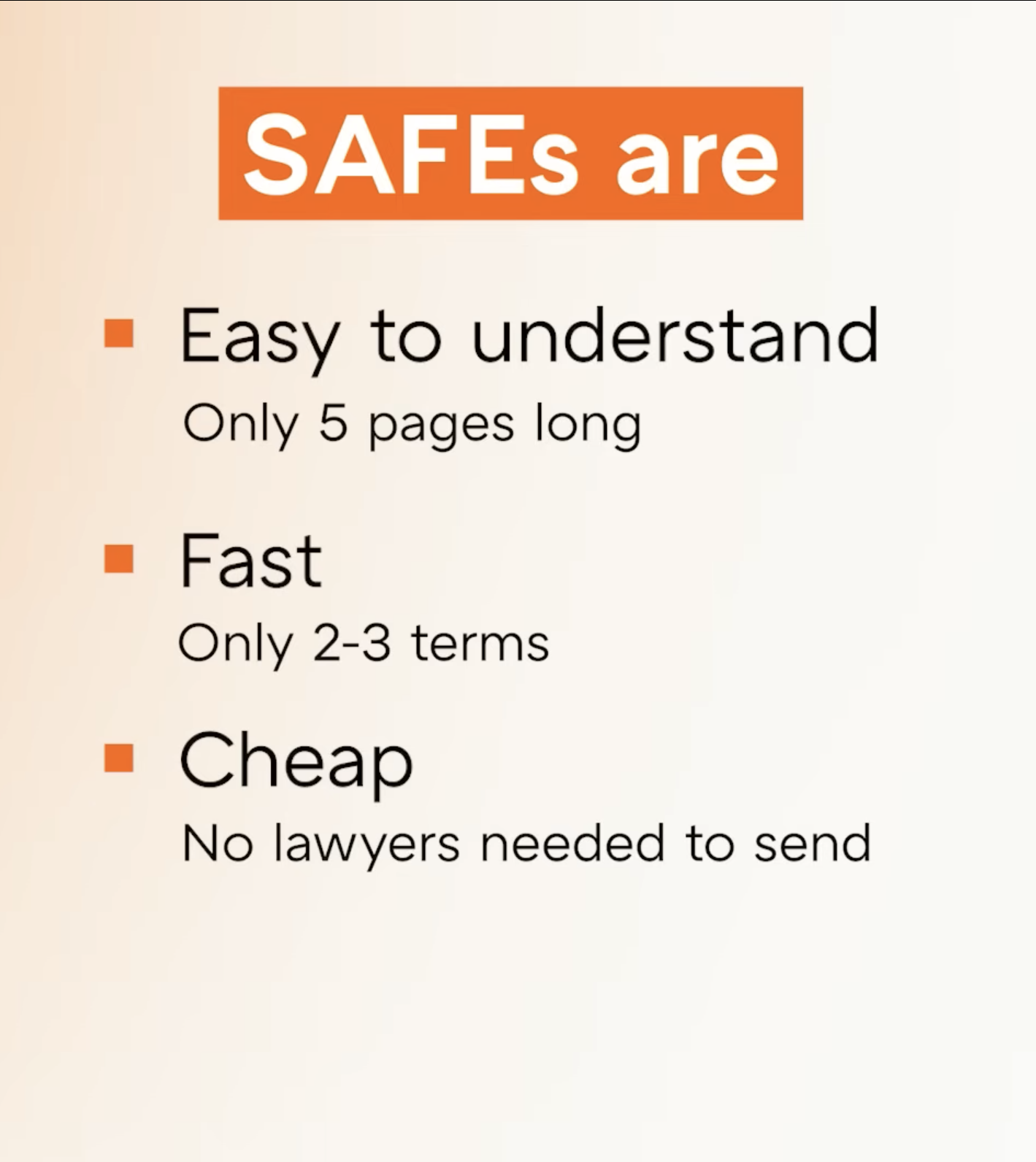
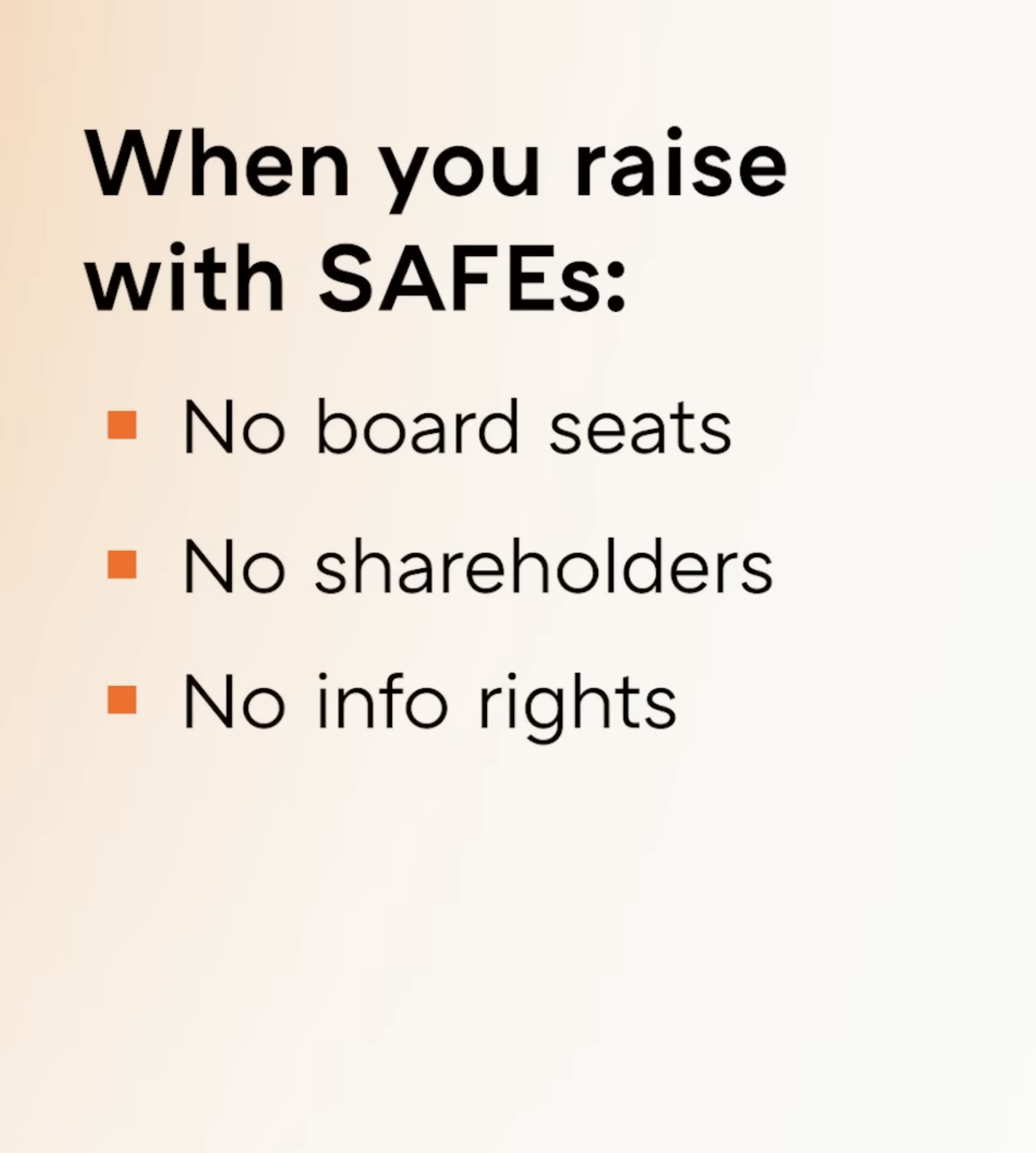
THE SAFE CHANGED FUNDRAISING
A SIMPLER EARLY-STAGE AGREEMENT
YC introduced the SAFE: Simple Agreement for Future Equity.
It allows startups to raise money with a short standard document and fewer terms.
This makes early fundraising faster and cheaper than negotiating a full priced equity round.
THE MAIN SAFE TERMS
INVESTMENT AMOUNT AND VALUATION CAP
A SAFE normally focuses on the investment amount and valuation cap.
The investor receives equity when a future financing converts the SAFE.
Founders should still understand dilution, conversion mechanics, local law, and the total effect of multiple SAFEs.
RAISE IN STEPS
USE EARLY CAPITAL TO CREATE MORE LEVERAGE
A smaller early round can finance the next technical, commercial, or regulatory milestone.
Once that milestone is reached, the startup can approach larger investors with stronger evidence and better negotiating power.
ASTRA RAISED BEFORE THE BIG ROUND
EARLY SAFES ACCELERATED BIOTECH PROGRESS
Astra, a biotech startup, used early SAFE funding from angels to accelerate laboratory progress.
That initial capital helped the team produce stronger evidence before approaching larger pharmaceutical investors.
Progress improved their leverage.
CONTROL AND BOOTSTRAPPING
CHAPTER 5
EARLY CAPITAL AND CONTROL
DEAL STRUCTURE DETERMINES GOVERNANCE
A SAFE usually grants no board seat at signing.
Founders can continue operating while the SAFE converts during a future financing.
Control still depends on ownership, financing terms, governance documents, and cumulative dilution.
DILUTION MUST BE PLANNED
EVERY CHECK CHANGES FUTURE OWNERSHIP
Raising money means selling part of the future company.
Model how each SAFE, option pool, and later round affects founder ownership.
Capital is useful when the value it helps create is greater than the ownership given away.
ZAPIER CHOSE ITS OWN PATH
ONE ROUND, THEN CUSTOMER-FUNDED GROWTH
Zapier raised an early round, built the company remotely, and later stopped raising.
The founders used outside capital to gain stability, then grew through customer revenue.
Fundraising served as a temporary tool supporting a long-term independent path.
BOOTSTRAPPING HAS A COST
REVENUE PRESSURE CAN LIMIT STRATEGIC CHOICES
Bootstrapping can preserve ownership, but it may also create constant cash pressure.
Founders may delay hiring, take consulting work, or prioritize short-term revenue over the core product.
The correct path depends on the business and market.
CHOOSE THE FUNDING MODEL
MATCH CAPITAL TO THE COMPANY
Bootstrap when the business can grow efficiently from customer revenue.
Raise when speed, research, infrastructure, regulation, or market timing requires more capital.
Choose the model that gives the company the strongest path toward durability.
YOU DO NOT NEED A FANCY NETWORK
CHAPTER 6
TRACTION OPENS DOORS
EVIDENCE CAN OUTPERFORM PEDIGREE
Investors may notice schools, employers, and personal connections.
They care more about the possibility of a strong return.
A product people want, growing revenue, strong retention, or unusual execution can overcome a limited network.
PODIUM STARTED FAR AWAY
SALES TRACTION CREATED CREDIBILITY
Podium began by selling customer-review software to tire shops.
The founders came from Utah without a major Silicon Valley network, but they were strong at sales and already generating revenue.
Performance made investors pay attention.
BUILD YOUR OWN NETWORK
EVERY USEFUL CONVERSATION CAN COMPOUND
Start with founders, operators, customers, accelerators, angels, and industry experts.
Ask for advice before asking for money. After a useful conversation, request one relevant introduction.
A network can be built through execution.
OWN THE INVESTOR RELATIONSHIP
FOUNDERS SHOULD LEAD THE MEETINGS
Someone may offer to raise money for you because they know investors.
Ask them for introductions, then lead the meetings yourself.
Investors are evaluating the founders, and the long-term relationship should begin directly with the people building the company.
REJECTION IS PART OF THE PROCESS
CHAPTER 7
REJECTION IS ONE DECISION
INVESTORS CAN MISJUDGE THE OPPORTUNITY
Strong startups are rejected constantly.
An investor may dislike the market, timing, business model, valuation, geography, or risk profile.
Their decision reflects their own strategy and conviction. The company’s future remains open.
ENVISION WAS REJECTED 50+ TIMES
ONE CHECK CREATED THE OPENING
Envision struggled to secure its first investment and faced more than 50 rejections.
The founder eventually raised an initial $25,000 check, completed a $500,000 first round, and kept building.
The company was later acquired for $275 million.
WHATNOT RAISED LESS THAN EXPECTED
EARLY INVESTORS MISSED THE SCALE
Whatnot had early traction but investors still disliked the opportunity.
The company raised only a fraction of its target seed round.
A few years later, it reached a multibillion-dollar valuation, showing how differently the future can unfold.
FIND ENOUGH BELIEVERS
FUNDRAISING IS NOT A POPULARITY CONTEST
A fundraising round needs enough aligned investors to finance the next stage.
Target people who understand the market, company type, stage, and risk.
A focused list creates better conversations and a higher chance of conviction.
LEARN WITHOUT LOSING CONVICTION
SEPARATE SIGNAL FROM NOISE
Track recurring objections.
One rejection may mean little. The same objection from many qualified investors may reveal a real weakness.
Use feedback to improve the business while preserving conviction that is supported by customer evidence.
THE FOUNDER FUNDRAISING SYSTEM
CHAPTER 8
STEP 1: BUILD SOMETHING PEOPLE WANT
START WITH REAL CUSTOMER VALUE
Create the smallest product that solves a meaningful problem.
Put it in front of users quickly. Observe behavior, usage, retention, revenue, and repeat demand.
These signals become the foundation of the fundraising story.
STEP 2: DEFINE THE MILESTONE
KNOW WHAT THE MONEY MUST ACHIEVE
State exactly what the round will unlock.
Examples: ship the product, reach 100 paying customers, complete a clinical milestone, enter a new market, or prove repeatable acquisition.
Capital without a milestone becomes expensive time.
STEP 3: PREPARE THE EVIDENCE
MAKE THE COMPANY EASY TO UNDERSTAND
Prepare a clear story, short deck, product demo, traction metrics, financial plan, cap table, and fundraising target.
Use simple language.
Every material should help an investor understand the opportunity and evaluate it quickly.
STEP 4: RUN A TIGHT PROCESS
CREATE MOMENTUM ACROSS MEETINGS
Build a qualified investor list and schedule meetings close together.
Track every conversation and follow up quickly. Share meaningful progress during the process.
Momentum improves focus, creates urgency, and reduces months of distraction.
STEP 5: CLOSE THE RIGHT CAPITAL
CHOOSE ALIGNMENT, NOT ONLY MONEY
Evaluate the investor’s reputation, speed, stage fit, decision process, terms, and ability to help.
Understand the legal documents before signing.
The best investor strengthens the company while respecting the founder’s ability to execute.
THE CORE LESSON
BUILD FIRST. RAISE WITH LEVERAGE.
Start building before seeking permission or capital.
Create a useful product, collect evidence, explain the opportunity clearly, and speak with many investors.
Expect rejection. Keep improving. Raise when capital can accelerate a specific path toward a stronger company.