CONTENT
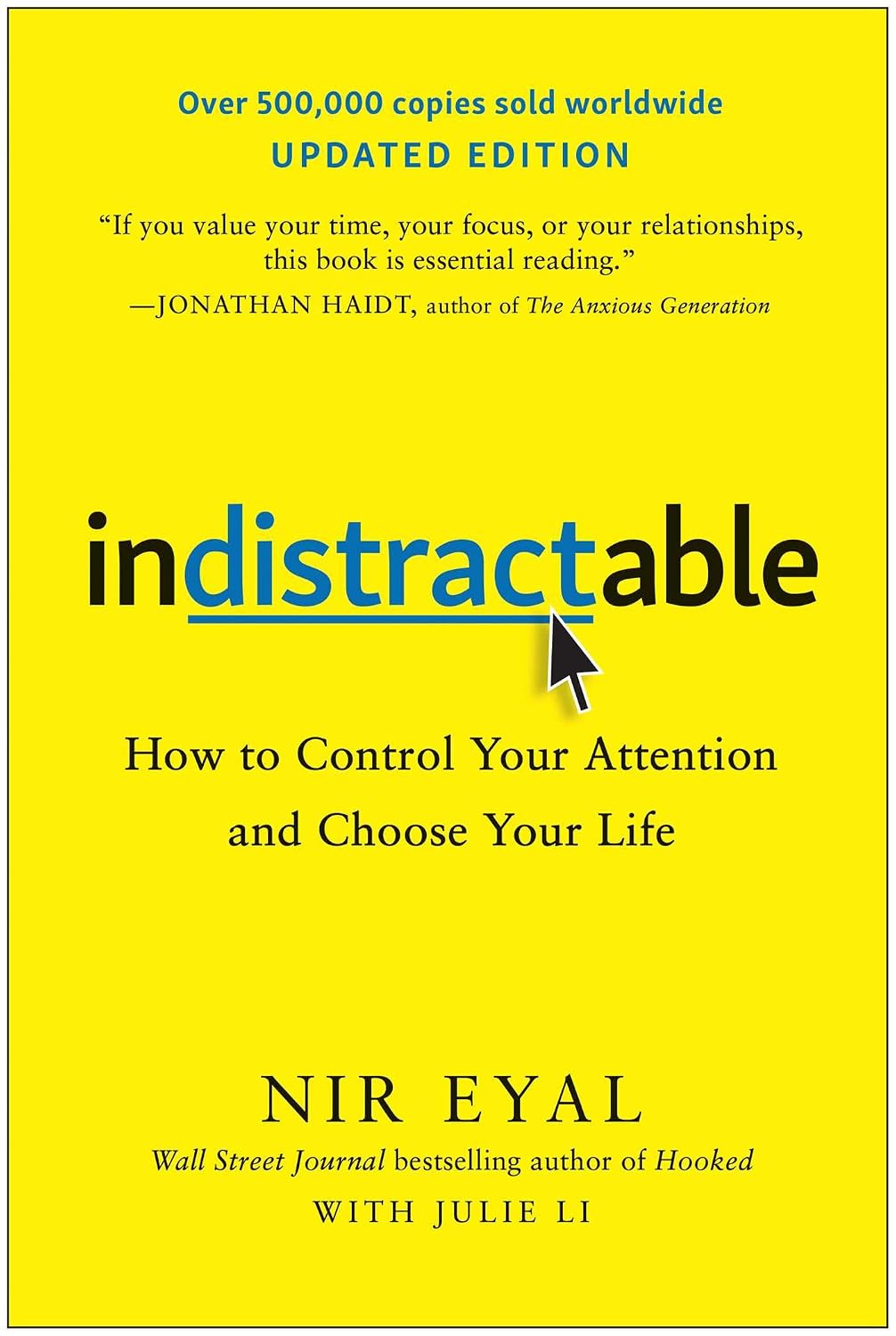
INDISTRACTABLE
CONTROL YOUR ATTENTION. CHOOSE YOUR LIFE.
The defining skill of the 21st century is the ability to control your attention.
When you become indistractable, you can do what you say you will do—even when distractions compete for your time.
YOUR ATTENTION IS BEING CONTESTED
THE HIDDEN BATTLE
Technology companies build products that keep us returning.
But phones and apps are only part of the problem. Distraction existed before social media and will continue after today’s technology disappears.
A DIGITAL DETOX IS NOT ENOUGH
REMOVING TECHNOLOGY DOES NOT REMOVE DISTRACTION
Nir Eyal replaced his smartphone, avoided online news, and used an offline word processor.
He still became distracted. When one distraction disappeared, another replaced it.
The real problem was deeper than technology.
THE COST OF DISTRACTION
YOU MAY BE PRESENT, BUT NOT TRULY THERE
While spending time with his daughter, Eyal became absorbed in his phone. When he finally looked up, she had left.
Distraction does more than reduce productivity. It steals moments with the people who matter.
THE REAL SUPERPOWER
DO WHAT YOU INTENDED TO DO
Living well requires two abilities:
1. Do the things that move life forward.
2. Stop doing the things you will regret.
Being indistractable means striving to do what you say you will do.
THE INDISTRACTABLE MODEL
THE FOUNDATION
TRACTION VS. DISTRACTION
DIRECTION DETERMINES THE DIFFERENCE
Traction is any action that moves you toward what you truly want.
Distraction is any action that pulls you away from it.
The same activity can be either one. Watching a movie is traction when planned and distraction when it replaces important work.
EVERY ACTION BEGINS WITH A TRIGGER
WHAT PROMPTED THE BEHAVIOR?
Two types of triggers drive behavior:
1. Internal triggers—boredom, anxiety, loneliness, stress.
2. External triggers—notifications, people, objects, and sounds.
The resulting action becomes traction or distraction.
THE FOUR-PART MODEL
YOUR MAP FOR CONTROLLING ATTENTION
1. Master internal triggers.
2. Make time for traction.
3. Hack back external triggers.
4. Prevent distraction with pacts.
These four strategies work together as a complete system.
PART 1
MASTER INTERNAL TRIGGERS
DISTRACTION STARTS WITHIN
FIND THE REAL CAUSE
Most distraction is an attempt to escape discomfort.
We reach for entertainment, food, email, or social media because we feel bored, uncertain, lonely, tired, or anxious.
The app is often the nearest escape—not the root cause.
TIME MANAGEMENT IS PAIN MANAGEMENT
LEARN TO REMAIN WITH DISCOMFORT
Human behavior is driven by the desire to escape discomfort.
Managing time therefore requires managing the uncomfortable feelings that precede distraction.
If every unpleasant feeling controls you, your schedule never will.
DO NOT SUPPRESS THE URGE
RESISTANCE CAN MAKE IT STRONGER
Trying to force an unwanted thought away often makes it return more powerfully.
Observe the urge without automatically obeying it. Feelings rise, peak, and eventually pass.
An urge is an experience, not a command.
THE FOUR STEPS TO HANDLE AN URGE
RESPOND WITH CURIOSITY
1. Identify the feeling before the distraction.
2. Write down the trigger and intended action.
3. Explore the sensation with curiosity.
4. Wait ten minutes before acting.
You are creating space between the trigger and your response.
REIMAGINE THE TRIGGER
STUDY WHAT HAPPENS INSIDE YOU
When distraction appears, ask:
What emotion came immediately before this urge?
Record the time, situation, feeling, and intended escape. Repeated observations reveal patterns that were previously invisible.
REIMAGINE THE TASK
FIND NOVELTY IN THE DETAILS
A difficult task can become engaging when you examine it more closely.
Turn the task into play. Look for variation, patterns, challenges, and opportunities to improve.
Fun often comes from focused attention and discovery.
REIMAGINE YOUR TEMPERAMENT
YOUR IDENTITY SHAPES YOUR BEHAVIOR
Avoid saying:
“I have no willpower.”
“I am easily distracted.”
“I have an addictive personality.”
These labels reinforce helplessness. Speak to yourself with curiosity and self-compassion, especially after a setback.
PART 2
MAKE TIME FOR TRACTION
YOU NEED SOMETHING TO BE DISTRACTED FROM
DEFINE TRACTION FIRST
You cannot identify distraction without first deciding how you intended to spend your time.
A clear calendar turns intention into a visible commitment. Without one, almost anything can appear productive.
TURN YOUR VALUES INTO TIME
VALUES NEED SPACE ON THE CALENDAR
Values are the qualities of the person you want to become.
Organize them into three life domains:
1. You
2. Relationships
3. Work
If something matters, reserve time for it.
TIMEBOX YOUR DAY
GIVE EVERY MINUTE A PURPOSE
Create a weekly schedule that includes work, rest, exercise, family, learning, entertainment, and sleep.
Time planned for leisure is not wasted. When it is intentional, it is traction.
CONTROL INPUTS, NOT OUTCOMES
FOCUS ON WHAT YOU CAN REPEAT
Outcomes are never completely under your control.
You can control inputs:
• Time spent exercising
• Hours devoted to focused work
• Time invested in relationships
• Consistency of practice
Reliable inputs increase the probability of desired results.
SCHEDULE TIME FOR YOURSELF
YOUR WELL-BEING COMES FIRST
Reserve time for sleep, exercise, reflection, and activities that restore you.
If your calendar excludes your physical and psychological needs, distraction will often become your improvised method of escape.
SCHEDULE IMPORTANT RELATIONSHIPS
PRESENCE REQUIRES PREPARATION
Put time with partners, children, family, and friends on the calendar.
Also schedule household responsibilities. Relationships rarely receive meaningful attention through leftover time alone.
SYNC WITH STAKEHOLDERS
ALIGN EXPECTATIONS
Share your planned schedule with the people affected by it.
At work, review priorities with your manager. At home, coordinate responsibilities with your partner or family.
Alignment prevents other people’s priorities from silently replacing yours.
REVIEW AND ADJUST
A SCHEDULE IS A LIVING SYSTEM
When you become distracted, ask:
1. Was an internal trigger responsible?
2. Did an external trigger interrupt me?
3. Was my schedule unrealistic?
Use the answer to improve the next version of your week.
PART 3
HACK BACK EXTERNAL TRIGGERS
ASK THE CRITICAL QUESTION
WHO IS SERVING WHOM?
For every notification, interruption, or environmental cue, ask:
“Is this trigger serving me, or am I serving it?”
A useful trigger supports your planned action. An unhelpful trigger pulls you away from it.
DEFEND YOUR FOCUS
MAKE CONCENTRATION VISIBLE
Interruptions increase mistakes, stress, and frustration.
Use a clear signal when you need uninterrupted work: a sign, status indicator, closed door, focus light, or agreed team symbol.
People cannot respect a boundary they cannot see.
HACK BACK EMAIL
REDUCE VOLUME AND RESPONSE TIME
To spend less time on email:
1. Send fewer messages.
2. Unsubscribe aggressively.
3. Delay non-urgent delivery.
4. Use office hours for complex discussions.
5. Schedule when you process replies.
HACK BACK GROUP CHAT
DO NOT LIVE INSIDE THE CONVERSATION
Group chat can become an all-day meeting.
Enter and exit at scheduled times. Include only necessary people. Avoid thinking aloud in shared channels, and move complex or sensitive discussions to a more suitable format.
HACK BACK MEETINGS
NO AGENDA, NO MEETING
Require an agenda that explains the problem, preparation, and decision needed.
Meetings work best for reaching consensus. Many problems should be explored before the meeting through focused individual work.
HACK BACK YOUR SMARTPHONE
REDESIGN THE DEVICE
1. Remove apps you no longer need.
2. Move distracting services to desktop.
3. Disable nonessential notifications.
4. Organize apps by purpose.
5. Use Do Not Disturb.
6. Keep the phone out of sight during focused work.
HACK BACK YOUR DESKTOP
PROTECT THE WORKSPACE
Turn off desktop notifications. Remove visual clutter. Close unused tabs and applications.
Every visible cue competes for a portion of your attention—even when you do not consciously respond to it.
HACK BACK ARTICLES AND FEEDS
CONSUME CONTENT INTENTIONALLY
Save interesting articles to read or listen to during scheduled time.
Use tools that hide algorithmic feeds while preserving useful platform functions.
Choose what you consume before an algorithm chooses for you.
PART 4
PREVENT DISTRACTION WITH PACTS
THE POWER OF PRE-COMMITMENT
DECIDE BEFORE TEMPTATION ARRIVES
The antidote to impulsiveness is forethought.
A pact is a decision made in advance that makes distraction more difficult. It works best after internal triggers, scheduled traction, and external triggers have already been addressed.
EFFORT PACTS
ADD FRICTION TO DISTRACTION
An effort pact makes an unwanted behavior harder to perform.
Examples:
• Use a website blocker.
• Place your phone in another room.
• Schedule focused work with a partner.
• Automatically shut down internet access at night.
PRICE PACTS
MAKE DISTRACTION EXPENSIVE
A price pact attaches money to your commitment.
If you fail to complete the promised behavior, you lose the money.
Use carefully. It is unsuitable when failure is outside your control or when punishment may reinforce shame.
IDENTITY PACTS
BECOME THE PERSON WHO FOLLOWS THROUGH
Behavior follows identity.
Instead of saying, “I am trying to be less distracted,” say, “I am indistractable.”
The identity becomes a standard for future decisions and strengthens each time you honor your plan.
PART 5
BUILD AN INDISTRACTABLE WORKPLACE
DISTRACTION CAN SIGNAL DYSFUNCTION
LOOK BEYOND PERSONAL DISCIPLINE
An always-on workplace creates anxiety and constant checking.
Excessive technology use is often a symptom of unclear expectations, overwhelming workloads, or low psychological safety—not simply an employee’s lack of self-control.
PSYCHOLOGICAL SAFETY MATTERS
PEOPLE NEED PERMISSION TO SPEAK
Healthy organizations allow people to discuss distraction, workload, and mistakes without fear of punishment.
When employees cannot raise problems openly, they often escape discomfort through more meetings, messaging, and reactive work.
CREATE A FOCUS-FRIENDLY CULTURE
START WITH SHARED STANDARDS
Build an environment where:
1. Focused work is protected.
2. Being offline is acceptable.
3. Communication expectations are explicit.
4. Employees can discuss problems safely.
5. Leaders model healthy technology use.
PART 6
RAISE INDISTRACTABLE CHILDREN
AVOID CONVENIENT EXCUSES
TECHNOLOGY IS NOT THE ENTIRE PROBLEM
Blaming devices alone prevents parents from discovering why children seek constant distraction.
Look for unmet needs, unclear boundaries, excessive structure, loneliness, boredom, or a lack of meaningful control.
MEET THREE PSYCHOLOGICAL NEEDS
WHAT CHILDREN NEED TO FLOURISH
Children need:
1. Autonomy—a sense of choice and control.
2. Competence—the experience of improving.
3. Relatedness—meaningful connection with others.
When these needs are missing offline, digital environments become more attractive.
TIMEBOX TOGETHER
GIVE CHILDREN OWNERSHIP
Help children create their own schedules, including schoolwork, sleep, family responsibilities, unstructured play, friends, and screen time.
When children participate in planning, they practice managing attention instead of merely obeying restrictions.
HELP THEM MANAGE TRIGGERS
TEACH THE SYSTEM
Show children how to disable notifications, move devices away during study, and recognize emotions that drive distraction.
Parents should also avoid becoming external triggers by interrupting children during their planned focused time.
LET CHILDREN MAKE PACTS
RESPONSIBILITY BUILDS CAPABILITY
Let children choose practical limits and consequences appropriate to their age.
The goal is larger than reducing screen time. It is teaching them that distraction is manageable and attention is their responsibility.
PART 7
BUILD INDISTRACTABLE RELATIONSHIPS
SPREAD SOCIAL ANTIBODIES
MAKE DISTRACTION DISCUSSABLE
When someone uses a device during a conversation, ask gently:
“I see you’re on your phone. Is everything okay?”
This makes the behavior visible without immediate accusation and creates a shared standard for presence.
PROTECT YOUR MOST INTIMATE TIME
REMOVE DEVICES FROM THE BEDROOM
Instant connection with the world can reduce connection with the person beside you.
Keep phones and televisions outside the bedroom. Set the internet to turn off at a specific time and reserve the reclaimed space for sleep and togetherness.
BEING INDISTRACTABLE IS A PRACTICE
PROGRESS DOES NOT REQUIRE PERFECTION
You will still become distracted, especially during stress or unexpected change.
The objective is to recognize what happened, apply the right strategy, and prevent the same pattern from repeatedly controlling your life.
THE COMPLETE SYSTEM
FOUR STEPS TO RECLAIM YOUR ATTENTION
1. Master the discomfort behind distraction.
2. Put your values into a timeboxed schedule.
3. Remove external triggers that do not serve you.
4. Use effort, price, and identity pacts to protect your intentions.
CHOOSE YOUR LIFE
ATTENTION DETERMINES DIRECTION
Your life is shaped by what receives your attention.
When you control that attention, you become more present, productive, and honest with yourself.
The real superpower is doing what you said you would do.


HOW TO USE FLOW STATE TO DO THE IMPOSSIBLE
YOUTUBE SUMMARY : BIG THINK
CHAPTER INDEX
THE IMPOSSIBLE IS OFTEN A MOVING TARGET
PEAK PERFORMANCE STARTS WITH BIOLOGY
Steven Kotler's core idea:
Humans are built for peak performance.
The goal is to get our biology, brain, and nervous system working for us rather than against us.
THE IMPOSSIBLE
WHY POSSIBILITY BEGINS IN THE MIND
WE ARE CAPABLE OF MORE THAN WE THINK
LIMITS ARE PARTLY PSYCHOLOGICAL
When we see someone achieve something previously considered impossible, our own thinking changes.
We stop asking:
"Can it be done?"
And start asking:
"How could I do it?"
THE MENTAL SEQUENCE
IMPOSSIBLE SLOWLY BECOMES ACTIONABLE
1. Someone proves it is possible.
2. You imagine yourself doing it.
3. You ask how it could be done.
4. You think about training.
5. The impossible becomes a problem that can be solved.
THE BANNISTER EFFECT
BELIEF CHANGES PERFORMANCE
ROGER BANNISTER
BREAKING THE FOUR-MINUTE MILE
For years, running one mile in under four minutes was considered almost impossible.
Then Roger Bannister ran it in 3 minutes 59.4 seconds on May 6, 1954.
A psychological barrier suddenly disappeared.
WHAT HAPPENED NEXT?
THE BODY DID NOT SUDDENLY EVOLVE
Soon after Bannister broke the barrier, other runners followed.
A month later, another runner beat his record.
Within several years, even teenagers had run sub-four-minute miles.
Human physiology had not suddenly changed.
THE BARRIER WAS ALSO MENTAL
POSSIBLE CHANGES BEHAVIOR
Before Bannister:
"It cannot be done."
After Bannister:
"It has been done."
That small psychological shift changes imagination, training, confidence, strategy, and willingness to attempt the goal.
BELIEF CREATES A NEW QUESTION
FROM POSSIBILITY TO EXECUTION
Once your brain accepts that something is possible, the question changes.
Not:
"Is this possible?"
But:
"What would it look like if I did it?"
That question begins turning an abstract dream into an executable plan.
MENTAL REHEARSAL
PRE-WIRE THE PERFORMANCE
THE BRAIN THINKS IN PATTERNS
IMAGINE BEFORE EXECUTING
Kotler argues that mentally rehearsing a future action can help pre-wire patterns before actual performance.
You imagine the movement, sequence, environment, challenge, and response before doing it.
PSYCHOLOGY MEETS PHYSIOLOGY
MIND AND BODY ARE TIGHTLY CONNECTED
The Bannister Effect points to a larger principle:
Psychology and physiology are deeply connected.
What you believe affects what you attempt.
What you repeatedly imagine can affect how you prepare and perform.
PATTERN MATCHING
FAMILIARITY CAN SUPPORT PERFORMANCE
Kotler suggests that when reality begins matching patterns previously rehearsed in the mind, the brain may reward that recognition.
That familiarity can increase confidence, motivation, and potentially help push performance toward flow.
FLOW STATE
THE ENGINE OF PEAK PERFORMANCE
WHAT IS FLOW?
OPTIMIZED CONSCIOUSNESS
Flow is an optimized state of consciousness in which we tend to feel our best and perform our best.
Attention becomes deeply absorbed in the task, and action begins to feel unusually smooth and automatic.
WHERE THE NAME COMES FROM
PERFORMANCE FEELS EFFORTLESS
Psychologist Mihaly Csikszentmihalyi studied people describing moments when they felt and performed at their best.
Again and again, people described actions flowing effortlessly and seamlessly from one moment to the next.
THE 4 SIGNS OF FLOW
HOW TO RECOGNIZE THE STATE
1. Complete concentration.
2. Action and awareness merge.
3. Self-consciousness decreases.
4. Time feels distorted.
You become so absorbed that five hours can feel like five minutes.
THE INNER CRITIC GETS QUIET
LESS SELF, MORE EXECUTION
During deep flow, attention moves away from self-evaluation.
You stop constantly asking:
"Am I doing this correctly?"
"How do I look?"
"What will people think?"
More mental energy becomes available for the task itself.
FLOW FEELS LIKE CONTROL
DOING WHAT NORMALLY FEELS DIFFICULT
Peak performance does not necessarily feel like "peak performance."
Internally, it can feel like extraordinary control.
An athlete may suddenly feel that the game has slowed down and difficult actions have become easier.
EXAMPLE: THE BASKETBALL ZONE
PERCEPTION CHANGES
A basketball player in the zone may describe the hoop as suddenly looking enormous.
The hoop has not changed.
The athlete's perception, attention, confidence, timing, and execution have changed.
FLOW AMPLIFIES PERFORMANCE
WHAT CHANGES INSIDE THE STATE
PERFORMANCE GOES UP TOGETHER
MENTAL AND PHYSICAL GAINS
Kotler argues that flow can amplify multiple dimensions of performance at once:
1. Motivation
2. Productivity
3. Learning
4. Creativity
5. Strength
6. Stamina and endurance
PRODUCTIVITY AND MOTIVATION
MORE OUTPUT FROM DEEP FOCUS
Kotler cites research suggesting that productivity and motivation can rise dramatically during flow.
The practical lesson is simpler:
Deep uninterrupted concentration can create substantially different output from fragmented attention.
LEARNING ACCELERATES
FLOW AND SKILL ACQUISITION
Kotler cites research reporting learning improvements of roughly 240% to 500% during flow conditions.
The exact number matters less than the principle:
Attention, motivation, feedback, and memory become tightly connected.
CREATIVITY EXPANDS
MORE CONNECTIONS BECOME AVAILABLE
Kotler also cites large increases in creativity during flow.
When self-consciousness decreases and attention becomes absorbed, people can connect ideas faster, explore unusual possibilities, and react more fluidly.
WHY FLOW EXISTS
EVOLUTION BUILT THE SYSTEM
SCARCITY CREATES PRESSURE
EVOLUTION REWARDS USEFUL RESPONSES
Kotler connects flow to evolution.
When resources become scarce, organisms must respond.
Survival depends on finding better ways to act under pressure, uncertainty, danger, and competition.
THREE RESPONSES TO SCARCITY
FIGHT, FLEE, OR INNOVATE
When resources disappear, we can:
1. Fight over what remains.
2. Flee danger or avoid becoming a resource ourselves.
3. Cooperate, create, innovate, and discover new resources.
FLOW SUPPORTS ALL THREE
A SURVIVAL AMPLIFIER
Flow amplifies many abilities needed under pressure:
Focus.
Speed.
Strength.
Learning.
Creativity.
Cooperation.
Problem solving.
That may explain why evolution preserved the state.
FLOW IS NOT RESERVED FOR GENIUSES
THE SYSTEM EXISTS IN ALL OF US
Kotler's major conclusion after decades studying peak performance:
Flow is universal.
It is not a superpower given only to elite athletes, artists, founders, or scientists.
The biological machinery already exists inside us.
THE IMPOSSIBLE FORMULA
HOW POSSIBILITY EXPANDS
STEP 1 — SEE PROOF
FIND EVIDENCE THAT IT CAN BE DONE
Impossible goals become easier to approach when your brain has evidence that they are achievable.
Find examples.
Study people who already crossed the barrier.
Proof changes the mental frame from fantasy to possibility.
STEP 2 — IMAGINE YOURSELF DOING IT
CREATE THE INTERNAL PICTURE
Do not stop at admiring someone else's achievement.
Ask:
"What would this look like if I did it?"
Make the imagined performance specific enough that your brain can begin working with it.
STEP 3 — TURN IT INTO TRAINING
MOVE FROM DREAM TO PROCESS
Ask increasingly practical questions:
What skills are required?
What needs to improve?
How would I train?
What would I practice every day?
The impossible becomes smaller once it becomes a training problem.
STEP 4 — CREATE CONDITIONS FOR FLOW
PROTECT DEEP EXECUTION
Flow requires deep engagement.
Reduce unnecessary distraction.
Choose a meaningful challenge.
Know the task.
Get immediate feedback.
Push your abilities near their current limits.
STEP 5 — REPEAT
EXPAND YOUR DEFINITION OF POSSIBLE
One breakthrough changes what you believe is possible.
That belief changes the next goal.
The process repeats:
See possibility → imagine → train → enter deep focus → perform → raise the standard.
THE BIG IDEA
PEAK PERFORMANCE IS TRAINABLE
YOUR BIOLOGY ALREADY HAS THE MACHINERY
THE SYSTEM IS BUILT IN
The lesson is not that flow makes everything possible.
It is that humans possess biological systems capable of dramatically amplifying performance when the right conditions are present.
IMPOSSIBLE OFTEN STARTS AS A BELIEF
CHANGE THE FRAME, THEN CHANGE THE PROCESS
First, something looks impossible.
Then someone proves it can be done.
Belief shifts.
Questions change.
Training changes.
Performance changes.
Eventually, yesterday's impossible becomes today's standard.
FLOW, IN ONE SENTENCE
STEVEN KOTLER'S CENTRAL LESSON
Flow is a built-in human state that amplifies attention, learning, creativity, motivation, and performance—and can help expand the boundary between what we currently believe is possible and what we can actually do.

HOW FLOW STATE CAN HEAL TRAUMA
YOUTUBE SUMMARY : BIG THINK
CHAPTER INDEX
PEAK PERFORMANCE STARTS WITH BIOLOGY
THE CORE IDEA
Kotler defines peak performance as getting our biology to work for us rather than against us.
Underneath performance are systems that shape motivation, learning, creativity, and flow.
FLOW STATE
WHAT IT IS AND WHY IT MATTERS
WHAT IS FLOW?
OPTIMIZED CONSCIOUSNESS
Flow is an optimized state of consciousness where we tend to feel and perform at our best.
It appears when attention becomes deeply absorbed in the task, until distractions and everything outside the activity seem to fade away.
THE 4 SIGNS OF FLOW
WHAT THE EXPERIENCE FEELS LIKE
1. Action and awareness begin to merge.
2. Self-consciousness and the inner critic become quieter.
3. Attention becomes intensely focused.
4. Time feels distorted: minutes may feel like seconds, or seconds may feel much longer.
WHY FLOW FEELS SO POWERFUL
BRAIN CHEMISTRY
Kotler describes flow as involving a powerful mix of feel-good neurochemicals.
That chemical environment is one reason flow can feel rewarding, immersive, and memorable—and why people often want to return to activities that reliably produce it.
FLOW + MEMORY
WHY DEEP EXPERIENCES STICK
FLOW CAN STRENGTHEN LEARNING
ATTENTION CREATES STRONGER ENCODING
Deep focus makes experiences easier to encode into memory.
Kotler argues that the neurochemistry of flow also contributes to learning, helping important moments become more strongly remembered.
THINK ABOUT YOUR STRONGEST MEMORIES
MANY INVOLVE TOTAL ABSORPTION
Some of our strongest positive memories come from moments when we were completely inside an experience.
A competition. A performance. A trip. A creative breakthrough. A dangerous challenge.
These can carry many characteristics of flow.
WHEN MEMORY BECOMES THE PROBLEM
TRAUMA AS A POWERFUL MEMORY NETWORK
Kotler describes PTSD in simplified terms as a highly powerful memory that other thoughts and experiences can keep reconnecting to.
His key question: can a new, deeply absorbing experience help create a competing memory strong enough to change that pattern?
FLOW + TRAUMA
THE THERAPEUTIC HYPOTHESIS
THE IDEA: BUILD A STRONG NEW EXPERIENCE
COMPETING WITH THE OLD PATTERN
Kotler's argument is not simply 'forget the trauma.'
The idea is to create powerful new experiences with intense attention, positive emotion, challenge, and learning—then use therapy to help integrate them into a healthier psychological pattern.
EXAMPLE: SURFING + TALK THERAPY
FLOW-RICH ACTIVITY FOLLOWED BY REFLECTION
Kotler cites an Army program combining surfing with talk therapy.
Surfing contains many flow triggers: immediate feedback, physical challenge, focused attention, risk, novelty, and clear consequences.
Therapy sessions then followed the surfing sessions.
WHY SURFING MAY TRIGGER FLOW
THE ENVIRONMENT DEMANDS PRESENCE
A wave does not allow much mental wandering.
You must read the water, balance, react, and adjust continuously.
That combination of challenge, feedback, movement, and full attention can push the mind toward deep absorption.
WHAT KOTLER SAYS HAPPENED
REPORTED PTSD IMPROVEMENT
Kotler says that five weeks of surfing twice a week, combined with regular talk therapy, significantly reduced PTSD symptoms for participants and reduced medication needs in some cases.
Treat this as a claim from the talk, not proof that surfing alone treats PTSD.
FLOW + ADDICTION
REPLACING THE REWARD SOURCE
FLOW AS AN ALTERNATIVE REWARD
WHY HIGH-FLOW ACTIVITIES MAY HELP
Kotler also points to addiction programs that use outdoor, high-flow activities.
The logic is practical: if the brain is seeking intensity, reward, novelty, and absorption, healthy experiences may provide some of those rewards without relying on drugs.
EXAMPLE: OUTDOOR RECOVERY PROGRAMS
MOUNTAINS, CHALLENGE, AND ENGAGEMENT
Some rehabilitation programs, especially for young people, use mountains and outdoor challenges as part of treatment.
The goal is not just distraction. It is to create demanding, meaningful experiences that engage attention, effort, emotion, and social connection.
EXPERIENCE AS MEDICINE?
A FUTURE POSSIBILITY
WHAT IF DOCTORS PRESCRIBED EXPERIENCES?
A PROVOCATIVE FUTURE IDEA
Kotler imagines a future where psychology uses experiences more deliberately.
Instead of only asking, 'Which drug or therapy?' we may also ask, 'Which experience could create the attention, emotion, learning, movement, and connection this person needs?'
HEARTBREAK WORKS THE SAME WAY
MEMORIES KEEP POINTING BACKWARD
After a breakup or loss, ordinary places and objects can repeatedly reactivate memories of the person.
The house. A song. A restaurant. A street.
Kotler's point: the mind may need powerful new experiences to begin building memories that no longer orbit the old relationship.
WHY HE USES SKYDIVING AS AN EXAMPLE
IMMEDIATE TOTAL ATTENTION
Skydiving is Kotler's extreme example because it rapidly demands total presence.
Fear, novelty, risk, sensory intensity, and immediate feedback can overwhelm ordinary mental chatter and create a deep state of absorption.
THE BIGGER PRINCIPLE
DO NOT ONLY CHANGE THOUGHTS—CHANGE EXPERIENCES
The central idea is bigger than surfing or skydiving:
Our experiences change our brain state.
Brain states influence learning and memory.
So carefully designed experiences may become useful tools for creating new patterns of attention, emotion, and behavior.
IMPORTANT: FLOW IS NOT A STANDALONE CURE
USE THE IDEA RESPONSIBLY
The talk presents an intriguing therapeutic direction, not a universal prescription.
PTSD, addiction, grief, and other mental-health conditions require individualized care. Flow-based activities are better understood as possible complements to evidence-based treatment, not automatic replacements.
FLOW, IN ONE SENTENCE
THE TAKEAWAY
Flow is more than feeling productive.
It is a state of deep absorption that can intensify learning and memory—and, in Kotler's view, may help people build powerful new experiences strong enough to reshape old patterns.