
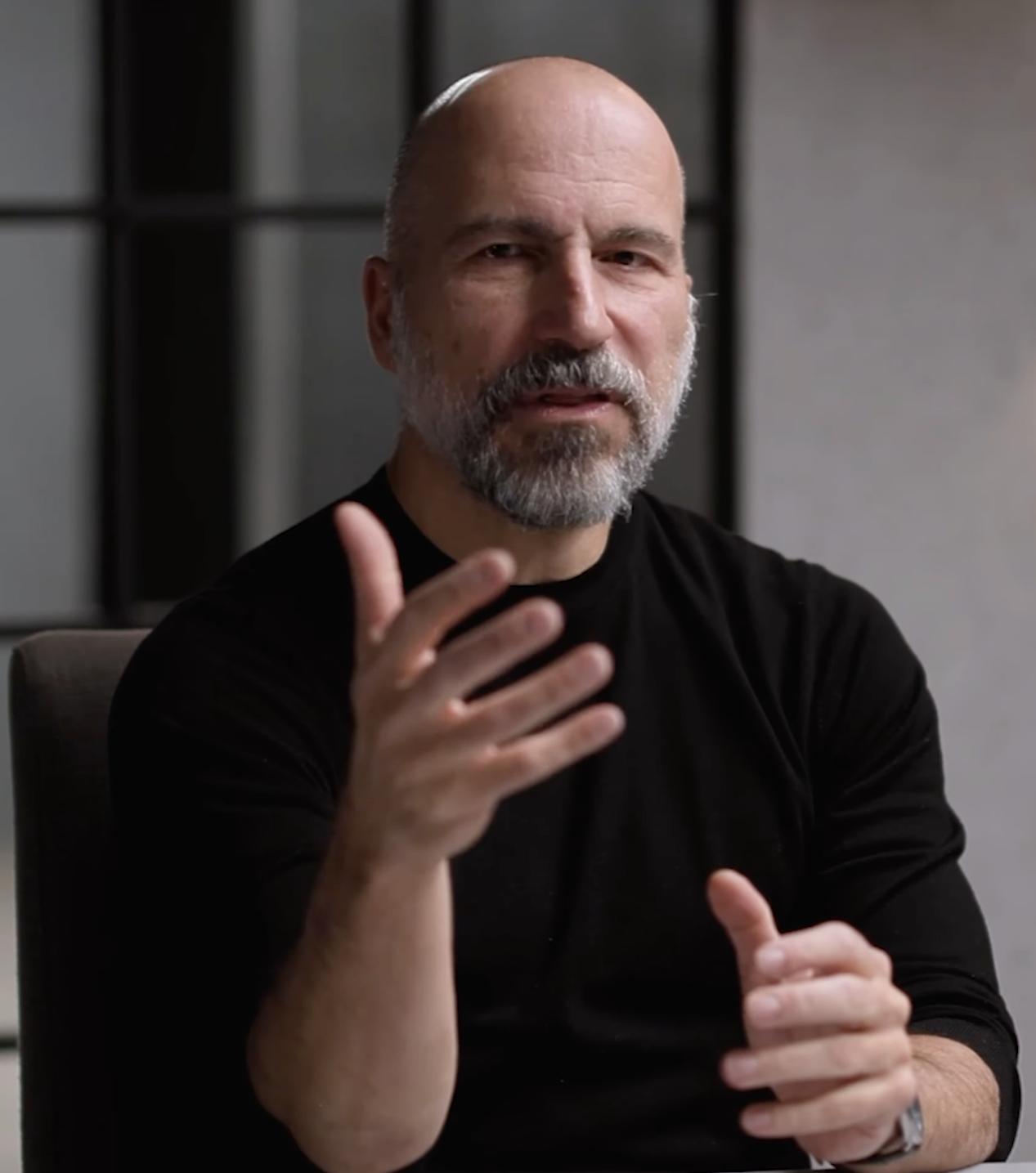
WHAT WE CAN LEARN FROM UBER CEO DARA KHOSROWSHAHI
A deep StackSlide based on Dara Khosrowshahi’s long-form interview about rebuilding, leadership, company culture, relentless execution, AI disruption, autonomous vehicles, and what founders, operators, and professionals can learn from it.
CHAPTER INDEX
FROM LOSS TO DRIVE
CHAPTER 1
BORN FROM INSTABILITY
THE EARLY IMPRINT
Dara’s life was shaped by political upheaval.
His family lost safety, status, and everything they had built in Iran.
That experience did not just create fear.
It created a permanent drive to rebuild and never take stability for granted.
WHEN THE FLOOR CAN DISAPPEAR
WHY URGENCY STAYS
He described a feeling that never leaves:
The rug can be pulled from under you.
That mindset can create anxiety.
But in business it also creates vigilance, ambition, and a refusal to become complacent when things look safe on the surface.
HIS FATHER’S IMPACT
MEANING BEYOND MONEY
Watching his father lose not just wealth but also his sense of value left a deep mark.
The lesson is massive:
Work is not only about income.
It is tied to dignity, worth, contribution, and identity.
That matters in every discussion about AI and unemployment.
WANTED TO MAKE FAMILY PROUD
CHAPTER 2
AMBITION BEGAN AS DUTY
BEFORE TITLES AND STRATEGY
He did not begin with a master plan to become CEO.
His early motivation was simpler:
Make his family proud.
That matters because many careers are built first on duty, responsibility, and hunger long before they are shaped by a polished career narrative.
IMPACT MATTERS MORE OVER TIME
MONEY FIRST THEN MEANING
After losing everything, making money mattered.
That was real.
But as safety improved, what mattered more was building something important.
This is a useful founder lesson:
Money can motivate the start.
Impact often sustains the long game.
LEARN FROM THE FATHER YOU SAW
POWER WITH RESPECT
One memory stayed with him:
Visiting his father’s factory and seeing workers respect him.
Not fear.
Respect.
That shaped a core idea:
Real leadership is not just scale or authority.
It is building something big while treating people with dignity.
ENGINEERING AS A CEO MINDSET
CHAPTER 3
WHY ENGINEERING MATTERS
THE COMPANY AS A SYSTEM
He loved engineering because equations map to reality.
That same logic shaped his view of business:
A company is an organism and a machine.
The CEO’s job is to engineer goals, structures, incentives, teams, and systems that make the machine produce the intended result.
PICK THE RIGHT GOALS
NOT JUST SOLVE HARD PROBLEMS
Problem solving is not enough.
You also have to choose the right problem.
That is a strong operator lesson:
A well-run team can still lose if it is optimizing the wrong goal.
Execution excellence cannot save a company from strategic misalignment.
GREAT CEOS THINK LIKE BUILDERS
OPERATIONAL DESIGN
His framing is sharp:
The CEO is not just a spokesperson or capital allocator.
The CEO is designing a living system.
That means structure, pacing, accountability, information flow, and talent design all become part of the product of leadership itself.
BET ON PEOPLE
CHAPTER 4
GREAT COMPANIES START WITH GREAT PEOPLE
A DURABLE RULE
One lesson he learned early:
Always bet on people.
Companies rise and fall.
Markets change.
But great people remain unusually valuable over long periods.
This matters for founders, investors, and hiring managers making long-term decisions.
WHAT MAKES SOMEONE WORTH BETTING ON
CHARACTER SIGNALS
He pointed to traits like success, honor, loyalty, and follow-through.
Not charisma alone.
Not hype alone.
A great person says what they will do and then does it.
That consistency compounds trust over time and becomes a strategic asset in business.
RELATIONSHIPS OVER TRANSACTIONS
THE LONG GAME
The idea is not just to find talent once.
It is to stay with good people through their careers.
That is how strong networks and enduring businesses are built.
You do not just collect deals.
You build long arcs of trust with exceptional people.
SPOTTING OPPORTUNITY IN TRANSITIONS
CHAPTER 5
FIND THE LEADERS IN THE SHIFT
WHO IS ALREADY WINNING
When big transitions happen, exact outcomes are unclear.
So instead of predicting every detail, identify who is already emerging as the leader in the shift.
That is how he and his team approached online commerce categories like travel, ticketing, and personals.
OVERPAYING FOR GREATNESS
PRICE VS FUTURE REALITY
He said they often overpaid for great companies based on what the market thought at the time.
But those prices looked cheap later because the future was not linear.
Strong transitions often create exponential outcomes that ordinary valuation logic fails to fully price.
HUMANS THINK LINEARLY
BUT TECHNOLOGY COMPOUNDS
People project the future in straight lines because everyday life feels linear.
But new technologies can create hockey-stick outcomes.
The opportunity often lives in the gap between what people assume will happen and how fast a superior technology actually scales.
TURNAROUNDS REQUIRE FORCE
CHAPTER 6
A BROKEN ENGINE IS AN EMERGENCY
EXPEDIA’S WARNING SIGN
At Expedia he saw something dangerous:
The technology engine was broken.
Old codebase.
Weak reinvestment.
Coasting leadership.
His lesson was decisive:
When you see the bell ring, act.
Do not wait for more proof while momentum turns against you.
TECHNOLOGY DECAY BECOMES EXPONENTIAL
THE DOWNSIDE CURVE
He explained that just as growth can become exponential, decline can too.
A bad technology trajectory may not look catastrophic in year one.
But if left untouched it can turn into a long-term disaster.
Leaders must act before the full damage becomes visible.
SOMETIMES YOU REPLACE THE TEAM
CULTURE VIA PEOPLE
He was blunt:
Sometimes the shortcut to changing culture is changing people.
Values posters are not enough.
If the company is coasting, you may need hungry people with the right operating instincts before culture can actually reset in real life.
TRANSPARENCY AS SELF-DEFENSE
CHAPTER 7
TELL THE TRUTH FIRST
SO TRUTH COMES BACK
His view is powerful:
As a leader, if you hide reality from your team, they will hide reality from you.
Transparency is not just ethics.
It is information strategy.
You tell the truth because it is the only way to increase the odds of receiving truth in return.
BAD DECISIONS OFTEN START WITH BAD DATA
THE REAL PROBLEM
He said many CEO failures are not from low intelligence.
They come from getting the wrong information.
This is crucial:
A leader must design channels that surface uncomfortable truth quickly.
Otherwise polished summaries slowly separate leadership from reality.
GO TO THE SOURCE
CUT THROUGH LAYERS
He learned to bypass filtered reporting and hear directly from the source.
The farther information travels up a hierarchy, the more its sharp edges get rounded off.
That is why direct channels with people deep in the system can be so valuable for CEOs.
CULTURE OF HARD WORK
CHAPTER 8
HARD WORK IS A SKILL
NOT JUST A PERSONALITY TRAIT
One of his strongest ideas:
Working hard is a skill.
It includes discipline, focus, repetition, emotional endurance, and the ability to keep going after losses.
He sees it as one of the most important advantages a person can build over time.
RELENTLESSNESS COMPOUNDS
TIME ACCELERATION
His logic is simple:
If you can take two shots while others take one, you compress time.
You get more data.
You learn faster.
You increase your odds of success.
Relentless execution is not just effort.
It is a compounding system for learning and winning.
BE HONEST ABOUT THE STANDARD
NO COASTING
He believes a company should be clear:
If you come here, you will work hard.
You will be stretched.
You will be held accountable.
That honesty lets the right people opt in.
It also reduces the damage caused by hidden expectations and cultural mismatch.
FLEXIBILITY IS NOT LAZINESS
DIFFERENT FROM LOW STANDARDS
He makes an important distinction:
You can work very hard and still have flexibility.
Dinner with family.
Emails at night.
Early morning check-ins.
The issue is not rigid office theater.
The issue is whether the person and the company are truly committed to output.
RISK, LOSS, AND LEARNING
CHAPTER 9
SAY THE LOSS OUT LOUD
THEN MOVE
He admired leaders who can say:
They won.
We lost.
Next.
That matters.
Do not deny the loss.
Do not drown in it.
Study it enough to learn.
Then move.
A company or person that cannot metabolize failure gets stuck in fear and self-protection.
TOO DEFENSIVE IS DANGEROUS
SUCCESS CAN WEAKEN YOU
As companies become successful they often become risk-averse.
They have more to protect.
He argues the opposite should happen.
A stronger company should be able to take smarter risks because it has more resources to absorb mistakes while pushing for bigger upside.
SET THE EXAMPLE ON RISK
THE LEADER DEFINES RANGE
He pushes teams to take smart risks through language, example, and personal decisions.
People do not learn courage from slogans.
They learn it when leaders take visible risks, survive misses, and show that intelligent experimentation is expected rather than punished.
VALUES THAT ACTUALLY MEAN SOMETHING
CHAPTER 10
GENERIC VALUES ARE FORGETTABLE
PASSION IS NOT ENOUGH
He criticized generic value lists that sound nice but describe every company on earth.
If your values could fit any brand, they do not really guide behavior.
Strong values should reflect how your company is different and how people are expected to act under pressure.
DO THE RIGHT THING. PERIOD.
JUDGMENT MATTERS
His favorite value was simple:
Do the right thing. Period.
No long paragraph.
No corporate poetry.
The power is in the burden it places on the employee:
Use judgment.
That pushes responsibility downward instead of hiding behind process or technical excuse.
GO GET IT
AN ATTITUDE NOT A PHRASE
One value he highlighted was 'go get it.'
It fits Uber’s product and its operating posture.
It signals movement, aggression, initiative, and winning intent.
Good values are memorable because they capture actual behavior in language the company can live with daily.
AI IS ALREADY INSIDE UBER
CHAPTER 11
UBER WAS BUILT ON APPLIED AI
BEFORE THE HYPE WAVE
He explained that Uber already runs on AI:
pricing, routing, matching, batching, and orchestration across tens of millions of daily trips.
This matters because it shows AI transformation often begins long before the public narrative catches up to it.
COMFORT WITH IMPERFECTION
96% RIGHT STILL MATTERS
Uber learned to live with AI systems that work most of the time but still create edge-case failures.
That is a mature lesson:
AI adoption is not about waiting for perfection.
It is about building organizations that can operate with probabilistic systems responsibly.
APPLIED AI WILL RESHAPE EVERY TEAM
NOT JUST AI LABS
He does not frame Uber as a frontier research lab.
He frames it as a company moving hard on applied AI.
That distinction matters for builders:
You do not need to invent foundation models to gain advantage.
You need to apply models deeply inside real workflows.
THE BIG JOB QUESTION
CHAPTER 12
AI CAN REPLACE MUCH HUMAN WORK
A SERIOUS WARNING
He said the capability may exist within about 10 years for many intellectual jobs and longer for physical jobs.
He did not give false comfort.
The point was clear:
The scale of disruption may be enormous and society may not be ready for the retraining challenge.
THE SPEED IS THE PROBLEM
NOT JUST THE TECHNOLOGY
Society has adjusted to past technological shifts.
But his concern is timing.
If the capability arrives too fast, the social systems around retraining, identity, income, and meaning may not adapt quickly enough.
That is where the real shock could happen.
JOBS ARE ALSO ABOUT WORTH
BEYOND SALARY
He connected work to value and self-worth.
That is why job loss is not only an economic issue.
It is psychological, social, and existential.
Any serious AI strategy that ignores human meaning will misread the scale of the coming societal challenge.
CODING IS CHANGING FAST
CHAPTER 13
MOST ENGINEERS ALREADY USE AI
BUT INTENSITY MATTERS
He shared that most of Uber’s coders already use AI tools.
But the biggest gains came from a smaller group of power users.
That is a useful signal:
Adoption alone is not the advantage.
Depth of usage and workflow redesign are where real productivity jumps begin.
FROM WRITING CODE TO ORCHESTRATING AGENTS
THE ROLE SHIFT
He sees coding moving from manual construction toward orchestration.
The engineer still matters.
But the job increasingly becomes directing systems, reviewing outputs, shaping architecture, and managing agent-based production rather than typing every piece by hand.
PRODUCTIVITY GAINS CHANGE HIRING LOGIC
MORE BUILDERS OR MORE AGENTS
His view is pragmatic:
If engineers become more productive, maybe you hire more of them to move faster.
Later, maybe you add fewer humans and more agents and GPUs.
That is how AI shifts strategy:
Not only what teams do but what management decides to buy.
AUTONOMY AND THE FUTURE OF UBER
CHAPTER 14
AUTONOMOUS VEHICLES WILL LIKELY WIN
ON SAFETY AND COST
He was direct:
Autonomous systems are becoming safer than human drivers in key contexts.
That creates a massive social upside through fewer deaths and cheaper transport.
But it also means large numbers of driving-related jobs may eventually disappear.
NOT TOMORROW BUT NOT FAR AWAY
PHYSICAL WORLD SLOWS IT
He does not expect full replacement overnight.
Regulation, hardware, manufacturing, sensors, and real-world deployment take time.
Still, the direction is clear:
Over 15 to 20 years, a growing share of trips could be fulfilled by non-human systems.
WHAT DO THE DRIVERS DO?
THE UNANSWERED QUESTION
When asked what millions of displaced drivers will do, he did not pretend to have a clean answer.
That honesty matters.
He pointed to new forms of platform work and AI-related tasks.
But the balance between new opportunity and automation remains uncertain.
ADVICE FOR PEOPLE IN THE AI ERA
CHAPTER 15
WORK HARD FIRST
A TIMELESS EDGE
His default advice to young people stayed the same:
Work hard.
Not because it solves everything.
But because it remains one of the few durable edges that compounds across industries, roles, and changing technology cycles.
A strong work ethic travels well across uncertainty.
DO NOT OVER-PLAN YOUR CAREER
LEAVE ROOM FOR SIGNAL
He warned against overly rigid career plans.
Why?
Because they reduce curiosity.
People start filtering reality for evidence that supports their existing plan instead of staying open to life-changing signals coming from the real world around them.
LET THE WORLD CHANGE YOU FIRST
STAY OPEN
Before trying to change the world, let the world change you.
That is one of the strongest lines in the interview.
It argues for curiosity over ego, signal over rigid identity, and responsiveness over self-constructed certainty in rapidly shifting environments.
FINAL LESSONS
CHAPTER 16
WHAT FOUNDERS CAN LEARN
PRACTICAL TAKEAWAYS
Tell the truth early.
Act fast when the engine is broken.
Bet on exceptional people.
Build direct information channels.
Treat hard work as culture.
Use values that actually guide behavior.
Take smart risks.
Operate with urgency before the market forces urgency on you.
WHAT PROFESSIONALS CAN LEARN
PERSONAL TAKEAWAYS
Do not depend only on job titles for security.
Build resilience.
Learn to work hard.
Stay useful.
Stay curious.
Adapt faster.
Treat AI as a force you must understand, not a topic you postpone.
And remember that meaning and contribution matter as much as income.
THE DEEPER TENSION
PROGRESS AND CONSEQUENCE
The interview sits inside one central tension:
Technology can improve life and still destabilize millions.
That means serious leaders must do two things at once:
Build the future aggressively and speak honestly about the cost of getting there.