
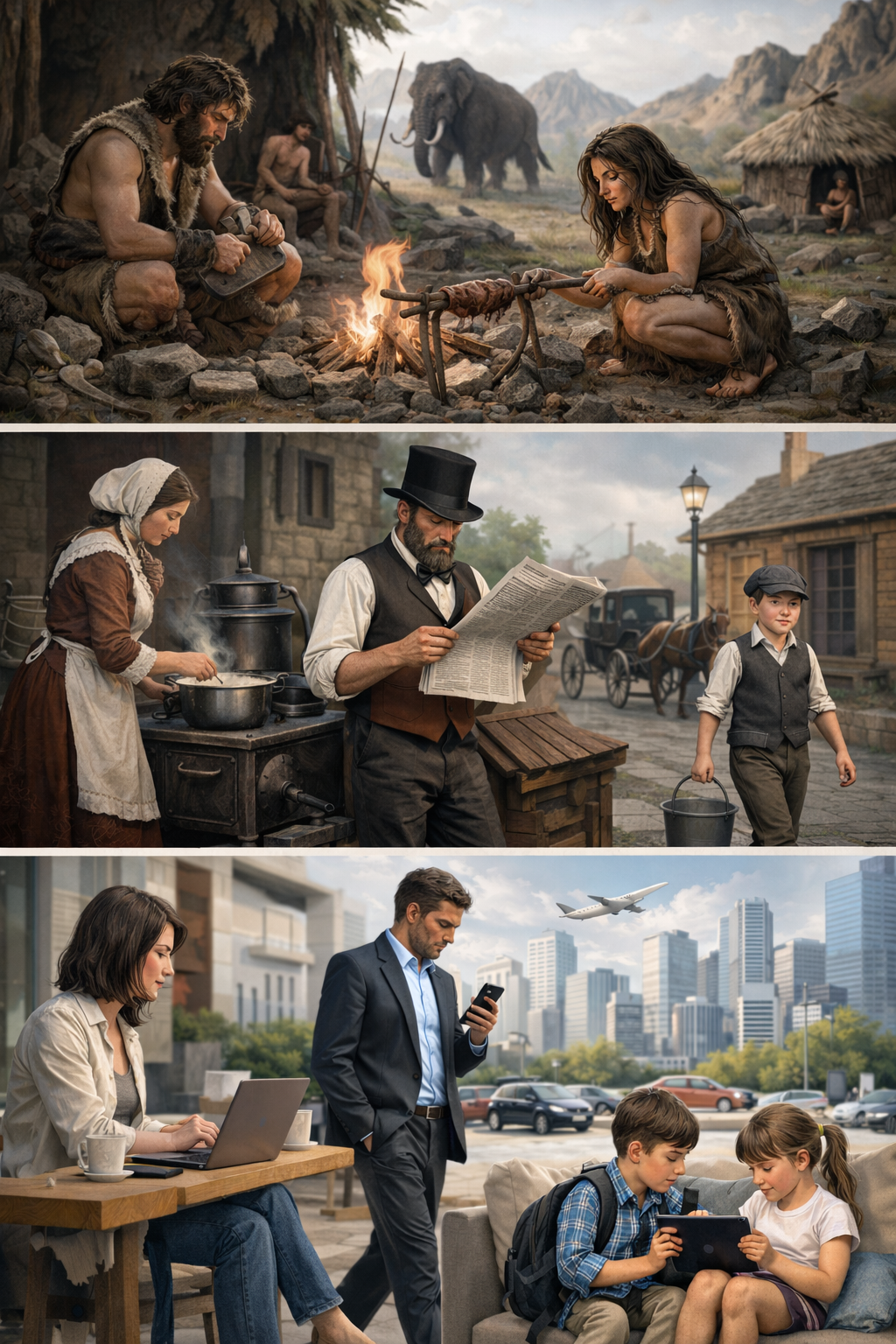
HISTORY OF HUMAN INVENTIONS & CIVILIZATION SHIFTS
BY HARIO SETO
How they were rejected then changed the way people lived
PROLOGUE
AI is not an isolated disruption but another invention event in a long stretch of human history.
At first, almost every major breakthrough triggered fear, skepticism, resistance, and loud optimism at the same time.
Here, I tried to trace back the history of human invention, learn the pattern
STONE TOOLS
C. 2,600,000 BCE
At first, shaped stones were simple survival aids with limited refinement.
Over time, toolmaking evolved into deliberate engineering, extending human strength and precision.
They increased hunting success, food security, and survival rates, marking the beginning of technological augmentation.
CONTROLLED FIRE
C. 1,000,000 BCE
At first, fire inspired fear and awe due to its destructive power.
Gradually it was controlled for cooking, warmth, and protection.
It improved nutrition, extended lifespan, enabled migration into colder regions, and strengthened social bonds around shared hearths.
AGRICULTURE
C. 10,000 BCE
At first, farming was labor-intensive and risky compared to hunting.
Communities slowly adopted it for stable food supply.
Agriculture created surplus, permanent settlements, population growth, specialization of labor, cities, and organized governance.
POTTERY
C. 9,000 BCE
At first, clay containers were fragile and experimental.
As technique improved, pottery enabled reliable storage & cooking.
It stabilized food reserves, supported trade of goods, and strengthened early economic systems.
WHEEL
C. 3,500 BCE
At first, its use was limited by rough terrain and infrastructure.
With roads and carts, adoption expanded.
The wheel revolutionized transport, logistics, trade networks, and later mechanical systems powering industry.
WRITING
C. 3,200 BCE
At first, writing was controlled by elites and scribes.
It gradually became central to administration.
Writing enabled laws, contracts, taxation, record-keeping, and scalable governance across civilizations.
MONEY (COINAGE)
C. 650 BCE
At first, barter dominated trade.
Standardized coinage simplified transactions and trust.
Money expanded trade networks, enabled markets, and laid foundations for complex economies.
IRON SMELTING
C. 1,200 BCE
At first, bronze was dominant and iron difficult to process.
Improved smelting techniques spread.
Stronger tools increased agricultural output, while durable weapons reshaped military and political power.
PAPER
105 CE
At first, parchment and bamboo were common.
Paper offered cheaper, lighter material for writing.
It expanded literacy, bureaucracy, record-keeping, and cultural preservation across empires.
COMPASS
11TH CENTURY
At first, navigation relied on stars and landmarks.
The magnetic compass enabled reliable direction at sea.
It expanded global exploration, trade routes, and maritime empires.
PRINTING PRESS
1450
At first, authorities feared loss of control over ideas.
Printed books spread rapidly across Europe.
It democratized knowledge, accelerated literacy, scientific progress, and social reform.
STEAM ENGINE
1712
At first, it was inefficient and limited to pumping water.
Refinements increased power and reliability.
It drove factories, railways, and the Industrial Revolution, transforming labor and urban life.
VACCINATION
1796
At first, many feared it as unnatural and unsafe.
Evidence of disease prevention increased trust.
Vaccination reduced mortality, extended lifespan, and strengthened public health systems.
ELECTRICITY (PRACTICAL)
1800S
At first, electricity was a scientific curiosity and safety concern.
Infrastructure slowly expandded.
Electrification powered lighting, industry, communications, & modern urban infrastructure.
CAMERA
1826
At first, photography amazed the public and raised privacy concerns.
As access widened, it became essential to journalism and memory.
It transformed identity, documentation, and visual evidence.
TELEGRAPH
1837
At first, instant long-distance signals seemed revolutionary yet limited.
Telegraph networks spread rapidly.
They compressed communication time, enabling coordinated trade, governance, and news.
TELEPHONE
1876
At first, some saw it as unnecessary beyond telegraphy.
Businesses and households adopted it widely.
It enabled real-time voice communication, transforming commerce and personal connection.
CAR
1886
At first, cars were noisy, expensive, and considered dangerous.
Mass production lowered cost.
Automobiles reshaped cities, suburbs, logistics networks, and global energy systems.
AEROPLANE
1903
At first, powered flight was met with disbelief; failure after failure attempts.
Rapid technological improvement expanded usage.
Aviation compressed global distance, transforming travel, trade, and warfare.
RADIO
1906
At first, it was a novelty for transmitting signals.
Broadcasting reached mass audiences.
Radio unified cultures, spread information instantly, and influenced politics.
TELEVISION
1927
At first, critics dismissed it as trivial entertainment.
Adoption surged in households.
Television became dominant mass media shaping culture, advertising, and political messaging.
COMPUTER
1940S
At first, computers were massive and limited to governments.
Miniaturization and commercialization expanded access.
They transformed science, finance, engineering, and administration.
TRANSISTOR
1947
At first, it replaced bulky vacuum tubes in limited applications.
Rapid scaling enabled miniaturization.
The transistor became the foundation of modern electronics and computing.
CALCULATOR (POCKET)
1972
At first, educators feared declining mental math skills.
Affordable devices spread globally.
Calculators made complex computation instant, improving productivity in science and business.
PERSONAL COMPUTER
1970S–1980S
At first, PCs were viewed as hobbyist machines.
Software ecosystems expanded adoption.
Personal computers decentralized computing power into homes and offices worldwide.
WALKMAN
1979
At first, it was praised as freedom yet criticized as anti-social.
Portable audio gained mainstream popularity.
It normalized private media consumption in public spaces.
DIGITAL CAMERA
1975 / 2000S MASS
At first, image quality was low and dismissed.
Rapid sensor improvements drove adoption.
Digital photography eliminated film cost and fueled social media culture.
INTERNET
1983 / 1991 WEB
At first, it was a niche academic network.
Public access expanded rapidly.
The internet redefined communication, commerce, media, and global connectivity.
SMARTPHONE
2007
At first, smartphones were expensive luxury devices.
App ecosystems accelerated adoption.
They merged phone, computer, camera, and internet into constant connectivity.
SOCIAL MEDIA
2004–2010
At first, it create connections but fear of privacy.
Mass participation reshaped communication habits.
Social media transformed identity, information flow, marketing, and politics.
ARTIFICIAL INTELLIGENCE (LLMS)
2022–PRESENT
At first, many questioned reliability and feared job disruption.
Rapid capability growth increased trust and integration.
Large Language Models automate writing, coding, reasoning, and reshape knowledge work globally.
FINAL WORDS
At first, we fear what changes the structures.
Then we debate it, regulate it, resist it, and eventually integrate it.
Every major invention once felt dangerous, unnecessary, or disruptive.
Yet over time, humans adapt, systems evolve, and society restructures around new capability.