
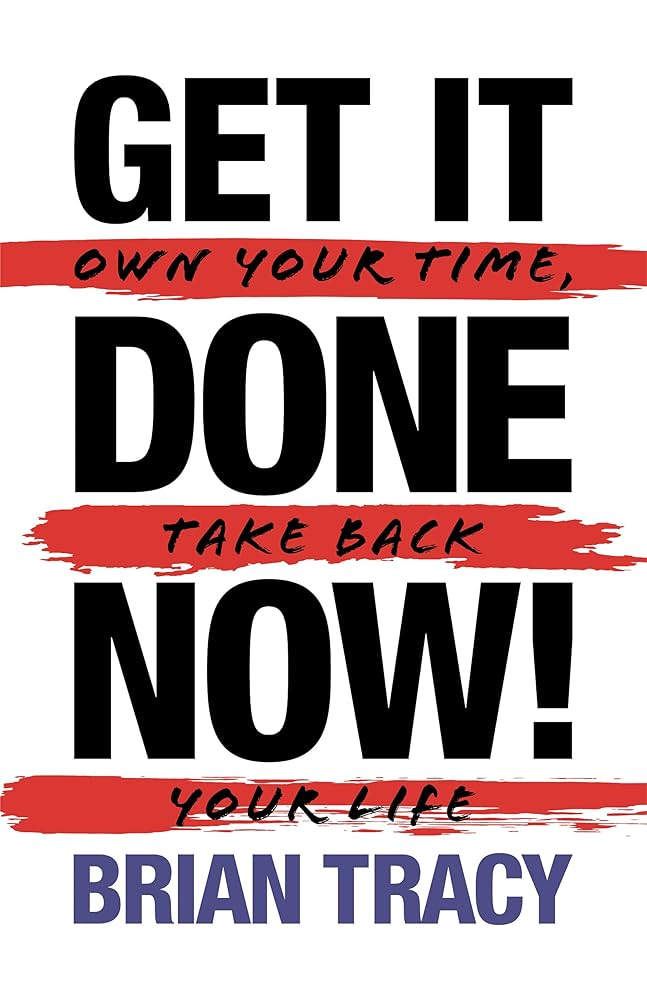
GET IT DONE NOW
BOOK SUMMARY BY BRIAN TRACY
A complete, practical system to prioritize high-value work, defeat procrastination, and build daily execution habits.
PRODUCTIVITY PROMISES & PITFALLS
CHAPTER 1
STARVE DISTRACTIONS, FEED FOCUS
THE FIRST PRODUCTIVITY RULE
Attention is fuel. If you keep feeding notifications, tabs, and endless scrolling, your best hours get eaten. Starve distractions: silence pings, close extra tabs, and block one protected session. Feed focus: one target, one timer, one clear finish line. A single deep block beats a noisy day.
PRODUCTIVITY IS RESULTS THAT HELP OTHERS
SERVICE IS THE REAL METRIC
Productivity isn’t “busy.” It’s creating results that help someone succeed—customers, teammates, family. Ask: “Who benefits from this?” When your work improves others’ outcomes, your value rises, trust grows, and opportunities expand. Measure days by outcomes delivered, not hours spent.
DECIDE FAST, PERSIST LONG
GRIT BEATS MOOD
Waiting to “feel ready” is procrastination wearing a suit. Productive people decide the next right action quickly, then persist through boredom, doubt, and setbacks. Start small, but start today. Momentum is built by showing up even when motivation is low, until the task is finished. Progress loves persistence.
THE PSYCHOLOGY OF PRODUCTIVITY
CHAPTER 2
THOUGHTS SHAPE OUTPUT
YOUR FOCUS BECOMES YOUR REALITY
Your mind moves toward what you repeatedly think about. If you obsess over distractions, you get distraction. If you lock onto outcomes, you get results. Train your attention to return to the task. Your dominant thoughts influence choices, energy, and discipline. Guard what you feed your mind daily.
SELF-IMAGE DRIVES BEHAVIOR
IDENTITY DECIDES ACTIONS
You act in line with who you believe you are. If you see yourself as “a finisher,” you choose actions that finish. Upgrade the identity with daily proof: small completions, commitments kept, standards protected. Your brain follows evidence. Build the identity first, and habits follow.
REAL SELF-ESTEEM IS EARNED
PROOF BEATS HYPE
Confidence that lasts comes from wins you can point to. Finish small tasks, practice skills, and keep promises to yourself. Each completion becomes evidence that you can execute. Stack evidence daily and procrastination loses power. Over time, you stop negotiating with yourself and start acting by default.
GOAL-ORIENTED PEOPLE WIN
CHAPTER 3
WRITE YOUR GOALS
CLARITY MULTIPLIES SPEED
Most people have wishes, not goals. Writing goals forces clarity: what you want, why it matters, and what must happen next. Written goals turn fuzzy ambition into daily direction, so you stop drifting into noise and start moving with intent. Review weekly to stay aligned and adjust fast.
CLARITY IS A WEAPON
AIM BEFORE YOU ACT
Define the target: the exact outcome, deadline, and success criteria. When the target is clear, decisions get faster and distractions become easier to reject. Without clarity, you confuse activity with progress. With clarity, you choose fewer tasks, execute deeper, and finish more. Aim first—then move.
SELLING IS A CLARITY TEST
VALUE MUST BE OBVIOUS
Customers decide based on value, not your effort. Be clear on what problem you solve, how you’re different, and why it matters now. When you can explain benefits in plain language, you become more persuasive and more productive, because you stop doing work that doesn’t move decisions. Clarity sells.
ORGANIZED PEOPLE EXECUTE
CHAPTER 4
ORGANIZATION IS A LEARNED HABIT
CHAOS IS TRAINED, SO IS ORDER
Disorganization isn’t personality; it’s lack of systems. Build simple structure: a daily list, a clean workspace, a routine, and checklists for repeatable tasks. Systems reduce reliance on willpower and make finishing the default, even when you’re tired. Remove friction and you remove excuses.
PLAN TOMORROW TONIGHT
START ALIGNED, NOT REACTIVE
End your day by planning the next one. List tasks, choose the #1 priority, and define the first step. You’ll wake up with direction instead of confusion, and you won’t let email or other people’s requests hijack your morning. A planned day protects focus and makes progress automatic.
WORK IN SEQUENCE
ONE STEP, THEN THE NEXT
Most projects fail because steps are unclear. Break the work into a simple sequence, like a recipe. When each step is visible, starting feels safe and finishing feels inevitable. Don’t rely on memory—use checklists. Clear sequence reduces mistakes, cuts rework, and keeps you moving when motivation fades.
A TREASURE TROVE OF METHODS
CHAPTER 5
THE 80/20 RULE
PROTECT THE HIGH-LEVERAGE 20%
A small set of actions produces most results. Find the 20% that drives revenue, learning, or impact, and protect it first on your calendar. Delegate, delay, or delete the low-value 80%. Your life changes when your time matches leverage, not guilt or habit. Choose impact over comfort daily.
THE ABCDE METHOD
PRIORITIZE WITH CONSEQUENCES
Label tasks: A (must do, serious consequences), B (should do), C (nice), D (delegate), E (eliminate). Then act in order. If you treat A-tasks like C-tasks, you pay later with stress and missed goals. This method forces hard choices early, so you don’t regret them late.
THE LAW OF THREE
YOUR CORE VALUE DRIVERS
In any role, three activities create most of your value. Identify them by asking: “Which three outputs, if done well, make everything else easier?” Start your day with those three. Everything else becomes support work. Protect the three like your job depends on it—because it usually does.
UPGRADE KEY SKILLS
COMPETENCE CREATES SPEED
Execution improves when skill improves. Pick the skills most tied to your goals—selling, writing, leadership, technical ability—and train daily. Read, practice, get feedback, repeat. Skill compounding raises confidence and output because you solve bigger problems faster. Reps beat talent. Consistency beats intensity.
IDENTIFY THE BOTTLENECK
CONSTRAINTS DECIDE PACE
Your progress is capped by a constraint—knowledge, time, approvals, tools, confidence, health. Identify what blocks the next milestone most, then fix that first. Don’t optimize everything. Remove the single bottleneck controlling throughput, and everything speeds up. Fix the constraint, then raise the next one.
ESCAPE TECH TIME TRAPS
MAKE TECH YOUR SERVANT
Tech becomes dangerous when it steals your best attention. Don’t start the day with email or social. Set fixed check-in windows, turn off nonessential notifications, and protect creation hours for deep work. Your highest-value tasks require long, uninterrupted focus—the kind distraction always destroys first.
SLICE & DICE BIG TASKS
MAKE STARTING EASY
Big projects trigger avoidance because the first action is unclear. Break the work into tiny, visible steps: outline one page, make one call, draft one paragraph. When the next action is small, starting becomes easy—and starting kills procrastination. Progress comes from small steps done daily, not big bursts.
SENSE OF URGENCY
SPEED MULTIPLIES LEARNING
Ideas decay with time. Build urgency by acting quickly on what you already know. Use “Do it now” as a trigger to start immediately, not to wait for perfect conditions. Fast starters get feedback sooner, fix mistakes earlier, and compound wins while others are still planning. Speed creates advantage.
SINGLE-HANDLE EVERY TASK
ONE THING UNTIL DONE
Multitasking feels productive but creates slow, messy output. Single-handle: choose one meaningful task, remove distractions, work until a clear stopping point, then finish it. Focus creates speed and quality. Completion creates calm. Do fewer things at a higher standard, and your results will jump.
HOW TO END PROCRASTINATION
CHAPTER 6
DO THE MOST IMPORTANT THING FIRST
YOUR #1 LEVER
Ask: “What one task most advances my main goal?” Start there. Procrastination shrinks when the target is clear and the first step is small. Work in focused bursts, then take short breaks. Motion creates clarity. Action creates confidence. Start fast, adjust later, and finish what matters.
SET DEADLINES & CONSEQUENCES
PRESSURE CREATES PROGRESS
Without deadlines, tasks expand forever. Set a specific finish time and attach a consequence: a public commitment, a review meeting, or a reward you only earn after completion. Deadlines create urgency and reduce overthinking. When time is real, you stop negotiating and start executing.
KILL ORPHAN PROJECTS
ONE OWNER, ONE FINISH LINE
Projects die when nobody owns completion. Assign one person responsible, define the next milestone, and schedule checkpoints. If ownership is shared, it becomes ignored. Clear responsibility turns vague intention into measurable progress. Fewer projects, better finished. Don’t start what you can’t shepherd to the end.
CREATIVE PROCRASTINATION
CHOOSE WHAT NOT TO DO
You can’t do everything, so choose intentionally what to ignore. Decide which low-value tasks will not be done now—or ever—so you stop unconsciously avoiding the high-value work. Saying “no” is not laziness; it’s strategy. Eliminate the trivial many to protect the vital few.
THE PRODUCTIVE PROFESSIONAL
CHAPTER 7
YOUR BOSS IS A CUSTOMER
ALIGN TO PRIORITIES
A customer is anyone who depends on your output. Learn what your boss values most, then deliver that reliably. Don’t optimize popularity; optimize usefulness. Communicate priorities, progress, and results clearly. Promotions and trust follow visible contribution that matches leadership goals. Make it easy to say: “They deliver.”
DON'T DO WHAT NEEDN'T BE DONE
AVOID FAKE IMPORTANCE
Some work is done well but should not be done at all. Before you invest time, ask: “If this disappeared, would anything break?” If not, reduce it, delegate it, or delete it. You don’t get rewarded for perfect busywork. You get rewarded for outcomes that matter to the mission.
GREAT TEAMS RUN ON 5 RULES
CLARITY CREATES UNITY
Strong teams share: clear goals, clear values, clear plans, leadership that inspires, and measurement that celebrates progress. Without clarity, people drift and blame. With clarity, they execute and improve. Make success visible: define targets, track them, review weekly, and celebrate wins so momentum becomes culture.
PRODUCTIVITY IN RELATIONSHIPS
CHAPTER 8
BE FULLY PRESENT
ATTENTION IS LOVE
Relationships don’t need speed; they need presence. Put the phone away, listen without rushing, and understand before responding. Ask follow-up questions to show you care about the real experience, not just the facts. Presence builds trust, and trust makes every conversation easier, calmer, and more productive.
USE MASTERMIND GROUPS
ACCOUNTABILITY WITHOUT EGO
Meet regularly with a small group of serious people. Share goals, obstacles, and ideas. Ask for feedback and commit to next actions. A mastermind multiplies thinking, keeps you honest, and reduces loneliness in hard seasons. It’s productivity for life: better decisions, faster learning, and stronger resilience.
MAKING A MEANINGFUL DIFFERENCE
CONCLUSION
PRODUCTIVITY IS FOR LIFE, NOT BURNOUT
MORE RESULTS, MORE MEANING
The goal isn’t to work nonstop. The goal is effectiveness: finish what matters, waste less time, and free energy for health, relationships, and purpose. When you focus, prioritize, and execute, you buy back life—more calm, more options, and more pride in your days. Do it now, then rest well.