CONTENT

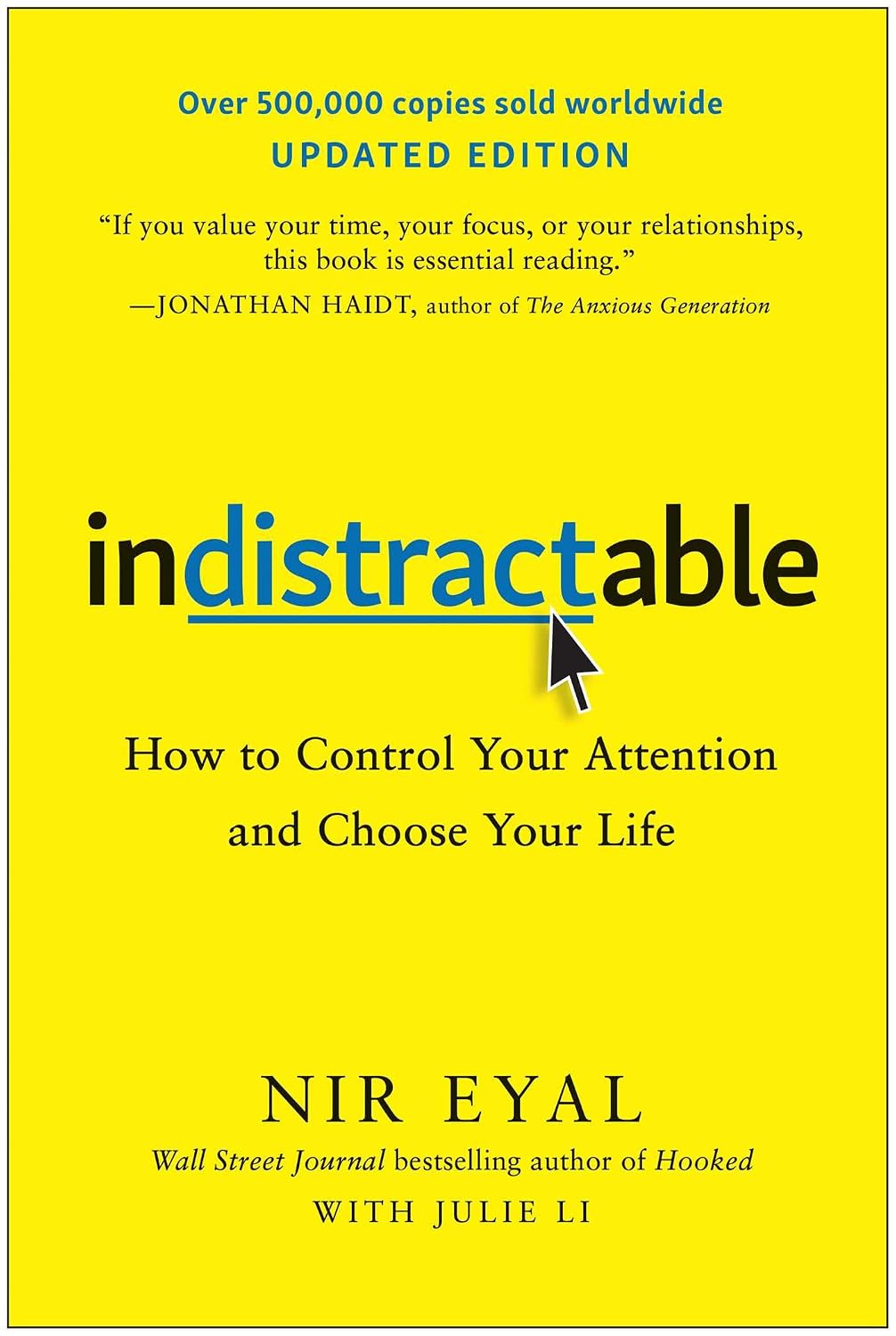
INDISTRACTABLE
CONTROL YOUR ATTENTION. CHOOSE YOUR LIFE.
The defining skill of the 21st century is the ability to control your attention.
When you become indistractable, you can do what you say you will do—even when distractions compete for your time.
YOUR ATTENTION IS BEING CONTESTED
THE HIDDEN BATTLE
Technology companies build products that keep us returning.
But phones and apps are only part of the problem. Distraction existed before social media and will continue after today’s technology disappears.
A DIGITAL DETOX IS NOT ENOUGH
REMOVING TECHNOLOGY DOES NOT REMOVE DISTRACTION
Nir Eyal replaced his smartphone, avoided online news, and used an offline word processor.
He still became distracted. When one distraction disappeared, another replaced it.
The real problem was deeper than technology.
THE COST OF DISTRACTION
YOU MAY BE PRESENT, BUT NOT TRULY THERE
While spending time with his daughter, Eyal became absorbed in his phone. When he finally looked up, she had left.
Distraction does more than reduce productivity. It steals moments with the people who matter.
THE REAL SUPERPOWER
DO WHAT YOU INTENDED TO DO
Living well requires two abilities:
1. Do the things that move life forward.
2. Stop doing the things you will regret.
Being indistractable means striving to do what you say you will do.
THE INDISTRACTABLE MODEL
THE FOUNDATION
TRACTION VS. DISTRACTION
DIRECTION DETERMINES THE DIFFERENCE
Traction is any action that moves you toward what you truly want.
Distraction is any action that pulls you away from it.
The same activity can be either one. Watching a movie is traction when planned and distraction when it replaces important work.
EVERY ACTION BEGINS WITH A TRIGGER
WHAT PROMPTED THE BEHAVIOR?
Two types of triggers drive behavior:
1. Internal triggers—boredom, anxiety, loneliness, stress.
2. External triggers—notifications, people, objects, and sounds.
The resulting action becomes traction or distraction.
THE FOUR-PART MODEL
YOUR MAP FOR CONTROLLING ATTENTION
1. Master internal triggers.
2. Make time for traction.
3. Hack back external triggers.
4. Prevent distraction with pacts.
These four strategies work together as a complete system.
PART 1
MASTER INTERNAL TRIGGERS
DISTRACTION STARTS WITHIN
FIND THE REAL CAUSE
Most distraction is an attempt to escape discomfort.
We reach for entertainment, food, email, or social media because we feel bored, uncertain, lonely, tired, or anxious.
The app is often the nearest escape—not the root cause.
TIME MANAGEMENT IS PAIN MANAGEMENT
LEARN TO REMAIN WITH DISCOMFORT
Human behavior is driven by the desire to escape discomfort.
Managing time therefore requires managing the uncomfortable feelings that precede distraction.
If every unpleasant feeling controls you, your schedule never will.
DO NOT SUPPRESS THE URGE
RESISTANCE CAN MAKE IT STRONGER
Trying to force an unwanted thought away often makes it return more powerfully.
Observe the urge without automatically obeying it. Feelings rise, peak, and eventually pass.
An urge is an experience, not a command.
THE FOUR STEPS TO HANDLE AN URGE
RESPOND WITH CURIOSITY
1. Identify the feeling before the distraction.
2. Write down the trigger and intended action.
3. Explore the sensation with curiosity.
4. Wait ten minutes before acting.
You are creating space between the trigger and your response.
REIMAGINE THE TRIGGER
STUDY WHAT HAPPENS INSIDE YOU
When distraction appears, ask:
What emotion came immediately before this urge?
Record the time, situation, feeling, and intended escape. Repeated observations reveal patterns that were previously invisible.
REIMAGINE THE TASK
FIND NOVELTY IN THE DETAILS
A difficult task can become engaging when you examine it more closely.
Turn the task into play. Look for variation, patterns, challenges, and opportunities to improve.
Fun often comes from focused attention and discovery.
REIMAGINE YOUR TEMPERAMENT
YOUR IDENTITY SHAPES YOUR BEHAVIOR
Avoid saying:
“I have no willpower.”
“I am easily distracted.”
“I have an addictive personality.”
These labels reinforce helplessness. Speak to yourself with curiosity and self-compassion, especially after a setback.
PART 2
MAKE TIME FOR TRACTION
YOU NEED SOMETHING TO BE DISTRACTED FROM
DEFINE TRACTION FIRST
You cannot identify distraction without first deciding how you intended to spend your time.
A clear calendar turns intention into a visible commitment. Without one, almost anything can appear productive.
TURN YOUR VALUES INTO TIME
VALUES NEED SPACE ON THE CALENDAR
Values are the qualities of the person you want to become.
Organize them into three life domains:
1. You
2. Relationships
3. Work
If something matters, reserve time for it.
TIMEBOX YOUR DAY
GIVE EVERY MINUTE A PURPOSE
Create a weekly schedule that includes work, rest, exercise, family, learning, entertainment, and sleep.
Time planned for leisure is not wasted. When it is intentional, it is traction.
CONTROL INPUTS, NOT OUTCOMES
FOCUS ON WHAT YOU CAN REPEAT
Outcomes are never completely under your control.
You can control inputs:
• Time spent exercising
• Hours devoted to focused work
• Time invested in relationships
• Consistency of practice
Reliable inputs increase the probability of desired results.
SCHEDULE TIME FOR YOURSELF
YOUR WELL-BEING COMES FIRST
Reserve time for sleep, exercise, reflection, and activities that restore you.
If your calendar excludes your physical and psychological needs, distraction will often become your improvised method of escape.
SCHEDULE IMPORTANT RELATIONSHIPS
PRESENCE REQUIRES PREPARATION
Put time with partners, children, family, and friends on the calendar.
Also schedule household responsibilities. Relationships rarely receive meaningful attention through leftover time alone.
SYNC WITH STAKEHOLDERS
ALIGN EXPECTATIONS
Share your planned schedule with the people affected by it.
At work, review priorities with your manager. At home, coordinate responsibilities with your partner or family.
Alignment prevents other people’s priorities from silently replacing yours.
REVIEW AND ADJUST
A SCHEDULE IS A LIVING SYSTEM
When you become distracted, ask:
1. Was an internal trigger responsible?
2. Did an external trigger interrupt me?
3. Was my schedule unrealistic?
Use the answer to improve the next version of your week.
PART 3
HACK BACK EXTERNAL TRIGGERS
ASK THE CRITICAL QUESTION
WHO IS SERVING WHOM?
For every notification, interruption, or environmental cue, ask:
“Is this trigger serving me, or am I serving it?”
A useful trigger supports your planned action. An unhelpful trigger pulls you away from it.
DEFEND YOUR FOCUS
MAKE CONCENTRATION VISIBLE
Interruptions increase mistakes, stress, and frustration.
Use a clear signal when you need uninterrupted work: a sign, status indicator, closed door, focus light, or agreed team symbol.
People cannot respect a boundary they cannot see.
HACK BACK EMAIL
REDUCE VOLUME AND RESPONSE TIME
To spend less time on email:
1. Send fewer messages.
2. Unsubscribe aggressively.
3. Delay non-urgent delivery.
4. Use office hours for complex discussions.
5. Schedule when you process replies.
HACK BACK GROUP CHAT
DO NOT LIVE INSIDE THE CONVERSATION
Group chat can become an all-day meeting.
Enter and exit at scheduled times. Include only necessary people. Avoid thinking aloud in shared channels, and move complex or sensitive discussions to a more suitable format.
HACK BACK MEETINGS
NO AGENDA, NO MEETING
Require an agenda that explains the problem, preparation, and decision needed.
Meetings work best for reaching consensus. Many problems should be explored before the meeting through focused individual work.
HACK BACK YOUR SMARTPHONE
REDESIGN THE DEVICE
1. Remove apps you no longer need.
2. Move distracting services to desktop.
3. Disable nonessential notifications.
4. Organize apps by purpose.
5. Use Do Not Disturb.
6. Keep the phone out of sight during focused work.
HACK BACK YOUR DESKTOP
PROTECT THE WORKSPACE
Turn off desktop notifications. Remove visual clutter. Close unused tabs and applications.
Every visible cue competes for a portion of your attention—even when you do not consciously respond to it.
HACK BACK ARTICLES AND FEEDS
CONSUME CONTENT INTENTIONALLY
Save interesting articles to read or listen to during scheduled time.
Use tools that hide algorithmic feeds while preserving useful platform functions.
Choose what you consume before an algorithm chooses for you.
PART 4
PREVENT DISTRACTION WITH PACTS
THE POWER OF PRE-COMMITMENT
DECIDE BEFORE TEMPTATION ARRIVES
The antidote to impulsiveness is forethought.
A pact is a decision made in advance that makes distraction more difficult. It works best after internal triggers, scheduled traction, and external triggers have already been addressed.
EFFORT PACTS
ADD FRICTION TO DISTRACTION
An effort pact makes an unwanted behavior harder to perform.
Examples:
• Use a website blocker.
• Place your phone in another room.
• Schedule focused work with a partner.
• Automatically shut down internet access at night.
PRICE PACTS
MAKE DISTRACTION EXPENSIVE
A price pact attaches money to your commitment.
If you fail to complete the promised behavior, you lose the money.
Use carefully. It is unsuitable when failure is outside your control or when punishment may reinforce shame.
IDENTITY PACTS
BECOME THE PERSON WHO FOLLOWS THROUGH
Behavior follows identity.
Instead of saying, “I am trying to be less distracted,” say, “I am indistractable.”
The identity becomes a standard for future decisions and strengthens each time you honor your plan.
PART 5
BUILD AN INDISTRACTABLE WORKPLACE
DISTRACTION CAN SIGNAL DYSFUNCTION
LOOK BEYOND PERSONAL DISCIPLINE
An always-on workplace creates anxiety and constant checking.
Excessive technology use is often a symptom of unclear expectations, overwhelming workloads, or low psychological safety—not simply an employee’s lack of self-control.
PSYCHOLOGICAL SAFETY MATTERS
PEOPLE NEED PERMISSION TO SPEAK
Healthy organizations allow people to discuss distraction, workload, and mistakes without fear of punishment.
When employees cannot raise problems openly, they often escape discomfort through more meetings, messaging, and reactive work.
CREATE A FOCUS-FRIENDLY CULTURE
START WITH SHARED STANDARDS
Build an environment where:
1. Focused work is protected.
2. Being offline is acceptable.
3. Communication expectations are explicit.
4. Employees can discuss problems safely.
5. Leaders model healthy technology use.
PART 6
RAISE INDISTRACTABLE CHILDREN
AVOID CONVENIENT EXCUSES
TECHNOLOGY IS NOT THE ENTIRE PROBLEM
Blaming devices alone prevents parents from discovering why children seek constant distraction.
Look for unmet needs, unclear boundaries, excessive structure, loneliness, boredom, or a lack of meaningful control.
MEET THREE PSYCHOLOGICAL NEEDS
WHAT CHILDREN NEED TO FLOURISH
Children need:
1. Autonomy—a sense of choice and control.
2. Competence—the experience of improving.
3. Relatedness—meaningful connection with others.
When these needs are missing offline, digital environments become more attractive.
TIMEBOX TOGETHER
GIVE CHILDREN OWNERSHIP
Help children create their own schedules, including schoolwork, sleep, family responsibilities, unstructured play, friends, and screen time.
When children participate in planning, they practice managing attention instead of merely obeying restrictions.
HELP THEM MANAGE TRIGGERS
TEACH THE SYSTEM
Show children how to disable notifications, move devices away during study, and recognize emotions that drive distraction.
Parents should also avoid becoming external triggers by interrupting children during their planned focused time.
LET CHILDREN MAKE PACTS
RESPONSIBILITY BUILDS CAPABILITY
Let children choose practical limits and consequences appropriate to their age.
The goal is larger than reducing screen time. It is teaching them that distraction is manageable and attention is their responsibility.
PART 7
BUILD INDISTRACTABLE RELATIONSHIPS
SPREAD SOCIAL ANTIBODIES
MAKE DISTRACTION DISCUSSABLE
When someone uses a device during a conversation, ask gently:
“I see you’re on your phone. Is everything okay?”
This makes the behavior visible without immediate accusation and creates a shared standard for presence.
PROTECT YOUR MOST INTIMATE TIME
REMOVE DEVICES FROM THE BEDROOM
Instant connection with the world can reduce connection with the person beside you.
Keep phones and televisions outside the bedroom. Set the internet to turn off at a specific time and reserve the reclaimed space for sleep and togetherness.
BEING INDISTRACTABLE IS A PRACTICE
PROGRESS DOES NOT REQUIRE PERFECTION
You will still become distracted, especially during stress or unexpected change.
The objective is to recognize what happened, apply the right strategy, and prevent the same pattern from repeatedly controlling your life.
THE COMPLETE SYSTEM
FOUR STEPS TO RECLAIM YOUR ATTENTION
1. Master the discomfort behind distraction.
2. Put your values into a timeboxed schedule.
3. Remove external triggers that do not serve you.
4. Use effort, price, and identity pacts to protect your intentions.
CHOOSE YOUR LIFE
ATTENTION DETERMINES DIRECTION
Your life is shaped by what receives your attention.
When you control that attention, you become more present, productive, and honest with yourself.
The real superpower is doing what you said you would do.