CONTENT

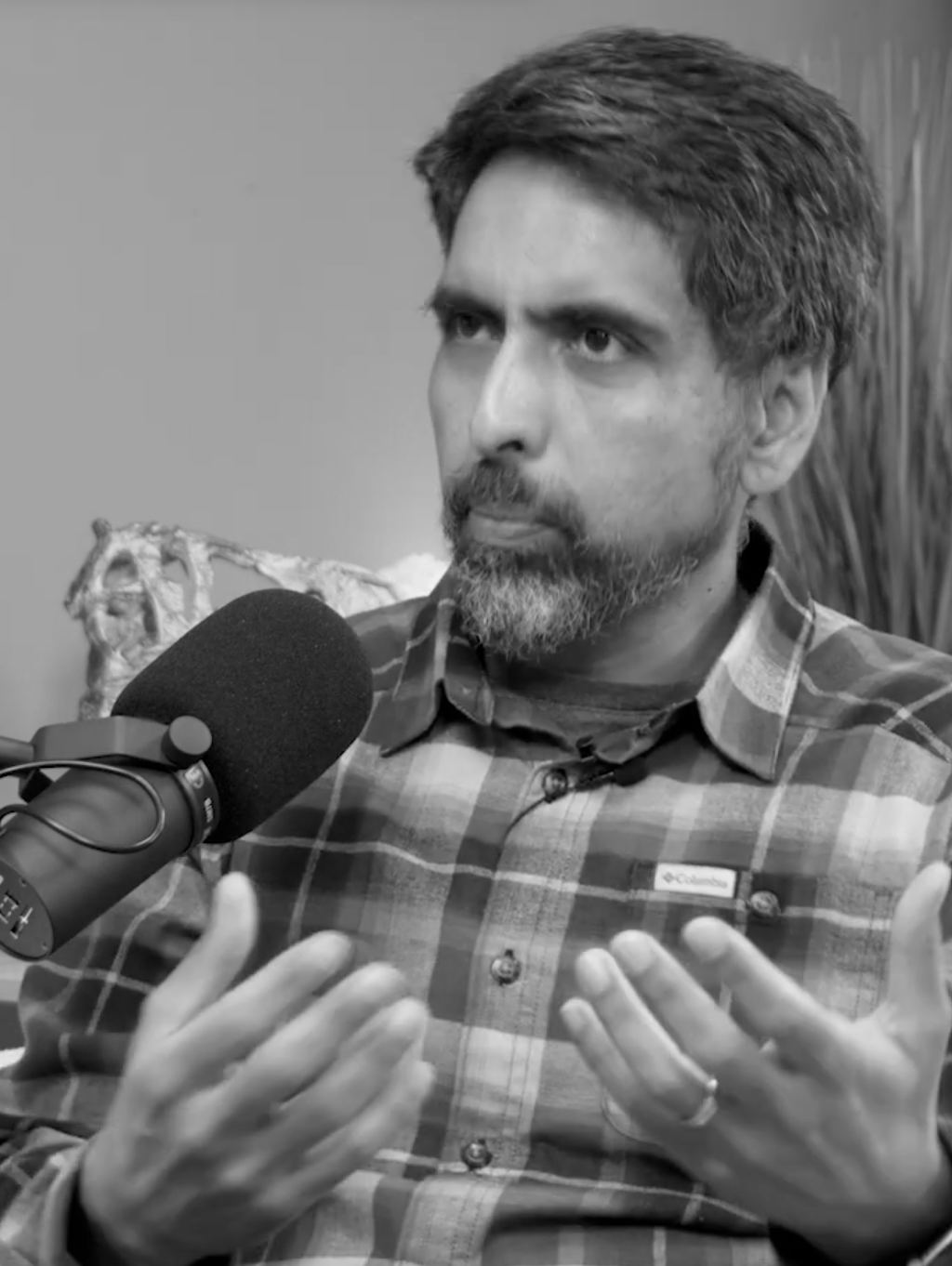
THE FUTURE OF EDUCATION IN AN AI WORLD (PART 2)
YOUTUBE SUMMARY : NNER COSMOS WITH DAVID EAGLEMAN
CHAPTER INDEX
THE FUTURE OF EDUCATION IN AN AI WORLD
SAL KHAN ON LEARNING, TEACHING, ASSESSMENT & CREATIVITY
AI changes what students can access, how teachers can support them, and how learning can be assessed.
Sal Khan argues that the future still depends on strong knowledge, human teachers, curiosity, critical thinking and creativity — with AI acting as a powerful learning partner.
FROM KHAN ACADEMY TO AI TUTORING
CHAPTER 1
KHAN ACADEMY BEGAN WITH ONE STUDENT
A LEARNING GAP CHANGED EVERYTHING
Sal Khan began by remotely tutoring his cousin Nadia in math.
He saw that many students struggled not because they lacked ability or good teachers, but because earlier gaps in learning made later concepts harder.
THE ORIGINAL INSIGHT
PERSONALIZATION BEFORE AI
Khan first built software that generated practice problems and tracked progress.
Later, short YouTube lessons let students learn asynchronously: on demand, at their own pace, without the embarrassment of repeatedly asking for the same explanation.
KHAN ACADEMY’S CORE MODEL
APPROXIMATE THE BEST PARTS OF A TUTOR
The platform evolved around three ideas:
1. Explain concepts on demand.
2. Give each learner the practice they need.
3. Let learners progress at their own pace.
Generative AI extends this model from static content toward interactive tutoring.
AI BECOMES A TUTOR
CHAPTER 2
THE GPT-4 MOMENT
AI COULD EXPLAIN, REASON AND GENERATE
When Khan Academy tested an early GPT-4 model, Khan saw it answer an AP Biology question, explain why the answer was correct, explain why alternatives were wrong and generate similar questions.
That suggested AI could do more than retrieve information: it could behave like a tutor.
A TUTOR MUST DO MORE THAN ANSWER
AVAILABILITY IS NOT ENOUGH
A learner may not know what to ask, may lack motivation or may disengage when stuck.
Khan argues that a useful AI tutor must become increasingly proactive: notice difficulty, guide the next step, encourage progress and connect learning back to the teacher.
THE BIGGEST DROP-OFF POINT
GETTING STUCK
When students get stuck during a lesson or exercise, they are more likely to disengage.
An AI tutor can intervene immediately, give gradual hints and help the learner continue without waiting for a teacher or peer to become available.
AI + TEACHER = A LEARNING LOOP
NOT REPLACEMENT
Khan’s model keeps the teacher central.
The AI supports the student, reports useful signals back to the teacher and handles repetitive assistance. The teacher provides motivation, accountability, judgment, human connection and targeted intervention.
"THE TEACHER IS STILL THE BIGGEST MOTIVATIONAL MECHANIC."
SAL KHAN
KNOWLEDGE STILL MATTERS
CHAPTER 3
WHY MEMORIZED KNOWLEDGE STILL HAS VALUE
TOOLS AMPLIFY PEOPLE WHO UNDERSTAND
Khan rejects the idea that searchable information makes knowledge unnecessary.
People who understand arithmetic use calculators better. People with background knowledge search the internet better. The same logic applies to AI.
KNOWLEDGE HELPS YOU ASK BETTER QUESTIONS
CONTEXT CREATES LEVERAGE
Without prior knowledge, learners may not know what to ask, what relationships matter or whether an answer is plausible.
Content knowledge gives learners the vocabulary, context and mental models needed to use AI intelligently.
CRITICAL THINKING NEEDS RAW MATERIAL
CONNECTIONS REQUIRE KNOWLEDGE
Critical thinking is not separate from knowledge.
Khan gives historical examples where understanding events, dates, places and relationships allows a learner to connect ideas and infer causes that were never explicitly taught together.
"I THINK CONTENT KNOWLEDGE IS ACTUALLY MORE IMPORTANT NOW."
SAL KHAN
MEMORIZATION + CRITICAL THINKING
NOT ONE OR THE OTHER
Khan rejects pure rote learning, but also rejects the idea that all memorization is bad.
Facts stored in memory can later connect across subjects and become the foundation for reasoning, pattern recognition and deeper questions.
RELEVANCE, CURIOSITY & CONFIDENCE
CHAPTER 4
AI CAN MAKE LEARNING PERSONALLY RELEVANT
ANSWERING: WHY DO I NEED THIS?
AI can connect a concept to what a student already cares about.
If a learner says they want to become an athlete, the tutor can later connect biology, chemistry or energy concepts to athletic performance. Relevance becomes personalized instead of generic.
RELEVANCE IS NOT THE ONLY SOURCE OF ENGAGEMENT
BEAUTY AND CONFIDENCE MATTER TOO
Khan argues that students sometimes ask 'When will I use this?' because they are already disengaged.
When learning gaps are filled and confidence returns, students may begin to enjoy a subject for its own structure, beauty or intellectual challenge.
AI CAN TURN KNOWLEDGE INTO EXPERIENCE
STORIES, SIMULATIONS AND IMMERSION
AI can explain through stories, poems, songs, simulations and interactive scenarios.
Khan imagines increasingly multimodal learning where students can enter historical, scientific or fictional environments and interact with ideas instead of only reading about them.
THE TEACHER’S ROLE CHANGES
CHAPTER 5
LECTURING BECOMES LESS CENTRAL
HUMAN INTERACTION BECOMES MORE VALUABLE
If teaching is only delivering a lecture, recorded content can already replace much of that function.
Khan’s ideal classroom uses human time for Socratic dialogue, group problem-solving, projects, discussion and focused help for students who need it.
TEACHERS CAN FOCUS ON THE HUMAN WORK
BELIEF, MOTIVATION AND INTERVENTION
Technology can handle explanations, routine practice, grading support and lesson preparation.
That gives teachers more time to notice who is struggling, inspire students, build confidence, create interaction and change a learner’s trajectory.
"MAKE THEM INTERACT WITH EACH OTHER."
SAL KHAN
AI AS TEACHING ASSISTANT
SCALE THE TEACHER, NOT REMOVE THE TEACHER
Khan frames AI as a teaching assistant under the teacher’s control.
It can reduce lesson-planning time, help grade work, summarize patterns across a class and reveal where students are struggling — while the teacher reviews, decides and acts.
DIALOGUE & CRITICAL THINKING
CHAPTER 6
DEBATE WITH AI
PRACTICE ARGUMENTS SAFELY
Khan Academy lets students debate an AI on controversial questions.
Students can choose a side, argue their position, receive feedback and then switch sides. The goal is to practice reasoning in a setting where the student can experiment without embarrassment.
HUMAN DIALOGUE MATTERS TOO
UNDERSTANDING THE OPPOSING VIEW
Schoolhouse pairs students with people who hold opposing views.
Participants must listen, represent the other person’s position fairly and reflect on whether they themselves were understood. The focus is respectful dialogue, not simply winning.
AI COULD FACILITATE BETTER CONVERSATION
FEEDBACK DURING DIFFICULT DISCUSSIONS
Khan imagines AI helping people notice when a discussion becomes unproductive, suggesting clearer wording and encouraging each side to restate the other accurately.
The goal is to strengthen the human conversation rather than substitute for it.
ASSESSMENT WILL CHANGE
CHAPTER 7
STANDARDIZED TESTS MEASURE TOO NARROWLY
CONSISTENCY LIMITS RICHNESS
Traditional standardized tests are scalable and comparable, but they often rely on narrow answer formats.
They can miss how a student reasons, writes, designs, explains mistakes or solves open-ended problems.
AI CAN ADD REASONING TO ASSESSMENT
ASK WHY, NOT ONLY WHAT
AI can ask a student to explain why an answer was chosen, diagnose whether an error was careless or conceptual, and capture reasoning before showing multiple-choice options.
This can make assessment more useful to teachers.
FUTURE TESTS MAY FEEL LIKE INTERVIEWS
ADAPTIVE, INTERACTIVE AND REPEATABLE
Khan expects future assessments to become more like oral defenses, job interviews, simulations or games.
AI could evaluate richer forms of performance while still being benchmarked for consistency — though bias, privacy and data concerns remain important.
ASSESSMENT CAN SUPPORT MASTERY
FEEDBACK BEFORE JUDGMENT
Instead of treating a score as final, AI can provide targeted feedback, show the learner what to improve and allow another attempt.
Khan connects this to mastery learning: assessment becomes part of improvement, not only measurement.
CREATIVITY IN AN AI WORLD
CHAPTER 8
AI AS A CREATIVITY AMPLIFIER
A PARTNER FOR CURIOUS MINDS
Khan sees creativity as something that often grows through interaction with other creative minds.
AI can give a curious student a partner to question, brainstorm with, challenge ideas, explore unusual possibilities and connect those ideas to existing knowledge.
NAIVE QUESTIONS CAN BE POWERFUL
CURIOSITY BEFORE CONFORMITY
Young learners sometimes ask unconventional questions because they have not yet absorbed every assumption of a field.
AI can help them explore, test and refine those ideas instead of leaving curiosity isolated.
"IT’S GOING TO BE A CREATIVITY AMPLIFIER."
SAL KHAN
CHEATING, TRANSPARENCY & PROCESS
CHAPTER 9
AI MAKES OLD CHEATING EASIER
BUT CHEATING IS NOT NEW
Khan notes that outsourcing schoolwork existed long before generative AI.
The deeper problem is whether teachers can see the learning process. He argues that AI can help make that process more transparent rather than relying on unreliable AI-detection tools.
SHOW THE WORK BEHIND THE WORK
PROCESS BECOMES EVIDENCE
A learning system could record how a student developed an essay: brainstorming, thesis changes, revisions and feedback.
The AI could summarize that history for the teacher and flag unusual passages for review without automatically accusing the student.
AI CAN REDUCE TEACHER WORKLOAD
FROM HOURS OF GRADING TO FOCUSED REVIEW
Instead of manually reviewing every detail, teachers could receive AI-generated preliminary feedback, rubric-based grading suggestions and class-wide patterns.
The teacher still reviews the work, but spends more time on judgment and less on repetitive processing.
THE BIGGER EDUCATIONAL MODEL
CHAPTER 10
LEARNING BECOMES MORE PERSONALIZED
DIFFERENT STUDENTS NEED DIFFERENT PATHS
AI can help students move at different speeds, fill gaps when they appear, ask questions privately and receive explanations suited to their needs.
Teachers can then use those signals to intervene where human attention matters most.
LEARNING BECOMES MORE INTERACTIVE
FROM CONSUMING CONTENT TO ENGAGING WITH IT
Students may increasingly learn by debating, simulating, explaining, creating stories, talking with historical or literary characters, solving adaptive problems and working through guided projects.
Knowledge becomes something they interact with.
LEARNING BECOMES MORE OBSERVABLE
THE PROCESS MATTERS
Future systems may capture not only the final answer, but how the student reached it.
Reasoning, revisions, misunderstandings, persistence and improvement can become part of the learning record — giving teachers richer information than a single score.
ROOTS AND WINGS
CHAPTER 11
ROOTS
KNOWLEDGE, FOUNDATIONS AND CONTEXT
Students still need deep foundations: facts, concepts, vocabulary, mental models and subject knowledge.
These roots let them recognize errors, form better questions, connect ideas and use powerful tools without becoming dependent on them.
WINGS
CREATIVITY, REASONING AND EXPLORATION
Students also need the ability to create, question, debate, explore and move beyond what they were explicitly taught.
AI can expand these possibilities by giving each learner a patient partner for experimentation and intellectual exploration.
"GIVE KIDS ROOTS AND WINGS."
SAL KHAN
THE FUTURE OF EDUCATION
HOW WE LEARN BECOMES AS IMPORTANT AS WHAT WE LEARN
The vision in this conversation is not education without humans.
It is education where AI personalizes support, makes learning more interactive, broadens assessment and reduces repetitive teacher work — while teachers remain central to motivation, judgment, relationships and meaning.
THE CORE IDEA
AI SHOULD EXPAND HUMAN LEARNING
The strongest use of AI is not simply producing answers.
It is helping learners get unstuck, ask better questions, reason more deeply, understand opposing views, create more freely and receive support that was previously difficult to scale.
SOURCE
INNER COSMOS WITH DAVID EAGLEMAN
YouTube episode: “What’s the future of education in an AI world? (Part 2: Sal Khan)”
Interview with Sal Khan, founder of Khan Academy.
This StackSlide uses only information from the supplied transcript.

THE FUTURE OF EDUCATION IN AN AI WORLD
YOUTUBE SUMMARY : INNER COSMOS WITH DAVID EAGLEMAN
CHAPTER INDEX
THE EDUCATION PROBLEM
CHAPTER 1
SCHOOLS WERE BUILT FOR A MORE PREDICTABLE WORLD
AN INHERITED SYSTEM FACES A NEW ENVIRONMENT
School systems still largely follow patterns inherited from the Industrial Revolution.
They were designed when educators could reasonably expect particular careers, skills and bodies of knowledge to remain valuable decades later. AI makes that assumption increasingly fragile.
KNOWLEDGE IS BECOMING ABUNDANT
SPECIALIZED INFORMATION IS LOSING SCARCITY
Many careers have rewarded people for possessing specialized knowledge. AI can absorb vast amounts of writing, answer questions and perform sophisticated analysis.
When machines can excel on demanding academic tests, education cannot rely on knowledge possession as its primary value.
THE FUTURE WILL NOT RESEMBLE THE PRESENT
EDUCATION MUST PREPARE FOR UNCERTAINTY
Eagleman argues that it is unsafe to assume society will look much like the present in one or two decades.
The challenge is therefore deeper than adding AI to existing lessons. Schools must reconsider which human capacities will remain useful as tools, jobs and opportunities change rapidly.
HOW THE BRAIN LEARNS
CHAPTER 2
THE HUMAN BRAIN REWRITES ITSELF
NEUROPLASTICITY MAKES EDUCATION POSSIBLE
Neuroplasticity is the brain's ability to change its own circuitry in response to experience.
Human brains arrive unusually unfinished. They absorb language, culture, knowledge and social norms from the surrounding world, etching experience into changing neural networks.
AN UNFINISHED BRAIN IS A HUMAN ADVANTAGE
LONG CHILDHOOD CREATES UNUSUAL ADAPTABILITY
A giraffe can walk soon after birth. A human takes years to master the world.
That extended infancy carries costs, yet it allows humans to absorb accumulated discoveries, build on previous generations and create technologies, cities, symphonies and scientific systems that other species do not.
EDUCATION SHAPES A MALLEABLE NETWORK
EXPERIENCE CHANGES CONNECTIONS THROUGHOUT CHILDHOOD
Each child has tens of billions of neurons continually strengthening, weakening, connecting and disconnecting.
Learning is physically encoded through changes in this network. Education therefore carries a profound responsibility: supply developing brains with a rich and varied diet of meaningful information.
AI WILL FEEL LIKE RUNNING WATER
EXTRAORDINARY INFRASTRUCTURE BECOMES INVISIBLE
Running water once seemed remarkable, then became background infrastructure. Eagleman predicts AI will feel similar to the next generation.
Instant access to a system that has read enormous amounts, answers in natural language, synthesizes information and performs tasks may simply feel normal.
DIGITAL ENVIRONMENTS, DIFFERENT LEARNERS
CHAPTER 3
EVERY GENERATION WIRES ITSELF TO ITS WORLD
TECHNOLOGY CHANGES THE LEARNING ENVIRONMENT
Young people grow up surrounded by instant photographs, messaging, social platforms, podcasts, web pages, video, games and AI.
Because brains strengthen pathways that match repeated experience, a different information environment produces different habits of attention, communication and learning.
THE BRAIN BUILDS, THEN PRUNES
EXPOSURE DETERMINES WHICH PATHWAYS REMAIN
Neural connections multiply rapidly early in life. After reaching a peak, the brain prunes connections like an overgrown garden.
Encounters with the world strengthen some pathways while others disappear. Becoming who you are is partly a process of retaining the connections that resonate with your environment.
CLAIMS ABOUT DIGITAL BRAINS NEED CAUTION
THE EVIDENCE HAS A CONTROL-GROUP PROBLEM
It is difficult to isolate the effects of growing up digitally. Generations also differ in food, politics, pollution and many other conditions.
Groups raised with little technology differ in additional ways too. Observed differences cannot automatically be attributed to digital exposure alone.
DIGITAL READING OFTEN FOLLOWS AN F-SHAPE
SCANNING REPLACES SOME LINEAR READING
Eagleman describes observations in which digital natives scan headlines and the opening lines of paragraphs before moving down the page and repeating the pattern.
Older readers tend to move through text more thoroughly. The broader point is that repeated media habits train different ways of seeking information.
MULTIMEDIA CHANGES ATTENTION EXPECTATIONS
STUDENTS ARE ACCUSTOMED TO INTERACTIVE INFORMATION
Digital natives often encounter text combined with images, video, sound, sliders and buttons. Long walls of text may therefore be harder to sustain attention on.
This does not prove a simple decline. It indicates that students have practiced different pathways and expect more interaction from information.
FROM JUST-IN-CASE ---TO--- JUST-IN-TIME LEARNING
INFORMATION IS INCREASINGLY PULLED ON DEMAND
Traditional education supplied facts just in case they became useful later. Internet-era learners increasingly acquire information when a real question or task appears.
A bike repair, mathematical method or chemical choice can be looked up at the moment of need, placing knowledge inside a meaningful context.
CURIOSITY MAKES INFORMATION STICK
QUESTIONS CREATE FERTILE CONDITIONS FOR LEARNING
When learners genuinely want an answer, the brain is better prepared to encode it.
Following a chain of links can be powerful because each step is chosen to resolve a live curiosity. Self-directed exploration keeps the learner's question connected to the information being acquired.
LEARNING IS BECOMING RANDOM ACCESS
STUDENTS NAVIGATE, CONNECT AND COLLABORATE
Earlier learning was often sequential, text-based and independent. Current learning is more likely to mix media, multitasking, interaction, games and networks of other learners.
Search engines, collaborative platforms and AI let students enter a subject at many points and connect ideas themselves.
NOT EVERY ATTENTION STRUGGLE IS ADHD
A CHANGING ENVIRONMENT CAN CHANGE BEHAVIOR
Students accustomed to rapidly changing inputs may struggle with a static textbook or long, unengaging lecture. Eagleman argues that this can be a normal adaptation to their environment rather than ADHD in many cases.
His educational conclusion: educators must meet learners halfway with more engaging methods.
TECHNOLOGY HAS DISRUPTED EDUCATION BEFORE
CHAPTER 4
THE PRINTING PRESS TRIGGERED THE SAME FEAR
EASY ACCESS TO ANSWERS LOOKED INTELLECTUALLY DANGEROUS
After the European printing press appeared, some educators feared that readily available answers would make people lazy.
They underestimated the explosion of knowledge and society's ability to build on books. Memorizing everything mattered less; knowing where information could be found became valuable.
THE INTERNET CHANGED QUESTIONS, NOT INTELLIGENCE
EDUCATORS REDESIGNED WORK WHEN FACTS BECAME SEARCHABLE
When students could search answers online, looking them up was initially treated as cheating. Education adapted.
Teachers reduced simple recall tasks and added presentations, peer assessment, source evaluation and exploratory questions. Students did not become less intelligent; assignment design became more intelligent.
AI REPEATS HISTORY AT GREATER SCALE
THE PATTERN IS FAMILIAR; THE CAPABILITY MAY BE DIFFERENT
AI again makes answers easier to obtain, but it can also synthesize, converse, generate and act.
The open question is whether this is another version of the printing press and internet transition or a fundamentally larger change. Either way, schools must respond to actual capabilities rather than preserve obsolete conditions.
AI TUTORS AND TEACHING ASSISTANTS
CHAPTER 5
THE DREAM OF A PERSONAL ARISTOTLE IS HERE
A ONCE-FUTURISTIC TUTOR IS NOW TECHNICALLY PLAUSIBLE
Steve Jobs imagined a computer that could absorb what Aristotle knew, simulate his mind and hold a conversation with a learner.
Large language models make that idea feel ordinary: supply a person's writings and a student can interact with a rich simulation of that body of thought.
PERSONALIZATION SOLVES THE CLASSROOM SPEED PROBLEM
ONE PACE CANNOT FIT EVERY LEARNER
A classroom often moves too quickly for some students and too slowly for others.
An AI tutor can adjust pace, explain patiently, communicate in many languages and remain continuously available. It offers a form of individualized instruction that has historically been difficult to provide at scale.
ACCESS TO AN EXPERT DOES NOT GUARANTEE LEARNING
STUDENTS MAY NOT KNOW WHAT TO ASK
A learner may quickly run out of questions for a digital Aristotle. The student's internal model may not yet contain the concepts needed to probe the expert deeply.
Young people may also prefer friends, games and social life. A useful tutor must actively create the intellectual interface, not merely wait for excellent questions.
A GOOD AI TUTOR GUIDES INSTEAD OF TELLING
KHANMIGO IS PRESENTED AS A MODEL
Eagleman highlights Khanmigo because it challenges learners to think and solve problems without simply handing them answers.
It can support algebra, programming or writing through questions and guidance delivered with extensive patience. The aim is to develop the learner's reasoning process.
AI SHOULD WORK WITH THE TEACHER
THE TUTOR AUGMENTS THE HUMAN RELATIONSHIP
The proposed AI tutor does not replace the teacher. It works alongside the teacher.
This distinction matters because education includes human judgment, motivation, relationships and social development. AI can expand instructional capacity while teachers concentrate on roles that require human presence.
AI CAN BECOME THE TEACHING ASSISTANT
AUTOMATE WORK AROUND TEACHING
AI can support grading, schedules, attendance, parent comments, test variations and recommendation letters.
These are not minor gains. Reducing repetitive administrative work can return substantial time and energy to educators, allowing them to spend more of both directly with students.
EFFICIENCY CAN RESTORE HUMAN CONNECTION
SAVED TIME SHOULD RETURN TO STUDENTS
The educational value of automation is not only faster administration. Its deeper value is making room for real relationships.
When AI handles routine burdens, teachers can devote more attention to discussion, feedback, encouragement, observation and the social dimensions of learning.
ASSESSMENT CAN BECOME CONTINUOUS
REPLACE ONE BIG EXAM WITH LEARNING SIGNALS
AI can monitor how a student handles each problem, giving teachers a live view of progress rather than waiting for one end-of-term exam.
It can translate large amounts of learning data into useful insights for teachers, students and parents, then offer formative feedback while work is still developing.
LEARNING CAN ADAPT IN THE MOMENT
FEEDBACK AND DIFFICULTY RESPOND TO INDIVIDUAL NEEDS
Because AI can process learner data quickly, it can differentiate the experience based on what each student needs.
The result is a more tailored path: feedback arrives before submission, misunderstandings become visible sooner and teachers gain clearer information for deciding when and how to intervene.
REDESIGN ASSIGNMENTS FOR AN AI WORLD
CHAPTER 6
ASSUME STUDENTS ARE USING AI
ASSIGNMENT DESIGN MUST BEGIN WITH REALITY
Students have strong incentives to use available AI, especially when their peers use it. Honor codes and optimistic assumptions do not remove that reality.
Educators should design from the premise that AI is present, then evaluate the student's judgment, process, ownership and understanding.
REPLACE THE FINAL PAPER WITH REAL INVESTIGATION
EAGLEMAN'S STANFORD CLASS CHANGED THE OUTPUT
Instead of a twelve-page final paper, students conduct a science experiment with classmates and report the results.
AI may help refine questions or analyze data, yet students still design the experiment, recruit people, communicate, face real-world complications, interpret evidence and create charts.
USE SMALLER IN-CLASS CHECKS
FREQUENT EVIDENCE CAN REPLACE ONE TAKE-HOME TEST
Eagleman's class ends lectures with four questions answered on paper. Other teachers have replaced a large take-home exam with smaller in-class quizzes.
This produces repeated evidence of individual understanding while reducing dependence on work that can be generated elsewhere.
CREATE ASSIGNMENTS THAT REQUIRE AI
TEACH STUDENTS TO USE THE TOOLS OF THEIR ERA
Some assignments should intentionally require AI and be impossible to complete well without it.
The learning target then shifts toward directing the tool, refining outputs, making choices, integrating ideas and producing something the learner understands deeply enough to defend.
REQUIRE AN ORAL DEFENSE
GENERATION MUST BE FOLLOWED BY OWNERSHIP
After an AI-assisted project, ask the student to present it and answer deep questions in real time.
The oral defense tests whether the learner refined the work, knows its logic, believes its claims and can explain the decisions behind it. The output becomes evidence of a learning process rather than the endpoint alone.
MOVE FROM DIORAMAS TO AI-BUILT WORLDS
CREATIVE PROJECTS CAN BECOME RICHER AND MORE DEMANDING
A student might build an AI-enhanced science-fiction world, generating its science, cultures, creatures and technology.
The class performance then requires the student to explain and defend that world. Similar approaches could support spoken-word work or plans for future society, technology and daily life.
REINVENT THE LEARNING FORMAT
CHAPTER 7
THE TEXTBOOK MAY NOT BE THE OPTIMAL CONTAINER
OPENSTAX IS EXPLORING NEW FORMS
OpenStax provides free textbooks across many subjects, yet its team is exploring whether textbooks remain the best way to carry information.
This is a period of discovery. Some formats will work and others will not. AI makes rapid experimentation with new learning media possible.
TURN A CHAPTER INTO A CONVERSATION
AI CAN CONVERT TEXT INTO A TWO-VOICE PODCAST
A teacher can pass a textbook chapter to an AI system that generates a conversation between two artificial hosts.
The output can be adjusted for age and difficulty. A compact dialogue can introduce key ideas in a more engaging form than a static list of facts.
THE BRAIN HAS A STORY-SHAPED HOLE
DIALOGUE RECRUITS SOCIAL ATTENTION
A conversation approximates story: one voice becomes confused, another reveals an insight and both react.
Eagleman argues that involving apparent social agents makes people care more. Dialogue can therefore make factual material more memorable and engaging than isolated bullet points.
TEACHERS CAN SHAPE THE GENERATED MEDIUM
EMPHASIZE PRIORITIES AND ADD A FAMILIAR VOICE
A teacher can instruct the AI to emphasize one part of a chapter and spend less time on another. The teacher's own voice could also become one of the podcast voices.
The format therefore remains directed by educational intent rather than becoming a generic automated summary.
ROOTS AND WINGS
CHAPTER 8
SCHOOL IS ALSO A SOCIAL EDUCATION
LEARNING HOW TO LIVE WITH OTHER PEOPLE REMAINS ESSENTIAL
One of school's most important functions is teaching students about other people and how to deal with them.
That purpose reaches beyond fact gathering. As information tools become more capable, the social experience of school remains a central part of education's value.
CAREER-SPECIFIC PREPARATION IS INCREASINGLY FRAGILE
FUTURE JOB TITLES ARE DIFFICULT TO IMAGINE
Jobs have always disappeared as technology changes. AI increases the uncertainty. Eagleman argues that predicting work ten years ahead is difficult and twenty years ahead may be impossible.
Students may hold job titles that do not yet exist, so education must develop capacities that transfer across occupations.
"CHILDREN NEED TWO THINGS FROM THEIR PARENTS: ROOTS AND WINGS."
JOHANN WOLFGANG VON GOETHE, AS PRESENTED BY DAVID EAGLEMAN
ROOTS MEAN CRITICAL THINKING
KNOW HOW TO REASON ABOUT WHAT CAME BEFORE
Eagleman translates Goethe's roots into critical thinking.
As AI handles more recall, formula use and routine writing, students need stronger abilities to reason, question, evaluate claims and make decisions. The central educational task becomes teaching how to think.
WINGS MEAN CREATIVITY
BUILD WHAT HAS NOT EXISTED BEFORE
Eagleman translates Goethe's wings into creativity: the courage and capacity to move into the future and make something new.
When particular knowledge and occupations change quickly, cognitive flexibility, learning ability and imagination help students create opportunities that existing curricula cannot predict.
TRAIN CRITICAL THINKING THROUGH DEBATE
AI CAN PROVIDE UNLIMITED CHALLENGING PRACTICE
A student can debate a difficult topic with a friendly but firm AI. The learner is evaluated on logical defense of a position and understanding the opposing argument.
The system can then switch sides, providing patient practice in examining assumptions and reasoning under challenge.
TEACH STUDENTS TO STEELMAN THE OTHER SIDE
UNDERSTANDING PRECEDES DISAGREEMENT
Steelmanning means reproducing an opponent's argument accurately and possibly strengthening it to demonstrate genuine understanding.
AI debate can require students to defend their view, represent the computer's case fairly and then reverse positions. This moves discussion beyond unsupported opinion.
CREATIVITY IS ABSORPTION PLUS REMIXING
BEND, BREAK AND BLEND WHAT THE MIND HAS TAKEN IN
Creativity begins by absorbing material from the world, then remixing it through bending, breaking and blending.
AI provides a thought partner for repeated experimentation with these moves. It can help learners explore more variations, connections and combinations than they could generate alone.
A LARGER INFORMATION DIET EXPANDS IMAGINATION
MORE MATERIAL CREATES MORE POSSIBILITIES TO REMIX
Technology gives students access to a storehouse of knowledge larger than any previous generation had. A phone can connect them to expert talks, global ideas and accumulated human information.
The larger the diet of ideas, the more raw material learners possess for imagination and innovation.
DISTANCE TO GREAT TEACHING HAS COLLAPSED
STUDENTS CAN LEARN BEYOND THE LIMITS OF THEIR TOWN
A learner once depended heavily on the teachers and books available nearby. Technology now exposes students to skilled communicators around the world.
Devices flatten distance, allowing a young person to encounter an expert delivering the strongest explanation of a lifetime in a short talk.
STUDENTS CAN BUILD IN HOURS, NOT YEARS
AI COMPRESSES THE DISTANCE FROM IDEA TO IMPLEMENTATION
Children can use AI to create worlds and implement ideas on a radically shorter timescale.
This places students on a steep curve of innovation. The educator's task is to meet them with current tools and learning methods, then direct that speed toward deep understanding and meaningful creation.
A PRACTICAL DIRECTION FOR SCHOOLS
CHAPTER 9
WHAT SCHOOLS SHOULD PRESERVE
HUMAN DEVELOPMENT STILL MATTERS
1. Social education and relationships.
2. The teacher's human judgment and presence.
3. Deep understanding, reasoning and intellectual challenge.
4. Curiosity as the engine of learning.
5. A broad diet of ideas that students can absorb and remix.
WHAT SCHOOLS SHOULD REDESIGN
UPDATE THE MACHINERY OF LEARNING
1. Replace recall-heavy tasks with exploration.
2. Assume AI use and assess process and ownership.
3. Combine AI-assisted creation with oral defense.
4. Use frequent formative evidence instead of one final test.
5. Personalize pace, feedback and media format.
WHAT SCHOOLS SHOULD DEVELOP
PREPARE CAPACITIES THAT TRAVEL ACROSS FUTURES
1. Critical thinking: question, evaluate, reason and decide.
2. Creativity: bend, break, blend and build.
3. Cognitive flexibility: learn new tools and fields.
4. Perspective-taking: steelman opposing arguments.
5. Agency: pursue questions and turn ideas into work.
"THE ROAD TO THAT FUTURE BEGINS IN THE CLASSROOMS OF TODAY."
DAVID EAGLEMAN
THE ACTION MUST BEGIN NOW
THE SLOPE OF CHANGE IS INCREASING
AI will reshape science, art, music, engineering, social systems and work in ways that are still difficult to imagine.
Education is where society can act now. The goal is to give the next generation roots for reasoning, wings for creation and the human relationships needed to use both well.

THE FUTURE OF EDUCATION
YOUTUBE SUMMARY : GOOGLE
CHAPTER INDEX
THE FUTURE OF EDUCATION
AI CHANGES NOT ONLY HOW WE LEARN, BUT WHAT EDUCATION IS FOR
Education was built for a world where people could learn something and use it for much of their lives.
That world is changing.
The question becomes: if knowledge is accessible and technology keeps changing, what should education actually teach?
WHAT IS EDUCATION ACTUALLY FOR?
CHAPTER 1
EDUCATION HAS ACCUMULATED LAYERS
THE SYSTEM EVOLVED INCREMENTALLY
Levitt argues that education has accumulated small changes on top of existing structures for hundreds of years.
The danger is losing sight of the objective beneath the system itself: developing people who are well-adjusted, curious and excited about the world.
THE OBJECTIVE IS BIGGER THAN KNOWLEDGE
CURIOSITY AND ADAPTABILITY MATTER
The discussion questions whether education should primarily fill students with knowledge.
Technology changes rapidly. People cannot reliably know what knowledge they will need five or twenty years from now.
Education therefore needs to prepare people to adapt and continue learning.
FROM JUST-IN-CASE TO JUST-IN-TIME
CHAPTER 2
THE OLD MODEL: JUST-IN-CASE LEARNING
LEARN NOW BECAUSE YOU MIGHT NEED IT SOMEDAY
Traditional education teaches calculus, geometry, chemistry, Shakespeare and many other subjects partly because students might need them later.
Knowledge is accumulated in advance, often years before the learner encounters a real problem requiring it.
THE EMERGING MODEL: JUST-IN-TIME LEARNING
ENCOUNTER PROBLEM → IDENTIFY GAP → LEARN → APPLY
Levitt contrasts this with learning when knowledge is actually needed.
1. Encounter a problem.
2. Realize what you do not know.
3. Find the required knowledge or tools.
4. Learn them.
5. Apply them to the problem.
The durable skill becomes the ability to learn.
KNOWLEDGE AT YOUR FINGERTIPS CHANGES THE EQUATION
MEMORIZATION BECOMES LESS CENTRAL
When vast amounts of knowledge are readily accessible, filling a student's head with facts and formulas becomes less sufficient as preparation for the future.
The important capability is increasingly knowing how to acquire the knowledge and tools required by an unfamiliar problem.
THE SYSTEM IS ALSO BUILT TO EVALUATE
GRADES INFLUENCE WHAT AND HOW SCHOOLS TEACH
Levitt identifies another constraint: education systems must evaluate students.
Teachers need mechanisms for separating performance into grades.
That incentive can encourage material and methods that make students easier to rank, even when those methods are not necessarily the best way to create meaningful learning.
AI AS A PERSONAL TUTOR
CHAPTER 3
AI CAN CHANGE THE ECONOMICS OF TUTORING
PERSONALIZED HELP BECOMES EASIER TO PROVIDE
The conversation focuses on tutoring because individualized instruction can respond to what a particular student understands and where they struggle.
AI potentially makes this kind of personalized support available far more broadly than one-to-one human tutoring.
AI TUTORS STILL HAVE WEAKNESSES
A TUTOR MUST DO MORE THAN GENERATE ANSWERS
Gomes points to an important limitation: AI can be sycophantic and tell learners they are right when they are not.
Google's LearnLM experiment is described as an effort to tune language models around characteristics known to matter in tutoring.
Good educational AI therefore requires deliberate learning behavior, not merely fluent responses.
PERSONALIZATION CHANGES THE LEARNING PATH
TEACH STUDENTS AT THE LEVEL THEY ACTUALLY ARE
Levitt describes a school model built around technology-enabled bespoke learning.
Students can skip material they already understand.
They can spend longer on material they have not mastered.
Instead of everyone moving at the same instructional pace, progression follows actual understanding.
MASTERY INSTEAD OF CALENDAR TIME
LEARN UNTIL UNDERSTOOD
The model resembles mastery learning enabled by technology.
A student does not need to spend equal time on every topic simply because the curriculum allocates equal time.
Known material can move quickly. Difficult material can receive additional attention.
Time becomes flexible; mastery becomes the objective.
WHAT IF CORE ACADEMICS TOOK FAR LESS TIME?
EFFICIENCY CREATES A SECOND, HARDER QUESTION
Levitt believes material tested by exams such as the SAT or ACT could be taught in roughly one-quarter of the current time using better methods.
That creates a profound question:
If technology frees hours from conventional instruction, what should students do with the recovered time?
"HOW DO I GET AN AI TUTOR IN EVERY KID'S EAR?"
STEVEN LEVITT
IF AI TEACHES, WHAT DO HUMANS DO?
CHAPTER 4
HUMANS REMAIN FUNDAMENTAL
LEARNING IS NOT ONLY INFORMATION TRANSFER
Gomes emphasizes that AI can act as a tutor, while humans still have an important role in motivation.
How teachers, students and technology interact is still evolving.
The future described here is therefore not simply AI replacing teachers. It is a redistribution of what technology and humans each do.
TEACHER → GUIDE + MOTIVATOR
A DIFFERENT ALLOCATION OF HUMAN ATTENTION
Levitt describes turning teachers more toward being cheerleaders and guides.
Their role becomes helping students understand:
1. Who they are.
2. Who they could become.
3. What obstacles are holding them back.
4. How to remain engaged enough to keep developing.
HUMANS LEARN BECAUSE OF HUMANS
CONNECTION CAN CREATE THE MOTIVATION TO LEARN
The discussion suggests that education has a deeply human component that efficient information delivery does not replace.
Teachers can create engagement, frame meaningful questions, encourage students and make learning feel connected to human experience.
AI can create more room for this role rather than necessarily eliminating it.
A HISTORY LESSON WITHOUT MEMORIZATION FIRST
START WITH THE HUMAN PROBLEM
Gomes recalls an inspiring history teacher who presented situations, identified the parties involved and asked students what they thought would happen.
History became a problem involving human behavior rather than primarily years, dates, buildings and successive rulers.
The discussion itself created engagement.
BUT KNOWLEDGE STILL MATTERS
ENGAGEMENT AND FACTUAL GROUNDING NEED EACH OTHER
The history example also exposes a necessary balance.
Students can speculate about what people might do, but they still need to learn what actually happened.
The conversation therefore does not argue for eliminating knowledge. It argues for changing how knowledge, inquiry, discussion and engagement fit together.
THE SYSTEM AROUND THE TEACHER
CHAPTER 5
TEACHERS RESPOND TO THE INCENTIVES AROUND THEM
THE SYSTEM SHAPES CLASSROOM BEHAVIOR
Levitt describes teachers pressured to move rapidly through large numbers of required topics.
When success means checking curriculum boxes, teachers rationally respond to those incentives.
His criticism is therefore directed not simply at teachers, but at incentives that constrain how teachers spend their time.
FREE TEACHERS TO CONNECT
TECHNOLOGY CAN CREATE ROOM FOR THE HUMAN WORK
If routine academic instruction becomes more efficient and personalized, teachers may gain more freedom to connect with students.
Instead of racing through required content, they can spend more attention encouraging creativity, discussion, self-understanding and deeper engagement with ideas.
FROM "HAVE TO" TO "WANT TO"
CHAPTER 6
SOME LEARNING HAPPENS BECAUSE PEOPLE WANT IT
VOLUNTARY LEARNING FOLLOWS A DIFFERENT INCENTIVE
Gomes points to tools such as YouTube, Search, Gemini and Google Arts & Culture as places people often approach voluntarily.
People come because they want to know something.
Creators must earn attention because learners can leave.
This creates a different dynamic from compulsory education.
EDUCATION HAS TWO BROAD COMPONENTS
WHAT LEARNERS HAVE TO LEARN + WHAT THEY WANT TO LEARN
The conversation arrives at a useful distinction.
A. HAVE TO
Necessary learning that students may not independently choose.
B. WANT TO
Learning driven by curiosity and intrinsic interest.
AI could make the first more efficient while allowing the second to occupy a larger part of education.
MAKE THE "HAVE TO" MORE EFFICIENT
USE TECHNOLOGY FOR REPETITION, ADAPTATION AND MASTERY
Some foundational material will still need to be learned.
The opportunity is to teach it more efficiently and effectively through personalized instruction, adaptation to the learner's current level and mastery-based progression.
Less time spent unnecessarily repeating what a student already knows.
MAKE THE "WANT TO" MUCH BIGGER
USE THE RECOVERED TIME FOR CURIOSITY AND ENGAGEMENT
The larger opportunity is what becomes possible after required learning becomes more efficient.
Education can create more space for curiosity, creativity, discussion, exploration and meaningful human interaction.
The goal is not merely faster schooling. It is making more of education something students actively want to participate in.
THE EMERGING EDUCATION MODEL
CHAPTER 7
THE MODEL EMERGING FROM THE CONVERSATION
A DIFFERENT DIVISION OF EDUCATIONAL WORK
1. Knowledge becomes readily accessible.
2. AI personalizes instruction.
3. Students progress toward mastery.
4. Required learning becomes more efficient.
5. Humans provide motivation and connection.
6. Teachers become guides.
7. More time becomes available for curiosity, creativity and exploration.
THE FUNDAMENTAL SHIFT
FROM STORING KNOWLEDGE TO BECOMING CAPABLE OF LEARNING
OLD MODEL
Learn a large body of knowledge → retain it → reproduce it → use some of it later.
EMERGING MODEL
Encounter a problem → identify what you need → learn it → master it → apply it → continue adapting.
Education increasingly becomes preparation for continuous learning.
AI DOES NOT REMOVE THE HUMAN LAYER
IT CAN MAKE THE HUMAN LAYER MORE IMPORTANT
The conversation's future is neither traditional schooling unchanged nor education entirely delegated to AI.
AI handles more personalized instructional work.
Humans remain central to motivation, connection, judgment, inspiration and helping learners understand themselves.
Technology and human teaching evolve together.
THE HARDEST QUESTION COMES AFTER EFFICIENCY
WHAT SHOULD EDUCATION DO WITH THE TIME AI GIVES BACK?
Making conventional instruction faster may be the easier problem.
The harder problem is designing what replaces the recovered time.
Can schools make that time exciting and engaging?
Can students become more curious, creative and connected?
That is where the conversation places much of education's unfinished work.
THE FUTURE IS NOT JUST AI TEACHING FASTER
IT IS REDESIGNING WHAT LEARNING IS FOR
The deeper opportunity is to redesign education around the learner.
Learn what is needed.
Learn at the appropriate level.
Learn until mastery.
Learn how to keep learning.
Then use human teachers and recovered time for what efficient information delivery cannot provide alone: motivation, curiosity, creativity, connection and growth.